
Metro Vancouver's active housing inventory was 24.3% above its long-term average in September 2026, according to CityNews's report on the regional market release. That changes the pricing question. A seller doesn't just need to know what a neighbour received, but what today's buyers will pay when they have more alternatives.
A comparative market analysis, or CMA, estimates a property's likely selling range using matched sales, adjustments for meaningful differences, and current competition. Learning how to do a comparative market analysis in real estate means separating evidence from anchors: an assessment notice, an ambitious listing, and a citywide benchmark aren't interchangeable with a current neighbourhood value.
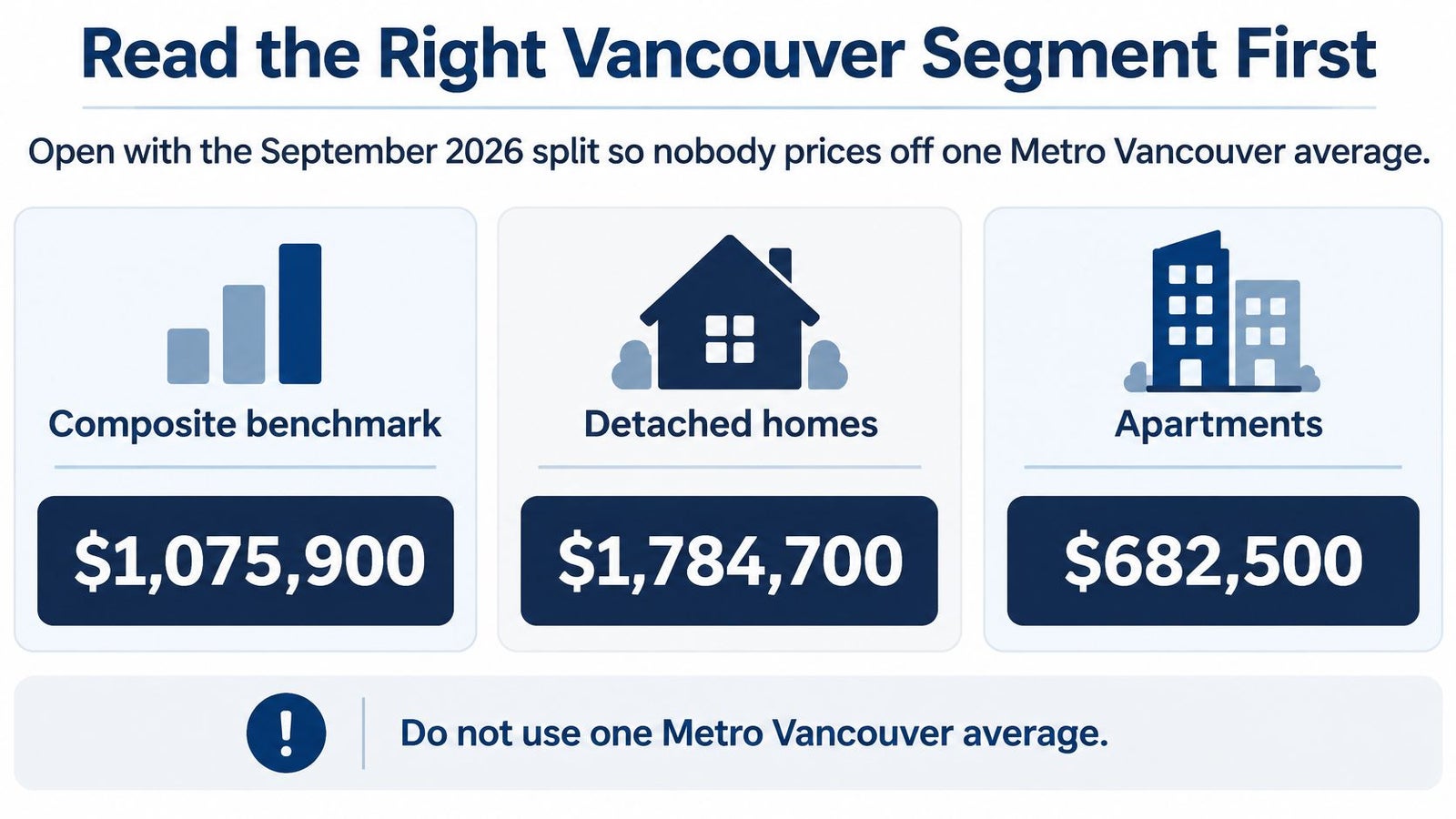
The September 2026 Metro Vancouver composite benchmark was $1,075,900, compared with $1,784,700 for detached homes and $682,500 for apartments, according to the Greater Vancouver market statistics published by CREA. The same report recorded sales-to-active-listings ratios of 9.7% for detached properties, 12.2% for attached properties, and 11.4% for apartments.
Those are different competitive environments. Detached sellers faced the slowest segment, with fewer than ten sales per hundred active listings, and every segment left buyers some negotiating room.
September 2026 Metro Vancouver benchmarks by segment
Segment Benchmark price Sales-to-active ratio How to use it
Composite $1,075,900 Blend of all three property types Context only; never the list price
Detached $1,784,700 9.7% Scale for houses; still adjust lot, age and condition
Apartment $682,500 11.4% Primary context for condo resales
Townhouses and duplexes belong to the attached segment: compare them with attached-product sales rather than the composite figure. Circle the relevant row before opening the MLS, and the segment display makes the distinction clear.
A two-bedroom Vancouver condo gets priced from apartment resales, narrowed by neighbourhood, building characteristics and unit features. Read the 11.4% ratio as a supply-demand indicator. Condo supply ran high through 2026, so buyers weighing a resale unit against other active listings have real alternatives. The price range has to come from recent building-level evidence rather than the averaged benchmark.
Detached sellers need a different search. Lot utility, street position, age, condition, parking and renovation quality separate houses that sit close together. A regional house benchmark establishes scale. It does not establish what buyers will pay for a particular lot and building.
For a clearer interpretation of sales pace, use this Vancouver guide to real estate absorption rates. Keep that market-condition reading separate from the property comparison.
Statistics Canada's 2024 New Housing Market Report reported Vancouver average new-home prices of $1.98 million for single-detached homes and $1.00 million for condominium apartments in the fourth quarter of 2024. Those figures describe newly built housing, not a resale condo with dated finishes or a detached house that needs repairs.
Resist carrying a new-product premium into a resale valuation without evidence. Compare what buyers receive: condition, building amenities and immediate repair obligations. The same discipline applies to the assessment notice, which carries a July 1 value date. A CMA effective in October 2026 sits more than a year past that date, so the assessed figure needs a market-movement adjustment before it can inform the range at all.
Finish the report header before searching: property type, municipality, competitive neighbourhood, effective valuation date and matching segment ratio. With 2026 condo oversupply pressing on resale pricing, the deliverable is a current neighbourhood range, not the assessed number and not the citywide average.
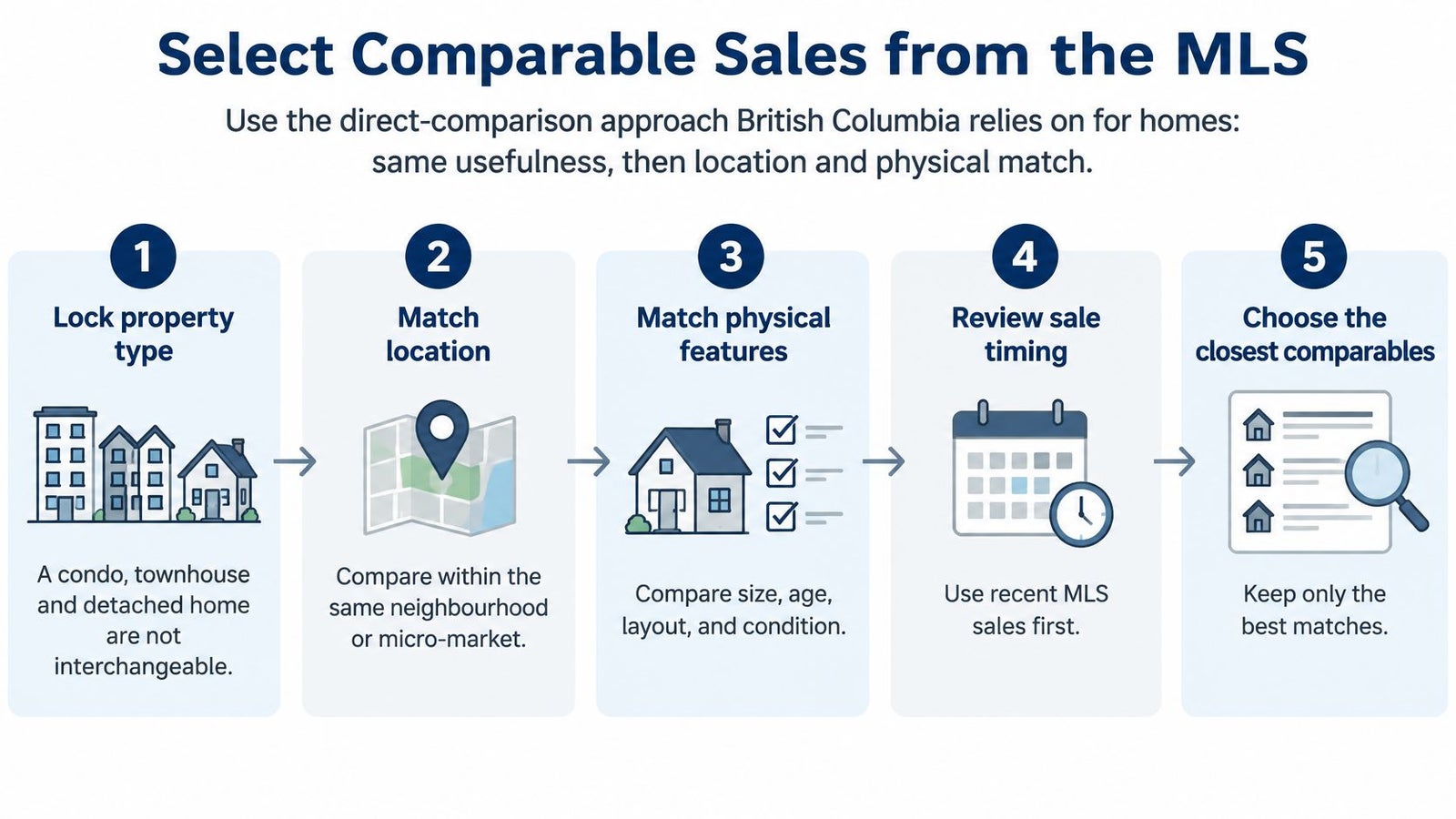
Use direct comparison: find properties with similar usefulness, location and physical characteristics, then account for their differences. BC Assessment's market-value guidance identifies recent comparable sales and factors including location, size, age, views, parking structures and outdoor features as relevant to valuation.
The search sequence below keeps geography and property similarity ahead of convenient arithmetic.
Understanding the record matters as much as finding it. This guide to finding and reading MLS sold prices helps distinguish the displayed price from the transaction history you need.
Say the subject is a Kitsilano residential strata unit. Start with similarly sized units in its building and nearby competing buildings, then inspect layouts and listing photographs. Reject a renovated penthouse if its terrace and outlook dominate its price, and reject a different suburb offering a convenient sale.
Flag whether each transaction falls before or after July 1, the annual valuation milestone explained in BC Assessment's assessment-process guidance. That flag establishes chronology; it doesn't supply the adjustment amount.
If fewer than three suitable closed sales appear within the initial window, I would extend the search to twelve months within the same building or strata before widening geography. Label that expanded window prominently because better physical similarity comes at the cost of older market evidence.
Give every candidate a pass, fail or explained exception:
A comparable's sale price is the starting point, not the answer. Adjust it toward the subject property, asking what that comparable might have sold for if it had the subject's characteristics on the CMA's effective date.
British Columbia's transaction guidelines and valuation procedures call for commentary describing each comparable, its relationship to the subject and the reasoning behind adjustments, supported by a qualitative or quantitative grid leading to a value or range. That's a useful discipline for a listing CMA, without presenting the CMA as a formal appraisal.
First record the actual sale date and price. Then adjust for market movement to the report's effective date before considering the property differences.
Support a time adjustment with relevant local evidence, such as similar transactions across the period and changes in the matching segment. Don't apply a regional annual price change mechanically to every sale.
Next address size, condition, parking, storage, outlook, floor and outdoor space. Add when the comparable is inferior; subtract when it is superior. Where possible, support the amount with sales that differ mainly in the feature being valued.
Consider a hypothetical 850 sq ft Kitsilano two-bedroom condo. The following prices and adjustments are teaching assumptions, not actual transactions, verified parking premiums or a live listing recommendation.
Sample Kitsilano condo adjustment grid
Line Comp A Comp B Comp C
Sale price $820,000 $795,000 $845,000
Time to current market -$15,000 -$8,000 -$18,000
Feature adjustment +$12,000 parking shortfall -$20,000 superior view +$15,000 inferior condition
Adjusted indication $817,000 $767,000 $842,000
Role in the range High weight Support for the low end High weight if condition gap is real
Comp A's calculation is $820,000 minus $15,000 plus $12,000, producing $817,000. Its parking shortfall receives an addition because the subject offers something the comparable lacked.
Comp B's superior view requires a subtraction. Comp C receives a condition addition, but only if photographs, descriptions and other available evidence support the claimed gap.
The hypothetical adjusted indications span $767,000 to $842,000. A working opinion near $800,000 to $830,000 could be defensible if A and C are materially closer matches, while B provides lower-end context. The narrower opinion requires that written explanation; the arithmetic alone doesn't prove it.
Avoid charging twice for the same disadvantage. If original interiors already receive a condition adjustment, an additional age penalty needs a separate reason, such as a building characteristic buyers distinguish independently.
Footnote assignments, incentives, non-arm's-length transactions and atypical condition. If an uncertain adjustment determines the conclusion, test the result with and without it rather than hiding that uncertainty inside a single number.
The 2026 assessment roll, released in January 2026, reflects estimated market value as of July 1, 2025, according to BC Assessment's Assessment Roll Report. Put that dated reference beside the analysis, not into the grid as another comparable sale.
Finally, distinguish probable sale value from launch strategy. Our process sets a competitive listing price using current market conditions and comparable listings in the seller's area. The difference between asking price and selling price matters because an evidence-based range still needs a deliberate position against available alternatives.
A seller should be able to follow the recommendation without decoding an MLS printout. Present the evidence in the order someone makes a decision: what the property offers, what buyers have paid, what they can buy instead, and where that leaves the seller.
Use a compact report with supporting detail available behind it. More pages won't fix an unexplained adjustment.
Stop collecting listings once you can put the working range, current competition and estimated net proceeds on a clear summary page. The next step is testing whether that position fits your plans.
A discovery meeting starts with the reason for selling, your preferred timing and your flexibility. With Jacky Levi, Vancouver Realtor, that conversation examines whether your goals align with current conditions before settling on a listing strategy.
Useful preparation isn't another online estimate. Bring information that helps distinguish your home from the records.
Ask which comparable sales were excluded and why. Then ask how current inventory changes the recommendation and whether repairs are worth completing before launch. Clear answers should connect those decisions to buyer alternatives, not to a preferred asking price.
An owner prioritizing a dependable move date may choose a different launch position from someone able to wait. Neither choice removes the need for a defensible range, but each changes how the owner weighs price, preparation costs and uncertainty.
We provide sellers with a detailed breakdown of expected selling costs so there are no surprises at closing. That lets you evaluate the likely financial outcome rather than focusing only on the headline sale price.
For owners who want an initial market-value read, Jacky Levi offers a complimentary home evaluation delivered by email. A pricing meeting can then examine the assumptions, unresolved property details and launch decisions in greater depth.
A useful review ends with reasons you can explain: why these sales, why these adjustments, and why this position against the homes buyers can choose today.
Jacky Levi - Vancouver Realtor offers a complimentary emailed home evaluation and a pricing meeting to turn comparable sales into a current, defensible selling strategy. Visit Jacky Levi - Vancouver Realtor with your property address, goal date and recent assessment notice to request your evaluation or arrange a pricing review.
A comparative market analysis, or CMA, estimates a property's likely selling range using matched sales, adjustments for meaningful differences, and current competition. Learning how to do a comparative market analysis in real estate means separating evidence from anchors: an assessment notice, an ambitious listing, and a citywide benchmark aren't interchangeable with a current neighbourhood value.
Read the Right Vancouver Segment First
The September 2026 Metro Vancouver composite benchmark was $1,075,900, compared with $1,784,700 for detached homes and $682,500 for apartments, according to the Greater Vancouver market statistics published by CREA. The same report recorded sales-to-active-listings ratios of 9.7% for detached properties, 12.2% for attached properties, and 11.4% for apartments.
Those are different competitive environments. Detached sellers faced the slowest segment, with fewer than ten sales per hundred active listings, and every segment left buyers some negotiating room.
September 2026 Metro Vancouver benchmarks by segment
Segment Benchmark price Sales-to-active ratio How to use it
Composite $1,075,900 Blend of all three property types Context only; never the list price
Detached $1,784,700 9.7% Scale for houses; still adjust lot, age and condition
Apartment $682,500 11.4% Primary context for condo resales
Townhouses and duplexes belong to the attached segment: compare them with attached-product sales rather than the composite figure. Circle the relevant row before opening the MLS, and the segment display makes the distinction clear.
Use the segment to frame the search
A two-bedroom Vancouver condo gets priced from apartment resales, narrowed by neighbourhood, building characteristics and unit features. Read the 11.4% ratio as a supply-demand indicator. Condo supply ran high through 2026, so buyers weighing a resale unit against other active listings have real alternatives. The price range has to come from recent building-level evidence rather than the averaged benchmark.
Detached sellers need a different search. Lot utility, street position, age, condition, parking and renovation quality separate houses that sit close together. A regional house benchmark establishes scale. It does not establish what buyers will pay for a particular lot and building.
For a clearer interpretation of sales pace, use this Vancouver guide to real estate absorption rates. Keep that market-condition reading separate from the property comparison.
Separate new product from resale evidence
Statistics Canada's 2024 New Housing Market Report reported Vancouver average new-home prices of $1.98 million for single-detached homes and $1.00 million for condominium apartments in the fourth quarter of 2024. Those figures describe newly built housing, not a resale condo with dated finishes or a detached house that needs repairs.
Resist carrying a new-product premium into a resale valuation without evidence. Compare what buyers receive: condition, building amenities and immediate repair obligations. The same discipline applies to the assessment notice, which carries a July 1 value date. A CMA effective in October 2026 sits more than a year past that date, so the assessed figure needs a market-movement adjustment before it can inform the range at all.
Finish the report header before searching: property type, municipality, competitive neighbourhood, effective valuation date and matching segment ratio. With 2026 condo oversupply pressing on resale pricing, the deliverable is a current neighbourhood range, not the assessed number and not the citywide average.
Select Comparable Sales from the MLS
Use direct comparison: find properties with similar usefulness, location and physical characteristics, then account for their differences. BC Assessment's market-value guidance identifies recent comparable sales and factors including location, size, age, views, parking structures and outdoor features as relevant to valuation.
The search sequence below keeps geography and property similarity ahead of convenient arithmetic.
Apply the filters in order
- Lock the property type. A condo, townhouse and detached house shouldn't share a comparable set. A Westside house, Burnaby townhouse and Richmond condo also serve different buyer searches.
- Stay within the competitive area. Begin in the same neighbourhood or building market. A nearby address across a meaningful location boundary may be less comparable than a slightly older sale on the subject's own street.
- Choose a deliberate sale window. I would start with arm's-length closed sales from the last three to six months. That's a search recommendation, not a valuation rule. If conditions have moved quickly, favour the freshest relevant evidence rather than importing an unrelated municipality.
- Match the attributes buyers compare. Record interior area, layout, age, condition, parking, storage, outdoor space and view. For condos, add floor, exposure, building condition, strata characteristics and fees; for houses, examine lot usability and street position.
- Keep a defensible closed-sale set. Aim for at least three strong matches where available. Put active, expired and withdrawn listings in a separate evidence group: they reveal competition and possible buyer resistance, not completed transaction values.
- Record the gaps before adjusting dollars. Capture address, sale date, price, size, price per square foot and feature differences. Use price per square foot as a cross-check among near twins, not as a substitute for comparison.
Understanding the record matters as much as finding it. This guide to finding and reading MLS sold prices helps distinguish the displayed price from the transaction history you need.
Screen a Kitsilano condo rather than a radius
Say the subject is a Kitsilano residential strata unit. Start with similarly sized units in its building and nearby competing buildings, then inspect layouts and listing photographs. Reject a renovated penthouse if its terrace and outlook dominate its price, and reject a different suburb offering a convenient sale.
Flag whether each transaction falls before or after July 1, the annual valuation milestone explained in BC Assessment's assessment-process guidance. That flag establishes chronology; it doesn't supply the adjustment amount.
If fewer than three suitable closed sales appear within the initial window, I would extend the search to twelve months within the same building or strata before widening geography. Label that expanded window prominently because better physical similarity comes at the cost of older market evidence.
Give every candidate a pass, fail or explained exception:
- Type and area: Same product and genuine competitive market.
- Date and size: Relevant timing and a sensible interior-area match.
- Condition: Renovation and maintenance differences documented.
- Parking or lot: Rights, utility and meaningful shortfalls checked.
- Terms: Unusual incentives or relationships flagged for verification.
Adjust Each Sale and Set the Price Range
A comparable's sale price is the starting point, not the answer. Adjust it toward the subject property, asking what that comparable might have sold for if it had the subject's characteristics on the CMA's effective date.
British Columbia's transaction guidelines and valuation procedures call for commentary describing each comparable, its relationship to the subject and the reasoning behind adjustments, supported by a qualitative or quantitative grid leading to a value or range. That's a useful discipline for a listing CMA, without presenting the CMA as a formal appraisal.
Work from timing to features
First record the actual sale date and price. Then adjust for market movement to the report's effective date before considering the property differences.
Support a time adjustment with relevant local evidence, such as similar transactions across the period and changes in the matching segment. Don't apply a regional annual price change mechanically to every sale.
Next address size, condition, parking, storage, outlook, floor and outdoor space. Add when the comparable is inferior; subtract when it is superior. Where possible, support the amount with sales that differ mainly in the feature being valued.
Read a teaching grid
Consider a hypothetical 850 sq ft Kitsilano two-bedroom condo. The following prices and adjustments are teaching assumptions, not actual transactions, verified parking premiums or a live listing recommendation.
Sample Kitsilano condo adjustment grid
Line Comp A Comp B Comp C
Sale price $820,000 $795,000 $845,000
Time to current market -$15,000 -$8,000 -$18,000
Feature adjustment +$12,000 parking shortfall -$20,000 superior view +$15,000 inferior condition
Adjusted indication $817,000 $767,000 $842,000
Role in the range High weight Support for the low end High weight if condition gap is real
Comp A's calculation is $820,000 minus $15,000 plus $12,000, producing $817,000. Its parking shortfall receives an addition because the subject offers something the comparable lacked.
Comp B's superior view requires a subtraction. Comp C receives a condition addition, but only if photographs, descriptions and other available evidence support the claimed gap.
The hypothetical adjusted indications span $767,000 to $842,000. A working opinion near $800,000 to $830,000 could be defensible if A and C are materially closer matches, while B provides lower-end context. The narrower opinion requires that written explanation; the arithmetic alone doesn't prove it.
Adjustment discipline: A precise dollar amount isn't strong evidence unless you can explain why it belongs in that particular comparison.
Avoid charging twice for the same disadvantage. If original interiors already receive a condition adjustment, an additional age penalty needs a separate reason, such as a building characteristic buyers distinguish independently.
Footnote assignments, incentives, non-arm's-length transactions and atypical condition. If an uncertain adjustment determines the conclusion, test the result with and without it rather than hiding that uncertainty inside a single number.
Keep the assessment beside the grid
The 2026 assessment roll, released in January 2026, reflects estimated market value as of July 1, 2025, according to BC Assessment's Assessment Roll Report. Put that dated reference beside the analysis, not into the grid as another comparable sale.
Finally, distinguish probable sale value from launch strategy. Our process sets a competitive listing price using current market conditions and comparable listings in the seller's area. The difference between asking price and selling price matters because an evidence-based range still needs a deliberate position against available alternatives.
Build the Client Report and Presentation
A seller should be able to follow the recommendation without decoding an MLS printout. Present the evidence in the order someone makes a decision: what the property offers, what buyers have paid, what they can buy instead, and where that leaves the seller.
Use a compact report with supporting detail available behind it. More pages won't fix an unexplained adjustment.
Assemble the decision pack
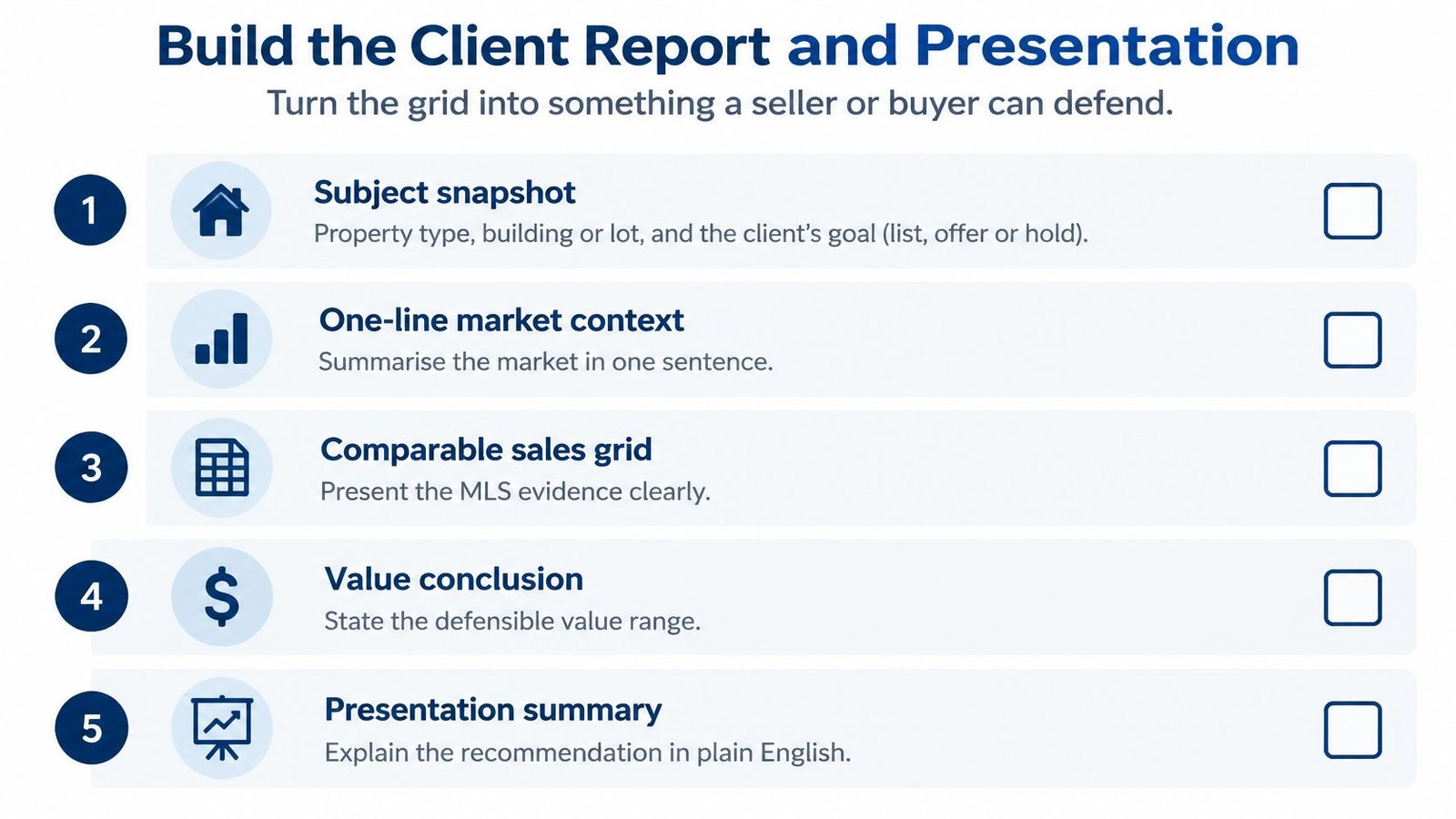
- Subject snapshot. Identify the property type, building or lot, condition and client's goal: list, offer or hold. Note anything still awaiting confirmation.
- Matching market context. Summarise the relevant segment in a sentence. State the report's effective date so the recommendation doesn't appear timeless.
- Closed-sale evidence. Show the selected properties on a map or clear address list, with transaction dates. Use side-by-side interior photographs so readers can judge the claimed similarities.
- Adjustment grid. Include the calculations and a short explanation under each comparable. Identify the sale you trust most and explain why.
- Active and unsuccessful competition. Label active, expired and withdrawn listings clearly. Separate seller expectations from prices buyers accepted.
- Conclusion and positioning. State the range, recommended list or offer position, and conditions supporting the lower or upper end. If inventory is heavy, distinguish a more competitive launch from a patient strategy.
- Expected selling costs. Keep a net-proceeds sketch separate from the sale-price opinion. Mortgage payout, applicable transaction expenses and preparation costs belong in the financial decision, not hidden inside valuation adjustments.
The presentation checklist keeps the conclusion connected to its supporting evidence.
Start with the strongest sale, not the highest sale. Show what the buyer received and identify the differences that matter to the subject. Then explain what would have to be true for the seller to achieve the upper end.
If the seller wants to list high, compare that position directly with the homes buyers can tour. Discuss what evidence would justify holding firm and what feedback would trigger a review. Don't promise that extra marketing can compensate for an unsupported price.
Renovation decisions deserve the same treatment. Show whether the comparable sales support a premium for the proposed work, rather than assuming the seller recovers every dollar spent.
Our showing strategy considers the seller's needs and may include public open houses, Realtor-only previews or private showings. Choose the format to support the property's positioning and access requirements, not because every listing must follow the same routine.
Before presenting, check the document:
Explain the trade-offs in the meeting
Start with the strongest sale, not the highest sale. Show what the buyer received and identify the differences that matter to the subject. Then explain what would have to be true for the seller to achieve the upper end.
If the seller wants to list high, compare that position directly with the homes buyers can tour. Discuss what evidence would justify holding firm and what feedback would trigger a review. Don't promise that extra marketing can compensate for an unsupported price.
Renovation decisions deserve the same treatment. Show whether the comparable sales support a premium for the proposed work, rather than assuming the seller recovers every dollar spent.
Our showing strategy considers the seller's needs and may include public open houses, Realtor-only previews or private showings. Choose the format to support the property's positioning and access requirements, not because every listing must follow the same routine.
The report is a range with reasons, not a printout of the assessment.
Before presenting, check the document:
- Dates labelled: Assessment valuation date, transaction dates and report date are distinct.
- Adjustments explained: The reader can follow both direction and reasoning.
- Terms disclosed: Unusual transaction conditions aren't buried.
- Segment named: Market context matches the property.
- Uncertainty visible: No averaged price is presented as an established fact.
Use the Vancouver listing presentation checklist to connect the pricing conversation with preparation, launch and communication decisions.
A polished CMA can still be wrong. The failure usually sits in the evidence the analyst chose, or in the alternatives buyers were considering that never made it into the file. Condo supply, stale comparables and weak adjustment logic matter more than how clean the final report looks.
The July 1 assessment valuation date belongs in the chronology, not in the asking-price calculation. Assessment value answers a question about the past. The CMA must answer one about the current neighbourhood range.
CMHC's 2026 Housing Supply Report identifies concentrated growth in completed and unsold condominium inventory in Surrey, Vancouver and Burnaby, particularly Burnaby.
That inventory doesn't justify a blanket condo discount. It does require checking whether a resale unit competes directly with unsold new product, because a buyer comparing both will price them against each other even if the CMA doesn't.
For a Burnaby condo, identify nearby completed projects offering similar layouts and buyer appeal. Examine advertised incentives and verify their terms before comparing headline prices. Then check whether competing units are concentrated in the subject building itself, where the closest substitute may sit two floors away.
The fix: combine closed building-level resales with a separate inventory schedule. Test price per square foot within the closest building set, and explain how a quicker-sale position differs from a patient asking strategy. Don't present the higher outcome as equally likely just because the owner can wait.
The September market conditions described at the outset create a practical timing problem. A sale negotiated when buyers faced fewer alternatives may not support an unchanged launch price against a fuller selection.
Say a comparable sold during a tighter period, but several similar units are now available. The analyst should inspect those alternatives before recommending the same positioning.
The fix: refresh active competition immediately before launch. Show the seller whether the original range still fits, whether a sharper entry price is warranted, or whether the plan requires greater tolerance for marketing time. Avoid inventing a precise time discount from inventory growth alone.
A provincial average combines places and property types that don't describe the subject's buyer pool. A citywide composite can mislead the same way when the home sits in a distinctive building or street market.
The fix: require a property-level reason for every pricing conclusion. If the strongest argument is that the home sits below a broad average, the comparable search needs more work.
An older building isn't automatically an inferior unit, and a renovated interior doesn't automatically erase building-level concerns. Keep interior finish quality separate from building condition, and avoid applying overlapping penalties that count the same weakness twice.
Assignments and incentives need particular care because the advertised or recorded price may not describe an economically equivalent purchase.
Pitfalls That Skew a Vancouver CMA
A polished CMA can still be wrong. The failure usually sits in the evidence the analyst chose, or in the alternatives buyers were considering that never made it into the file. Condo supply, stale comparables and weak adjustment logic matter more than how clean the final report looks.
The July 1 assessment valuation date belongs in the chronology, not in the asking-price calculation. Assessment value answers a question about the past. The CMA must answer one about the current neighbourhood range.
Ignoring unsold condo competition
CMHC's 2026 Housing Supply Report identifies concentrated growth in completed and unsold condominium inventory in Surrey, Vancouver and Burnaby, particularly Burnaby.
That inventory doesn't justify a blanket condo discount. It does require checking whether a resale unit competes directly with unsold new product, because a buyer comparing both will price them against each other even if the CMA doesn't.
For a Burnaby condo, identify nearby completed projects offering similar layouts and buyer appeal. Examine advertised incentives and verify their terms before comparing headline prices. Then check whether competing units are concentrated in the subject building itself, where the closest substitute may sit two floors away.
The fix: combine closed building-level resales with a separate inventory schedule. Test price per square foot within the closest building set, and explain how a quicker-sale position differs from a patient asking strategy. Don't present the higher outcome as equally likely just because the owner can wait.
Treating September sales as timeless evidence
The September market conditions described at the outset create a practical timing problem. A sale negotiated when buyers faced fewer alternatives may not support an unchanged launch price against a fuller selection.
Say a comparable sold during a tighter period, but several similar units are now available. The analyst should inspect those alternatives before recommending the same positioning.
The fix: refresh active competition immediately before launch. Show the seller whether the original range still fits, whether a sharper entry price is warranted, or whether the plan requires greater tolerance for marketing time. Avoid inventing a precise time discount from inventory growth alone.
Borrowing the wrong benchmark
A provincial average combines places and property types that don't describe the subject's buyer pool. A citywide composite can mislead the same way when the home sits in a distinctive building or street market.
The fix: require a property-level reason for every pricing conclusion. If the strongest argument is that the home sits below a broad average, the comparable search needs more work.
Double-counting condition or overlooking terms
An older building isn't automatically an inferior unit, and a renovated interior doesn't automatically erase building-level concerns. Keep interior finish quality separate from building condition, and avoid applying overlapping penalties that count the same weakness twice.
Assignments and incentives need particular care because the advertised or recorded price may not describe an economically equivalent purchase.
- For condition: Write what each adjustment measures before assigning dollars.
- For terms: Verify incentives and transaction circumstances, or reduce reliance on the sale when they remain unclear.
If the only support for the price is the assessment or a city benchmark, the CMA is not finished.
Book a Pricing Review Before You List
Stop collecting listings once you can put the working range, current competition and estimated net proceeds on a clear summary page. The next step is testing whether that position fits your plans.
A discovery meeting starts with the reason for selling, your preferred timing and your flexibility. With Jacky Levi, Vancouver Realtor, that conversation examines whether your goals align with current conditions before settling on a listing strategy.
Bring the property facts that change the answer
Useful preparation isn't another online estimate. Bring information that helps distinguish your home from the records.
- Property details: Address, floor plan, parking and storage information, and relevant strata or lot documents.
- Changes since purchase: Renovation descriptions, permits where applicable and outstanding repairs.
- Timing and constraints: Preferred move date, occupancy arrangements and showing limitations.
- Financial context: Recent assessment notice and known costs that affect your selling decision.
Ask which comparable sales were excluded and why. Then ask how current inventory changes the recommendation and whether repairs are worth completing before launch. Clear answers should connect those decisions to buyer alternatives, not to a preferred asking price.
Match the strategy to the goal
An owner prioritizing a dependable move date may choose a different launch position from someone able to wait. Neither choice removes the need for a defensible range, but each changes how the owner weighs price, preparation costs and uncertainty.
We provide sellers with a detailed breakdown of expected selling costs so there are no surprises at closing. That lets you evaluate the likely financial outcome rather than focusing only on the headline sale price.
For owners who want an initial market-value read, Jacky Levi offers a complimentary home evaluation delivered by email. A pricing meeting can then examine the assumptions, unresolved property details and launch decisions in greater depth.
A useful review ends with reasons you can explain: why these sales, why these adjustments, and why this position against the homes buyers can choose today.
Jacky Levi - Vancouver Realtor offers a complimentary emailed home evaluation and a pricing meeting to turn comparable sales into a current, defensible selling strategy. Visit Jacky Levi - Vancouver Realtor with your property address, goal date and recent assessment notice to request your evaluation or arrange a pricing review.