
You're considering listing your Burnaby condo, but the preparation decisions keep multiplying. Should you repaint, order strata documents, or get a price opinion first? Meanwhile, another owner in your building may be preparing to list at the same time.
Consider neighbouring condos launching in the same week. One seller has a written pricing rationale, staged living spaces, and strata documents ready for review. The other has attractive photographs but starts chasing records after receiving an offer. Buyers might like both homes, yet they have different levels of uncertainty to work through.
Preparation doesn't guarantee a higher sale price. It helps you avoid preventable delays, spend selectively, and respond to buyers without scrambling. A strong listing presentation should explain those decisions, not bury them beneath brokerage slides.
Your circumstances matter as much as the property. An occupied Richmond condo needs a different access plan from a vacant North Vancouver house. A seller relocating out of province needs clear local oversight, not another list of tasks to coordinate remotely.
Use this listing presentation checklist to decide what to prepare, when to prepare it, and where the money goes. Bring your questions, mortgage information, renovation records, and preferred moving dates to the consultation.
Your decision is which price position you can defend with evidence. A Comparative Market Analysis, or CMA, should weigh recent sales against active competition, available pending information, and expired or withdrawn listings.

Ask for MLS evidence with adjustments explained for size, age, condition, location, strata characteristics, or land utility. A renovated kitchen can support an adjustment, while installation cost alone does not set resale value.
Market context changes by property type. Greater Vancouver Realtors' June 2025 statistics reported sales-to-active-listings ratios of 9.9% for detached homes and 16.9% for attached homes. Treat those figures as background, then test them against current comparables in your building or neighbourhood.
Say you own a Coquitlam townhome with a renovated kitchen and an unusually usable patio. Compare sales inside the complex first, then check whether unsuccessful listings offered similar features at higher asking prices.
An ambitious list price can add weeks of carrying costs and more showings to manage. A deliberately low price can create attention yet still leave money on the table if buyers read it as desperation.
Request a comparative market analysis from Jacky Levi, Vancouver REALTOR®, to establish where your property fits before committing to preparation spending.
A slow bathroom drain and a dated bathroom aren't the same decision. Fixing the drain addresses a maintenance concern. Replacing the bathroom commits money and time that you might not recover.
Start with a property walkthrough before booking contractors. We help you separate repairs that reduce buyer uncertainty from cosmetic upgrades that mainly reflect personal taste.
For a Vancouver condo, that might mean repairing damaged paint near the entry, replacing a broken light fixture, and investigating a stain beneath a window. Don't repaint over the stain until you understand its cause and whether strata involvement is needed.
For a North Vancouver detached home with an older furnace, a service report may be more useful than an immediate replacement. It gives you factual information for disclosure and negotiation without assuming that new equipment will pay for itself.
Leaving a dated finish can be sensible if your price accounts for it. Leaving an unexplained defect creates a different risk.
Book a pre-listing walkthrough with Jacky Levi to establish a prioritized repair plan and identify suitable vendors before you spend.
Would buyers understand how to furnish your home if they walked through it empty? In compact Vancouver condos, that question matters more than whether the cushions match.
Furniture scale and placement help buyers read a room.

A Yaletown condo with an oversized sectional may feel cramped despite a workable layout. Replacing it with appropriately scaled seating and defining the dining area can explain the space without pretending it's larger.
Your choice is full staging, partial staging, or an edited version of your existing furnishings. Full staging adds rental, installation, removal, and potentially storage costs. Partial staging concentrates spending where photographs and showings need the most help.
We work with Urban Presentations and related vendors when staging makes sense. Our practical Vancouver home-staging guide explains how to approach the preparation.
A Richmond condo might benefit from a short tour connecting its layout with its balcony, parking, storage, and permitted amenity footage. Buyers need accurate features more than a long sequence of decorative close-ups.
Extra formats cost money and coordination time. Choose them because they resolve a specific buyer question, not because a larger package sounds more impressive.
Ask Jacky Levi to plan the photography, video, and 3D package around your home's layout and likely buyer pool before approving production.
A Shaughnessy house and a Burnaby starter condo shouldn't receive identical campaigns. Their buyers may search through different channels, compare different alternatives, and need different information before booking a showing.
Competition makes that distinction important. Greater Vancouver Realtors' year-end 2025 statistics reported annual listings 13.1% above the region's ten-year annual average. That historical context supports careful preparation, not a promise about how any current listing will perform.
Your decision is where to concentrate exposure and how to judge whether it's producing qualified interest. Sotheby's International Realty Canada provides network reach, but distribution still needs accurate property information and a locally defensible price.
We prepare professionally written, SEO-focused MLS descriptions and provide regular market and showing updates. You should still review factual details, especially parking, storage, renovations, and strata fees.
A Shaughnessy campaign might emphasize relocation-oriented outreach through the Sotheby's network. A Burnaby condo campaign might focus more heavily on local buyers comparing monthly costs and transit access.
Use these Vancouver real estate marketing strategies to evaluate the proposed mix. Review a customized plan with Jacky Levi before approving optional expenditure.
6. Seller Documentation and Disclosure Package
Decide who will assemble your sale file before you need it. Attractive presentation won't resolve missing renovation permits, unexplained levies, or unanswered insurance questions during a buyer's conditional period.
Keep property records together and easy to review.

For a Vancouver condo, request strata records early enough to investigate what they contain. Ordering a package isn't the same as understanding a pending repair project or an unresolved insurance issue.
We explain the documents relevant to your property and identify questions that belong with a lawyer, notary, accountant, or other specialist. The Property Disclosure Statement communicates known property conditions; it isn't a reason to guess when you don't know an answer.
Say your townhome has a finished basement. Finding the original permits before launch lets you describe the work accurately rather than making unsupported claims about approval.
Document charges and professional advice add costs, but unresolved questions can delay a transaction or change a buyer's terms. Update the file when new strata meetings, notices, or property issues arise.
Ask Jacky Levi for a property-specific documentation checklist and appropriate legal referrals before the listing goes live.
If you live in Calgary while selling a Vancouver condo, who checks the property after a showing? If you live in the condo, how much notice do you need to leave with your children or pets?
Those are listing decisions, not details to improvise after publication. We establish the showing plan before launch and discuss whether public open houses, Realtor-only previews, or private appointments suit your situation.
Broad access can make viewing easier but increases disruption. Narrow windows protect your routine but may exclude buyers with limited availability.
For an out-of-town seller, local oversight should identify who handles access and who authorizes unexpected work. Regular summaries should explain what happened and what to do next, rather than just report that viewers liked the home.
If buyers consistently call a Vancouver condo's kitchen dated, compare its price with renovated alternatives before replacing fixtures. A small cosmetic change may help presentation without resolving a pricing gap.
Review the practical Vancouver open-house guide, then establish a showing and feedback plan with Jacky Levi, including local oversight if you'll be away.
The highest offer isn't automatically the best outcome. You also need to understand the buyer's conditions, deposit, completion timing, included items, and the cost of meeting the proposed terms.
Your decision is whether the likely net proceeds and transaction timetable support your next move. We provide a detailed breakdown of expected selling costs and review the material terms of an offer with you.
The Province of British Columbia's home-selling guidance notes that sellers of properties purchased less than 730 days earlier may be subject to the BC home-flipping tax unless an exemption applies. Flag potential tax exposure with your accountant rather than treating the estimated sale proceeds as immediately available spending money.
For a relocating Vancouver condo owner, accepting a lower offer with workable dates might reduce temporary accommodation and overlapping ownership costs. Calculate those trade-offs instead of assuming either the higher price or faster completion is better.
Use the transaction sequence to check dependencies, not to assume fixed deadlines.
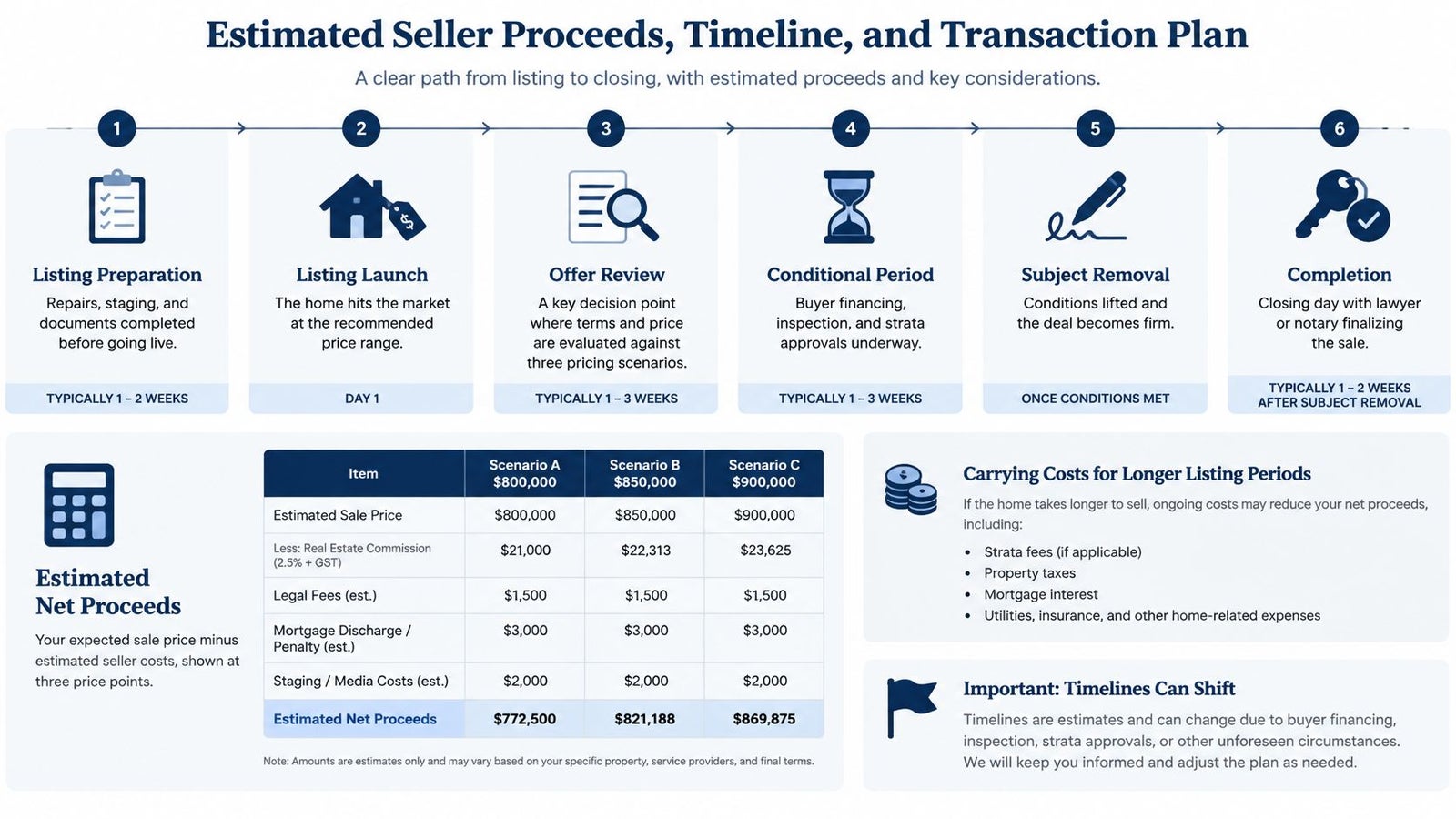
Review how to estimate BC real estate commission, then book a listing presentation with Jacky Levi for a personalized proceeds estimate and transaction plan.
Use these points to decide where your money, access, and patience do the most work before the home goes live.
Comparative Market Analysis and Pricing Strategy: Get an evidence-based price range and rationale before setting the list price. Direct cost is low, but a weak price can cost you time.
Pre-Listing Property Condition Review and Repair Plan: Prioritize repairs before finalizing preparations. Start with a walkthrough and spend only where the work justifies its cost.
Staging Consultation and Presentation Plan: Set staging recommendations and coordinate vendors before photography. Costs range from focused tips to full staging; a vacant condo may need more than an occupied house.
Professional Photography, Video Tours, and 3D Walkthroughs: Produce listing media and floor plans after staging and before launch. Cost depends on scope, with video and 3D adding to the order.
Marketing Plan and Digital Syndication: Prepare the MLS, digital, and partner-channel promotion plan before launch. Confirm what core marketing includes and what optional exposure costs.
Seller Documentation and Disclosure Package: Gather disclosures, property records, and applicable strata documents early. Budget your time and any required document fees.
Showing Schedule, Open House Plan, and Feedback Reporting: Set access rules before launch and review feedback throughout the listing. Cash costs may be low, but privacy and disruption matter.
Estimated Seller Proceeds, Timeline, and Transaction Plan: Review net proceeds and the sale-to-completion timeline before listing. The estimate has no added presentation fee and helps expose transaction and holding costs early.
A useful listing presentation ends with decisions you understand. You should know why the proposed price is defensible, which preparation expenses matter, who's responsible for the work, and how you'll assess buyer response.
Work through the steps in sequence, while starting document collection early enough to avoid delays. Price with comparable evidence, fix the defects buyers will question, choose appropriate staging, and photograph the finished presentation. Assemble the disclosure package, establish access and feedback routines, and confirm your expected proceeds and timing.
Your moving deadline, available preparation budget, mortgage terms, and tolerance for disruption belong in the plan from the beginning. Hiding a tight deadline doesn't create flexibility; it makes the recommendations less useful.
A seller who needs to relocate quickly may reasonably choose modest preparation and a market-aligned price. An owner with more flexibility might approve additional work, provided the likely benefit justifies the expense and delay.
Set priorities: Identify your preferred outcome and the compromises you can accept.
Gather essentials: Bring renovation records, available strata documents, mortgage details, and moving requirements.
Assign responsibility: Confirm who orders records, meets vendors, approves invoices, and checks completed work.
Define communication: Choose how you'll receive updates and how urgent decisions will be handled.
Keep a reserve: Allow room for unexpected preparation, carrying, or transaction costs.
The same principle applies to luxury properties and investment units. More elaborate marketing isn't automatically better, and the cheapest preparation plan isn't automatically more profitable. Each expense should address a specific buyer concern or make the sale easier to manage.
Don't treat every disappointing showing as a reason to change everything. Review the evidence together: buyer comments, repeat visits, competing listings, and any new sales. Then choose a targeted response.
Before signing, understand the listing agreement's price, duration, responsibilities, and remuneration terms. Ask questions about anything that remains unclear, including which costs you're approving and which services are included.
Book a listing presentation with Jacky Levi to turn this checklist into a plan built around your property, timeline, and goals. The next step is a practical conversation about what your home needs, what it doesn't, and how to move forward without unnecessary spending.
Jacky Levi provides Greater Vancouver sellers with pricing analysis, preparation coordination, marketing, showing management, and transaction guidance. Visit Jacky Levi - Vancouver Realtor to book a listing presentation and develop a property-specific checklist, selling-cost estimate, and timeline.
Consider neighbouring condos launching in the same week. One seller has a written pricing rationale, staged living spaces, and strata documents ready for review. The other has attractive photographs but starts chasing records after receiving an offer. Buyers might like both homes, yet they have different levels of uncertainty to work through.
Preparation doesn't guarantee a higher sale price. It helps you avoid preventable delays, spend selectively, and respond to buyers without scrambling. A strong listing presentation should explain those decisions, not bury them beneath brokerage slides.
Your circumstances matter as much as the property. An occupied Richmond condo needs a different access plan from a vacant North Vancouver house. A seller relocating out of province needs clear local oversight, not another list of tasks to coordinate remotely.
A useful listing presentation leaves you knowing what you're approving, what you're spending, and what would cause you to change course.
Use this listing presentation checklist to decide what to prepare, when to prepare it, and where the money goes. Bring your questions, mortgage information, renovation records, and preferred moving dates to the consultation.
1. Comparative Market Analysis and Pricing Strategy
Your decision is which price position you can defend with evidence. A Comparative Market Analysis, or CMA, should weigh recent sales against active competition, available pending information, and expired or withdrawn listings.
Ask for MLS evidence with adjustments explained for size, age, condition, location, strata characteristics, or land utility. A renovated kitchen can support an adjustment, while installation cost alone does not set resale value.
Market context changes by property type. Greater Vancouver Realtors' June 2025 statistics reported sales-to-active-listings ratios of 9.9% for detached homes and 16.9% for attached homes. Treat those figures as background, then test them against current comparables in your building or neighbourhood.
Approve the reasoning before the number
Say you own a Coquitlam townhome with a renovated kitchen and an unusually usable patio. Compare sales inside the complex first, then check whether unsuccessful listings offered similar features at higher asking prices.
- Comparable evidence: Review a concise sheet with adjustment explanations, sale dates, and competing properties.
- Pricing choices: Compare aspirational, market-aligned, and accelerated-sale positions, including likely exposure and risks.
- Assessment differences: Understand why the recommendation differs from your tax assessment.
- Review trigger: Agree on what showing activity, buyer objections, or competing sales would prompt reconsideration.
An ambitious list price can add weeks of carrying costs and more showings to manage. A deliberately low price can create attention yet still leave money on the table if buyers read it as desperation.
Request a comparative market analysis from Jacky Levi, Vancouver REALTOR®, to establish where your property fits before committing to preparation spending.
2. Pre-Listing Property Condition Review and Repair Plan
A slow bathroom drain and a dated bathroom aren't the same decision. Fixing the drain addresses a maintenance concern. Replacing the bathroom commits money and time that you might not recover.
Start with a property walkthrough before booking contractors. We help you separate repairs that reduce buyer uncertainty from cosmetic upgrades that mainly reflect personal taste.
For a Vancouver condo, that might mean repairing damaged paint near the entry, replacing a broken light fixture, and investigating a stain beneath a window. Don't repaint over the stain until you understand its cause and whether strata involvement is needed.
Choose repair, investigate, or leave alone
- Record the condition: Take dated photographs and retain invoices before work begins.
- Investigate warning signs: Refer moisture, electrical, structural, or equipment concerns to an appropriate professional.
- Compare quotations: Get written scopes that identify labour, materials, exclusions, and scheduling.
- Prioritize visible defects: Address the entry, kitchen, bathrooms, lighting, and obvious maintenance problems.
- Confirm permissions: Check strata approvals and permit requirements before authorizing work.
For a North Vancouver detached home with an older furnace, a service report may be more useful than an immediate replacement. It gives you factual information for disclosure and negotiation without assuming that new equipment will pay for itself.
Spending rule: Repair a problem because it improves saleability or reduces uncertainty, not because every improvement deserves a place in the renovation budget.
Leaving a dated finish can be sensible if your price accounts for it. Leaving an unexplained defect creates a different risk.
Book a pre-listing walkthrough with Jacky Levi to establish a prioritized repair plan and identify suitable vendors before you spend.
3. Staging Consultation and Presentation Plan
Would buyers understand how to furnish your home if they walked through it empty? In compact Vancouver condos, that question matters more than whether the cushions match.
Furniture scale and placement help buyers read a room.
A Yaletown condo with an oversized sectional may feel cramped despite a workable layout. Replacing it with appropriately scaled seating and defining the dining area can explain the space without pretending it's larger.
Your choice is full staging, partial staging, or an edited version of your existing furnishings. Full staging adds rental, installation, removal, and potentially storage costs. Partial staging concentrates spending where photographs and showings need the most help.
Choose a setup you can maintain
We work with Urban Presentations and related vendors when staging makes sense. Our practical Vancouver home-staging guide explains how to approach the preparation.
- Choose priority rooms: Focus on spaces whose function or scale isn't immediately clear.
- Review the proposal: Confirm rental terms, extensions, delivery, removal, and damage responsibilities.
- Edit personal belongings: Remove family photographs, excess furniture, and countertop clutter.
- Protect functionality: Keep doors, storage, and walking routes usable.
- Finish before photography: Photograph the arrangement buyers will encounter.
A vacant Burnaby townhome might need furniture in the living room and primary bedroom, while secondary rooms remain uncluttered. An occupied home may need only rearrangement and selective accessories.
Discuss staging through Urban Presentations with Jacky Levi and choose an approach that fits both your budget and daily life.
Approve media that answers buyer questions. Professional photographs establish appearance, a floor plan explains room relationships, and a walkthrough helps buyers assess circulation before arranging a visit.
These assets aren't interchangeable. A cinematic video can show atmosphere without explaining where the bedrooms sit, while a clear floor plan may resolve that question immediately.
For a North Vancouver detached home, a 3D walkthrough could help an out-of-town buyer assess stairs and living arrangements before travelling. Drone footage may explain the setting, but it shouldn't replace clear interior photography or imply features the property doesn't offer.
Discuss staging through Urban Presentations with Jacky Levi and choose an approach that fits both your budget and daily life.
4. Professional Photography, Video Tours, and 3D Walkthroughs
Approve media that answers buyer questions. Professional photographs establish appearance, a floor plan explains room relationships, and a walkthrough helps buyers assess circulation before arranging a visit.
These assets aren't interchangeable. A cinematic video can show atmosphere without explaining where the bedrooms sit, while a clear floor plan may resolve that question immediately.
For a North Vancouver detached home, a 3D walkthrough could help an out-of-town buyer assess stairs and living arrangements before travelling. Drone footage may explain the setting, but it shouldn't replace clear interior photography or imply features the property doesn't offer.
Match the package to the property
- Set the sequence: Finish repairs, staging, cleaning, and decluttering before the shoot.
- Plan for light: Choose timing around the home's exposure and workable weather conditions.
- Verify the floor plan: Review room labels, measurements, and any qualifications attached to them.
- Check accuracy: Reject stretched-looking rooms, misleading edits, and photographs that hide material conditions.
- Protect privacy: Remove identifying paperwork, family photographs, valuables, and security details.
- Confirm permissions: Check building access and filming arrangements for strata amenities.
A Richmond condo might benefit from a short tour connecting its layout with its balcony, parking, storage, and permitted amenity footage. Buyers need accurate features more than a long sequence of decorative close-ups.
Extra formats cost money and coordination time. Choose them because they resolve a specific buyer question, not because a larger package sounds more impressive.
Ask Jacky Levi to plan the photography, video, and 3D package around your home's layout and likely buyer pool before approving production.
5. Marketing Plan and Digital Syndication
A Shaughnessy house and a Burnaby starter condo shouldn't receive identical campaigns. Their buyers may search through different channels, compare different alternatives, and need different information before booking a showing.
Competition makes that distinction important. Greater Vancouver Realtors' year-end 2025 statistics reported annual listings 13.1% above the region's ten-year annual average. That historical context supports careful preparation, not a promise about how any current listing will perform.
Your decision is where to concentrate exposure and how to judge whether it's producing qualified interest. Sotheby's International Realty Canada provides network reach, but distribution still needs accurate property information and a locally defensible price.
Approve deliverables, not channel names
- Publication plan: Confirm MLS, website, email, social media, advertising, and applicable network distribution.
- Property narrative: Identify the features that distinguish your home from genuine alternatives.
- Cost boundaries: Separate included marketing from optional paid promotion.
- Launch calendar: Approve the order of publication, outreach, showings, and follow-up.
- Reporting: Agree on updates covering inquiries, showings, repeat visits, and buyer objections.
We prepare professionally written, SEO-focused MLS descriptions and provide regular market and showing updates. You should still review factual details, especially parking, storage, renovations, and strata fees.
A Shaughnessy campaign might emphasize relocation-oriented outreach through the Sotheby's network. A Burnaby condo campaign might focus more heavily on local buyers comparing monthly costs and transit access.
Use these Vancouver real estate marketing strategies to evaluate the proposed mix. Review a customized plan with Jacky Levi before approving optional expenditure.
6. Seller Documentation and Disclosure Package
Decide who will assemble your sale file before you need it. Attractive presentation won't resolve missing renovation permits, unexplained levies, or unanswered insurance questions during a buyer's conditional period.
Keep property records together and easy to review.
For a Vancouver condo, request strata records early enough to investigate what they contain. Ordering a package isn't the same as understanding a pending repair project or an unresolved insurance issue.
We explain the documents relevant to your property and identify questions that belong with a lawyer, notary, accountant, or other specialist. The Property Disclosure Statement communicates known property conditions; it isn't a reason to guess when you don't know an answer.
Assemble a usable file
- Ownership records: Gather title information, available surveys, and relevant ownership documents.
- Property history: Locate permits, warranties, inspection reports, renovation invoices, and insurance-claim information.
- Strata package: Obtain the Form B, bylaws, rules, minutes, financial statements, budget, depreciation report, insurance information, strata plan, and levy details as applicable.
- Disclosure review: Identify known defects and distinguish confirmed facts from assumptions.
- Secure sharing: Use an organized folder and remove unnecessary personal information.
Say your townhome has a finished basement. Finding the original permits before launch lets you describe the work accurately rather than making unsupported claims about approval.
Document charges and professional advice add costs, but unresolved questions can delay a transaction or change a buyer's terms. Update the file when new strata meetings, notices, or property issues arise.
Ask Jacky Levi for a property-specific documentation checklist and appropriate legal referrals before the listing goes live.
7. Showing Schedule, Open House Plan, and Feedback Reporting
If you live in Calgary while selling a Vancouver condo, who checks the property after a showing? If you live in the condo, how much notice do you need to leave with your children or pets?
Those are listing decisions, not details to improvise after publication. We establish the showing plan before launch and discuss whether public open houses, Realtor-only previews, or private appointments suit your situation.
Broad access can make viewing easier but increases disruption. Narrow windows protect your routine but may exclude buyers with limited availability.
Set access rules and a review routine
- Showing windows: Agree on notice, availability, cancellations, and occupied-home arrangements.
- Building logistics: Confirm visitor parking, concierge procedures, elevator access, and relevant strata rules.
- Privacy: Secure valuables, medication, personal documents, and sensitive belongings.
- Remote oversight: Assign responsibility for keys, lights, temperature, cleaning, and post-showing checks.
- Specific feedback: Ask about price, condition, layout, objections, and willingness to return.
- Decision points: Review activity regularly and record agreed changes.
For an out-of-town seller, local oversight should identify who handles access and who authorizes unexpected work. Regular summaries should explain what happened and what to do next, rather than just report that viewers liked the home.
Repeated objections deserve investigation. A single buyer's preference doesn't automatically justify a renovation or price reduction.
If buyers consistently call a Vancouver condo's kitchen dated, compare its price with renovated alternatives before replacing fixtures. A small cosmetic change may help presentation without resolving a pricing gap.
Review the practical Vancouver open-house guide, then establish a showing and feedback plan with Jacky Levi, including local oversight if you'll be away.
8. Estimated Seller Proceeds, Timeline, and Transaction Plan
The highest offer isn't automatically the best outcome. You also need to understand the buyer's conditions, deposit, completion timing, included items, and the cost of meeting the proposed terms.
Your decision is whether the likely net proceeds and transaction timetable support your next move. We provide a detailed breakdown of expected selling costs and review the material terms of an offer with you.
The Province of British Columbia's home-selling guidance notes that sellers of properties purchased less than 730 days earlier may be subject to the BC home-flipping tax unless an exemption applies. Flag potential tax exposure with your accountant rather than treating the estimated sale proceeds as immediately available spending money.
Compare outcomes and dependencies
- Price scenarios: Compare net proceeds at different achievable sale prices.
- Selling costs: Include remuneration, applicable taxes, legal or notary fees, mortgage discharge costs, and potential penalties.
- Carrying costs: Account for mortgage interest, strata fees, insurance, property taxes, and utilities during extended exposure.
- Transaction stages: Map preparation, launch, offer review, conditions, subject removal, completion, and possession.
- Contingencies: Identify what changes if financing, the move, or your next purchase takes longer.
For a relocating Vancouver condo owner, accepting a lower offer with workable dates might reduce temporary accommodation and overlapping ownership costs. Calculate those trade-offs instead of assuming either the higher price or faster completion is better.
Use the transaction sequence to check dependencies, not to assume fixed deadlines.
Review how to estimate BC real estate commission, then book a listing presentation with Jacky Levi for a personalized proceeds estimate and transaction plan.
How each listing presentation step compares before you list
Use these points to decide where your money, access, and patience do the most work before the home goes live.
Comparative Market Analysis and Pricing Strategy: Get an evidence-based price range and rationale before setting the list price. Direct cost is low, but a weak price can cost you time.
Pre-Listing Property Condition Review and Repair Plan: Prioritize repairs before finalizing preparations. Start with a walkthrough and spend only where the work justifies its cost.
Staging Consultation and Presentation Plan: Set staging recommendations and coordinate vendors before photography. Costs range from focused tips to full staging; a vacant condo may need more than an occupied house.
Professional Photography, Video Tours, and 3D Walkthroughs: Produce listing media and floor plans after staging and before launch. Cost depends on scope, with video and 3D adding to the order.
Marketing Plan and Digital Syndication: Prepare the MLS, digital, and partner-channel promotion plan before launch. Confirm what core marketing includes and what optional exposure costs.
Seller Documentation and Disclosure Package: Gather disclosures, property records, and applicable strata documents early. Budget your time and any required document fees.
Showing Schedule, Open House Plan, and Feedback Reporting: Set access rules before launch and review feedback throughout the listing. Cash costs may be low, but privacy and disruption matter.
Estimated Seller Proceeds, Timeline, and Transaction Plan: Review net proceeds and the sale-to-completion timeline before listing. The estimate has no added presentation fee and helps expose transaction and holding costs early.
Turn This Checklist Into Your Listing Plan
A useful listing presentation ends with decisions you understand. You should know why the proposed price is defensible, which preparation expenses matter, who's responsible for the work, and how you'll assess buyer response.
Work through the steps in sequence, while starting document collection early enough to avoid delays. Price with comparable evidence, fix the defects buyers will question, choose appropriate staging, and photograph the finished presentation. Assemble the disclosure package, establish access and feedback routines, and confirm your expected proceeds and timing.
Bring the constraints into the conversation
Your moving deadline, available preparation budget, mortgage terms, and tolerance for disruption belong in the plan from the beginning. Hiding a tight deadline doesn't create flexibility; it makes the recommendations less useful.
A seller who needs to relocate quickly may reasonably choose modest preparation and a market-aligned price. An owner with more flexibility might approve additional work, provided the likely benefit justifies the expense and delay.
Set priorities: Identify your preferred outcome and the compromises you can accept.
Gather essentials: Bring renovation records, available strata documents, mortgage details, and moving requirements.
Assign responsibility: Confirm who orders records, meets vendors, approves invoices, and checks completed work.
Define communication: Choose how you'll receive updates and how urgent decisions will be handled.
Keep a reserve: Allow room for unexpected preparation, carrying, or transaction costs.
The same principle applies to luxury properties and investment units. More elaborate marketing isn't automatically better, and the cheapest preparation plan isn't automatically more profitable. Each expense should address a specific buyer concern or make the sale easier to manage.
Don't treat every disappointing showing as a reason to change everything. Review the evidence together: buyer comments, repeat visits, competing listings, and any new sales. Then choose a targeted response.
Before signing, understand the listing agreement's price, duration, responsibilities, and remuneration terms. Ask questions about anything that remains unclear, including which costs you're approving and which services are included.
Book a listing presentation with Jacky Levi to turn this checklist into a plan built around your property, timeline, and goals. The next step is a practical conversation about what your home needs, what it doesn't, and how to move forward without unnecessary spending.
Jacky Levi provides Greater Vancouver sellers with pricing analysis, preparation coordination, marketing, showing management, and transaction guidance. Visit Jacky Levi - Vancouver Realtor to book a listing presentation and develop a property-specific checklist, selling-cost estimate, and timeline.