
You arrive at a Vancouver open house on a busy Saturday afternoon and find a steady stream of people moving through the front door. A neighbour is discussing the renovation, a couple is checking the view, and another visitor is asking whether the seller has an offer already. The room feels active, but activity alone doesn't tell you whether the property is correctly priced, whether a buyer is ready, or whether an offer will follow.
For sellers, an open house is a controlled marketing event, not a guaranteed sale mechanism. For buyers, it's a useful first inspection, but it can't replace documents, comparable sales, independent advice, or careful contract review. The strongest results come from treating the event as one part of a property-specific process.
On a Saturday morning in East Vancouver, preparation determines what the event can reveal. Lights are on, counters are clear, personal items and valuables are secured, and the listing representative has property details ready. By afternoon, the visitors may include buyers comparing several homes, curious neighbours, and qualified prospects returning to assess the layout.
That mix is normal. In the Greater Vancouver and Fraser Valley MLS-feed snapshot, 2,334 of 29,155 active listings, or 8.0%, advertised at least one open-house session. The snapshot recorded 3,350 sessions, approximately 93% held on weekends, with 2:00–4:00 p.m. the most common time slot. These figures describe market practice, not the likelihood that a particular home will sell because of an open house. The MLS-feed snapshot cautions that listing-presence data cannot establish whether open houses produce faster sales or higher prices.
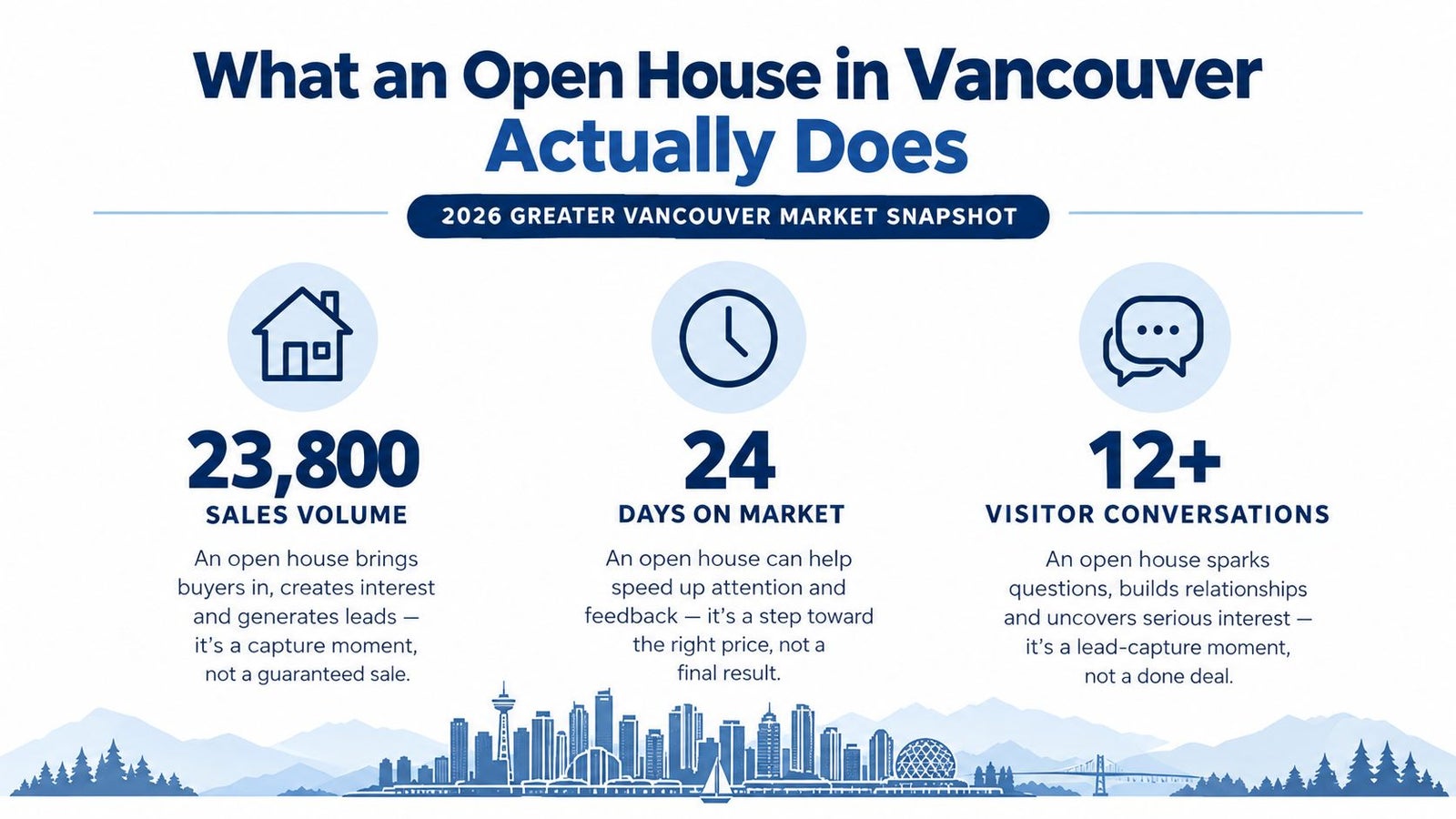
Greater Vancouver recorded 23,800 residential sales in 2025, nearly 25% below its 10-year annual average. More than 65,000 properties were listed during the year, 8.2% more than in 2024 and 28.4% more than in 2023. That supply gives buyers more choice. Sellers need evidence of genuine interest, not just a busy room.
A casual visitor may comment that the kitchen feels small. A qualified prospect may request the disclosure package, ask for a private showing, confirm financing readiness, and explain a realistic purchase timeline. The second interaction carries more weight because it creates a path to due diligence and a possible offer.
For sellers, record representation status, follow-up conversations, second-showing requests, disclosure-package requests, and offer-related activity. For buyers, use the event to compare property types, identify unanswered questions, and decide whether the home warrants deeper investigation.
Vancouver's housing structure makes that comparison useful. Statistics Canada's 2021 Vancouver CMA Census profile counted 1,043,320 households, with a 62.1% homeownership rate, down 1.6 percentage points from 2016 and below British Columbia's 66.8% rate. Condominium apartments account for almost one-third of residential properties in the CMA, while single-detached homes represent 36.4% of the region's residential stock. A condo viewing therefore calls for different questions from a detached-home viewing, including strata documents, storage, parking, and building conditions.
For sellers, the working sequence is pricing, preparation, promotion, hosting, and follow-up. A broader Vancouver seller marketing strategy should support the open house rather than depend on it. Busy attendance can create useful conversations, but it does not establish urgency, value, or buyer readiness.
An effective open house begins well before the sign goes up. The seller and listing representative need a shared plan covering price, preparation, media, disclosure materials, event timing, visitor handling, and the follow-up decision.
Start with comparative market analysis and positioning. The asking price, property description, photography, and event timing all influence who attends, but the open house can't rescue a listing that enters the market with an unsupported price or unresolved presentation problem.
Next, walk the property room by room. On a Vancouver condo, inspect sightlines from the entry, reduce visual clutter, confirm parking and storage information, and gather strata documents. In a detached home, review curb appeal, drainage concerns, unfinished repairs, outdoor flow, and any permits or suite information that buyers may ask about.
Photography and video should follow cleaning, repairs, and staging, not precede them. The listing needs to be live before the event so visitors can review the floor plan, photos, property information, and event details before arriving. Sellers who need a detailed preparation calendar can use this guide to preparing a Vancouver home for sale.

Choose the weekend slot after checking competing listings in the same neighbourhood and property segment. Saturday from 2:00–4:00 p.m. is a common default in the local snapshot, but a directly competing condo event or a cluster of detached-home opens may make another window more productive. The right question isn't, “What time do agents usually use?” It's, “When can the intended buyer see this home without choosing between several similar events?”
A national Royal LePage survey of 611 real estate professionals, conducted from August 17–30, 2023, found that 48% used open houses in at least half of their listings, and 46% considered them as effective as before the pandemic for attracting quality buyers. The survey identified buyer flexibility, meeting prospective clients, and concentrating viewers in a short period as leading benefits. The Royal LePage survey summary supports using the event as a concentrated discovery and lead-generation opportunity, not as the entire marketing plan.
Publish through MLS and digital channels once the time is confirmed. Prepare a concise property sheet, floor plan, strata or disclosure material where appropriate, and a system for recording non-confidential feedback.
The final check should happen before the morning of the event. Confirm access, signage, lighting, temperature, valuables, pets, tenant arrangements, and who will answer questions. The listing representative should know which questions require documents rather than an improvised verbal answer.
The legal layer matters because an open house is not just an informal gathering in a private home. In British Columbia, BCFSA defines it as a scheduled public or semi-public viewing of a property for sale. Its practical purposes are to generate interest in the seller's property and identify potential buyers.
For seller representation, BCFSA identifies the seller's agent as the best-practice host. The agent is positioned to answer factual questions for the seller while acting in the seller's best interests. If that agent can't attend, the seller's direction should be obtained before proceeding, and another licensee from the same brokerage may host as a designated agent, subject to consultation with the managing broker and brokerage policies. The BCFSA guidance on hosting open houses explains the responsibility in practical terms.
A seller should ask for the arrangement in writing. The plan should identify the host, the brokerage, the access process, the information visitors will receive, and how feedback will be reported. A host from another brokerage shouldn't be treated as a casual substitute.
A licensee can answer general factual questions without presenting the Disclosure of Representation in Trading Services form, provided the discussion doesn't involve confidential information. Questions about listed features, room dimensions, asking price, or visible inclusions generally stay within that factual lane.
The conversation changes when a visitor discusses confidential circumstances or asks for advice about their financial position or negotiating strategy. “How much can I afford?” and “What offer would the seller accept from me?” go beyond a simple property question. BCFSA's representation disclosure FAQ explains that the professional should pause and provide the required disclosure form and, where appropriate, the Disclosure of Risks to Unrepresented Parties form.
Buyers don't need to disclose their maximum budget, urgency, personal circumstances, or negotiating position at the door. Sellers should ensure the hosting representative knows when a greeting has become a representation discussion.
A tenanted property requires a different access plan. The BC Residential Tenancy Branch states that a standard showing requires the landlord or the landlord's agent, such as a realtor, to accompany each prospective buyer. The provincial showings guidance for selling a rental property identifies open houses as a rental-property viewing category. Buyers should expect supervised entry, and landlords should confirm who will attend, how access works, and how tenant privacy will be protected.
Advertising also needs seller authorisation. A licensee can't publish advertising for a property without consent from the owner or authorised agent, and the brokerage name must appear prominently and be easy to read. That applies to online notices, flyers, signs, and other invitations. Before publication, check the address, date, time, property details, seller consent, and visible brokerage identification. The BC real-estate advertising rules provide the underlying requirement.
Visitors form their first impression before they reach the kitchen. At a Vancouver condo, that impression may begin in a lobby or elevator. At a detached home, it starts at the sidewalk, front steps, and entry.
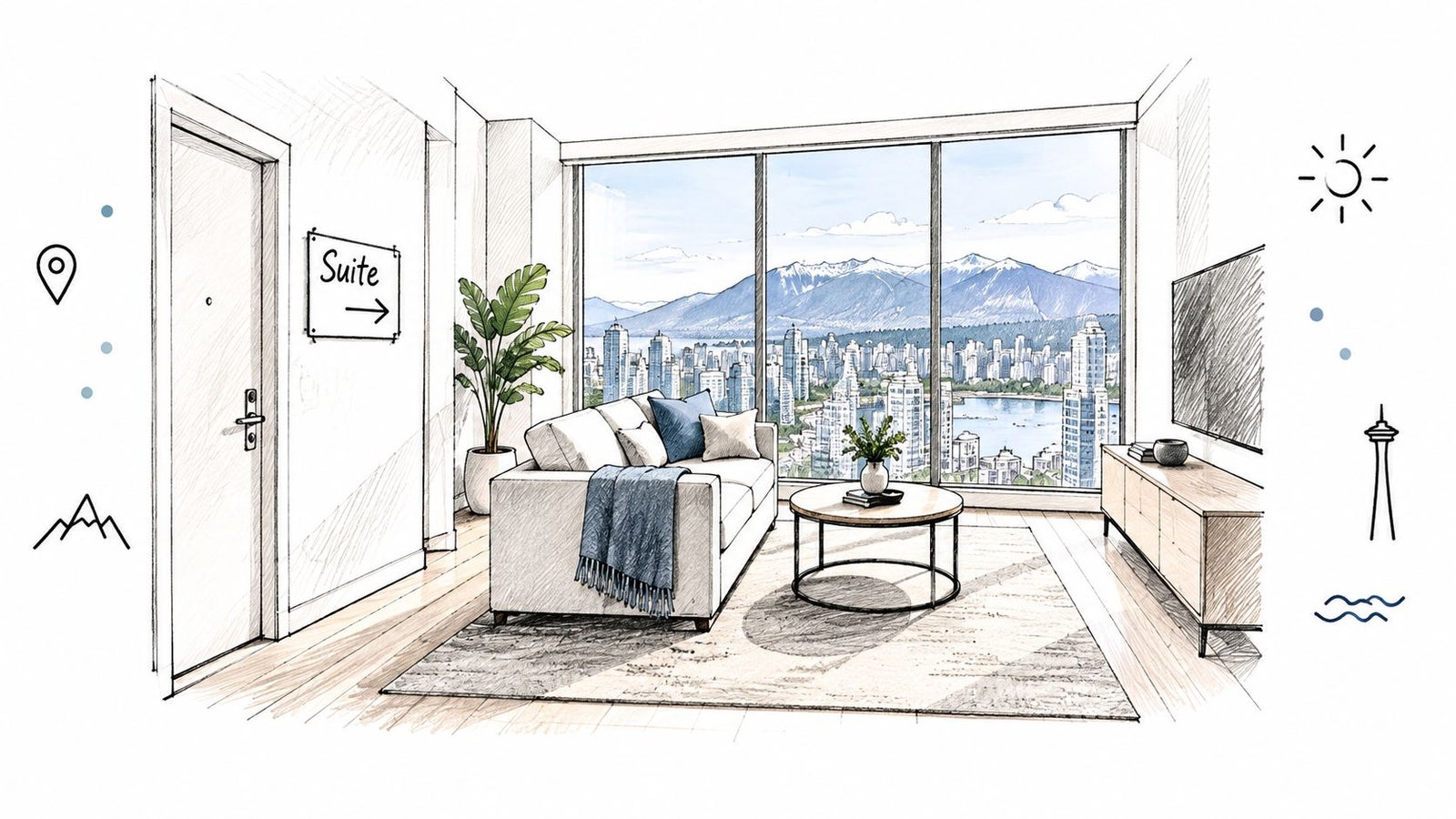
Condo staging should protect sightlines and make limited space feel usable without hiding information. Clear the entry, simplify furniture, open blinds, clean windows, and show how the living area works for an ordinary day. If the home has a mountain, water, or city view, furniture should direct attention toward it rather than block the windows.
The practical details matter just as much. Have accurate information on parking, storage, monthly strata fees, inclusions, building amenities, and the floor plan. Buyers evaluating a condo aren't only buying finishes. They're assessing the building, monthly ownership costs, rules, maintenance history, and the relationship between space and location.
Townhomes need both interior and exterior attention. Make the front approach easy to read, show the relationship between the living areas and patio or yard, and clarify which spaces are private, shared, or subject to strata rules. A crowded storage room can undermine confidence more quickly than an outdated light fixture.
Detached homes require a room-by-room purpose. Remove excess furniture, repair obvious small defects, make the yard accessible, and present basement, suite, garage, and outdoor areas clearly. A buyer should understand the lot, circulation, renovation potential, and practical limitations without needing to guess.
A property-specific Vancouver home staging guide can help organize those choices before photography and showings.
Place signage where it helps visitors find the property without creating confusion or blocking neighbours. At the door, greet people, explain where to leave shoes if necessary, and provide the basic property information. Don't pressure a visitor to disclose personal details before they've had a chance to look around.
Feedback should be factual and non-confidential. Record recurring comments about price, layout, condition, light, noise, location, or missing information. Don't write down sensitive personal details that visitors didn't need to share, and don't let casual remarks become an immediate pricing instruction.
The host should know where visitors are and maintain a respectful flow through the home. Valuables, medication, personal documents, spare keys, and devices should be secured before the event. A successful presentation feels easy to move through, while the seller retains control over access and information.
You arrive to find every room busy, two buyers discussing the kitchen, and a line at the entrance. That may reflect genuine competition. It may also include neighbours, repeat visitors, unrepresented buyers, investors comparing several homes, or people who are months away from purchasing. A crowded open house is a reason to ask sharper questions, not proof that you should make an aggressive offer.
Market conditions make that distinction important. Greater Vancouver sales in February 2026 were 28.7% below the 10-year seasonal average, according to the February 2026 regional market report. The composite benchmark price was $1,104,300 in March, down 6.8% year over year, according to the March 2026 regional market report. Visible interest still needs interpretation. Attendance alone does not establish urgency or value.
Ask whether the seller has received an offer, whether an offer-review date exists, how long the property has been listed, and whether the price has changed. Ask which comparable sales the listing representative considers relevant. The answers will not replace your own analysis, but they can show whether the seller is testing the market, preparing for offers, or just gathering feedback.
Keep your maximum budget, preferred closing strategy, purchase deadline, and personal motivation private. Direct affordability questions to your own representative or mortgage specialist. If you are unrepresented, ask the hosting professional whether the discussion has entered representation territory before sharing confidential circumstances. In British Columbia, that distinction affects how the professional can work with you and whose interests they represent.
Property type should determine your next document request. For a condo or townhome, ask for strata minutes, the depreciation report, upcoming special levies, insurance deductibles and coverage, contingency-fund adequacy, engineering or envelope reports, parking and storage legality, rental and pet restrictions, and records of alterations. Check flood or moisture history, noise, and redevelopment risk. Staging can make ownership feel attractive while revealing little about future costs.
Detached-home buyers need a separate review. Ask about drainage, retaining walls, permits, oil tanks where relevant, suite legality, and floodplain or slope conditions. An independent inspection and written records carry more weight than a confident verbal explanation. This home inspection guide for Vancouver buyers can help you prepare for that review.
Leave with a short list of written requests and a clear decision about whether the property merits a private showing, professional inspection, or offer review. If the evidence does not support the asking price, walk away from the crowd rather than letting it set your limit.
The most useful seller conversation often happens after the last visitor leaves. A listing representative should be able to explain who attended, what they asked, which objections were repeated, and whether any visitor showed signs of genuine purchasing intent.
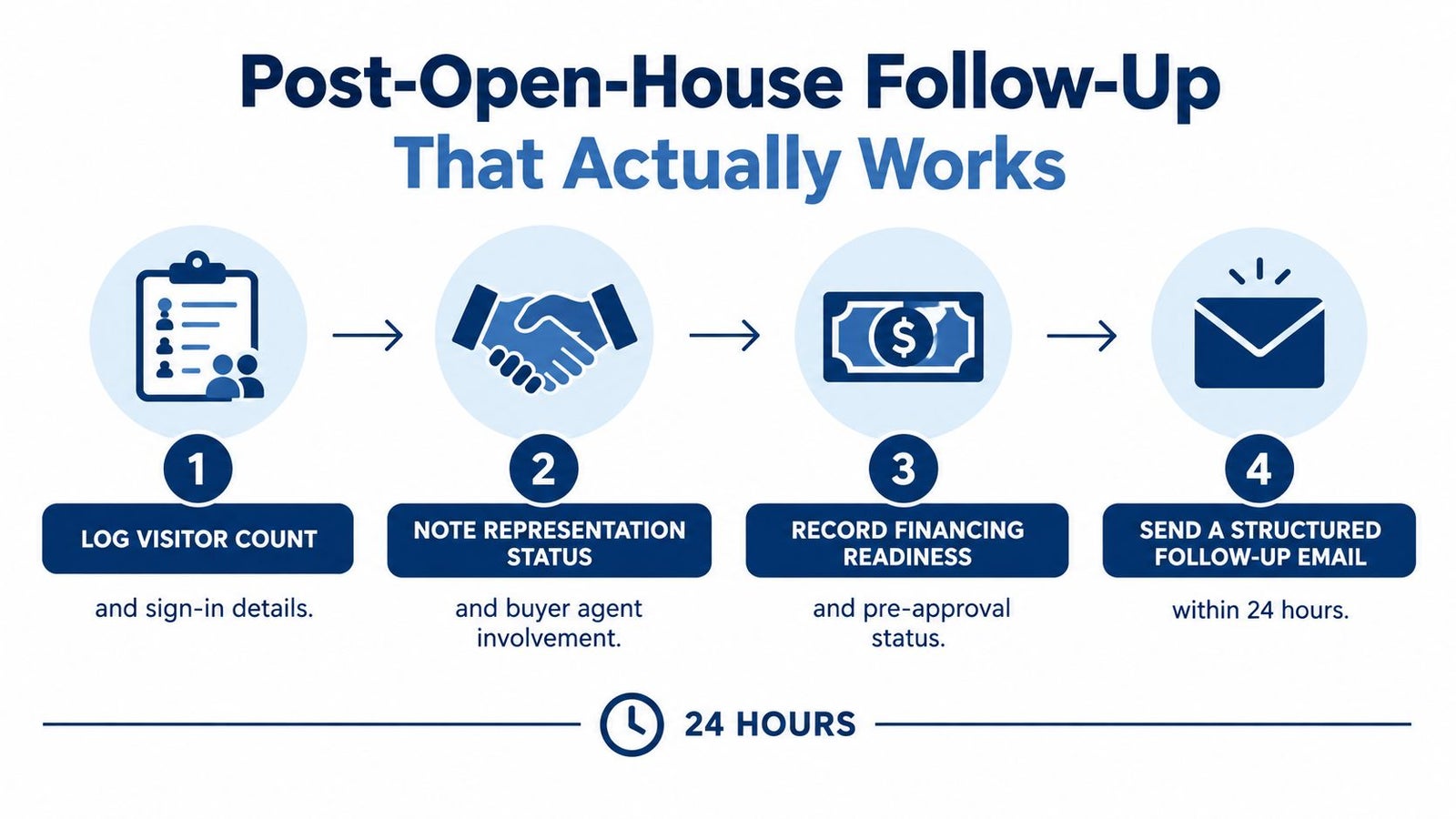
Start with an organized event record:
Separate casual foot traffic from qualified prospects. A neighbour who enjoyed the view isn't equivalent to a buyer requesting the disclosure package. A repeat visitor who brings a representative, asks about a second showing, and discusses timing deserves a different follow-up from someone who only comments on the paint colour.
Within the first 24 hours, contact appropriate prospects through the correct professional channel. Confirm what information they need, answer factual questions from the listing file, and offer a private showing when the interest is specific. Don't pressure every visitor with the same message. A buyer comparing condos needs different information from a family evaluating a detached home.
The seller recap should connect event feedback with other signals, including online saves, showing requests, second-showing activity, and comparable listings. One casual comment shouldn't trigger a price change. Repeated objections from qualified visitors may justify revisiting photography, staging, property information, or positioning. A lack of follow-up activity may call for a broader review rather than a reaction to attendance alone.
Royal LePage survey respondents identified buyer flexibility, prospective-client conversations, and concentrated viewing as important benefits of open houses. Those benefits only become useful when the host records what happened and the seller receives a clear recommendation. The event creates evidence. The follow-up turns that evidence into a decision.
Sellers should ask for a written post-event report that includes the attendance pattern, qualified leads, recurring objections, requested documents, private-showing opportunities, and the recommended next action. Buyers should keep their own notes and avoid allowing the atmosphere of the event to replace independent analysis.
Jacky Levi - Vancouver Realtor offers property-specific open-house planning, preparation coordination, hosting, visitor feedback, and follow-up for Vancouver-area condos, townhomes, and detached homes. To build a practical hosting or buying plan around your property, visit Jacky Levi - Vancouver Realtor and arrange a conversation about the next step.
Ask AI to rewrite this article…
For sellers, an open house is a controlled marketing event, not a guaranteed sale mechanism. For buyers, it's a useful first inspection, but it can't replace documents, comparable sales, independent advice, or careful contract review. The strongest results come from treating the event as one part of a property-specific process.
What an Open House in Vancouver Does
On a Saturday morning in East Vancouver, preparation determines what the event can reveal. Lights are on, counters are clear, personal items and valuables are secured, and the listing representative has property details ready. By afternoon, the visitors may include buyers comparing several homes, curious neighbours, and qualified prospects returning to assess the layout.
That mix is normal. In the Greater Vancouver and Fraser Valley MLS-feed snapshot, 2,334 of 29,155 active listings, or 8.0%, advertised at least one open-house session. The snapshot recorded 3,350 sessions, approximately 93% held on weekends, with 2:00–4:00 p.m. the most common time slot. These figures describe market practice, not the likelihood that a particular home will sell because of an open house. The MLS-feed snapshot cautions that listing-presence data cannot establish whether open houses produce faster sales or higher prices.
Exposure is not the same as demand
Greater Vancouver recorded 23,800 residential sales in 2025, nearly 25% below its 10-year annual average. More than 65,000 properties were listed during the year, 8.2% more than in 2024 and 28.4% more than in 2023. That supply gives buyers more choice. Sellers need evidence of genuine interest, not just a busy room.
A casual visitor may comment that the kitchen feels small. A qualified prospect may request the disclosure package, ask for a private showing, confirm financing readiness, and explain a realistic purchase timeline. The second interaction carries more weight because it creates a path to due diligence and a possible offer.
Practical rule: Measure an open house by qualified engagement, not by the number of people who walk through the door.
For sellers, record representation status, follow-up conversations, second-showing requests, disclosure-package requests, and offer-related activity. For buyers, use the event to compare property types, identify unanswered questions, and decide whether the home warrants deeper investigation.
Vancouver's housing structure makes that comparison useful. Statistics Canada's 2021 Vancouver CMA Census profile counted 1,043,320 households, with a 62.1% homeownership rate, down 1.6 percentage points from 2016 and below British Columbia's 66.8% rate. Condominium apartments account for almost one-third of residential properties in the CMA, while single-detached homes represent 36.4% of the region's residential stock. A condo viewing therefore calls for different questions from a detached-home viewing, including strata documents, storage, parking, and building conditions.
For sellers, the working sequence is pricing, preparation, promotion, hosting, and follow-up. A broader Vancouver seller marketing strategy should support the open house rather than depend on it. Busy attendance can create useful conversations, but it does not establish urgency, value, or buyer readiness.
Planning the Event
An effective open house begins well before the sign goes up. The seller and listing representative need a shared plan covering price, preparation, media, disclosure materials, event timing, visitor handling, and the follow-up decision.
Two to three weeks before the event
Start with comparative market analysis and positioning. The asking price, property description, photography, and event timing all influence who attends, but the open house can't rescue a listing that enters the market with an unsupported price or unresolved presentation problem.
Next, walk the property room by room. On a Vancouver condo, inspect sightlines from the entry, reduce visual clutter, confirm parking and storage information, and gather strata documents. In a detached home, review curb appeal, drainage concerns, unfinished repairs, outdoor flow, and any permits or suite information that buyers may ask about.
Photography and video should follow cleaning, repairs, and staging, not precede them. The listing needs to be live before the event so visitors can review the floor plan, photos, property information, and event details before arriving. Sellers who need a detailed preparation calendar can use this guide to preparing a Vancouver home for sale.
The week before
Choose the weekend slot after checking competing listings in the same neighbourhood and property segment. Saturday from 2:00–4:00 p.m. is a common default in the local snapshot, but a directly competing condo event or a cluster of detached-home opens may make another window more productive. The right question isn't, “What time do agents usually use?” It's, “When can the intended buyer see this home without choosing between several similar events?”
A national Royal LePage survey of 611 real estate professionals, conducted from August 17–30, 2023, found that 48% used open houses in at least half of their listings, and 46% considered them as effective as before the pandemic for attracting quality buyers. The survey identified buyer flexibility, meeting prospective clients, and concentrating viewers in a short period as leading benefits. The Royal LePage survey summary supports using the event as a concentrated discovery and lead-generation opportunity, not as the entire marketing plan.
Publish through MLS and digital channels once the time is confirmed. Prepare a concise property sheet, floor plan, strata or disclosure material where appropriate, and a system for recording non-confidential feedback.
The final check should happen before the morning of the event. Confirm access, signage, lighting, temperature, valuables, pets, tenant arrangements, and who will answer questions. The listing representative should know which questions require documents rather than an improvised verbal answer.
Legal and Compliance Essentials
The legal layer matters because an open house is not just an informal gathering in a private home. In British Columbia, BCFSA defines it as a scheduled public or semi-public viewing of a property for sale. Its practical purposes are to generate interest in the seller's property and identify potential buyers.
Who should host
For seller representation, BCFSA identifies the seller's agent as the best-practice host. The agent is positioned to answer factual questions for the seller while acting in the seller's best interests. If that agent can't attend, the seller's direction should be obtained before proceeding, and another licensee from the same brokerage may host as a designated agent, subject to consultation with the managing broker and brokerage policies. The BCFSA guidance on hosting open houses explains the responsibility in practical terms.
A seller should ask for the arrangement in writing. The plan should identify the host, the brokerage, the access process, the information visitors will receive, and how feedback will be reported. A host from another brokerage shouldn't be treated as a casual substitute.
Where representation conversations change
A licensee can answer general factual questions without presenting the Disclosure of Representation in Trading Services form, provided the discussion doesn't involve confidential information. Questions about listed features, room dimensions, asking price, or visible inclusions generally stay within that factual lane.
The conversation changes when a visitor discusses confidential circumstances or asks for advice about their financial position or negotiating strategy. “How much can I afford?” and “What offer would the seller accept from me?” go beyond a simple property question. BCFSA's representation disclosure FAQ explains that the professional should pause and provide the required disclosure form and, where appropriate, the Disclosure of Risks to Unrepresented Parties form.
Buyers don't need to disclose their maximum budget, urgency, personal circumstances, or negotiating position at the door. Sellers should ensure the hosting representative knows when a greeting has become a representation discussion.
Tenanted homes and advertising
A tenanted property requires a different access plan. The BC Residential Tenancy Branch states that a standard showing requires the landlord or the landlord's agent, such as a realtor, to accompany each prospective buyer. The provincial showings guidance for selling a rental property identifies open houses as a rental-property viewing category. Buyers should expect supervised entry, and landlords should confirm who will attend, how access works, and how tenant privacy will be protected.
Advertising also needs seller authorisation. A licensee can't publish advertising for a property without consent from the owner or authorised agent, and the brokerage name must appear prominently and be easy to read. That applies to online notices, flyers, signs, and other invitations. Before publication, check the address, date, time, property details, seller consent, and visible brokerage identification. The BC real-estate advertising rules provide the underlying requirement.
Staging, Signage, and On-Site Flow
Visitors form their first impression before they reach the kitchen. At a Vancouver condo, that impression may begin in a lobby or elevator. At a detached home, it starts at the sidewalk, front steps, and entry.
Stage for the property type
Condo staging should protect sightlines and make limited space feel usable without hiding information. Clear the entry, simplify furniture, open blinds, clean windows, and show how the living area works for an ordinary day. If the home has a mountain, water, or city view, furniture should direct attention toward it rather than block the windows.
The practical details matter just as much. Have accurate information on parking, storage, monthly strata fees, inclusions, building amenities, and the floor plan. Buyers evaluating a condo aren't only buying finishes. They're assessing the building, monthly ownership costs, rules, maintenance history, and the relationship between space and location.
Townhomes need both interior and exterior attention. Make the front approach easy to read, show the relationship between the living areas and patio or yard, and clarify which spaces are private, shared, or subject to strata rules. A crowded storage room can undermine confidence more quickly than an outdated light fixture.
Detached homes require a room-by-room purpose. Remove excess furniture, repair obvious small defects, make the yard accessible, and present basement, suite, garage, and outdoor areas clearly. A buyer should understand the lot, circulation, renovation potential, and practical limitations without needing to guess.
A property-specific Vancouver home staging guide can help organize those choices before photography and showings.
Build a calm visitor route
Place signage where it helps visitors find the property without creating confusion or blocking neighbours. At the door, greet people, explain where to leave shoes if necessary, and provide the basic property information. Don't pressure a visitor to disclose personal details before they've had a chance to look around.
Feedback should be factual and non-confidential. Record recurring comments about price, layout, condition, light, noise, location, or missing information. Don't write down sensitive personal details that visitors didn't need to share, and don't let casual remarks become an immediate pricing instruction.
The host should know where visitors are and maintain a respectful flow through the home. Valuables, medication, personal documents, spare keys, and devices should be secured before the event. A successful presentation feels easy to move through, while the seller retains control over access and information.
What Smart Buyers Do at the Open House
You arrive to find every room busy, two buyers discussing the kitchen, and a line at the entrance. That may reflect genuine competition. It may also include neighbours, repeat visitors, unrepresented buyers, investors comparing several homes, or people who are months away from purchasing. A crowded open house is a reason to ask sharper questions, not proof that you should make an aggressive offer.
Market conditions make that distinction important. Greater Vancouver sales in February 2026 were 28.7% below the 10-year seasonal average, according to the February 2026 regional market report. The composite benchmark price was $1,104,300 in March, down 6.8% year over year, according to the March 2026 regional market report. Visible interest still needs interpretation. Attendance alone does not establish urgency or value.
Read the room without revealing your position
Ask whether the seller has received an offer, whether an offer-review date exists, how long the property has been listed, and whether the price has changed. Ask which comparable sales the listing representative considers relevant. The answers will not replace your own analysis, but they can show whether the seller is testing the market, preparing for offers, or just gathering feedback.
Keep your maximum budget, preferred closing strategy, purchase deadline, and personal motivation private. Direct affordability questions to your own representative or mortgage specialist. If you are unrepresented, ask the hosting professional whether the discussion has entered representation territory before sharing confidential circumstances. In British Columbia, that distinction affects how the professional can work with you and whose interests they represent.
Property type should determine your next document request. For a condo or townhome, ask for strata minutes, the depreciation report, upcoming special levies, insurance deductibles and coverage, contingency-fund adequacy, engineering or envelope reports, parking and storage legality, rental and pet restrictions, and records of alterations. Check flood or moisture history, noise, and redevelopment risk. Staging can make ownership feel attractive while revealing little about future costs.
Detached-home buyers need a separate review. Ask about drainage, retaining walls, permits, oil tanks where relevant, suite legality, and floodplain or slope conditions. An independent inspection and written records carry more weight than a confident verbal explanation. This home inspection guide for Vancouver buyers can help you prepare for that review.
Leave with a short list of written requests and a clear decision about whether the property merits a private showing, professional inspection, or offer review. If the evidence does not support the asking price, walk away from the crowd rather than letting it set your limit.
Post-Open-House Follow-Up That Actually Works
The most useful seller conversation often happens after the last visitor leaves. A listing representative should be able to explain who attended, what they asked, which objections were repeated, and whether any visitor showed signs of genuine purchasing intent.
Start with an organized event record:
- Visitor count: Record attendance without treating it as a sales forecast.
- Representation status: Note whether visitors arrived with a representative, were unrepresented, or identified an agent afterward.
- Financing readiness: Capture whether a prospect discussed pre-approval or showed other evidence of readiness, without collecting unnecessary confidential details.
- Target timing: Record the visitor's stated purchase horizon when they volunteer it.
- Objections: Code comments under price, layout, condition, location, light, noise, storage, parking, or documentation.
- Comparable properties: Note which other homes visitors are comparing, where that information is available.
The first evening
Separate casual foot traffic from qualified prospects. A neighbour who enjoyed the view isn't equivalent to a buyer requesting the disclosure package. A repeat visitor who brings a representative, asks about a second showing, and discusses timing deserves a different follow-up from someone who only comments on the paint colour.
Within the first 24 hours, contact appropriate prospects through the correct professional channel. Confirm what information they need, answer factual questions from the listing file, and offer a private showing when the interest is specific. Don't pressure every visitor with the same message. A buyer comparing condos needs different information from a family evaluating a detached home.
The seller recap should connect event feedback with other signals, including online saves, showing requests, second-showing activity, and comparable listings. One casual comment shouldn't trigger a price change. Repeated objections from qualified visitors may justify revisiting photography, staging, property information, or positioning. A lack of follow-up activity may call for a broader review rather than a reaction to attendance alone.
Royal LePage survey respondents identified buyer flexibility, prospective-client conversations, and concentrated viewing as important benefits of open houses. Those benefits only become useful when the host records what happened and the seller receives a clear recommendation. The event creates evidence. The follow-up turns that evidence into a decision.
Sellers should ask for a written post-event report that includes the attendance pattern, qualified leads, recurring objections, requested documents, private-showing opportunities, and the recommended next action. Buyers should keep their own notes and avoid allowing the atmosphere of the event to replace independent analysis.
Jacky Levi - Vancouver Realtor offers property-specific open-house planning, preparation coordination, hosting, visitor feedback, and follow-up for Vancouver-area condos, townhomes, and detached homes. To build a practical hosting or buying plan around your property, visit Jacky Levi - Vancouver Realtor and arrange a conversation about the next step.
Ask AI to rewrite this article…