Why would a seller pay for a 3D virtual tour, watch the view counter climb, and still see no change in the offers?
A 3D virtual tour is an interactive, navigable model of a property, built from scans, that lets viewers move from room to room on a phone or laptop. In Vancouver's attached-home market, tours now show up on a large share of listings and have been associated with a modest lift in sale price. Yet plenty of sellers who invest in one come away wondering what it accomplished.
The answer sits in a distinction most listing pages blur. A tour is information, and information only moves a decision when someone is actively trying to make one. A walkthrough answers layout questions with real precision and tells you almost nothing about condition. When those two get treated as the same thing, a buyer ends up reassured by visuals nobody ever verified.
The technology is rarely the problem. Knowing which side of that line you stand on is what separates a useful tour from a decorative one.
Strip away the sales language and a 3D tour is a navigable model of a home assembled from scans, not a set of images you scroll through. That single distinction explains almost everything about what the format does well.
Three stages, and each one leaves a mark on the finished product.
Capture. A technician sets a 360-degree camera on a tripod near the middle of a room, steps out of frame, and fires. Then the tripod moves two or three metres and the process repeats, room by room. Every position becomes a fixed viewpoint, which is why a good capture places one looking down a hallway rather than tucked into a corner.
Stitching. Cloud software matches the overlapping scans and builds a continuous model where each viewpoint connects to the next. Clutter, mirrors and blocked doorways are what break that continuity, which is why preparation on capture day matters more than the camera model.
Measurement. The same scan data produces a measured floor plan. The format is established enough in Canada that iGUIDE reported its tours and floor plans appearing in approximately 20% of homes sold nationally by August 2022, as the Globe and Mail reported on the shift away from the traditional open house. That plan is the part buyers rely on most.
A 3D tour sits closer to a dollhouse you can walk through than to a folder of photographs, because you choose the path and the pace. In a photo set, the photographer decides what you see. In a model, you decide whether to check the storage room or the sightline from the kitchen sink.
Most tours offer the same three modes, and each answers something the others can't.
Walkthrough view: eye level, room to room. Use it to feel circulation and flow, and to catch awkward corners that a wide-angle lens flattens.
Dollhouse view: the walls fall away and the whole plan appears at once. Use it to compare bedroom sizes and see how hallways connect.
Floor-plan overlay: the plan sits beneath the model with dimensions attached. Use it to check whether the bed you already own will fit.
Say a buyer in Calgary is weighing a two-bedroom townhome in Burnaby. In ten minutes she can walk the kitchen-to-living-room flow, notice that the second bedroom is narrower than the photos implied, and decide whether the flight is worth booking. That's the tour doing real work before anyone schedules a showing.
If you're the one publishing the tour, publishing and SEO tips for tours cover how to title, embed and distribute it so buyers find it.
From here, the useful question isn't what a tour is. It's what it proves, and what it only appears to prove.
Virtual tours went from a niche extra to a standard marketing tool across Canada during the COVID-19 period, when agents needed a way to keep listings moving while in-person showings were restricted. Widespread adoption never removed the appetite for standing in a room. Buyers used tours to narrow the field, then still wanted to walk the finalists themselves before committing. Read those two patterns together and the tool's real job comes into focus: it screens far more than it sells.
For a Greater Vancouver seller, that makes a tour a qualification filter. It helps remote buyers, relocating professionals, and time-pressed investors understand a layout before they commit to an appointment, which means the people who do walk through the door already know they like the floor plan.
Room layout and flow: The tour shows how rooms connect. Confirm the layout against the measured floor plan.
Approximate scale and sightlines: The tour shows relative room sizes and views. Measure key rooms on site.
Natural light by time of day: The tour shows the light at capture time. Visit at several times of day to see how it changes.
Noise and odours: The tour cannot convey either. Visit at busy hours and check neighbouring units.
Window and building envelope condition: The tour cannot verify condition. Arrange a building inspection.
Strata documents and depreciation reports: The tour cannot show the risks in these records. Request and read them before waiving conditions.
Appliance operation: The tour cannot tell you whether appliances work. Test each one in person.
What the tour shows is why it earns its place in a listing. What you still need to verify is why a polished walkthrough is never due diligence. Natural light is the clearest case: a capture made at 2 pm in July says nothing about that same living room on a grey December afternoon. Smell works the same way. No model can tell you that the unit below cooks with fish oil every night or that the elevator shaft hums through the bedroom wall.
Work the table as a screening tool. Reject the homes that fail the layout test from your laptop, then keep the physical appointments for the two or three that survive. Once you are standing in the unit, a home inspection guide for buyers sets out what an inspector should be checking now that the tour has done its job.
The tour works alongside accurate plans, professional photography and detailed listing information rather than replacing any of them. A walkthrough with no verified floor plan is a nice video with no numbers in it.
A polished walkthrough feels like evidence. It's a shortlist tool, and treating it as more than that is how buyers waive a condition they should have kept. Canadian survey evidence shows the appetite is real: 88% of surveyed urban homebuyers said they would want a virtual or simulated home tour, and 87% wanted mortgage and financing information online, per the Ipsos survey of urban Canadian home buyers. Strong demand for digital research isn't proof of condition.
Once a tour moves a home onto your shortlist, run these five checks in order.
Check the dimensions against the plan. Compare the model's room sizes with the measured floor plan and write down any gap. A discrepancy is a question for the seller's side, not a rounding error.
Request strata minutes and the depreciation report. Read them before the offer is written, not after. Those documents carry risks no camera can capture.
Book two visits at different times of day. Morning and evening, ideally one on a weekday when street traffic and building noise are at their peak.
Confirm parking, storage and permits. Get the stall number, the locker number and any renovation permits in writing.
Set the inspection deadline inside the offer. Then arrange an in-person or trusted local inspection before that date arrives.
Say a first-time buyer is looking at a Richmond condo. On screen, the second bedroom reads as generous; against the plan, it's narrow enough that a queen bed would block the closet door. She caught it before removing the inspection condition, and the tour had already saved her three other trips across the city.
The home-buying process step by step in Vancouver covers the paperwork and timing around each of these checks if you want the fuller sequence.
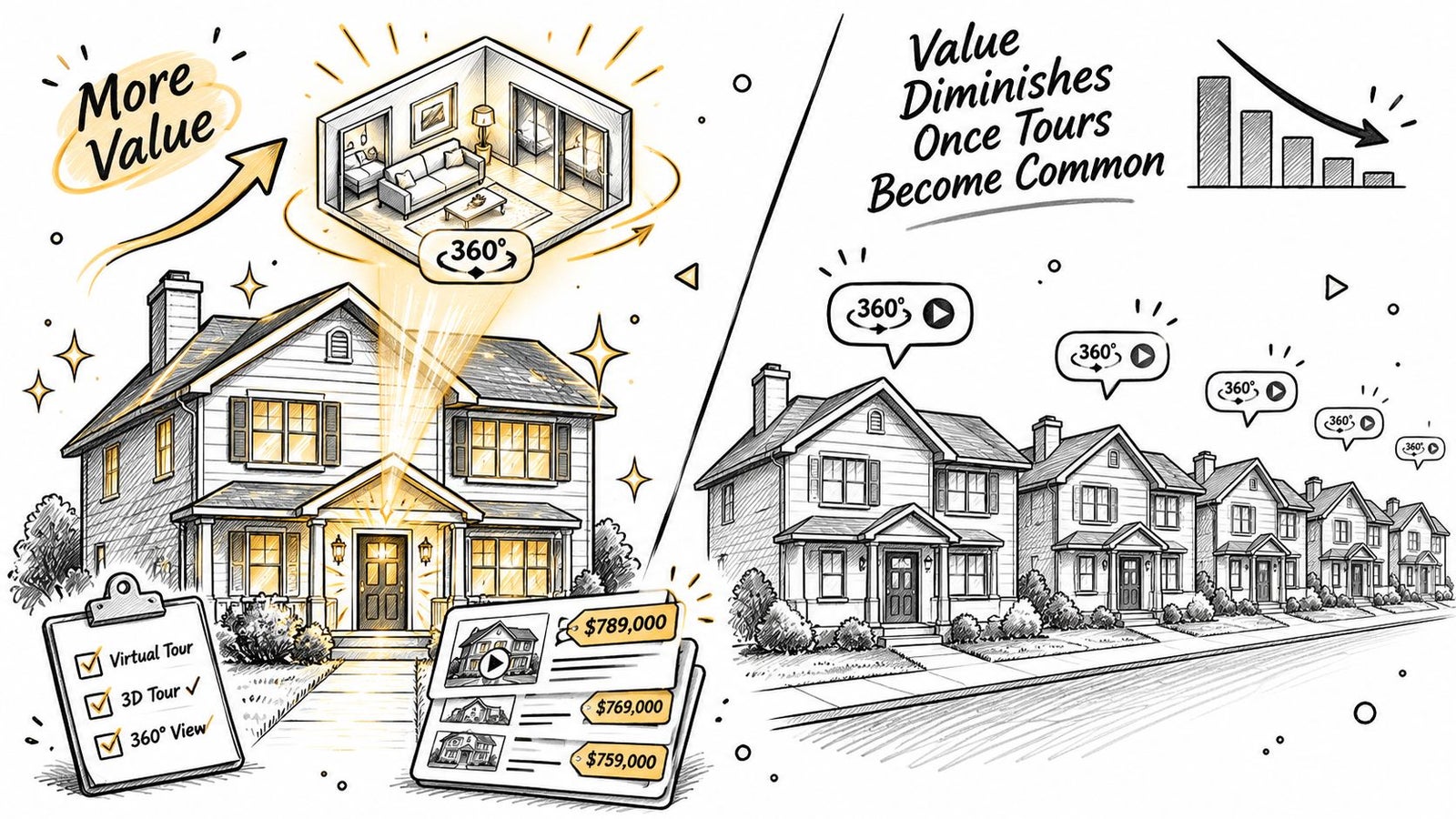
Tours can add measurable value, and the same evidence shows the value thinning. A Vancouver study of 197,345 attached-home sales found that virtual tours were associated with approximately a 1% higher sale price on average, but the effect weakened as tours became commonplace, per this analysis of the Vancouver virtual tour study. Usage rose from about 25% of listings before COVID-19 to more than 50% during the pandemic, then stabilized near 47%.
The first seller on the block with a walkthrough earned a genuine lift. The seller listing this month is competing against buyers who expect one.
That expectation is why a second piece of evidence matters. A Harvard Business School study of 75,178 homes sold in greater Los Angeles from March 2019 through March 2021 controlled for listing-photo content and quality, description length, sentiment and pricing before measuring outcomes. After those controls, 3D tours did not significantly increase final sale prices and were associated with a slight increase in time on market, according to the Harvard study of virtual tours and home sales. The lesson isn't that tours fail. It's that a tour is an information and qualification layer, and it won't rescue a price that the market disagrees with.
If you want to watch how a buyer moves through one of these models, the walkthrough below shows the navigation in action.
Take a 1970s concrete townhome in Burnaby with a recent kitchen and bathroom renovation. The tour carries more weight there than any photo set could, because a buyer needs to see how the new kitchen sits against the older structure and whether the renovated bathroom's layout works. A standard two-bedroom condo in a tower with six similar units for sale gets far less from the same spend.
That's the rule for planning your marketing mix, and 10 real estate marketing strategies for Vancouver sellers shows where the tour fits alongside the other channels. The study measured sale-price performance, remember, not faster sales or fewer showings.
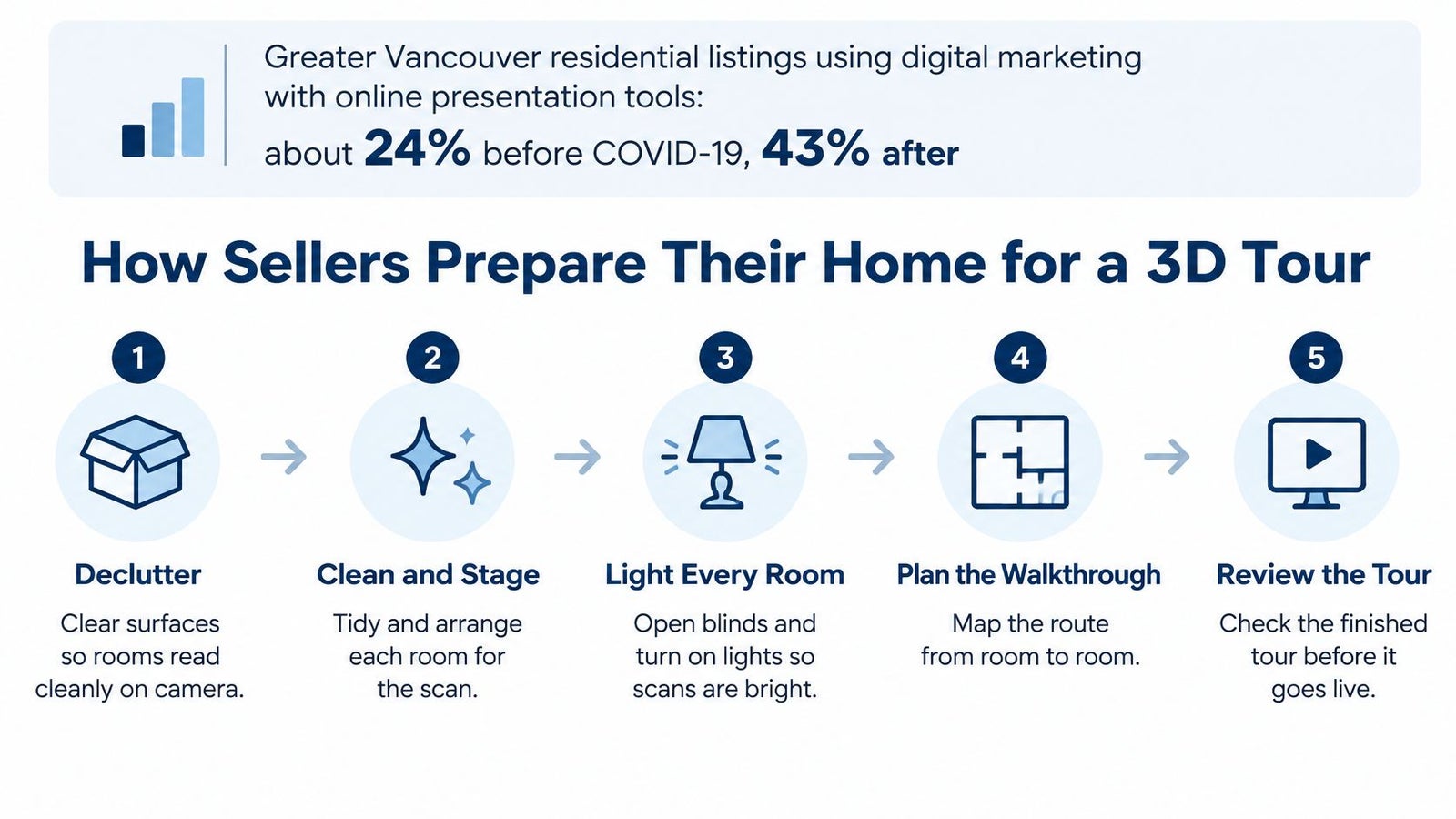
Before the COVID-19 outbreak, approximately 24% of Greater Vancouver residential listings used digital marketing that included online presentation tools. After the outbreak, that share rose to 43%, and virtual tours grew from about 3.4% of digital-marketing activity in 2015 to approximately 7.3% by 2020, per Roomvu's analysis of Vancouver listings and virtual technology. Your listing is now competing against homes that already have one.
1. Declutter surfaces, not just floors. The scan reads volume. Clear counters, shelves and the top of the fridge so rooms read as space rather than storage.
2. Light every room and record the capture time. Open the blinds, switch on the lamps, and note when the best natural light reaches the living room. That timing is worth repeating for the photo shoot.
3. Clear the path. Hallways, stair landings and doorways all need to be walkable. A capture route that detours around boxes leaves gaps in the model that no editing fixes.
4. Measure first, scan second. Confirm each room's dimensions against the floor plan before capture day. The common slip is letting the tour go live before anyone has verified the plan, and a tour carrying wrong dimensions is worse than no tour at all.
5. Book the capture window with the home fully ready. A rushed morning turns into a model with a coat rack in the hallway and dishes on the counter, and those details stay in the file for every future buyer to see.
6. Review the finished tour the way a buyer will. Look for missing rooms, blurred spots, mislabelled rooms and mirrors that reveal the camera. Ask for corrections before it publishes.
A 3D virtual tour is an interactive, navigable model of a property, built from scans, that lets viewers move from room to room on a phone or laptop. In Vancouver's attached-home market, tours now show up on a large share of listings and have been associated with a modest lift in sale price. Yet plenty of sellers who invest in one come away wondering what it accomplished.
The answer sits in a distinction most listing pages blur. A tour is information, and information only moves a decision when someone is actively trying to make one. A walkthrough answers layout questions with real precision and tells you almost nothing about condition. When those two get treated as the same thing, a buyer ends up reassured by visuals nobody ever verified.
The technology is rarely the problem. Knowing which side of that line you stand on is what separates a useful tour from a decorative one.
What a 3D Virtual Tour Is and How It Works
Strip away the sales language and a 3D tour is a navigable model of a home assembled from scans, not a set of images you scroll through. That single distinction explains almost everything about what the format does well.
How the model gets built
Three stages, and each one leaves a mark on the finished product.
Capture. A technician sets a 360-degree camera on a tripod near the middle of a room, steps out of frame, and fires. Then the tripod moves two or three metres and the process repeats, room by room. Every position becomes a fixed viewpoint, which is why a good capture places one looking down a hallway rather than tucked into a corner.
Stitching. Cloud software matches the overlapping scans and builds a continuous model where each viewpoint connects to the next. Clutter, mirrors and blocked doorways are what break that continuity, which is why preparation on capture day matters more than the camera model.
Measurement. The same scan data produces a measured floor plan. The format is established enough in Canada that iGUIDE reported its tours and floor plans appearing in approximately 20% of homes sold nationally by August 2022, as the Globe and Mail reported on the shift away from the traditional open house. That plan is the part buyers rely on most.
A 3D tour sits closer to a dollhouse you can walk through than to a folder of photographs, because you choose the path and the pace. In a photo set, the photographer decides what you see. In a model, you decide whether to check the storage room or the sightline from the kitchen sink.
Three views, three different questions
Most tours offer the same three modes, and each answers something the others can't.
Walkthrough view: eye level, room to room. Use it to feel circulation and flow, and to catch awkward corners that a wide-angle lens flattens.
Dollhouse view: the walls fall away and the whole plan appears at once. Use it to compare bedroom sizes and see how hallways connect.
Floor-plan overlay: the plan sits beneath the model with dimensions attached. Use it to check whether the bed you already own will fit.
Say a buyer in Calgary is weighing a two-bedroom townhome in Burnaby. In ten minutes she can walk the kitchen-to-living-room flow, notice that the second bedroom is narrower than the photos implied, and decide whether the flight is worth booking. That's the tour doing real work before anyone schedules a showing.
If you're the one publishing the tour, publishing and SEO tips for tours cover how to title, embed and distribute it so buyers find it.
From here, the useful question isn't what a tour is. It's what it proves, and what it only appears to prove.
Where a 3D Tour Helps Buyers and Where It Stops
Virtual tours went from a niche extra to a standard marketing tool across Canada during the COVID-19 period, when agents needed a way to keep listings moving while in-person showings were restricted. Widespread adoption never removed the appetite for standing in a room. Buyers used tours to narrow the field, then still wanted to walk the finalists themselves before committing. Read those two patterns together and the tool's real job comes into focus: it screens far more than it sells.
For a Greater Vancouver seller, that makes a tour a qualification filter. It helps remote buyers, relocating professionals, and time-pressed investors understand a layout before they commit to an appointment, which means the people who do walk through the door already know they like the floor plan.
Practical rule: use the tour to talk a buyer out of a wasted trip, never to talk them into an offer.
What the tour answers and what it only seems to answer
Room layout and flow: The tour shows how rooms connect. Confirm the layout against the measured floor plan.
Approximate scale and sightlines: The tour shows relative room sizes and views. Measure key rooms on site.
Natural light by time of day: The tour shows the light at capture time. Visit at several times of day to see how it changes.
Noise and odours: The tour cannot convey either. Visit at busy hours and check neighbouring units.
Window and building envelope condition: The tour cannot verify condition. Arrange a building inspection.
Strata documents and depreciation reports: The tour cannot show the risks in these records. Request and read them before waiving conditions.
Appliance operation: The tour cannot tell you whether appliances work. Test each one in person.
What the tour shows is why it earns its place in a listing. What you still need to verify is why a polished walkthrough is never due diligence. Natural light is the clearest case: a capture made at 2 pm in July says nothing about that same living room on a grey December afternoon. Smell works the same way. No model can tell you that the unit below cooks with fish oil every night or that the elevator shaft hums through the bedroom wall.
Work the table as a screening tool. Reject the homes that fail the layout test from your laptop, then keep the physical appointments for the two or three that survive. Once you are standing in the unit, a home inspection guide for buyers sets out what an inspector should be checking now that the tour has done its job.
The tour works alongside accurate plans, professional photography and detailed listing information rather than replacing any of them. A walkthrough with no verified floor plan is a nice video with no numbers in it.
Buyer Sequence From Tour to Offer
A polished walkthrough feels like evidence. It's a shortlist tool, and treating it as more than that is how buyers waive a condition they should have kept. Canadian survey evidence shows the appetite is real: 88% of surveyed urban homebuyers said they would want a virtual or simulated home tour, and 87% wanted mortgage and financing information online, per the Ipsos survey of urban Canadian home buyers. Strong demand for digital research isn't proof of condition.
The sequence from shortlist to offer
Once a tour moves a home onto your shortlist, run these five checks in order.
Check the dimensions against the plan. Compare the model's room sizes with the measured floor plan and write down any gap. A discrepancy is a question for the seller's side, not a rounding error.
Request strata minutes and the depreciation report. Read them before the offer is written, not after. Those documents carry risks no camera can capture.
Book two visits at different times of day. Morning and evening, ideally one on a weekday when street traffic and building noise are at their peak.
Confirm parking, storage and permits. Get the stall number, the locker number and any renovation permits in writing.
Set the inspection deadline inside the offer. Then arrange an in-person or trusted local inspection before that date arrives.
Say a first-time buyer is looking at a Richmond condo. On screen, the second bedroom reads as generous; against the plan, it's narrow enough that a queen bed would block the closet door. She caught it before removing the inspection condition, and the tour had already saved her three other trips across the city.
A tour speeds up screening. It creates overconfidence when visual polish replaces the physical and documentary checks.
The home-buying process step by step in Vancouver covers the paperwork and timing around each of these checks if you want the fuller sequence.
When a 3D Tour Adds Value to a Listing
Tours can add measurable value, and the same evidence shows the value thinning. A Vancouver study of 197,345 attached-home sales found that virtual tours were associated with approximately a 1% higher sale price on average, but the effect weakened as tours became commonplace, per this analysis of the Vancouver virtual tour study. Usage rose from about 25% of listings before COVID-19 to more than 50% during the pandemic, then stabilized near 47%.
The first seller on the block with a walkthrough earned a genuine lift. The seller listing this month is competing against buyers who expect one.
That expectation is why a second piece of evidence matters. A Harvard Business School study of 75,178 homes sold in greater Los Angeles from March 2019 through March 2021 controlled for listing-photo content and quality, description length, sentiment and pricing before measuring outcomes. After those controls, 3D tours did not significantly increase final sale prices and were associated with a slight increase in time on market, according to the Harvard study of virtual tours and home sales. The lesson isn't that tours fail. It's that a tour is an information and qualification layer, and it won't rescue a price that the market disagrees with.
If you want to watch how a buyer moves through one of these models, the walkthrough below shows the navigation in action.
Which properties gain and which just keep up
Take a 1970s concrete townhome in Burnaby with a recent kitchen and bathroom renovation. The tour carries more weight there than any photo set could, because a buyer needs to see how the new kitchen sits against the older structure and whether the renovated bathroom's layout works. A standard two-bedroom condo in a tower with six similar units for sale gets far less from the same spend.
Where the money is: judge a tour by qualified enquiries and offer quality, not by view counts.
That's the rule for planning your marketing mix, and 10 real estate marketing strategies for Vancouver sellers shows where the tour fits alongside the other channels. The study measured sale-price performance, remember, not faster sales or fewer showings.
How Sellers Prepare Their Home for a 3D Tour
Before the COVID-19 outbreak, approximately 24% of Greater Vancouver residential listings used digital marketing that included online presentation tools. After the outbreak, that share rose to 43%, and virtual tours grew from about 3.4% of digital-marketing activity in 2015 to approximately 7.3% by 2020, per Roomvu's analysis of Vancouver listings and virtual technology. Your listing is now competing against homes that already have one.
Six steps before the camera arrives
1. Declutter surfaces, not just floors. The scan reads volume. Clear counters, shelves and the top of the fridge so rooms read as space rather than storage.
2. Light every room and record the capture time. Open the blinds, switch on the lamps, and note when the best natural light reaches the living room. That timing is worth repeating for the photo shoot.
3. Clear the path. Hallways, stair landings and doorways all need to be walkable. A capture route that detours around boxes leaves gaps in the model that no editing fixes.
4. Measure first, scan second. Confirm each room's dimensions against the floor plan before capture day. The common slip is letting the tour go live before anyone has verified the plan, and a tour carrying wrong dimensions is worse than no tour at all.
5. Book the capture window with the home fully ready. A rushed morning turns into a model with a coat rack in the hallway and dishes on the counter, and those details stay in the file for every future buyer to see.
6. Review the finished tour the way a buyer will. Look for missing rooms, blurred spots, mislabelled rooms and mirrors that reveal the camera. Ask for corrections before it publishes.
Preparation pays twice, because the same tidy rooms serve the still photography and the tour. If your home needs more than tidying, our practical seller's guide to home staging in Vancouver covers furniture arrangement and the rooms buyers judge fastest.
A tour should sit alongside professional stills, accurate room measurements, a concise description and scheduled private showings. Buyers screen remotely; serious prospects arrive at the appointment already knowing the layout. Ask for a listing plan that shows how the tour will be distributed and how it connects to the rest of the campaign, rather than a link dropped into the MLS field and forgotten.
Sellers should ask for a 3D tour when it fits the property and only when it's paired with professional photography, an accurate floor plan and a written listing plan. Buyers should use the tour to shortlist, then book a verification visit before any offer goes in. Those two instructions cover most of the decision.
Jacky Levi is a licensed REALTOR® and Associate Broker with Sotheby's International Realty Canada, working with sellers, buyers and investors across Vancouver, Burnaby, Richmond and North Vancouver on condos, townhomes and detached homes. Marketing for sellers involves professional photography, video tours, 3D walkthroughs, social media campaigns and targeted advertising, which means the tour is planned as one channel rather than the whole campaign.
For sellers, the first step is a discovery meeting to talk through layout, renovation history, pricing and the marketing mix, followed by a showing plan agreed before the home goes live. For buyers, an online meeting works well to sort which tours deserve trust and which checks to run before waiving conditions.
If you're weighing how much of your budget belongs to search and social rather than media production, attracting local buyers and sellers is a sensible starting point for the visibility side of the plan.
Both groups can take the same action, and it costs nothing to start the conversation early.
Jacky Levi - Vancouver Realtor builds each seller's campaign around professional photography, video tours and 3D walkthroughs, then pairs them with a showing plan agreed before the home goes live, so the media work and the showing strategy point in the same direction. Buyers get help reading what a tour can and cannot prove before they waive a condition on a Vancouver condo, townhome or detached house. Book a discovery meeting through Jacky Levi - Vancouver Realtor to decide whether a 3D tour, an open house or private showings fit your timing and goals.
Present the walkthrough as part of a media package, never on its own.
A tour should sit alongside professional stills, accurate room measurements, a concise description and scheduled private showings. Buyers screen remotely; serious prospects arrive at the appointment already knowing the layout. Ask for a listing plan that shows how the tour will be distributed and how it connects to the rest of the campaign, rather than a link dropped into the MLS field and forgotten.
Plan Your 3D Tour With a Vancouver Realtor
Sellers should ask for a 3D tour when it fits the property and only when it's paired with professional photography, an accurate floor plan and a written listing plan. Buyers should use the tour to shortlist, then book a verification visit before any offer goes in. Those two instructions cover most of the decision.
Jacky Levi is a licensed REALTOR® and Associate Broker with Sotheby's International Realty Canada, working with sellers, buyers and investors across Vancouver, Burnaby, Richmond and North Vancouver on condos, townhomes and detached homes. Marketing for sellers involves professional photography, video tours, 3D walkthroughs, social media campaigns and targeted advertising, which means the tour is planned as one channel rather than the whole campaign.
For sellers, the first step is a discovery meeting to talk through layout, renovation history, pricing and the marketing mix, followed by a showing plan agreed before the home goes live. For buyers, an online meeting works well to sort which tours deserve trust and which checks to run before waiving conditions.
If you're weighing how much of your budget belongs to search and social rather than media production, attracting local buyers and sellers is a sensible starting point for the visibility side of the plan.
Both groups can take the same action, and it costs nothing to start the conversation early.
Jacky Levi - Vancouver Realtor builds each seller's campaign around professional photography, video tours and 3D walkthroughs, then pairs them with a showing plan agreed before the home goes live, so the media work and the showing strategy point in the same direction. Buyers get help reading what a tour can and cannot prove before they waive a condition on a Vancouver condo, townhome or detached house. Book a discovery meeting through Jacky Levi - Vancouver Realtor to decide whether a 3D tour, an open house or private showings fit your timing and goals.