
Buying a condo for investment in Vancouver often starts with rent, because rent is easy to quote and easy to compare. Rent is not return. Once you subtract strata fees, financing, taxes, insurance, repairs and empty months, a unit that looks strong on a listing sheet can require a monthly subsidy from you. The analysis below tests the downside first, then lets the upside speak for itself.
Rental condos in Metro Vancouver averaged $2,715 across all unit sizes in 2025, which is $745 per month, or 38%, above purpose-built rentals at $1,970, according to CMHC's 2025 Rental Market Report. That premium is real, and it's the strongest argument for buying a condo for Investment rather than chasing a cheaper rental building interest. It is also where many buyers stop calculating.
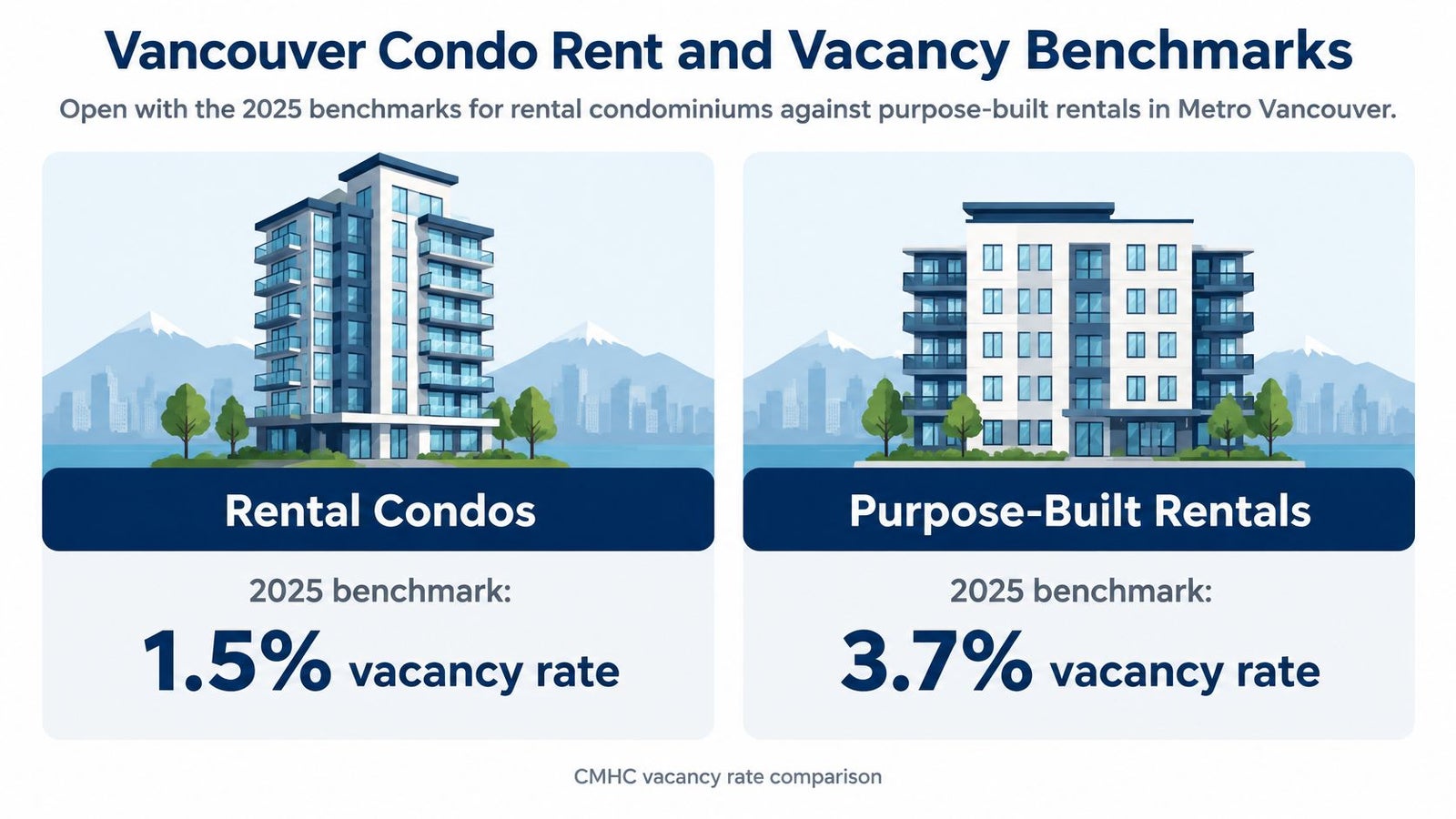
The same benchmark set shows a 1.5% vacancy rate for rental condominium apartments in the Vancouver census metropolitan area, compared with 3.7% for purpose-built rental housing. For two-bedroom units, the average condo rent was $2,900, compared with $2,363 for purpose-built rentals. Condos were tighter and pricier at the same time.
Neither figure is a return on its own. The 38% premium only helps after purchase price, mortgage costs, strata fees, property tax, insurance, maintenance and vacancy are subtracted. A $745 advantage disappears quickly if strata fees and debt service on a higher purchase price exceed it.
The 1.5% vacancy rate is also a regional average, not a promise for your building. Unit size, transit access, building age, amenities, condition and competing listings move achievable rent in either direction. A dated one-bedroom far from transit doesn't inherit the regional average because it's a condo.
If the asking rent in your model sits above the regional average, you need a specific reason, such as size, location or finish. If you can't name that reason, bring the rent assumption down.
A conventional long-term tenancy is the default case you should underwrite. In British Columbia, strata corporations can't screen tenants, require approval of tenants, or otherwise restrict ordinary rentals of a strata lot under section 141 of the Strata Property Act, as the BC guidance for landlords and strata corporations explains. Short-term rentals are treated differently, because strata corporations may restrict or ban them through a bylaw and local governments can impose stricter rules.
That distinction widened on November 24, 2022, when BC invalidated residential rental-restriction bylaws in strata corporations. Long-term rental eligibility generally improved. Short-term rental bylaws and municipal rules still apply, so don't treat the two income streams as interchangeable.
Vancouver generally limits short-term rentals to a principal residence. If you don't live in the condo, you generally can't operate it as a short-term rental, whatever a listing's revenue projection says. A strata ban adds a second barrier on top of the city's rule.
Say you buy a condo for $650,000 and project $180 a night at 60% occupancy. The arithmetic gives about $39,420 in gross revenue a year, before cleaning, platform fees, furnishing, utilities and taxes. That number makes almost any purchase look workable.
If the strata bans the use or the principal-residence rule blocks you, that revenue falls to zero. Your mortgage, strata fees, property tax and insurance don't fall with it. You've bought a long-term rental at a short-term rental price, and the monthly gap is yours to fund.
Even a compliant long-term tenancy carries building rules you must price in. Bylaws on pets, smoking, quiet hours and age restrictions shape your tenant pool and your turnover costs. A pet ban, for example, shrinks demand in a neighbourhood full of dog owners.
You must give your tenant the strata bylaws and rules and have the tenant complete Form K, the Notice of Tenant's Responsibilities. Tenants stay bound by those rules even if you missed the form, so a careless handover doesn't protect you from bylaw complaints or fines that land on the owner.
Request the current bylaws, rules, Form B information certificate, meeting minutes and any rental-related correspondence before you offer. If those documents contradict the income story, believe the documents.
Review strata documents in the order they change your cash-flow model, not in the order a seller's package lists them. The depreciation report comes first. Effective July 1, 2024, strata corporations with five or more lots must obtain depreciation reports on a five-year cycle and can no longer defer one through an annual three-quarters vote, under BC's strata legislation changes.
The chart below sets out the five documents that carry the most cost information.
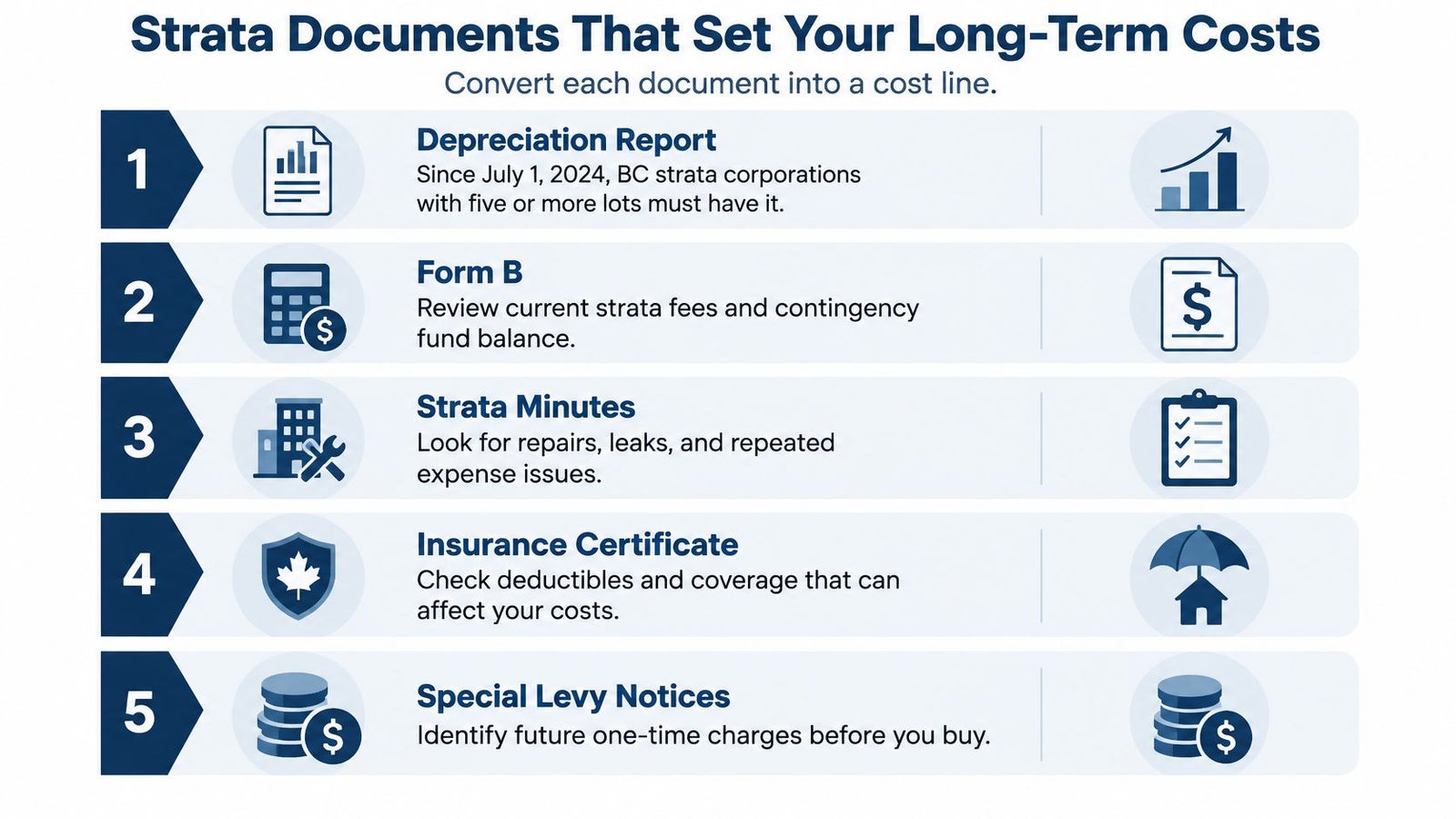
A depreciation report includes a physical inventory and evaluation of major common-property components, plus relevant repair and maintenance history. Roofs, elevators, balconies, plumbing, windows and building envelopes drive the large bills. Any component with a short remaining life is a likely future levy, whether or not council has announced one.
Next, compare the contingency reserve fund balance against those forecast costs. Then read the budget, two years of council minutes and any disclosed special levies. Minutes show you what owners argued about, which often reveals deferred work sooner than a formal notice does.
Convert the report's expected spending into an annual reserve and levy allowance, then add it to the strata fee in your model. The listing's current monthly fee tells you what owners pay today. It doesn't tell you whether that fee is adequate.
You can run your own inputs to analyze rental investments with RealtyAPI.io, which makes it easier to test rent and rate changes side by side. Change one input at a time so you can see which assumption carries the deal.
The common slip is treating the cap rate as cash flow. The cap rate ignores financing, so a low cap rate can still be defensible if rents grow and you hold for a long period. Negative cash flow is different, because you fund that gap from other income every single month.
If the answer requires rent well above comparable units or a much lower rate at renewal, the deal depends on events you don't control. Price it accordingly or pass.
A single rent figure flatters almost every condo. Metro Vancouver's purpose-built vacancy rate rose from 0.9% in 2022 and 2023 to 3.7% in 2025, the highest level in more than 30 years, while average annual rent growth slowed to 2.0%, according to Metro Vancouver's rental housing data. Conditions moved quickly, and they can move against your unit just as quickly.
Run three scenarios for the same unit before you offer. Each one asks a harder question than the last.
Scenario one uses current comparable rent with a vacancy allowance of about 5%. This is the case most listings imply. It tells you whether the unit works today, and nothing about next year.
Scenario two grows rent at 2.0% a year and applies a vacancy allowance of about 3.7%. Slower growth plus softer occupancy reflects a market where new rental supply competes for your tenant. Watch how much of your margin that combination removes.
Scenario three is the weak case, with two to three empty months plus one month of incentives to fill the unit. Incentives such as a free month are real costs, even though they never appear as an expense line. If you want to sanity-check occupancy assumptions, the occupancy rate formula for vacation rentals shows how small occupancy changes compound across a year.
For each scenario, recalculate the break-even rent after strata fees, property tax, insurance, financing, repairs and vacancy. Then measure the monthly gap against the current-rent case. That gap is the amount you'd subsidize from other income.
Drivers inside one neighbourhood explain much of the spread between scenarios. Consider each one for your specific unit:
Unit size: Studios and two-bedrooms draw different tenant pools with different turnover patterns.
Transit access: Walkable stations support rent when supply rises elsewhere.
Furnished positioning: Furnished units can rent faster to relocating professionals but cost more to turn over.
New supply: A purpose-built tower completing nearby competes directly for your next tenant.
The test isn't whether the unit wins the current-rent scenario. It's whether it survives the weak one without forcing a sale.
Start with rate risk, because renewal is where thin cash flow breaks. Run your debt service at a rate above the one you're offered today and see whether rent still covers it. If a modest increase turns a small surplus into a monthly subsidy, the purchase has no cushion.
A rental purchase generally needs a larger down payment than an owner-occupied one, and insured mortgage options are generally not available for investment properties. Plan your equity around a substantial down payment scenario, such as the 20% example used earlier. Confirm current qualifying-rate rules with a mortgage specialist, since lenders test whether property income and your own income support the loan at a stressed rate.
Closing costs belong in the same conversation. Our BC property transfer tax exemption guide sets out what applies at purchase, and most investment purchases won't qualify for relief. Budget the tax as a cost of entry, not an afterthought.
Sell after a hold: Best when prices and rents have risen since purchase. Check selling costs, your tax position and any disclosed special levies.
Refinance to fund another purchase: Best when rent covers debt service at the new rate. Check qualifying rules and the appraised value.
Move in as an owner: Best when your circumstances change and the unit suits you. Check the tax treatment of the change of use and remaining mortgage terms.
Say you buy at $650,000 and sell after three years in a flat market. Legal fees, realtor commissions and moving costs still apply, and they can absorb a year of cash flow on their own. A short hold leaves no time for rent growth or principal paydown to offset those costs.
Refinancing only works if the appraised value and the rent both support a larger loan at the new rate. Moving in changes the property's use, which carries tax consequences an accountant should confirm before you buy, not after. Each route rewards a different hold period.
Write down two numbers before you purchase. First, the exit price needed to recover your purchase costs, selling costs and any cash you've subsidised. Second, the hold period that gives your strategy time to reach that price. If the hold period is longer than you're willing to commit, the exit plan isn't real.
Four things must be true before you write an offer. Treat any failure as a reason to renegotiate or walk away, not as a detail to sort out later.
Documents support the model: The depreciation report and reserve balance back up your rent-minus-costs figures.
Bylaws permit your plan: The long-term tenancy you intend fits the building's rules.
Downside rent covers costs: Your weak-case scenario still pays the bills.
Financing survives a rate rise: Cash flow holds after you stress the renewal rate.
Schedule the document review before any condition deadline. If a buyer has conditions such as financing, inspection or review of strata documents, the transaction enters the subject or condition period, during which the buyer works to satisfy or waive those conditions by the specified deadlines. Miss a deadline and you may lose the protection the condition was meant to give you.
Pricing the unit against comparable sales matters as much as the rental math. Our explainer on how to do a comparative market analysis shows how sold prices, not asking prices, set a defensible offer range. An overpriced purchase can't be rescued by optimistic rent.
The first step is an initial meeting with a realtor, often called a discovery meeting, to share plans and explore whether timing and market conditions align with your goals. Book that meeting with Jacky Levi, Vancouver REALTOR®, to review your target building's documents and test the rent and vacancy scenarios. Bring the building address, the listing's stated monthly fees and the rent assumption you plan to use.
You'll leave with one of three decisions, and each one is a good outcome if the numbers support it. Proceed when the downside case works. Renegotiate when the building is sound but the price isn't. Walk away when only the optimistic case works.
If you're weighing a Vancouver condo as a rental, bring the listing, the strata documents and your rent assumption to a discovery meeting, and we'll test the cash flow, levy risk and downside scenarios together before you commit. You'll get a clear proceed, renegotiate or walk-away recommendation grounded in comparable sales and the building's own records. Start at Jacky Levi - Vancouver Realtor to book your meeting.
Vancouver Condo Rent and Vacancy Benchmarks
Rental condos in Metro Vancouver averaged $2,715 across all unit sizes in 2025, which is $745 per month, or 38%, above purpose-built rentals at $1,970, according to CMHC's 2025 Rental Market Report. That premium is real, and it's the strongest argument for buying a condo for Investment rather than chasing a cheaper rental building interest. It is also where many buyers stop calculating.
The same benchmark set shows a 1.5% vacancy rate for rental condominium apartments in the Vancouver census metropolitan area, compared with 3.7% for purpose-built rental housing. For two-bedroom units, the average condo rent was $2,900, compared with $2,363 for purpose-built rentals. Condos were tighter and pricier at the same time.
Rental Condo and Purpose-Built Benchmarks in 2025
- Vacancy rate, 2025 (CMHC): Rental condominiums: 1.5%; purpose-built rentals: 3.7%.
- Average two-bedroom rent, 2025 (CMHC): Rental condominiums: $2,900; purpose-built rentals: $2,363.
- Average rent, all unit sizes, 2025 (Metro Vancouver): Rental condominiums: $2,715; purpose-built rentals: $1,970.
- Condo rent premium over purpose-built: $745 per month, 38%; purpose-built rentals are the baseline.
Neither figure is a return on its own. The 38% premium only helps after purchase price, mortgage costs, strata fees, property tax, insurance, maintenance and vacancy are subtracted. A $745 advantage disappears quickly if strata fees and debt service on a higher purchase price exceed it.
The 1.5% vacancy rate is also a regional average, not a promise for your building. Unit size, transit access, building age, amenities, condition and competing listings move achievable rent in either direction. A dated one-bedroom far from transit doesn't inherit the regional average because it's a condo.
First action: Write down the regional rent and vacancy figures, then compare your target building's expected rent against them before you read another listing.
If the asking rent in your model sits above the regional average, you need a specific reason, such as size, location or finish. If you can't name that reason, bring the rent assumption down.
Long-Term Rentals vs Short-Term Rental Risk
A conventional long-term tenancy is the default case you should underwrite. In British Columbia, strata corporations can't screen tenants, require approval of tenants, or otherwise restrict ordinary rentals of a strata lot under section 141 of the Strata Property Act, as the BC guidance for landlords and strata corporations explains. Short-term rentals are treated differently, because strata corporations may restrict or ban them through a bylaw and local governments can impose stricter rules.
That distinction widened on November 24, 2022, when BC invalidated residential rental-restriction bylaws in strata corporations. Long-term rental eligibility generally improved. Short-term rental bylaws and municipal rules still apply, so don't treat the two income streams as interchangeable.
Rental Use Options Compared for a Vancouver Condo
- Long-term tenancy: Available to any owner, subject to bylaws and tenancy law. Main risks are vacancy and slower rent growth. Underwrite permitted rent less all costs.
- Short-term rental by a principal-residence owner: Available to an owner who lives in the unit, where local rules allow. A strata ban or city enforcement is the main risk. Underwrite only with written approval.
- Short-term rental by a non-resident investor: Generally not permitted in Vancouver. A strata bylaw may impose fines of up to $1,000 per day. Do not count any short-term income.
Vancouver generally limits short-term rentals to a principal residence. If you don't live in the condo, you generally can't operate it as a short-term rental, whatever a listing's revenue projection says. A strata ban adds a second barrier on top of the city's rule.
The $180 a Night Example
Say you buy a condo for $650,000 and project $180 a night at 60% occupancy. The arithmetic gives about $39,420 in gross revenue a year, before cleaning, platform fees, furnishing, utilities and taxes. That number makes almost any purchase look workable.
If the strata bans the use or the principal-residence rule blocks you, that revenue falls to zero. Your mortgage, strata fees, property tax and insurance don't fall with it. You've bought a long-term rental at a short-term rental price, and the monthly gap is yours to fund.
Even a compliant long-term tenancy carries building rules you must price in. Bylaws on pets, smoking, quiet hours and age restrictions shape your tenant pool and your turnover costs. A pet ban, for example, shrinks demand in a neighbourhood full of dog owners.
You must give your tenant the strata bylaws and rules and have the tenant complete Form K, the Notice of Tenant's Responsibilities. Tenants stay bound by those rules even if you missed the form, so a careless handover doesn't protect you from bylaw complaints or fines that land on the owner.
Underwrite permitted long-term rent unless you hold written municipal and strata approval for anything else.
Request the current bylaws, rules, Form B information certificate, meeting minutes and any rental-related correspondence before you offer. If those documents contradict the income story, believe the documents.
Strata Documents That Set Your Long-Term Costs
Review strata documents in the order they change your cash-flow model, not in the order a seller's package lists them. The depreciation report comes first. Effective July 1, 2024, strata corporations with five or more lots must obtain depreciation reports on a five-year cycle and can no longer defer one through an annual three-quarters vote, under BC's strata legislation changes.
The chart below sets out the five documents that carry the most cost information.
A depreciation report includes a physical inventory and evaluation of major common-property components, plus relevant repair and maintenance history. Roofs, elevators, balconies, plumbing, windows and building envelopes drive the large bills. Any component with a short remaining life is a likely future levy, whether or not council has announced one.
Next, compare the contingency reserve fund balance against those forecast costs. Then read the budget, two years of council minutes and any disclosed special levies. Minutes show you what owners argued about, which often reveals deferred work sooner than a formal notice does.
Turning Documents Into Cost Lines
Convert the report's expected spending into an annual reserve and levy allowance, then add it to the strata fee in your model. The listing's current monthly fee tells you what owners pay today. It doesn't tell you whether that fee is adequate.
- Depreciation report: Annualize upcoming component costs and add the figure to your expenses.
- Reserve balance: Flag any gap between the balance and the spending schedule as levy risk.
- Minutes and levies: Note repeated special levies, pending litigation and deferred maintenance.
Insurance needs the same treatment. Strata coverage protects the building, but it doesn't cover your contents, personal liability, temporary accommodation or upgrades. You may also face exposure to the strata deductible where you're responsible, so budget for your own policy rather than assuming the building's policy reaches your unit.
For a strata property sale, sellers may need documents such as the Form B Information Certificate, strata bylaws and rules, meeting minutes, financial statements, annual budget, depreciation report, insurance information, strata plan and information on special levies. Our guide to the Form B Information Certificate for Vancouver condo buyers explains what each field means for your costs.
Building type changes your exposure too. A low-rise townhouse-style or duplex strata can carry different maintenance and governance risk from a high-rise tower, even at a higher price. Fewer owners means each owner absorbs a larger share when a roof or envelope fails.
Treat reserves below schedule, repeated levies and minutes full of postponed repairs as price problems. Either the purchase price drops to absorb them, or you walk away.
Work through the calculation in order, using a hypothetical $650,000 one-bedroom condo bought with 20% down. Every figure below is an example input, so replace each one with the target building's actual numbers. The sequence matters more than the specific result.
The flow chart below shows the order of the calculation.
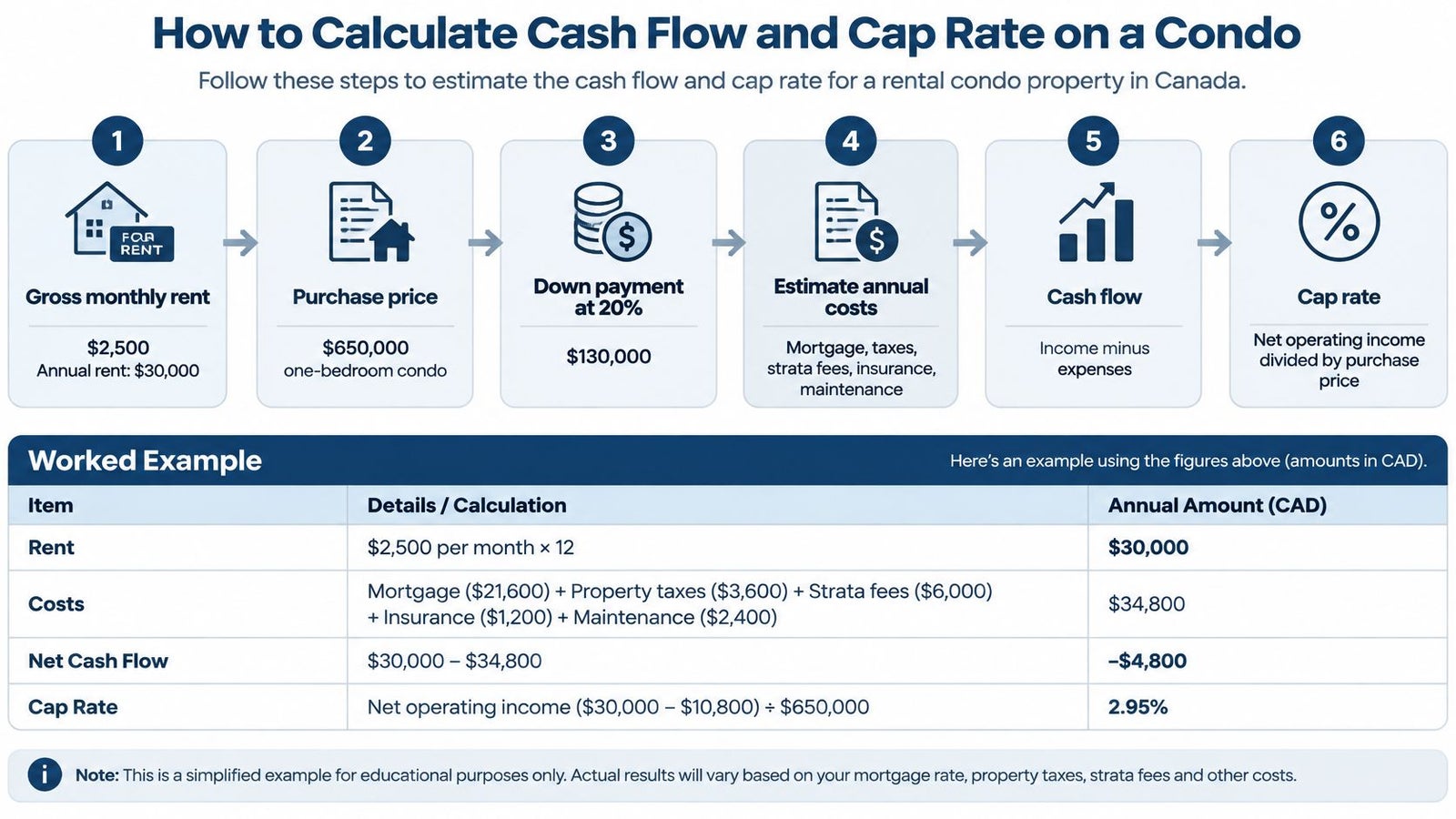
Estimate gross rent. Take monthly rent from comparable rented units, not asking rents. At $2,500 a month, gross annual rent is $30,000.
Deduct vacancy. An allowance of about 5% removes $1,500, because turnover and empty months cost money even in a tight market.
Deduct strata fees. Use the strata budget figure, not the listing. At $600 a month, that's $7,200 a year.
Deduct tax and unit costs. Property tax of $2,400 plus insurance and a repair set-aside of $1,800. Our Vancouver property tax guide for homeowners shows how to confirm the tax figure.
Find net operating income. The example gives $17,100 before any mortgage payment.
Calculate the cap rate. Divide NOI by the purchase price. Here, $17,100 over $650,000 is about 2.6%.
Subtract debt service. At an assumed 4.5% rate on a $520,000 loan over 25 years, annual payments run about $34,700, leaving cash flow near negative $17,600.
For a strata property sale, sellers may need documents such as the Form B Information Certificate, strata bylaws and rules, meeting minutes, financial statements, annual budget, depreciation report, insurance information, strata plan and information on special levies. Our guide to the Form B Information Certificate for Vancouver condo buyers explains what each field means for your costs.
Building type changes your exposure too. A low-rise townhouse-style or duplex strata can carry different maintenance and governance risk from a high-rise tower, even at a higher price. Fewer owners means each owner absorbs a larger share when a roof or envelope fails.
Treat reserves below schedule, repeated levies and minutes full of postponed repairs as price problems. Either the purchase price drops to absorb them, or you walk away.
How to Calculate Cash Flow and Cap Rate on a Condo
Work through the calculation in order, using a hypothetical $650,000 one-bedroom condo bought with 20% down. Every figure below is an example input, so replace each one with the target building's actual numbers. The sequence matters more than the specific result.
The flow chart below shows the order of the calculation.
Estimate gross rent. Take monthly rent from comparable rented units, not asking rents. At $2,500 a month, gross annual rent is $30,000.
Deduct vacancy. An allowance of about 5% removes $1,500, because turnover and empty months cost money even in a tight market.
Deduct strata fees. Use the strata budget figure, not the listing. At $600 a month, that's $7,200 a year.
Deduct tax and unit costs. Property tax of $2,400 plus insurance and a repair set-aside of $1,800. Our Vancouver property tax guide for homeowners shows how to confirm the tax figure.
Find net operating income. The example gives $17,100 before any mortgage payment.
Calculate the cap rate. Divide NOI by the purchase price. Here, $17,100 over $650,000 is about 2.6%.
Subtract debt service. At an assumed 4.5% rate on a $520,000 loan over 25 years, annual payments run about $34,700, leaving cash flow near negative $17,600.
Worked Example Cash Flow on a $650,000 One-Bedroom Condo at 20% Down
- Vacancy allowance, about 5%: Covers turnover and empty months.
- Property tax: Illustrative; confirm on the tax notice.
- Insurance and repair set-aside: Unit coverage and maintenance reserve.
- Net operating income: Before mortgage payments.
- Cap rate on $650,000: NOI divided by purchase price.
- Cash flow before tax: Negative; the owner funds the gap every month.
You can run your own inputs to analyze rental investments with RealtyAPI.io, which makes it easier to test rent and rate changes side by side. Change one input at a time so you can see which assumption carries the deal.
The common slip is treating the cap rate as cash flow. The cap rate ignores financing, so a low cap rate can still be defensible if rents grow and you hold for a long period. Negative cash flow is different, because you fund that gap from other income every single month.
Ask this last: Which single input would have to change, and by how much, for cash flow to turn positive?
If the answer requires rent well above comparable units or a much lower rate at renewal, the deal depends on events you don't control. Price it accordingly or pass.
Stress-Testing Rent and Vacancy Before You Offer
A single rent figure flatters almost every condo. Metro Vancouver's purpose-built vacancy rate rose from 0.9% in 2022 and 2023 to 3.7% in 2025, the highest level in more than 30 years, while average annual rent growth slowed to 2.0%, according to Metro Vancouver's rental housing data. Conditions moved quickly, and they can move against your unit just as quickly.
Run three scenarios for the same unit before you offer. Each one asks a harder question than the last.
Three Scenarios for One Unit
Scenario one uses current comparable rent with a vacancy allowance of about 5%. This is the case most listings imply. It tells you whether the unit works today, and nothing about next year.
Scenario two grows rent at 2.0% a year and applies a vacancy allowance of about 3.7%. Slower growth plus softer occupancy reflects a market where new rental supply competes for your tenant. Watch how much of your margin that combination removes.
Scenario three is the weak case, with two to three empty months plus one month of incentives to fill the unit. Incentives such as a free month are real costs, even though they never appear as an expense line. If you want to sanity-check occupancy assumptions, the occupancy rate formula for vacation rentals shows how small occupancy changes compound across a year.
For each scenario, recalculate the break-even rent after strata fees, property tax, insurance, financing, repairs and vacancy. Then measure the monthly gap against the current-rent case. That gap is the amount you'd subsidize from other income.
Drivers inside one neighbourhood explain much of the spread between scenarios. Consider each one for your specific unit:
Unit size: Studios and two-bedrooms draw different tenant pools with different turnover patterns.
Transit access: Walkable stations support rent when supply rises elsewhere.
Furnished positioning: Furnished units can rent faster to relocating professionals but cost more to turn over.
New supply: A purpose-built tower completing nearby competes directly for your next tenant.
The test isn't whether the unit wins the current-rent scenario. It's whether it survives the weak one without forcing a sale.
If a building only works at today's rent with no empty months, you're looking at a speculative purchase, not a rental income property.
Financing Rules and Exit Options to Plan Early
Start with rate risk, because renewal is where thin cash flow breaks. Run your debt service at a rate above the one you're offered today and see whether rent still covers it. If a modest increase turns a small surplus into a monthly subsidy, the purchase has no cushion.
A rental purchase generally needs a larger down payment than an owner-occupied one, and insured mortgage options are generally not available for investment properties. Plan your equity around a substantial down payment scenario, such as the 20% example used earlier. Confirm current qualifying-rate rules with a mortgage specialist, since lenders test whether property income and your own income support the loan at a stressed rate.
Closing costs belong in the same conversation. Our BC property transfer tax exemption guide sets out what applies at purchase, and most investment purchases won't qualify for relief. Budget the tax as a cost of entry, not an afterthought.
Exit Routes and What Each One Must Cover
Sell after a hold: Best when prices and rents have risen since purchase. Check selling costs, your tax position and any disclosed special levies.
Refinance to fund another purchase: Best when rent covers debt service at the new rate. Check qualifying rules and the appraised value.
Move in as an owner: Best when your circumstances change and the unit suits you. Check the tax treatment of the change of use and remaining mortgage terms.
Say you buy at $650,000 and sell after three years in a flat market. Legal fees, realtor commissions and moving costs still apply, and they can absorb a year of cash flow on their own. A short hold leaves no time for rent growth or principal paydown to offset those costs.
Refinancing only works if the appraised value and the rent both support a larger loan at the new rate. Moving in changes the property's use, which carries tax consequences an accountant should confirm before you buy, not after. Each route rewards a different hold period.
Write down two numbers before you purchase. First, the exit price needed to recover your purchase costs, selling costs and any cash you've subsidised. Second, the hold period that gives your strategy time to reach that price. If the hold period is longer than you're willing to commit, the exit plan isn't real.
Confirm the Numbers Before You Make an Offer
Four things must be true before you write an offer. Treat any failure as a reason to renegotiate or walk away, not as a detail to sort out later.
Documents support the model: The depreciation report and reserve balance back up your rent-minus-costs figures.
Bylaws permit your plan: The long-term tenancy you intend fits the building's rules.
Downside rent covers costs: Your weak-case scenario still pays the bills.
Financing survives a rate rise: Cash flow holds after you stress the renewal rate.
Schedule the document review before any condition deadline. If a buyer has conditions such as financing, inspection or review of strata documents, the transaction enters the subject or condition period, during which the buyer works to satisfy or waive those conditions by the specified deadlines. Miss a deadline and you may lose the protection the condition was meant to give you.
Pricing the unit against comparable sales matters as much as the rental math. Our explainer on how to do a comparative market analysis shows how sold prices, not asking prices, set a defensible offer range. An overpriced purchase can't be rescued by optimistic rent.
The first step is an initial meeting with a realtor, often called a discovery meeting, to share plans and explore whether timing and market conditions align with your goals. Book that meeting with Jacky Levi, Vancouver REALTOR®, to review your target building's documents and test the rent and vacancy scenarios. Bring the building address, the listing's stated monthly fees and the rent assumption you plan to use.
You'll leave with one of three decisions, and each one is a good outcome if the numbers support it. Proceed when the downside case works. Renegotiate when the building is sound but the price isn't. Walk away when only the optimistic case works.
If you're weighing a Vancouver condo as a rental, bring the listing, the strata documents and your rent assumption to a discovery meeting, and we'll test the cash flow, levy risk and downside scenarios together before you commit. You'll get a clear proceed, renegotiate or walk-away recommendation grounded in comparable sales and the building's own records. Start at Jacky Levi - Vancouver Realtor to book your meeting.