A qualifying first-time buyer in BC can save up to $8,000 in property transfer tax when the home is valued at or below $835,000, but a purchase between $835,000 and $860,000 needs careful calculation because the benefit phases out. That narrow range can change your closing-cost budget even when the home price moves only modestly.
You've found a Vancouver condo that fits your budget, your lender has approved the financing, and you're preparing an offer. Then someone asks whether you've included property transfer tax in your cash needed to close. If you're buying a resale home near an exemption threshold, the answer isn't “I'm a first-time buyer, so I pay nothing.” The property's fair market value, its use as your principal residence, the registration date, and whether it's new construction all matter.
The Hidden Cost of Buying Your First Home in BC
You are comparing Vancouver condos near the $835,000 mark when the numbers change. One property may receive the full first-time buyer exemption, while another only a little higher may receive part of it. The difference is a tax cliff, not a benefit that disappears at the same pace as the purchase price. The province sets these rules, not the listing brokerage, lender, or developer. The BC first-time home buyers' exemption guide explains the program requirements.
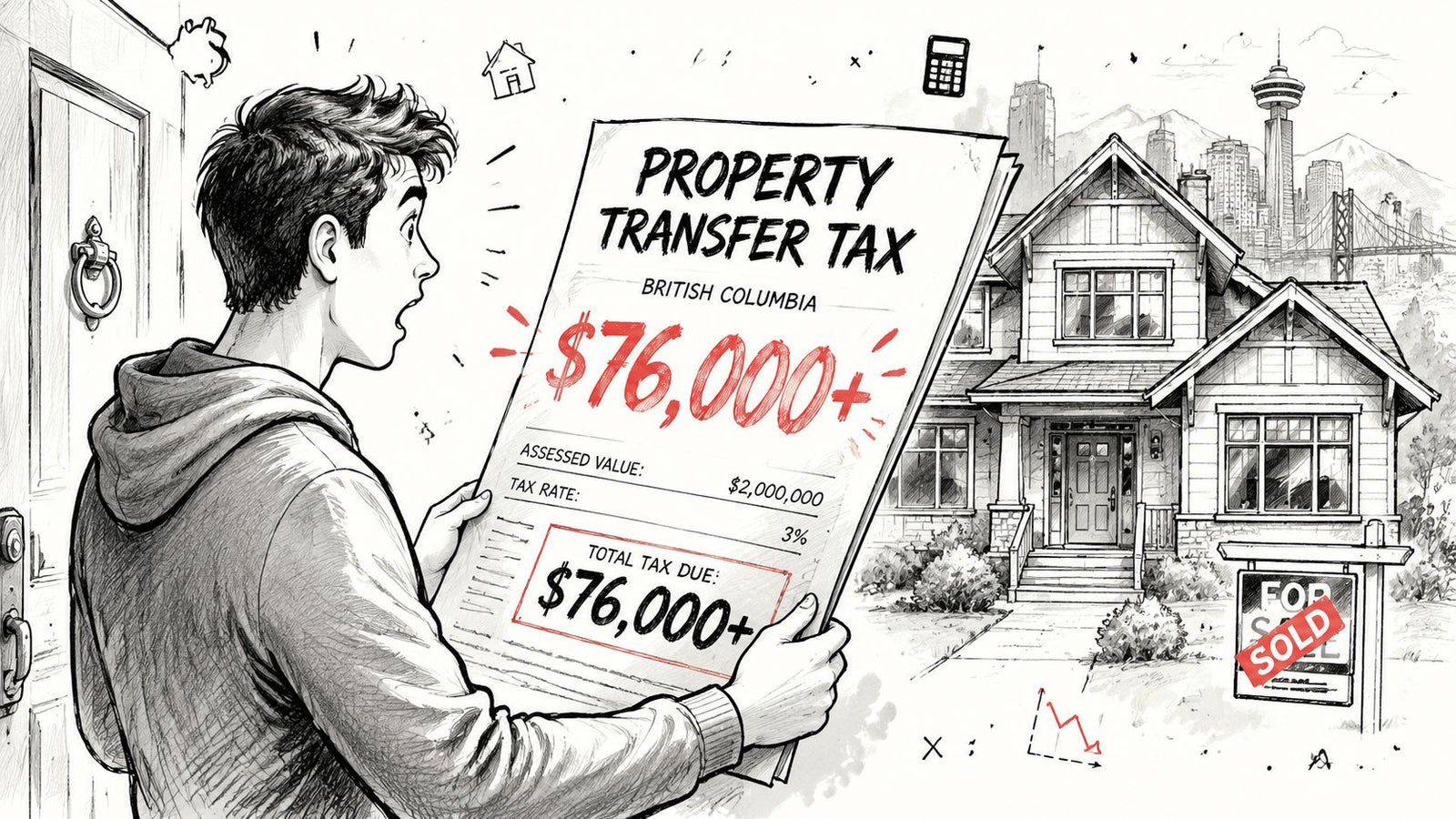
The practical question has two parts: do you qualify, and how much tax remains payable? A qualifying first-time buyer can receive a full exemption on a home valued at $835,000 or less, provided the other requirements are met. Above that value and below $860,000, the exemption is partial. It decreases linearly as the property value approaches the upper cutoff, so a modest price difference can leave a noticeable amount in your closing-cost budget. At $860,000, the first-time buyer benefit disappears for properties registered on or after April 1, 2024. The provincial exemption information sets out these thresholds.
Greater Vancouver buyers often compare condos, townhomes, and older detached homes within a narrow price band. A change in the accepted price can alter the exemption, and a difference between a formal appraisal and the contract amount may affect the tax calculation. The home must also become the buyer's principal residence. The land must be 0.5 hectares, or 1.24 acres, or smaller, and the property must contain only eligible residential improvements, according to BC's government eligibility rules.
The policy changed significantly on April 1, 2024. Before then, the full first-time buyer exemption limit was $500,000. The higher threshold helps more buyers, but it also makes homes near the limits harder to compare by headline price alone. A Vancouver homes for sale buyer's guide can help frame the purchase price across neighbourhoods and property types, while your legal professional confirms the applicable tax treatment.
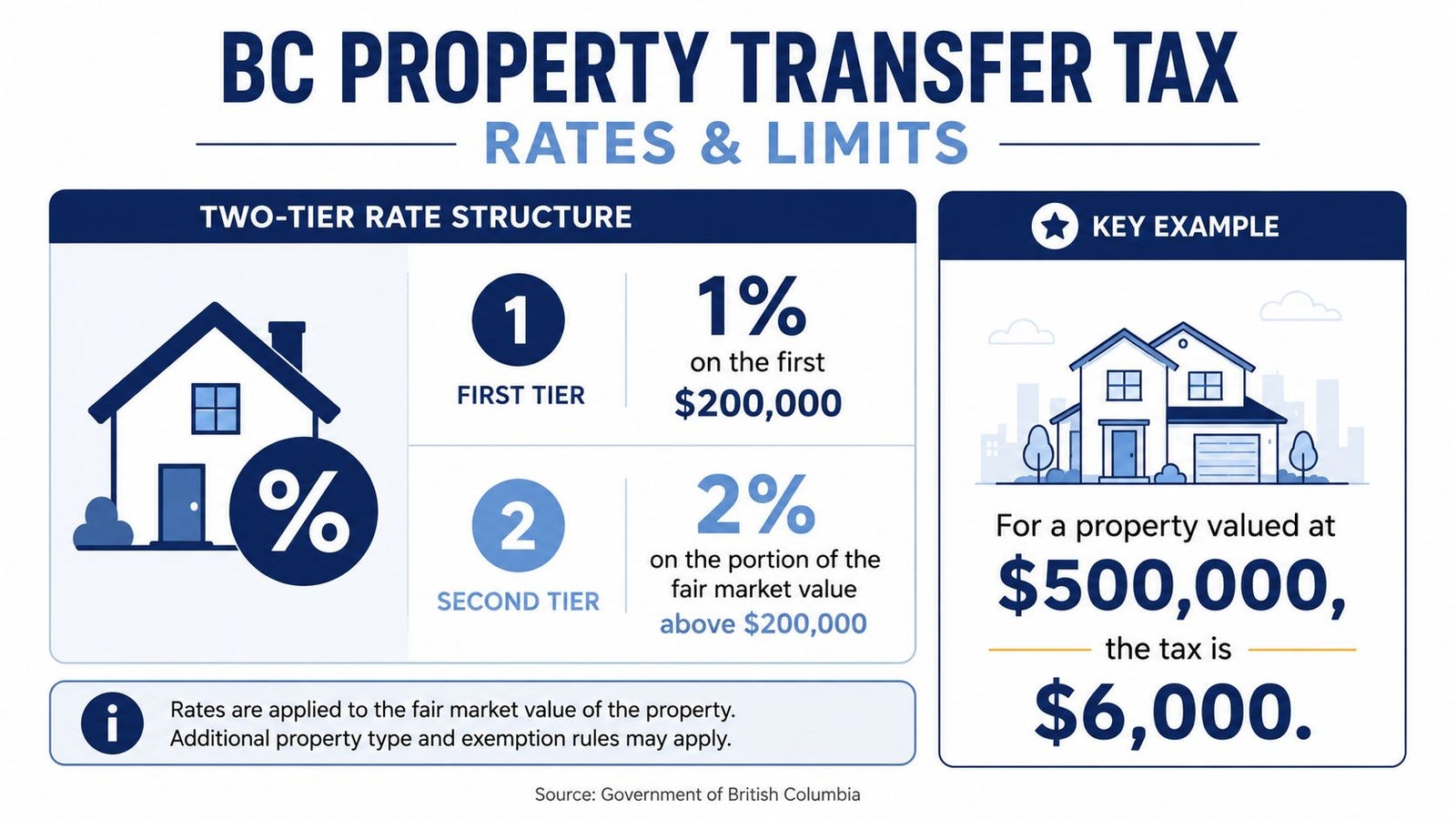
Suppose you are buying a Vancouver home valued at $500,000. Before any exemption, the property transfer tax, or PTT, is $6,000. The calculation applies 1% on the first $200,000 and 2% on the remaining $300,000. A qualifying first-time buyer may eliminate tax on the first $500,000, creating a potential saving of $8,000 under the current rules. The BC government's current amount guidance sets out the applicable thresholds.
Why Vancouver buyers feel the threshold
Greater Vancouver buyers often compare condos, townhomes, and older detached homes within a narrow price band. A change in the accepted price can alter the exemption, and a difference between a formal appraisal and the contract amount may affect the tax calculation. The home must also become the buyer's principal residence. The land must be 0.5 hectares, or 1.24 acres, or smaller, and the property must contain only eligible residential improvements, according to BC's government eligibility rules.
"Practical rule: Include the exemption in your offer analysis, rather than leaving the calculation until your lawyer or Notary Public reviews the closing documents."
The policy changed significantly on April 1, 2024. Before then, the full first-time buyer exemption limit was $500,000. The higher threshold helps more buyers, but it also makes homes near the limits harder to compare by headline price alone. A Vancouver homes for sale buyer's guide can help frame the purchase price across neighbourhoods and property types, while your legal professional confirms the applicable tax treatment.
Understanding BC Property Transfer Tax Rates and Limits
Suppose you are buying a Vancouver home valued at $500,000. Before any exemption, the property transfer tax, or PTT, is $6,000. The calculation applies 1% on the first $200,000 and 2% on the remaining $300,000. A qualifying first-time buyer may eliminate tax on the first $500,000, creating a potential saving of $8,000 under the current rules. The BC government's current amount guidance sets out the applicable thresholds.
The exemption has a phase-out zone
The first-time buyer program is not a blanket waiver. It works more like a sliding scale near the upper limit. If the property falls within the partial-exemption band, the benefit decreases rather than continuing at its full amount. A modest change in the property's value can therefore create a noticeable change in the tax payable.
Eligibility also has two separate parts. You may qualify personally as a first-time buyer, yet still owe PTT because the home exceeds the full-exemption threshold. The property must meet its own conditions, and the buyer must satisfy the required residency and personal tests. Your lawyer or Notary Public confirms the final treatment during registration.
PTT is based on the property's fair market value at registration, not the figure that feels affordable in your budget. For broader ownership-cost planning, this guide to Vancouver property taxes is useful, but annual property tax and PTT are separate charges.
Rate structure at a glance
- First $200,000 --> 1%
- Portion from $200,000 to $2,000,000 -->2%
New construction follows a different program, not an extended version of the first-time buyer exemption. Qualifying newly built homes can receive a full exemption up to $1,100,000, with a partial exemption between $1,100,000 and $1,150,000. The benefit ends above that range, according to the BC newly built home exemption rules.
That distinction matters in Metro Vancouver, where a resale condo near one threshold and a qualifying new home near another can produce very different closing costs. Compare the program first, then compare the purchase price.
Step-by-Step Guide to Claiming the First-Time Buyer Exemption
The first-time buyer exemption is usually addressed when the property is registered in the Land Title Office. You generally do not submit a separate provincial application before making an offer. Instead, your lawyer or Notary Public prepares the transfer documents and records your eligibility on the Property Transfer Tax form.
Step one: check your personal eligibility
Begin with your ownership history. The program is designed for buyers who have not previously owned an interest in a principal residence anywhere in the world. A spouse's history may also affect the result when both of you are purchasing. A small ownership share, inherited property, or home owned outside Canada can still matter, so review those details with your legal advisor before signing the declaration.
You must also meet the applicable Canadian citizenship or permanent-resident requirement and satisfy the provincial residence or tax-history test. Someone relocating to Vancouver should raise this early if their BC history is limited. Review the province's first-time buyer exemption requirements against your own facts. Treat the rules like a screening process, not a quick yes-or-no assumption.
Step two: confirm the property qualifies
The property must be in BC and become your principal residence. Its value must fit the relevant exemption range, and the land must be 0.5 hectares, or 1.24 acres, or smaller. Eligible residential improvements are included, while the full exemption does not automatically cover every feature or use connected to the property.
A price just above the full-exemption threshold can produce a partial benefit rather than eliminating the exemption altogether. Ask your legal representative to confirm how the property's fair market value affects the calculation before you rely on an estimated closing-cost figure.
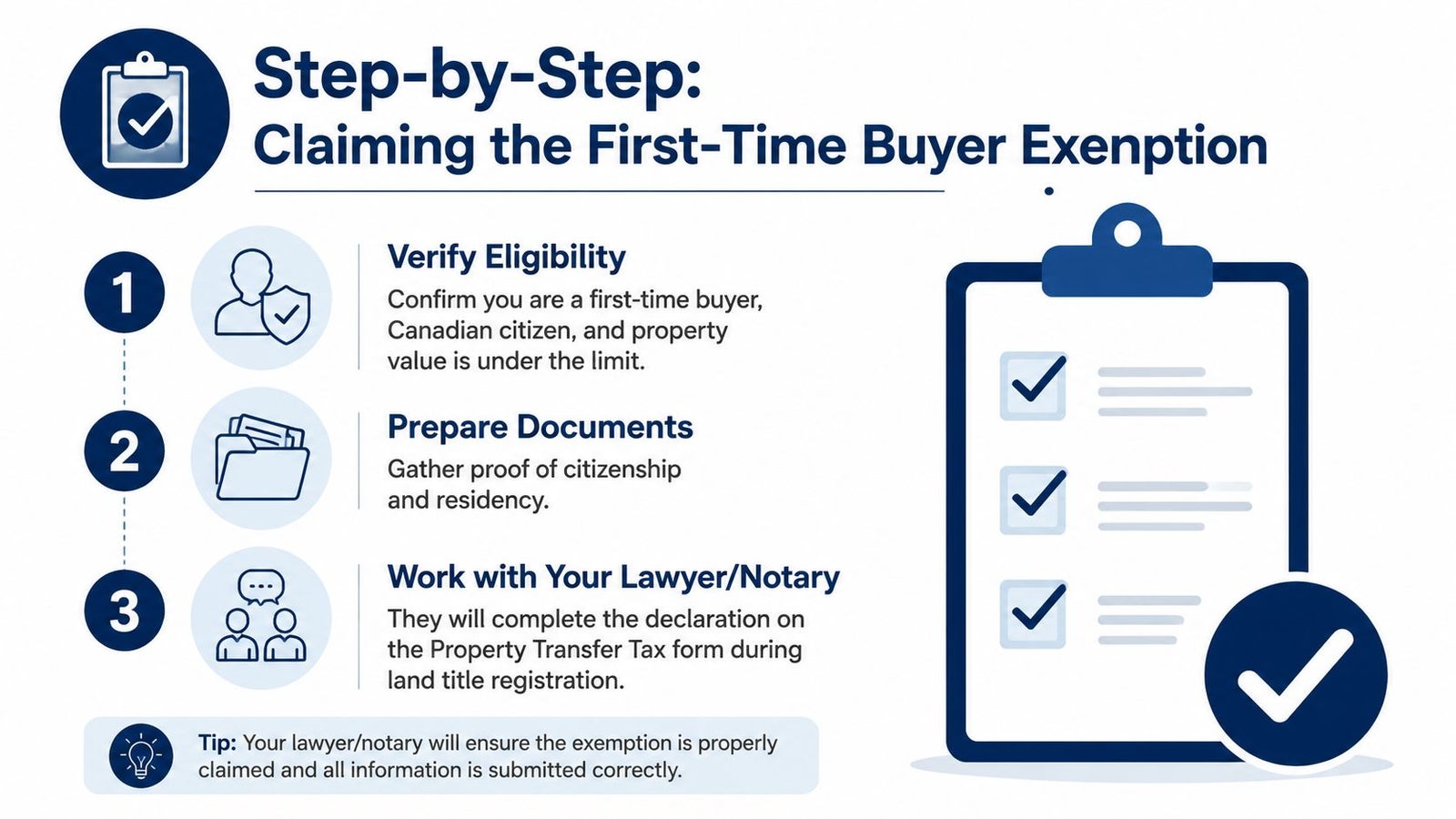
Your lawyer or Notary Public completes the relevant declaration on the Property Transfer Tax form during registration. Prepare information supporting your citizenship or permanent-resident status, residence, ownership history, and intended occupancy. The documents requested can differ by transaction, so provide clear answers and ask what evidence is needed.
The exemption is assessed in connection with registration, which makes the final stage important. A change before registration, or a reassessment of fair market value, can require another review. Tell your legal team about ownership changes, assignment arrangements, financing changes, or concerns about occupying the home before completion.
The first-time buyer program and the newly built home program are separate forms of relief. The first focuses on the buyer's history and the property's use, while the second focuses on qualifying new construction and has a higher value threshold. That difference can materially change the closing-tax outcome for a Vancouver condo or townhome.
Step three: prepare the declaration
Your lawyer or Notary Public completes the relevant declaration on the Property Transfer Tax form during registration. Prepare information supporting your citizenship or permanent-resident status, residence, ownership history, and intended occupancy. The documents requested can differ by transaction, so provide clear answers and ask what evidence is needed.
Step four: plan for registration
The exemption is assessed in connection with registration, which makes the final stage important. A change before registration, or a reassessment of fair market value, can require another review. Tell your legal team about ownership changes, assignment arrangements, financing changes, or concerns about occupying the home before completion.
"Before signing: If one eligibility condition is unclear, disclose it to your lawyer or Notary Public. Investigating before signing is safer than making a declaration and correcting it later."
First-Time Buyer vs. Newly Built Home Exemptions
The first-time buyer program and the newly built home program are separate forms of relief. The first focuses on the buyer's history and the property's use, while the second focuses on qualifying new construction and has a higher value threshold. That difference can materially change the closing-tax outcome for a Vancouver condo or townhome.
The first-time buyer program can be valuable for a qualifying resale purchase at or below $835,000. It applies to the first $500,000 of the purchase price, and the maximum tax saving under the current rate structure is $8,000. Above the full-exemption threshold, the benefit phases out linearly and ends at $860,000 for applicable registrations.
The newly built home exemption reaches further. A qualifying new home valued at or below $1,100,000 can receive a full exemption, while a home valued above that amount and below $1,150,000 receives a partial exemption. The exemption disappears above the upper limit. These rules make “new build means no PTT” an unreliable shortcut. The home still has to meet the program's conditions, and the value cliff remains important.
For a resale condo, the first-time buyer exemption is the relevant starting point if you meet the buyer requirements. For qualifying new construction, examine the newly built home program separately. Don't assume that being a first-time buyer automatically combines both programs or that one program can repair an ineligible purchase under the other.
A new condo priced at $1,050,000 may fall within the full newly built home exemption range, while a resale home at the same value won't receive the full first-time buyer benefit because it exceeds that program's range. A new home at $1,120,000 falls within the newly built home phase-out range, so the result requires a calculation rather than a blanket “exempt” answer.
GST, strata fees, financing costs, and other closing expenses still need separate budgeting. PTT relief can lower one major cost, but it doesn't make the complete purchase affordable by itself.
A buyer comparing two homes can face very different PTT bills, even when the prices look similar. The examples below apply the BC two-tier calculation described earlier. They assume the buyer and property meet every other program condition, and they isolate PTT from GST, legal fees, strata costs, and other closing expenses.
A resale condo at $750,000
The newly built home exemption reaches further. A qualifying new home valued at or below $1,100,000 can receive a full exemption, while a home valued above that amount and below $1,150,000 receives a partial exemption. The exemption disappears above the upper limit. These rules make “new build means no PTT” an unreliable shortcut. The home still has to meet the program's conditions, and the value cliff remains important.
Which program should you examine?
For a resale condo, the first-time buyer exemption is the relevant starting point if you meet the buyer requirements. For qualifying new construction, examine the newly built home program separately. Don't assume that being a first-time buyer automatically combines both programs or that one program can repair an ineligible purchase under the other.
A new condo priced at $1,050,000 may fall within the full newly built home exemption range, while a resale home at the same value won't receive the full first-time buyer benefit because it exceeds that program's range. A new home at $1,120,000 falls within the newly built home phase-out range, so the result requires a calculation rather than a blanket “exempt” answer.
GST, strata fees, financing costs, and other closing expenses still need separate budgeting. PTT relief can lower one major cost, but it doesn't make the complete purchase affordable by itself.
Real-World Calculation Examples and Scenarios
A buyer comparing two homes can face very different PTT bills, even when the prices look similar. The examples below apply the BC two-tier calculation described earlier. They assume the buyer and property meet every other program condition, and they isolate PTT from GST, legal fees, strata costs, and other closing expenses.
A resale condo at $750,000
Without an exemption, the standard PTT is:
- First $200,000: 1% produces $2,000.
- Remaining $550,000: 2% produces $11,000.
- Total standard PTT: $13,000.
A qualifying first-time buyer can apply the exemption to the first $500,000 of the purchase price. That removes the tax on that portion, while the remaining value stays taxable. The buyer therefore pays $5,000, calculated on the remaining $250,000 at 2%. The provincial property transfer tax rate guidance explains the rate structure used in this calculation.
The common misunderstanding is treating eligibility as an all-or-nothing result. The property can qualify for the first-time buyer program while part of the purchase price remains subject to tax. The full-exemption limit concerns fair market value, while the relief itself applies to the first $500,000 of purchase price.
A qualifying new build at $1,000,000
Standard PTT on a $1,000,000 home is $18,000, using 1% on the first $200,000 and 2% on the remaining $800,000.
A qualifying newly built home can receive a full exemption at this value because it falls below the $1,100,000 full-exemption threshold. If the buyer and property satisfy the program conditions, the potential PTT saving is therefore $18,000.
The two programs work like separate doors. A buyer who does not qualify for the first-time buyer program may still qualify through a qualifying new build, while a first-time buyer purchasing a resale property cannot use the new-build rules just because the buyer is new to ownership. A newly marketed property is not automatically qualifying new construction. Its legal description, construction status, and transaction details still matter.
"Budgeting insight: Compare the tax treatment of the actual property type, not only your buyer status."
A resale purchase at $845,000
An $845,000 resale home falls within the first-time buyer partial-exemption range. Standard PTT is $14,900, made up of $2,000 on the first $200,000 and $12,900 on the remaining $645,000.
Because the fair market value is above $835,000 but below $860,000, the benefit phases out linearly. The exact exemption depends on the home's position within that range. At this price, the buyer is partway through the phase-out, so the payable PTT cannot be found by subtracting one fixed credit from the standard tax.
This partial zone is the hidden cliff in many offer discussions. A buyer negotiating near the full-exemption threshold should obtain a property-specific estimate before accepting a higher counteroffer. The price increase can raise the purchase cost and reduce the remaining tax benefit at the same time. Once the upper cutoff is reached, the benefit disappears.
Holding period and resale plans can raise a separate issue. Buyers and investors should keep PTT distinct from the rules described in this BC home flipping tax overview. That tax follows a different analysis and should not be folded into the PTT calculation.
Final Steps and When to Seek Professional Advice
The safest approach is to treat PTT as a transaction-planning issue. Confirm the likely tax before submitting an offer, identify whether the property is resale or qualifying new construction, and ask your lender and legal professional to include the tax result in your cash-to-close estimate.
Use a threshold checklist
- Confirm fair market value: Don't rely only on a listing headline. Ask how the value used for registration will be assessed.
- Identify the property type: Establish whether the home is resale, newly built, or part of a transaction that needs special legal review.
- Review buyer history: Check prior ownership interests, including interests outside Canada, before declaring first-time buyer eligibility.
- Plan principal-residence use: Make sure your intended occupancy matches the program's requirements.
- Check the registration timing: Discuss completion and registration dates with your lawyer or Notary Public.
- Model the partial zone: If the price is near $835,000, $860,000, $1,100,000, or $1,150,000, obtain a property-specific calculation.
Make the offer with the tax in mind
A buyer who focuses only on the negotiated price can overlook the cost of crossing an exemption threshold. That doesn't mean you should force every purchase below a limit. It means you should know the tax consequence before treating a seller's counteroffer as affordable.
New construction requires its own diligence. Ask whether the home qualifies under the newly built home exemption, whether the transaction is an assignment or a direct purchase, and whether the property will be your principal residence. GST, legal expenses, strata charges, and financing costs remain separate, so PTT relief should be added to a complete closing-cost worksheet rather than treated as the whole answer.
For condo buyers, the tax review should sit alongside document review. A buyer assessing a building's financial and maintenance history can also consult this Form B and information certificate guide, then ask the legal team to confirm how the specific transaction affects registration and exemption eligibility.
"Professional advice matters most at the edge. A straightforward purchase well below a threshold may be easy to estimate, but a high-value resale, new construction, assignment, unusual ownership history, or registration timing issue deserves direct legal review."
The central lesson is simple. A first-time buyer may save up to $8,000, but only a qualifying purchase at or below $835,000 receives the full first-time buyer benefit. The benefit phases out before disappearing at $860,000. A qualifying new build follows a separate, more generous path, with full relief up to $1,100,000 and a partial range ending at $1,150,000. Knowing which rule applies can prevent an unpleasant cash call and improve your negotiating position.
If you're buying or selling in Greater Vancouver, Jacky Levi - Sotheby's Realty Advisor & Realtor can help you compare resale and new-build options, review threshold-sensitive offer strategies, and coordinate the right questions for your lender and legal team. Visit Jacky Levi - Sotheby's Realty Advisor & Realtor to discuss your property search or transaction plan.