
You've found a Vancouver condo that fits your budget, but the seller has another interested buyer and wants an offer quickly. You're weighing how high to go, whether to keep an inspection condition, and how much of your deposit to put at risk. The answer isn't to offer more. A sound negotiation matches price with the certainty, timing, and protections that matter to both parties.
A buyer once lost a Kitsilano condo after offering above the asking price. They'd focused on the headline number, but left important details unresolved: financing still needed confirmation, the deposit timing was vague, and the proposed completion date didn't suit the seller. The other buyer came in lower but presented a clearer financing picture, a workable schedule, and conditions suited to the property.
That kind of result can feel counterintuitive if you assume the highest price always wins. In practice, sellers compare what they might receive with the risk of the deal faltering, the time involved, and whether the terms fit their plans. A price that looks stronger on paper may be less appealing if the buyer's financing is uncertain or the conditions leave key questions open.
After more than two decades at Greater Vancouver offer tables, the pattern is familiar: buyers often spend too much energy deciding what number will win and too little on whether the whole offer will work. In a market where sales can run below seasonal norms, a well-supported offer can matter more than a dramatic bid. But there's no universal winning formula. A desirable, correctly priced home can still draw firm competition, while another listing may leave room to negotiate on dates or conditions.
The practical lesson is to build an offer as a package. Before you sign, know your price limit, understand what the seller values, and identify which conditions protect you from risks you can't assess yet. Sellers should make the same calculation in reverse: don't judge an offer by price alone when financing, timing, deposit terms, and the buyer's diligence plan could affect the likelihood of completion.
Preparation starts before the offer is drafted. In British Columbia, a signed offer is generally binding, and a buyer with subject conditions must use every reasonable effort to satisfy them. That makes it risky to write first and investigate later, especially when financing, insurability, or building documents could change your decision.
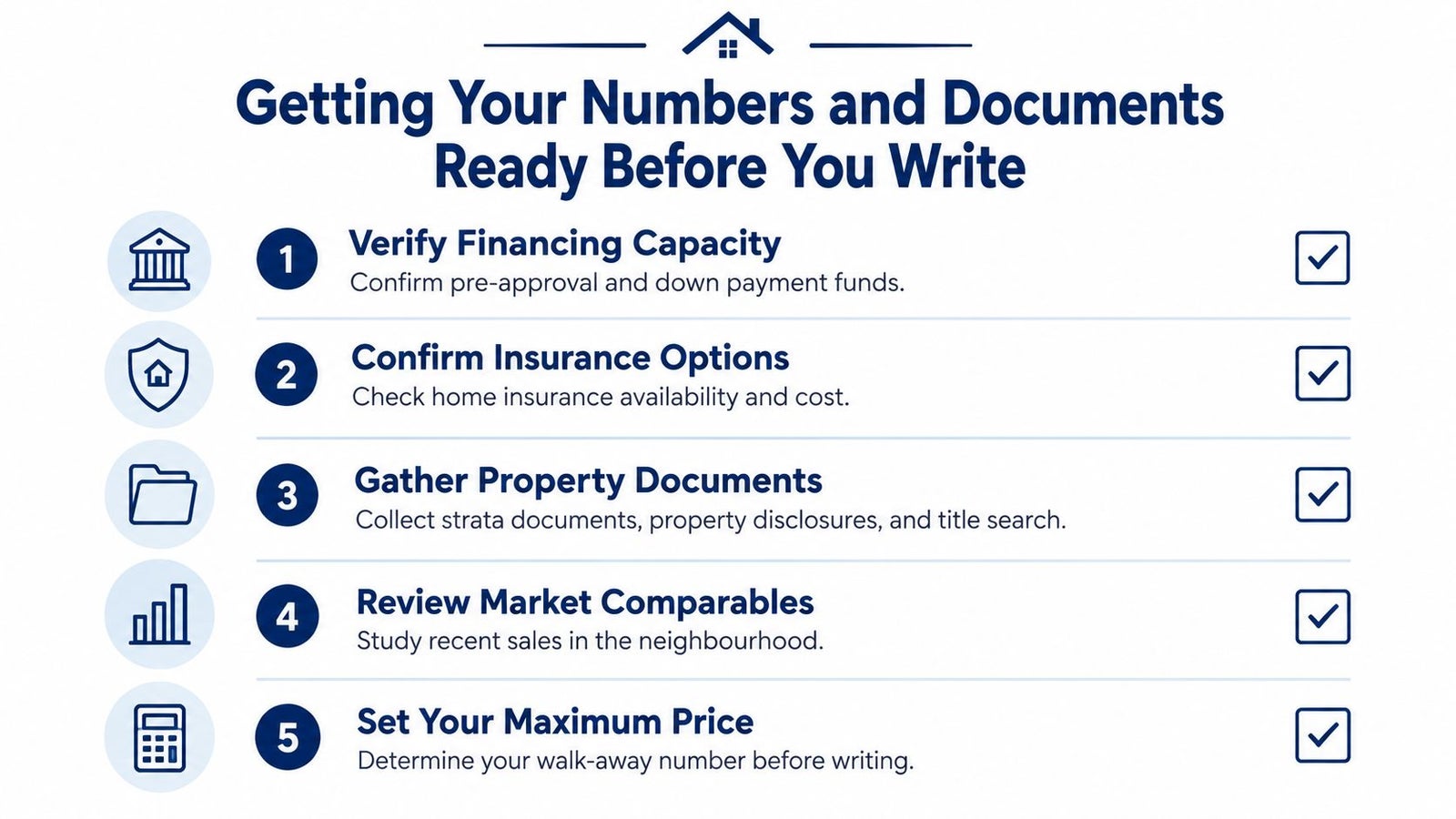
Start with financing. Confirm your lender's requirements, the funds available for your down payment and closing costs, and whether your intended purchase price fits your capacity. Pre-approval helps, but it isn't the same as final approval on a specific property.
Next, check whether insurance is available and workable for the home you're considering. For a condo, ask about the building's insurance information and whether your lender has any related requirements. For a property with possible flood exposure, confirm insurance options before you commit. Don't assume a policy will be available on acceptable terms just because the property is for sale.
Then gather the documents you can review before writing. Condo buyers should request available strata records and examine the minutes, depreciation report, engineering studies, bylaws, insurance information, and any known special-assessment concerns. Arrange an inspection where appropriate, and check the title and property disclosures with the right professional advice.
Before responding to an offer, review recent comparable sales and decide what matters beyond price. A specific completion date may be essential; inclusions, possession timing, or a possible rent-back arrangement may carry real value too. Set your acceptable terms before the pressure of a counteroffer begins.
A buyer who has already checked financing, insurance, and available documents can write a more precise offer. A seller who knows their priorities can counter without changing every term at once. Both sides avoid the most expensive negotiation mistake: making commitments before they understand what they're agreeing to.
A real estate offer has several moving parts, and each one affects the deal differently. Price is obvious, but the deposit, deposit timing, completion date, inclusions, and conditions can change how attractive and reliable an offer feels. A useful starting point is to establish a comparable-sales range, then rank each term by its economic value and the risk it creates.
For a grounded price range, use comparable properties and adjust for differences such as condition, layout, parking, exposure, and location within the neighbourhood. A comparative market analysis guide can help you understand why the closest relevant sales matter more than a broad neighbourhood average.
Eligible residential purchases in British Columbia are subject to a three-business-day Home Buyer Rescission Period after acceptance, with exemptions that depend on the transaction and property type. A buyer can rescind without the seller's consent, but must pay 0.25% of the purchase price. That equals $2,250 on a $900,000 Vancouver home or $3,000 on a $1,200,000 property, as set out in the provincial regulation. The rule gives buyers additional time to arrange financing, review the transaction, and organize inspections, but rescission isn't a cost-free substitute for careful negotiation.
Before submitting, compare two complete versions of your offer. Change the price, deposit timing, completion date, or condition window deliberately, then decide which package best balances your protection with the seller's priorities.
A counteroffer should make the next decision easier, not create a new argument about every term. Pick the terms that matter most, state them clearly, and document the response deadline. Keep the tone businesslike, even when the opening offer feels far from your expectations.

A buyer might write: “We can improve the price to reflect the seller's position, provided the completion date remains workable and the financing condition ends on the stated date.” A seller responding to a low offer could say: “Thank you for the offer. We're prepared to counter on price while keeping your proposed completion date and subject structure.” Both messages identify a path forward without surrendering every term.
Include a clear expiry date and time in the written offer or counteroffer. Don't imply that a deadline will create urgency if the seller has already said they need time or the listing has been quiet. Attach financing qualification or proof of funds when it's appropriate and available. That evidence doesn't guarantee completion, but it gives the seller useful context.
An escalation clause can be considered when there's credible competition, but it shouldn't become permission to bid without a ceiling. Decide your maximum in advance, define the terms that would trigger an increase, and ask your REALTOR® or lawyer to confirm the wording fits the transaction. The BC buyer's guide to escalation clauses can help you think through the trade-offs before using one.
If you're selling, counter on the issue that matters most instead of changing price, dates, and conditions all at once. A measured reply keeps a qualified buyer engaged. For both sides, document every counteroffer and its expiry time in writing.
Set the response deadline to suit the actual situation. Consider the listing's time on market and the seller's stated urgency, then allow enough time for the other party to review the terms properly. A deadline that feels artificial can make a reasonable offer look like a pressure tactic.
“Subject-free” isn't a magic phrase that makes an offer strong. A buyer who removes every condition before checking financing or reviewing a condo's records may take on risks that a seller's marginally higher price doesn't justify. The stronger approach is to make conditions specific, achievable, and proportionate to the property.
BCFSA's offer guidance for sellers says a subject clause makes the contract legally binding once signed and requires the buyer to use every reasonable effort to satisfy the condition. In BCFSA's 2025 brokerage sample, 88% of accepted offers had at least one condition; home inspection appeared in approximately 85%, financing in 81%, and insurance in 71% of reported transactions. Those figures don't mean every offer needs identical conditions. They do show why removing all of them shouldn't be treated as the default route to acceptance.
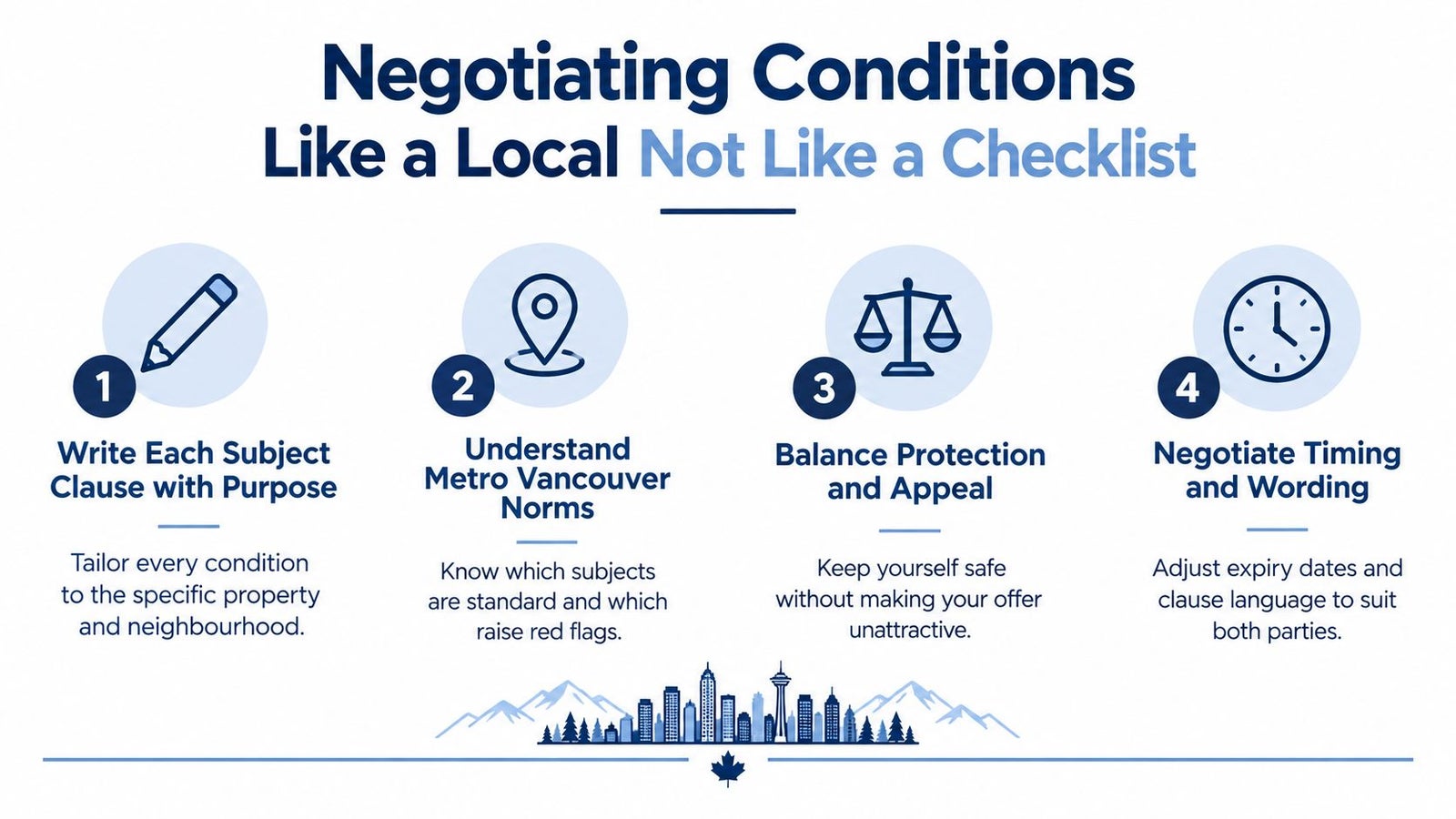
For each condition, state who is responsible, what must be reviewed or confirmed, the deadline, and how written notice will be given. A financing condition should reflect the lender's actual process. An inspection condition should give enough time to arrange the inspection and assess findings. Avoid vague language that leaves both parties uncertain about what counts as satisfying the term.
For condos, diligence may include strata minutes, depreciation reports, engineering studies, bylaws, the insurance certificate, and possible special assessments. A general home inspection doesn't replace that review. Buyers can use a home inspection guide to understand what an inspection can and cannot address, then organize separate document review as needed.
Sellers can reasonably ask for tighter deadlines or evidence that the buyer has spoken with a lender, especially when a broad condition creates uncertainty. But shortening a review period only works if the buyer can realistically complete the required checks within it.
Before accepting a condition, sellers should ask: Is it precise? Is the deadline clear? Can the buyer reasonably meet it? Does the clause explain how written notice will be delivered? If the answer is unclear, ask for tighter wording rather than assuming the only choices are to accept a vague clause or demand a subject-free offer.
Negotiation power depends on the property segment and the evidence around that listing, not only on whether the home is in Greater Vancouver. Greater Vancouver REALTORS® reported 2,110 sales in April 2026, 22.9% below the 10-year seasonal average, alongside 6,684 new listings and a composite benchmark price of $1,098,000. The detached-home benchmark was $1,840,700, according to the April 2026 market statistics package.
Those regional figures are useful context, not a pricing instruction for an individual home. Start with three to five comparable recent sales, then account for property type, strata condition, renovation level, exposure, parking, and micro-location. Compare the subject property with current competing listings too. A Vancouver guide to absorption rate offers another way to think about the relationship between available listings and sales activity.
For buyers, stale pricing is a reason to prepare an evidence-led counter, not to send an unsupported low offer. Identify the comparable sales behind your proposed range, explain the property differences, and present financing information, a deposit proposal, and a realistic response deadline. That gives the seller something substantive to consider while keeping the discussion constructive.
For sellers, a low offer doesn't automatically deserve acceptance or rejection. If the price is weak but the buyer has a credible financing plan and flexible dates, consider whether improving certainty is more valuable than holding out for a higher number. If the offer is poorly supported and the home is drawing qualified interest, a firm counter on price may make more sense. In either case, compare expected net proceeds and completion risk, not just the headline figure.
If you're preparing to buy or sell, book a strategy session with Jacky Levi to model a risk-adjusted offer or counter for the specific property, including price, conditions, deposit timing, and dates. Jacky Levi, Vancouver Realtor provides buyer and seller representation, comparative market analysis, and offer negotiation across Greater Vancouver, from condos and townhomes to detached homes.
The Offer That Almost Fell Apart in Kitsilano
A buyer once lost a Kitsilano condo after offering above the asking price. They'd focused on the headline number, but left important details unresolved: financing still needed confirmation, the deposit timing was vague, and the proposed completion date didn't suit the seller. The other buyer came in lower but presented a clearer financing picture, a workable schedule, and conditions suited to the property.
That kind of result can feel counterintuitive if you assume the highest price always wins. In practice, sellers compare what they might receive with the risk of the deal faltering, the time involved, and whether the terms fit their plans. A price that looks stronger on paper may be less appealing if the buyer's financing is uncertain or the conditions leave key questions open.
After more than two decades at Greater Vancouver offer tables, the pattern is familiar: buyers often spend too much energy deciding what number will win and too little on whether the whole offer will work. In a market where sales can run below seasonal norms, a well-supported offer can matter more than a dramatic bid. But there's no universal winning formula. A desirable, correctly priced home can still draw firm competition, while another listing may leave room to negotiate on dates or conditions.
The practical lesson is to build an offer as a package. Before you sign, know your price limit, understand what the seller values, and identify which conditions protect you from risks you can't assess yet. Sellers should make the same calculation in reverse: don't judge an offer by price alone when financing, timing, deposit terms, and the buyer's diligence plan could affect the likelihood of completion.
Getting Your Numbers and Documents Ready Before You Write
Preparation starts before the offer is drafted. In British Columbia, a signed offer is generally binding, and a buyer with subject conditions must use every reasonable effort to satisfy them. That makes it risky to write first and investigate later, especially when financing, insurability, or building documents could change your decision.
Buyers should resolve the biggest uncertainties first
Start with financing. Confirm your lender's requirements, the funds available for your down payment and closing costs, and whether your intended purchase price fits your capacity. Pre-approval helps, but it isn't the same as final approval on a specific property.
Next, check whether insurance is available and workable for the home you're considering. For a condo, ask about the building's insurance information and whether your lender has any related requirements. For a property with possible flood exposure, confirm insurance options before you commit. Don't assume a policy will be available on acceptable terms just because the property is for sale.
Then gather the documents you can review before writing. Condo buyers should request available strata records and examine the minutes, depreciation report, engineering studies, bylaws, insurance information, and any known special-assessment concerns. Arrange an inspection where appropriate, and check the title and property disclosures with the right professional advice.
Sellers need their own decision framework
Before responding to an offer, review recent comparable sales and decide what matters beyond price. A specific completion date may be essential; inclusions, possession timing, or a possible rent-back arrangement may carry real value too. Set your acceptable terms before the pressure of a counteroffer begins.
A buyer who has already checked financing, insurance, and available documents can write a more precise offer. A seller who knows their priorities can counter without changing every term at once. Both sides avoid the most expensive negotiation mistake: making commitments before they understand what they're agreeing to.
Pricing the Whole Package, Not Just the Price
A real estate offer has several moving parts, and each one affects the deal differently. Price is obvious, but the deposit, deposit timing, completion date, inclusions, and conditions can change how attractive and reliable an offer feels. A useful starting point is to establish a comparable-sales range, then rank each term by its economic value and the risk it creates.
For a grounded price range, use comparable properties and adjust for differences such as condition, layout, parking, exposure, and location within the neighbourhood. A comparative market analysis guide can help you understand why the closest relevant sales matter more than a broad neighbourhood average.
Account for the rescission right
Eligible residential purchases in British Columbia are subject to a three-business-day Home Buyer Rescission Period after acceptance, with exemptions that depend on the transaction and property type. A buyer can rescind without the seller's consent, but must pay 0.25% of the purchase price. That equals $2,250 on a $900,000 Vancouver home or $3,000 on a $1,200,000 property, as set out in the provincial regulation. The rule gives buyers additional time to arrange financing, review the transaction, and organize inspections, but rescission isn't a cost-free substitute for careful negotiation.
Before submitting, compare two complete versions of your offer. Change the price, deposit timing, completion date, or condition window deliberately, then decide which package best balances your protection with the seller's priorities.
Counteroffers, Escalation Clauses, and What to Actually Say
A counteroffer should make the next decision easier, not create a new argument about every term. Pick the terms that matter most, state them clearly, and document the response deadline. Keep the tone businesslike, even when the opening offer feels far from your expectations.
A buyer might write: “We can improve the price to reflect the seller's position, provided the completion date remains workable and the financing condition ends on the stated date.” A seller responding to a low offer could say: “Thank you for the offer. We're prepared to counter on price while keeping your proposed completion date and subject structure.” Both messages identify a path forward without surrendering every term.
Include a clear expiry date and time in the written offer or counteroffer. Don't imply that a deadline will create urgency if the seller has already said they need time or the listing has been quiet. Attach financing qualification or proof of funds when it's appropriate and available. That evidence doesn't guarantee completion, but it gives the seller useful context.
Escalation clauses need limits
An escalation clause can be considered when there's credible competition, but it shouldn't become permission to bid without a ceiling. Decide your maximum in advance, define the terms that would trigger an increase, and ask your REALTOR® or lawyer to confirm the wording fits the transaction. The BC buyer's guide to escalation clauses can help you think through the trade-offs before using one.
If you're selling, counter on the issue that matters most instead of changing price, dates, and conditions all at once. A measured reply keeps a qualified buyer engaged. For both sides, document every counteroffer and its expiry time in writing.
Set the response deadline to suit the actual situation. Consider the listing's time on market and the seller's stated urgency, then allow enough time for the other party to review the terms properly. A deadline that feels artificial can make a reasonable offer look like a pressure tactic.
Negotiating Conditions Like a Local, Not Like a Checklist
“Subject-free” isn't a magic phrase that makes an offer strong. A buyer who removes every condition before checking financing or reviewing a condo's records may take on risks that a seller's marginally higher price doesn't justify. The stronger approach is to make conditions specific, achievable, and proportionate to the property.
BCFSA's offer guidance for sellers says a subject clause makes the contract legally binding once signed and requires the buyer to use every reasonable effort to satisfy the condition. In BCFSA's 2025 brokerage sample, 88% of accepted offers had at least one condition; home inspection appeared in approximately 85%, financing in 81%, and insurance in 71% of reported transactions. Those figures don't mean every offer needs identical conditions. They do show why removing all of them shouldn't be treated as the default route to acceptance.
Write conditions that answer practical questions
For each condition, state who is responsible, what must be reviewed or confirmed, the deadline, and how written notice will be given. A financing condition should reflect the lender's actual process. An inspection condition should give enough time to arrange the inspection and assess findings. Avoid vague language that leaves both parties uncertain about what counts as satisfying the term.
For condos, diligence may include strata minutes, depreciation reports, engineering studies, bylaws, the insurance certificate, and possible special assessments. A general home inspection doesn't replace that review. Buyers can use a home inspection guide to understand what an inspection can and cannot address, then organize separate document review as needed.
Sellers can reasonably ask for tighter deadlines or evidence that the buyer has spoken with a lender, especially when a broad condition creates uncertainty. But shortening a review period only works if the buyer can realistically complete the required checks within it.
A workable condition protects the buyer without leaving the seller guessing about the deadline, the task, or what happens next.
Before accepting a condition, sellers should ask: Is it precise? Is the deadline clear? Can the buyer reasonably meet it? Does the clause explain how written notice will be delivered? If the answer is unclear, ask for tighter wording rather than assuming the only choices are to accept a vague clause or demand a subject-free offer.
Reading Vancouver Market Conditions Before You Counter
Negotiation power depends on the property segment and the evidence around that listing, not only on whether the home is in Greater Vancouver. Greater Vancouver REALTORS® reported 2,110 sales in April 2026, 22.9% below the 10-year seasonal average, alongside 6,684 new listings and a composite benchmark price of $1,098,000. The detached-home benchmark was $1,840,700, according to the April 2026 market statistics package.
Those regional figures are useful context, not a pricing instruction for an individual home. Start with three to five comparable recent sales, then account for property type, strata condition, renovation level, exposure, parking, and micro-location. Compare the subject property with current competing listings too. A Vancouver guide to absorption rate offers another way to think about the relationship between available listings and sales activity.
Choose the move that fits the listing
For buyers, stale pricing is a reason to prepare an evidence-led counter, not to send an unsupported low offer. Identify the comparable sales behind your proposed range, explain the property differences, and present financing information, a deposit proposal, and a realistic response deadline. That gives the seller something substantive to consider while keeping the discussion constructive.
For sellers, a low offer doesn't automatically deserve acceptance or rejection. If the price is weak but the buyer has a credible financing plan and flexible dates, consider whether improving certainty is more valuable than holding out for a higher number. If the offer is poorly supported and the home is drawing qualified interest, a firm counter on price may make more sense. In either case, compare expected net proceeds and completion risk, not just the headline figure.
If you're preparing to buy or sell, book a strategy session with Jacky Levi to model a risk-adjusted offer or counter for the specific property, including price, conditions, deposit timing, and dates. Jacky Levi, Vancouver Realtor provides buyer and seller representation, comparative market analysis, and offer negotiation across Greater Vancouver, from condos and townhomes to detached homes.