
You're preparing to list your Kitsilano condo, and every recent MLS® listing seems to suggest a different price. One neighbour's home sold quickly, another has been sitting on the market, and the asking prices you see online don't tell you what buyers paid. Choosing a number by instinct could leave you overpriced, negotiating from a weak position, or accepting less than the market supports.
A comparative market analysis, usually called a CMA, replaces guesswork with a structured review of similar properties. It helps sellers set a realistic asking range and gives buyers evidence for evaluating an offer. In Greater Vancouver, where neighbourhood conditions can vary sharply, the quality of the comparisons matters as much as the final recommendation.
A buyer comparing a Yaletown condo with nearby listings may see several asking prices but no clear indication of what purchasers accepted. A comparative market analysis, or CMA, turns that uncertainty into a reasoned pricing range by comparing the subject property with recent sales, current listings, and expired listings. BC-focused CMA guidance describes a CMA as a licensed real estate professional's opinion, rather than an appraisal.
The comparison works like a doctor's initial diagnosis. A doctor reviews observable symptoms and medical history before recommending a course of action. A CMA reviews a property's condition, location, features, and market evidence before supporting a pricing or negotiation decision. A formal appraisal resembles a specialist examination, completed by a qualified appraiser for a defined purpose through a formal valuation process.

Sold listings show what buyers accepted in completed transactions. Active listings show the competition a seller faces now. Expired listings may indicate that pricing, presentation, timing, or market conditions did not attract a buyer.
An asking price remains a seller's target, not proof of market value. A sound CMA therefore gives more weight to completed MLS® transactions and uses unsold inventory to assess positioning. This distinction prevents a high active listing from being treated as evidence that buyers will pay the same amount.
Greater Vancouver contains distinct neighbourhood and property markets. A condo near a SkyTrain station, a detached home in a particular school catchment, and a waterfront property may attract different buyers even when their addresses are relatively close. Recent local comparisons help account for those differences more accurately than broad provincial or national averages.
Adjustments also require care. Floor area, renovations, parking, storage, exposure, floor level, building age, strata upkeep, and the timing of each sale can affect comparability. A CMA guides pricing and negotiation. It does not replace an appraisal when a lender or another formal decision-maker requires one.
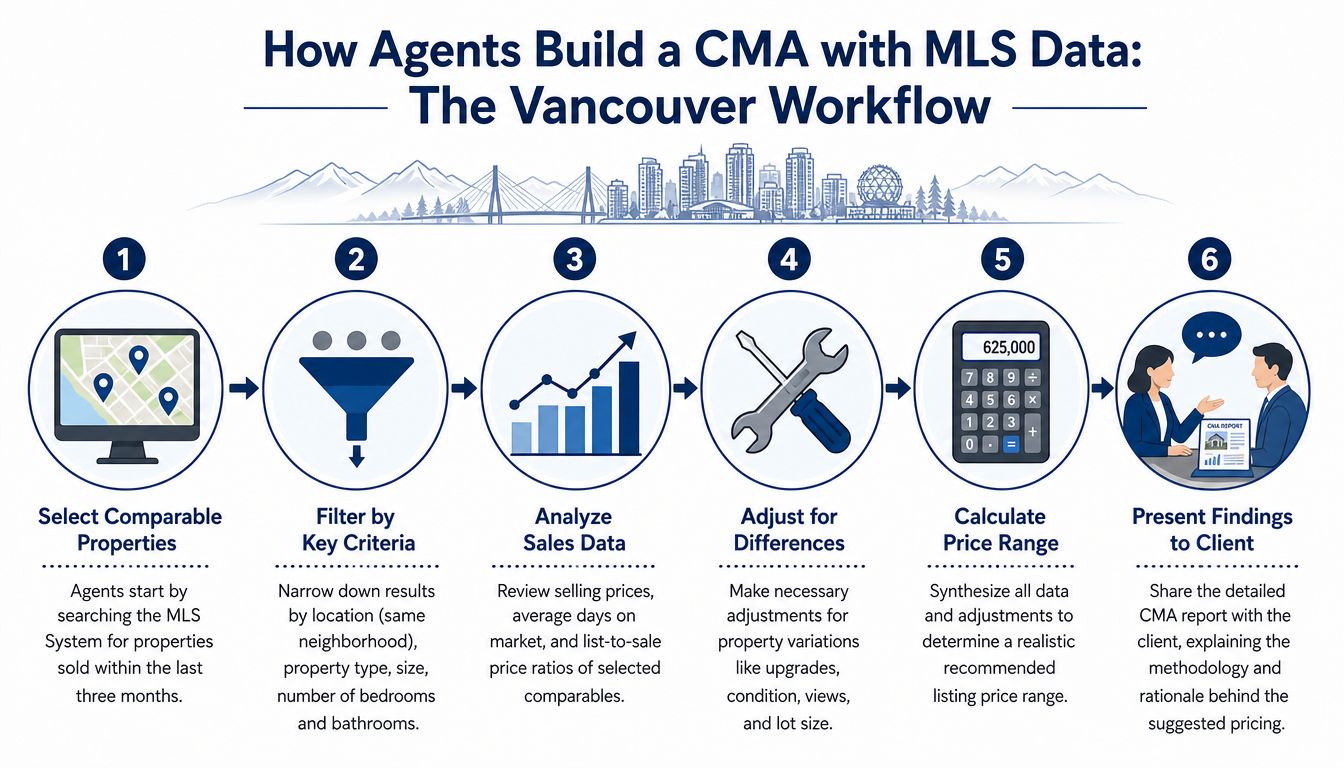
A strong CMA follows a sequence. The agent starts with the subject property, then narrows the comparison set until the remaining homes resemble the property closely enough to support useful adjustments.
The analysis begins with facts that influence buyer decisions:
An agent then searches the MLS® System for sold properties with a similar profile. Recent sales usually deserve priority because they reflect completed negotiations rather than intentions.
The best comparable isn't necessarily the closest address. It's the property that most closely matches the subject home in location, type, size, condition, and buyer appeal. A Mount Pleasant condo with a quiet outlook, well-managed strata, and extensive updates may need different comparisons from a similar-sized unit facing a busy road in an older building.
Thin samples create another risk. In a low-liquidity pocket, a few sales may not represent the whole market. An agent should identify whether a comparable was unusually renovated, unusually compromised, stale before selling, or exposed during a different supply environment.
Adjustments aren't arbitrary bonuses added to reach a preferred price. They should explain how differences between the subject and each comparable affect buyer willingness to pay. Common adjustment areas include:
A seller in Greater Vancouver can list a well-presented home, receive little serious interest, and later wonder whether the market is weak. Often, the issue is positioning. Price determines who engages with a listing and how much negotiating strength the seller maintains. A price above the evidence may cause buyers and their agents to dismiss the property. A price below the evidence may give away negotiating room. A sound CMA places the home where recent market evidence and likely buyer response meet.
The BC Property Assessment Appeal Board recommends choosing sales comparables that sold as close to July 1 as possible and that resemble the subject property closely. The principle is useful in Vancouver's changing neighbourhoods, where a similar address may still differ meaningfully in view, exposure, building quality, or renovation level. The comparable-sales explanation for Vancouver readers provides further context for evaluating comparable sales.
A CMA also helps prevent seasonal or emotional pricing. A seller should not treat the strongest recent sale as an automatic target, especially if that property had a better outlook, a superior layout, or less competition when it launched. A buyer should not treat an active listing's asking price as proof of market value. Asking prices show current competition. Completed sales show what buyers accepted.
The CMA should answer practical questions:
Pricing works like choosing a place on a shelf. Too high, and buyers may pass before examining the product. Too low, and interest may come at the cost of negotiating strength. The right position depends on the home's evidence, competition, condition, and timing.
A seller considering a high test price should understand the likely trade-off before listing. A buyer can apply the same reasoning to judge whether a property appears fairly priced, deliberately positioned to attract attention, or overpriced relative to comparable evidence. For a practical discussion of how to price a home in Vancouver, review how local pricing decisions connect comparable sales with current competition.
Consider a simplified CMA for a Mount Pleasant condo. The subject property has a similar general profile to three recently sold units, but each comparable differs in condition, outlook, parking, or layout. The agent doesn't copy the sale prices into a recommendation. Instead, the agent adjusts each result to reflect how the comparable would likely perform if it resembled the subject property.
A client reviewing a report should ask why each comparable was included, how the agent determined each adjustment, and whether any active or expired listings change the recommended positioning. The report should make the reasoning visible rather than presenting an unexplained price.
BCREA's regional reporting summarises MLS® average prices, unit sales, and months of existing inventory, making MLS-based comparisons the core data source for BC pricing work, as described in BCREA's markets-at-a-glance data. Sellers can also inspect sold Vancouver properties as part of their broader research, while remembering that public-facing examples don't replace a property-specific CMA.
Sellers and buyers should use a CMA as a decision tool, not as a magic number. The same evidence can lead to different actions depending on whether you're preparing a listing, writing an offer, evaluating an investment, or assessing a luxury property with few direct comparables.

Start by checking the evidence rather than defending a preferred price.
A comparative market analysis, usually called a CMA, replaces guesswork with a structured review of similar properties. It helps sellers set a realistic asking range and gives buyers evidence for evaluating an offer. In Greater Vancouver, where neighbourhood conditions can vary sharply, the quality of the comparisons matters as much as the final recommendation.
Understanding the Key Concept
A buyer comparing a Yaletown condo with nearby listings may see several asking prices but no clear indication of what purchasers accepted. A comparative market analysis, or CMA, turns that uncertainty into a reasoned pricing range by comparing the subject property with recent sales, current listings, and expired listings. BC-focused CMA guidance describes a CMA as a licensed real estate professional's opinion, rather than an appraisal.
The comparison works like a doctor's initial diagnosis. A doctor reviews observable symptoms and medical history before recommending a course of action. A CMA reviews a property's condition, location, features, and market evidence before supporting a pricing or negotiation decision. A formal appraisal resembles a specialist examination, completed by a qualified appraiser for a defined purpose through a formal valuation process.
The three types of market evidence
Sold listings show what buyers accepted in completed transactions. Active listings show the competition a seller faces now. Expired listings may indicate that pricing, presentation, timing, or market conditions did not attract a buyer.
An asking price remains a seller's target, not proof of market value. A sound CMA therefore gives more weight to completed MLS® transactions and uses unsold inventory to assess positioning. This distinction prevents a high active listing from being treated as evidence that buyers will pay the same amount.
Why Vancouver conditions require local context
Greater Vancouver contains distinct neighbourhood and property markets. A condo near a SkyTrain station, a detached home in a particular school catchment, and a waterfront property may attract different buyers even when their addresses are relatively close. Recent local comparisons help account for those differences more accurately than broad provincial or national averages.
Adjustments also require care. Floor area, renovations, parking, storage, exposure, floor level, building age, strata upkeep, and the timing of each sale can affect comparability. A CMA guides pricing and negotiation. It does not replace an appraisal when a lender or another formal decision-maker requires one.
How Agents Build a CMA with MLS Data
A strong CMA follows a sequence. The agent starts with the subject property, then narrows the comparison set until the remaining homes resemble the property closely enough to support useful adjustments.
Step one: define the subject property
The analysis begins with facts that influence buyer decisions:
- Property type: A condo shouldn't be compared casually with a townhome or detached house.
- Location: A home near a major boundary, school catchment, transit route, or waterfront may compete in a different micro-market from a nearby property.
- Physical characteristics: Floor area, bedrooms, bathrooms, parking, storage, outdoor space, floor level, exposure, and building age all matter.
- Condition: Renovations, deferred maintenance, staging quality, and strata upkeep can materially affect appeal.
Step two: vet the comparables
The best comparable isn't necessarily the closest address. It's the property that most closely matches the subject home in location, type, size, condition, and buyer appeal. A Mount Pleasant condo with a quiet outlook, well-managed strata, and extensive updates may need different comparisons from a similar-sized unit facing a busy road in an older building.
Thin samples create another risk. In a low-liquidity pocket, a few sales may not represent the whole market. An agent should identify whether a comparable was unusually renovated, unusually compromised, stale before selling, or exposed during a different supply environment.
Step three: make reasoned adjustments
Adjustments aren't arbitrary bonuses added to reach a preferred price. They should explain how differences between the subject and each comparable affect buyer willingness to pay. Common adjustment areas include:
- View and exposure, especially where outlook, privacy, or natural light differs.
- Renovation level, including kitchens, bathrooms, flooring, windows, and mechanical systems.
- Parking and storage, which can influence condo usefulness and resale appeal.
- Lot size and layout, particularly for detached homes and townhomes.
- Strata quality, monthly costs, building maintenance, contingency planning, and special assessments.
The adjusted comparables then form a range. An agent interprets that range alongside active competition, inventory, and market momentum before recommending a list price.
BC REALTORS® define active listings, new listings, home sales, and average sale price directly from MLS® transactions, which is why BCREA's housing monitor dashboard supports using sold MLS® data rather than relying mainly on asking prices. If you're choosing representation, you can also review how to choose a Vancouver Realtor and ask how the agent selects, verifies, and adjusts comparables.
BC REALTORS® define active listings, new listings, home sales, and average sale price directly from MLS® transactions, which is why BCREA's housing monitor dashboard supports using sold MLS® data rather than relying mainly on asking prices. If you're choosing representation, you can also review how to choose a Vancouver Realtor and ask how the agent selects, verifies, and adjusts comparables.
Why CMA Matters for Pricing Strategy
A seller in Greater Vancouver can list a well-presented home, receive little serious interest, and later wonder whether the market is weak. Often, the issue is positioning. Price determines who engages with a listing and how much negotiating strength the seller maintains. A price above the evidence may cause buyers and their agents to dismiss the property. A price below the evidence may give away negotiating room. A sound CMA places the home where recent market evidence and likely buyer response meet.
The BC Property Assessment Appeal Board recommends choosing sales comparables that sold as close to July 1 as possible and that resemble the subject property closely. The principle is useful in Vancouver's changing neighbourhoods, where a similar address may still differ meaningfully in view, exposure, building quality, or renovation level. The comparable-sales explanation for Vancouver readers provides further context for evaluating comparable sales.
A CMA also helps prevent seasonal or emotional pricing. A seller should not treat the strongest recent sale as an automatic target, especially if that property had a better outlook, a superior layout, or less competition when it launched. A buyer should not treat an active listing's asking price as proof of market value. Asking prices show current competition. Completed sales show what buyers accepted.
Pricing is a positioning decision
The CMA should answer practical questions:
- Does the recommended price fit the range supported by recent sales?
- How does the home compare with active listings nearby?
- Are adjustments documented and tied to features buyers can evaluate?
- Would the price remain reasonable if buyers had several alternatives?
- Does the strategy reflect the property's likely marketing period?
Pricing works like choosing a place on a shelf. Too high, and buyers may pass before examining the product. Too low, and interest may come at the cost of negotiating strength. The right position depends on the home's evidence, competition, condition, and timing.
A seller considering a high test price should understand the likely trade-off before listing. A buyer can apply the same reasoning to judge whether a property appears fairly priced, deliberately positioned to attract attention, or overpriced relative to comparable evidence. For a practical discussion of how to price a home in Vancouver, review how local pricing decisions connect comparable sales with current competition.
Sample CMA Outputs in Practice
Consider a simplified CMA for a Mount Pleasant condo. The subject property has a similar general profile to three recently sold units, but each comparable differs in condition, outlook, parking, or layout. The agent doesn't copy the sale prices into a recommendation. Instead, the agent adjusts each result to reflect how the comparable would likely perform if it resembled the subject property.
What the client should ask
A client reviewing a report should ask why each comparable was included, how the agent determined each adjustment, and whether any active or expired listings change the recommended positioning. The report should make the reasoning visible rather than presenting an unexplained price.
BCREA's regional reporting summarises MLS® average prices, unit sales, and months of existing inventory, making MLS-based comparisons the core data source for BC pricing work, as described in BCREA's markets-at-a-glance data. Sellers can also inspect sold Vancouver properties as part of their broader research, while remembering that public-facing examples don't replace a property-specific CMA.
Practical Tips for Sellers and Buyers in Greater Vancouver
Sellers and buyers should use a CMA as a decision tool, not as a magic number. The same evidence can lead to different actions depending on whether you're preparing a listing, writing an offer, evaluating an investment, or assessing a luxury property with few direct comparables.
For sellers
Start by checking the evidence rather than defending a preferred price.
- Verify sale dates: A comparable that looked relevant months ago may no longer reflect the current neighbourhood context.
- Separate property types: Compare a condo with appropriate condos, a townhome with similar townhomes, and detached homes with properly comparable detached properties.
- Document improvements: Gather renovation records, strata documents, appliance details, and information about parking or storage before the analysis.
- Treat presentation as part of positioning: Staging, photography, cleanliness, and repairs can affect how buyers interpret the same underlying floor plan.
- Use a band, not a fantasy number: A realistic range helps you decide whether to list for broad exposure, target a specific buyer segment, or wait for better preparation.
Greater Vancouver requires extra care with strata comparables. Two units in the same building can differ because of outlook, floor, exposure, maintenance history, special assessments, layout, or renovation quality.
A buyer should request the reasoning behind the recommended value, not just the conclusion. Review each comparable's location, condition, floor plan, parking, storage, and sale circumstances. If an adjustment appears unusually generous, ask what evidence supports it.
Inventory and time on market can also influence negotiation. In the BCFSA's 2025 data call, listings averaged 56 days on market, compared with 40 days in 2024, and 87% of properties sold at or below list price, according to the cited British Columbia market summary. Those figures support using realistic pricing bands rather than assuming every seller has strong pricing power.
A buyer can then match the offer strategy to the evidence. A property with several alternatives may justify firmer negotiation, while a rare home with strong comparable support may require a different approach. These tips for selling a Vancouver home quickly also illustrate why preparation and positioning belong in the pricing conversation.
A CMA estimates a property's likely market position by combining comparable sales, current competition, expired listings, local supply conditions, and carefully explained adjustments. It isn't a formal appraisal, and it shouldn't be reduced to a single optimistic asking price. In Greater Vancouver, reliable analysis depends on MLS® evidence, neighbourhood knowledge, property-specific details, and a realistic view of timing and buyer demand.
If you're selling or buying, request a CMA that shows the comparable properties, adjustment logic, recommended range, and risks. That documentation gives you a stronger basis for pricing, offers, and negotiations.
Jacky Levi, Vancouver Realtor, provides CMA guidance, listing preparation, buyer representation, negotiation, and transaction coordination for condos, townhomes, detached homes, luxury properties, and investments across Greater Vancouver. Visit the site to request a property-specific consultation and discuss a data-informed pricing or offer strategy.
For buyers
Inventory and time on market can also influence negotiation. In the BCFSA's 2025 data call, listings averaged 56 days on market, compared with 40 days in 2024, and 87% of properties sold at or below list price, according to the cited British Columbia market summary. Those figures support using realistic pricing bands rather than assuming every seller has strong pricing power.
A buyer can then match the offer strategy to the evidence. A property with several alternatives may justify firmer negotiation, while a rare home with strong comparable support may require a different approach. These tips for selling a Vancouver home quickly also illustrate why preparation and positioning belong in the pricing conversation.
Conclusion and Next Steps
A CMA estimates a property's likely market position by combining comparable sales, current competition, expired listings, local supply conditions, and carefully explained adjustments. It isn't a formal appraisal, and it shouldn't be reduced to a single optimistic asking price. In Greater Vancouver, reliable analysis depends on MLS® evidence, neighbourhood knowledge, property-specific details, and a realistic view of timing and buyer demand.
If you're selling or buying, request a CMA that shows the comparable properties, adjustment logic, recommended range, and risks. That documentation gives you a stronger basis for pricing, offers, and negotiations.
Jacky Levi, Vancouver Realtor, provides CMA guidance, listing preparation, buyer representation, negotiation, and transaction coordination for condos, townhomes, detached homes, luxury properties, and investments across Greater Vancouver. Visit the site to request a property-specific consultation and discuss a data-informed pricing or offer strategy.