
Staging in Vancouver is a probabilistic, segment-dependent decision, not a guaranteed price premium. The right question is whether the spend is more defensible than the carrying cost of a stale listing in your property's price band.
Does staging create value, or does it make an overpriced home look more attractive for a few weeks? Sellers often ask whether staging adds a certain percentage to the sale price, but that framing misses the practical decision. Your listing may need better photography, clearer room function, less clutter, a more credible price, or repairs that furniture can't hide.
For a Vancouver condo, townhome, or detached home, staging is worth considering when it fixes a visible presentation problem that comparable listings don't have. It isn't worth paying for when price, condition, location, or strata concerns are the actual objection.
The first question I ask a seller isn't, “How much more will staging get me?” I ask, “What problem is staging supposed to solve?”
An empty condo can photograph as cold or undersized. In an occupied townhome, furniture may block circulation. A detached house may include a den, basement, or outdoor area that buyers cannot understand from listing photos. These are presentation problems, and staging can address them.
Price and condition create different obstacles. Furniture cannot correct a listing positioned materially above comparable sales, resolve deferred maintenance, explain an unresolved moisture concern, or remove doubts about strata documents. It improves visual appeal. It does not fix the reason a buyer rejects the property.
Metro Vancouver inventory was 24.3% above its 10-year average in September 2026, sales were 25% below the seasonal norm, and the composite benchmark price was down 5.5% year over year. These figures describe a market with more buyer choice and less room for vague positioning. The reported Greater Vancouver market conditions support strong presentation, while also making accurate pricing more important.
A polished listing competes more effectively for online attention. An incorrectly priced listing can still sit unsold despite excellent photography and rented furniture. In this market, staging should help convert views into showings and qualified offers. It should not disguise a price that comparable evidence cannot support.
Tie each staging dollar to a specific local signal. If comparable listings look brighter, improve lighting and photography. If buyers cannot read the floor plan, clarify room purpose and circulation. If competing homes show better condition, address repairs before renting furniture. If the listing is already clear and competitive, full staging may add little.
Your preparation plan should separate three decisions:
Use Vancouver real estate statistics for February 2026 as market context, then test the decision against comparable properties with similar housing type, neighbourhood, condition, exposure, and price position.
The often-repeated 49% staging figure needs careful handling. It comes from a survey of U.S. real estate agents, not a controlled study of completed Canadian sales. A Canadian staging source explicitly notes that no Canadian study has measured staged homes against comparable unstaged homes for days on market, so the number can't establish a Vancouver-specific price premium or causal effect. The Canadian discussion of the frequently cited staging survey provides important context.
The survey reported that 30% of sellers' agents observed a slight reduction in market time and 19% observed a large reduction, producing the 49% figure. 17% saw no effect, while 13% saw homes take longer to sell. Those results support a practical conclusion: staging may improve the probability of a faster sale, but the outcome varies by property and market.
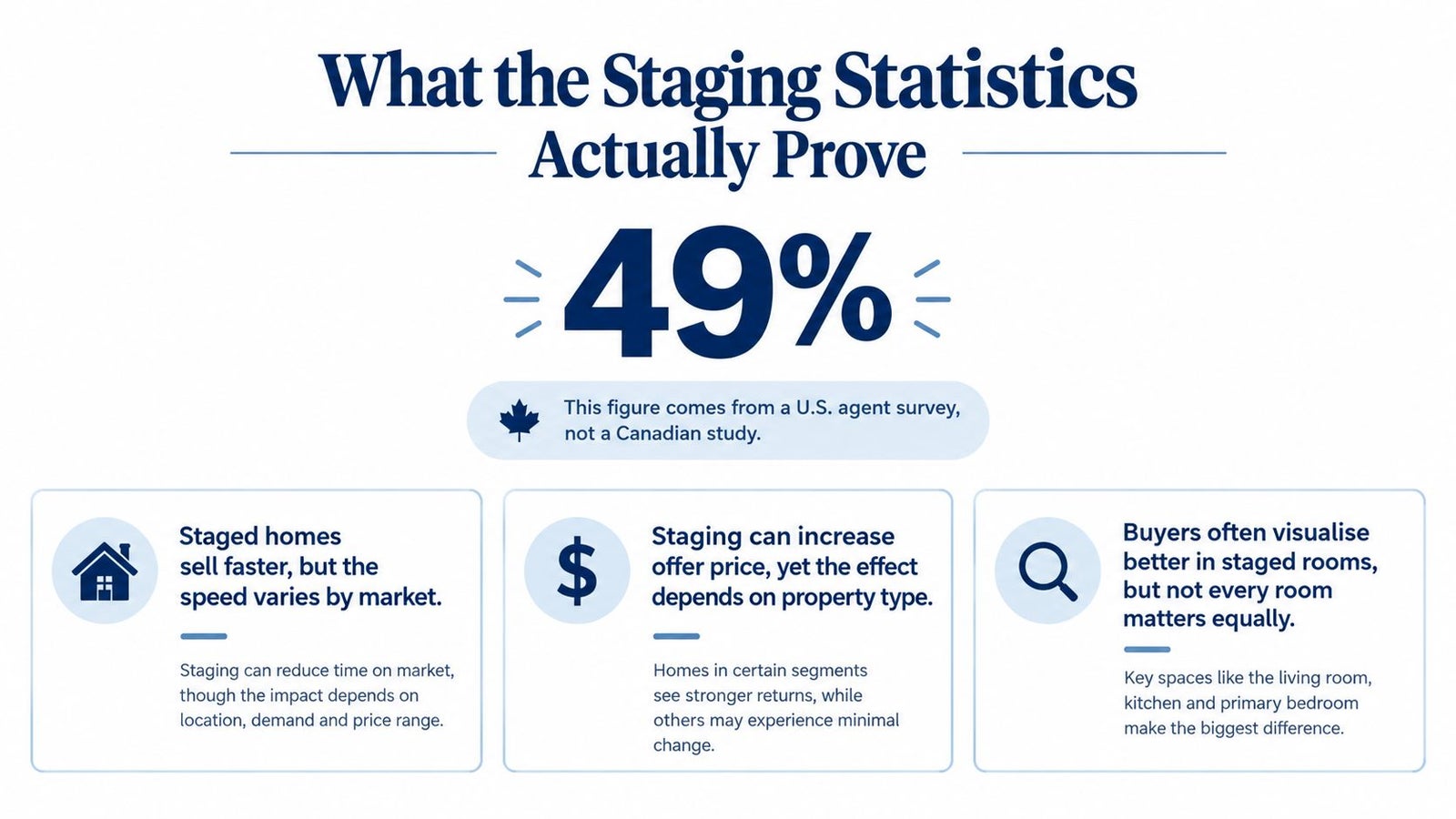
The more useful buyer-focused finding is that 83% of buyers' agents said staging made it easier for buyers to envision a property as their future home. The same survey found that buyers most often prioritized the living room at 37%, the primary bedroom at 34%, and the kitchen at 23%. The Vancouver seller guide reporting those buyer-agent findings connects the research to practical room selection.
Those figures don't prove a fixed premium in Vancouver. They do explain why a well-scaled sofa, a readable dining area, or a calm primary bedroom can matter in a listing viewed first through photographs.
The result still isn't universal. 60% of buyers' agents said staging affects some buyers but not always, 26% said it affects most buyers, and 12% reported no effect. Treat those numbers as directional evidence about buyer visualization, not as a promise attached to your address.
This is also why absorption matters. A seller comparing a staged listing with competing inventory should understand whether buyers are entering the segment quickly or choosing among many available homes. This Vancouver guide to absorption rate offers useful market context, but your staging decision still depends on the specific alternatives buyers will see beside your listing.
Staging should pass a simple financial test before it becomes a recommendation. Industry summaries cite professional staging costs of approximately $1,500 to $5,000 for a vacant home, but those are broad estimates, not a guaranteed local return. This BC staging cost guide also frames a possible 2% improvement on an $800,000 to $1.2 million property as roughly $16,000 to $24,000 in gross proceeds, but that remains a scenario, not a prediction.
Use this formula:
Break-even price lift = staging cost ÷ expected sale price
At an expected sale price of $1,000,000, a $3,000 staging bill requires a 0.30% gross lift to recover its cost. A $5,000 bill requires 0.50%, before tax and transaction effects.
These calculations show why a small presentation improvement can be financially rational even without a dramatic price increase. The return may come from avoiding a reduction, shortening the time before a serious offer, or preventing repeated carrying costs. It may also come from improving buyer confidence enough to protect the asking position.
For an entry-level condo, a full package can be excessive if decluttering, rental pieces in the living room, and professional photography solve the issue. For a vacant detached home, empty rooms may photograph poorly enough that full staging earns consideration. For a luxury property, scale, finish, and room hierarchy matter, but the budget still needs to be compared with competing listings and expected exposure.
Don't confuse gross break-even with guaranteed profit. A staged home can sell for the same amount while producing a better result by avoiding a price reduction or reducing the time your property carries expenses. Before committing, compare the recommendation with your pricing analysis and transaction costs, including the considerations outlined in this BC REALTOR fee calculator guide.
Does staging solve a measurable disadvantage against the listings buyers will compare with yours? In Metro Vancouver's slower market, that is the right test. If competing condos have better-scaled furniture, brighter photography, and clearer layouts, a cluttered or vacant home starts behind before the first showing.

Match the spend to the signal you need to change. A vacant home may require furniture because buyers cannot judge room proportions online. In a compact condo, selected pieces can prove that the living room, dining area, and work zone fit without blocking circulation. In a townhome, staging can connect a lower-level room, flex space, or roof deck to the way buyers expect to use the home.
The strongest staging candidates have a specific presentation problem:
Detached homes often need more attention in the primary bedroom, because buyers compare that room closely against similar homes at the same price point. In a condo, the living room usually does the heaviest lifting, because the floor plan has to make sense almost instantly on a phone screen.
Natural light and views deserve special attention in Vancouver. Keep windows open, avoid blocking sightlines, and let the furniture support the outlook instead of fighting it. Pair selective staging with decluttering, accurate listing remarks, and strong photography. That combination usually solves more than filling every room with rental pieces.
A staged property can look finished while still carrying serious transaction risk. BCFSA states that sellers must disclose known material latent defects, meaning defects that can't be discovered through ordinary inspection, and that the disclosure must be made in writing. Sellers must also disclose known latent defects and must not provide false or misleading information when buyers ask about the property. BCFSA's consumer disclosure guidance sets out those obligations.
That changes the order of operations. Before furniture arrives, identify known issues, gather repair invoices, review relevant strata information, and discuss required written disclosures with your representative. If a hidden leak, recurring water ingress, unsafe condition, or other material defect exists, staging doesn't remove the obligation to address or disclose it.
Staging must clarify a property's function without creating a false impression. A den should not be presented as a legally conforming bedroom if it lacks the required characteristics. A staged condo shouldn't make excluded appliances, fixtures, or furniture appear included in the sale.
Pay attention to what furniture blocks. Buyers need to inspect storage, access panels, windows, mechanical components, and signs of moisture. Attractive artwork and a carefully arranged sofa can't justify concealing a known limitation.
BCFSA's disclosure guidelines for real-estate professionals also emphasize written disclosure and confirmation that it was provided and received. For sellers, the practical lesson is straightforward: document the property, correct the sequence, and keep the marketing accurate.
Documenting means recording included fixtures, excluded staging items, known limitations, repairs, and outstanding questions. Correcting the sequence means investigating and disclosing before investing heavily in cosmetic presentation. Keeping the marketing accurate means photographs, room labels, listing remarks, and showing materials describe what buyers are purchasing.
A dollar spent on disclosure, repair investigation, or documentation may protect the transaction more effectively than a dollar spent on décor. Staging has value only after the property can be marketed openly.
Use this checklist before approving a staging quote:
My recommendation is direct. Stage when presentation is the problem, price accurately when price is the problem, and investigate or repair when condition is the problem. A Vancouver condo, townhome, or detached home doesn't need the same package, and a generic staging percentage can't replace a property-specific comparison.
Jacky Levi - Vancouver Realtor offers seller representation, comparative market analysis, listing preparation, professional media coordination, and staging consultation across Greater Vancouver. Visit Jacky Levi - Vancouver Realtor to arrange a property-specific staging and pricing assessment before you commit to furniture, repairs, or a list price.
Does staging create value, or does it make an overpriced home look more attractive for a few weeks? Sellers often ask whether staging adds a certain percentage to the sale price, but that framing misses the practical decision. Your listing may need better photography, clearer room function, less clutter, a more credible price, or repairs that furniture can't hide.
For a Vancouver condo, townhome, or detached home, staging is worth considering when it fixes a visible presentation problem that comparable listings don't have. It isn't worth paying for when price, condition, location, or strata concerns are the actual objection.
Staging as a Positioning Decision in the Vancouver Market
The first question I ask a seller isn't, “How much more will staging get me?” I ask, “What problem is staging supposed to solve?”
An empty condo can photograph as cold or undersized. In an occupied townhome, furniture may block circulation. A detached house may include a den, basement, or outdoor area that buyers cannot understand from listing photos. These are presentation problems, and staging can address them.
Price and condition create different obstacles. Furniture cannot correct a listing positioned materially above comparable sales, resolve deferred maintenance, explain an unresolved moisture concern, or remove doubts about strata documents. It improves visual appeal. It does not fix the reason a buyer rejects the property.
What local conditions reward
Metro Vancouver inventory was 24.3% above its 10-year average in September 2026, sales were 25% below the seasonal norm, and the composite benchmark price was down 5.5% year over year. These figures describe a market with more buyer choice and less room for vague positioning. The reported Greater Vancouver market conditions support strong presentation, while also making accurate pricing more important.
A polished listing competes more effectively for online attention. An incorrectly priced listing can still sit unsold despite excellent photography and rented furniture. In this market, staging should help convert views into showings and qualified offers. It should not disguise a price that comparable evidence cannot support.
Tie each staging dollar to a specific local signal. If comparable listings look brighter, improve lighting and photography. If buyers cannot read the floor plan, clarify room purpose and circulation. If competing homes show better condition, address repairs before renting furniture. If the listing is already clear and competitive, full staging may add little.
Your preparation plan should separate three decisions:
- Presentation: decluttering, furniture scale, room purpose, lighting, styling, and photography.
- Pricing: comparable sales, active competition, exposure expectations, and negotiation room.
- Disclosure and condition: repairs, known defects, strata documentation, and accurate listing remarks.
Use Vancouver real estate statistics for February 2026 as market context, then test the decision against comparable properties with similar housing type, neighbourhood, condition, exposure, and price position.
Practical rule: Don't approve a staging package until you can name the buyer misunderstanding or presentation weakness it will fix.
What the Staging Statistics Actually Prove
The often-repeated 49% staging figure needs careful handling. It comes from a survey of U.S. real estate agents, not a controlled study of completed Canadian sales. A Canadian staging source explicitly notes that no Canadian study has measured staged homes against comparable unstaged homes for days on market, so the number can't establish a Vancouver-specific price premium or causal effect. The Canadian discussion of the frequently cited staging survey provides important context.
The survey reported that 30% of sellers' agents observed a slight reduction in market time and 19% observed a large reduction, producing the 49% figure. 17% saw no effect, while 13% saw homes take longer to sell. Those results support a practical conclusion: staging may improve the probability of a faster sale, but the outcome varies by property and market.
The strongest evidence concerns visualization
The more useful buyer-focused finding is that 83% of buyers' agents said staging made it easier for buyers to envision a property as their future home. The same survey found that buyers most often prioritized the living room at 37%, the primary bedroom at 34%, and the kitchen at 23%. The Vancouver seller guide reporting those buyer-agent findings connects the research to practical room selection.
Those figures don't prove a fixed premium in Vancouver. They do explain why a well-scaled sofa, a readable dining area, or a calm primary bedroom can matter in a listing viewed first through photographs.
The result still isn't universal. 60% of buyers' agents said staging affects some buyers but not always, 26% said it affects most buyers, and 12% reported no effect. Treat those numbers as directional evidence about buyer visualization, not as a promise attached to your address.
This is also why absorption matters. A seller comparing a staged listing with competing inventory should understand whether buyers are entering the segment quickly or choosing among many available homes. This Vancouver guide to absorption rate offers useful market context, but your staging decision still depends on the specific alternatives buyers will see beside your listing.
The Vancouver Break-Even Calculation
Staging should pass a simple financial test before it becomes a recommendation. Industry summaries cite professional staging costs of approximately $1,500 to $5,000 for a vacant home, but those are broad estimates, not a guaranteed local return. This BC staging cost guide also frames a possible 2% improvement on an $800,000 to $1.2 million property as roughly $16,000 to $24,000 in gross proceeds, but that remains a scenario, not a prediction.
Use this formula:
Break-even price lift = staging cost ÷ expected sale price
At an expected sale price of $1,000,000, a $3,000 staging bill requires a 0.30% gross lift to recover its cost. A $5,000 bill requires 0.50%, before tax and transaction effects.
These calculations show why a small presentation improvement can be financially rational even without a dramatic price increase. The return may come from avoiding a reduction, shortening the time before a serious offer, or preventing repeated carrying costs. It may also come from improving buyer confidence enough to protect the asking position.
Test the spend against the listing problem
For an entry-level condo, a full package can be excessive if decluttering, rental pieces in the living room, and professional photography solve the issue. For a vacant detached home, empty rooms may photograph poorly enough that full staging earns consideration. For a luxury property, scale, finish, and room hierarchy matter, but the budget still needs to be compared with competing listings and expected exposure.
Don't confuse gross break-even with guaranteed profit. A staged home can sell for the same amount while producing a better result by avoiding a price reduction or reducing the time your property carries expenses. Before committing, compare the recommendation with your pricing analysis and transaction costs, including the considerations outlined in this BC REALTOR fee calculator guide.
When Staging Earns Its Keep in a Slower Market
Does staging solve a measurable disadvantage against the listings buyers will compare with yours? In Metro Vancouver's slower market, that is the right test. If competing condos have better-scaled furniture, brighter photography, and clearer layouts, a cluttered or vacant home starts behind before the first showing.
Match the spend to the signal you need to change. A vacant home may require furniture because buyers cannot judge room proportions online. In a compact condo, selected pieces can prove that the living room, dining area, and work zone fit without blocking circulation. In a townhome, staging can connect a lower-level room, flex space, or roof deck to the way buyers expect to use the home.
The strongest staging candidates have a specific presentation problem:
- Weak visual translation: Photos make the home look smaller, darker, or less functional than it feels in person.
- Unclear layout: Buyers cannot identify whether a room is a dining area, office, bedroom, or storage space.
- Stronger competition: Similar active listings look more prepared, so your property appears less competitive online.
- Weak conversion at a defensible price: Comparable evidence supports the price, yet online interest is not producing enough showings or offers.
Staging cannot repair a listing priced materially above comparable sales. It also will not remove objections caused by deferred maintenance, an unattractive location, high strata costs, a building concern, or poor condition. Direct the budget toward investigation, repairs, documentation, or a pricing adjustment when one of those issues drives the resistance.
Before approving the invoice, name the market signal each dollar addresses: stronger first photos, clearer circulation, more confident showings, or less time exposed to competing inventory. If the recommendation has no specific mechanism, keep the money.
Staging should answer the question buyers are already asking when they compare your listing with similar homes. A flat percentage of list price is the wrong test. A compact condo needs restraint. A detached house may need enough furniture to show scale across several rooms. A townhome often needs selective staging where split levels, flex spaces, or tight transitions create doubt.
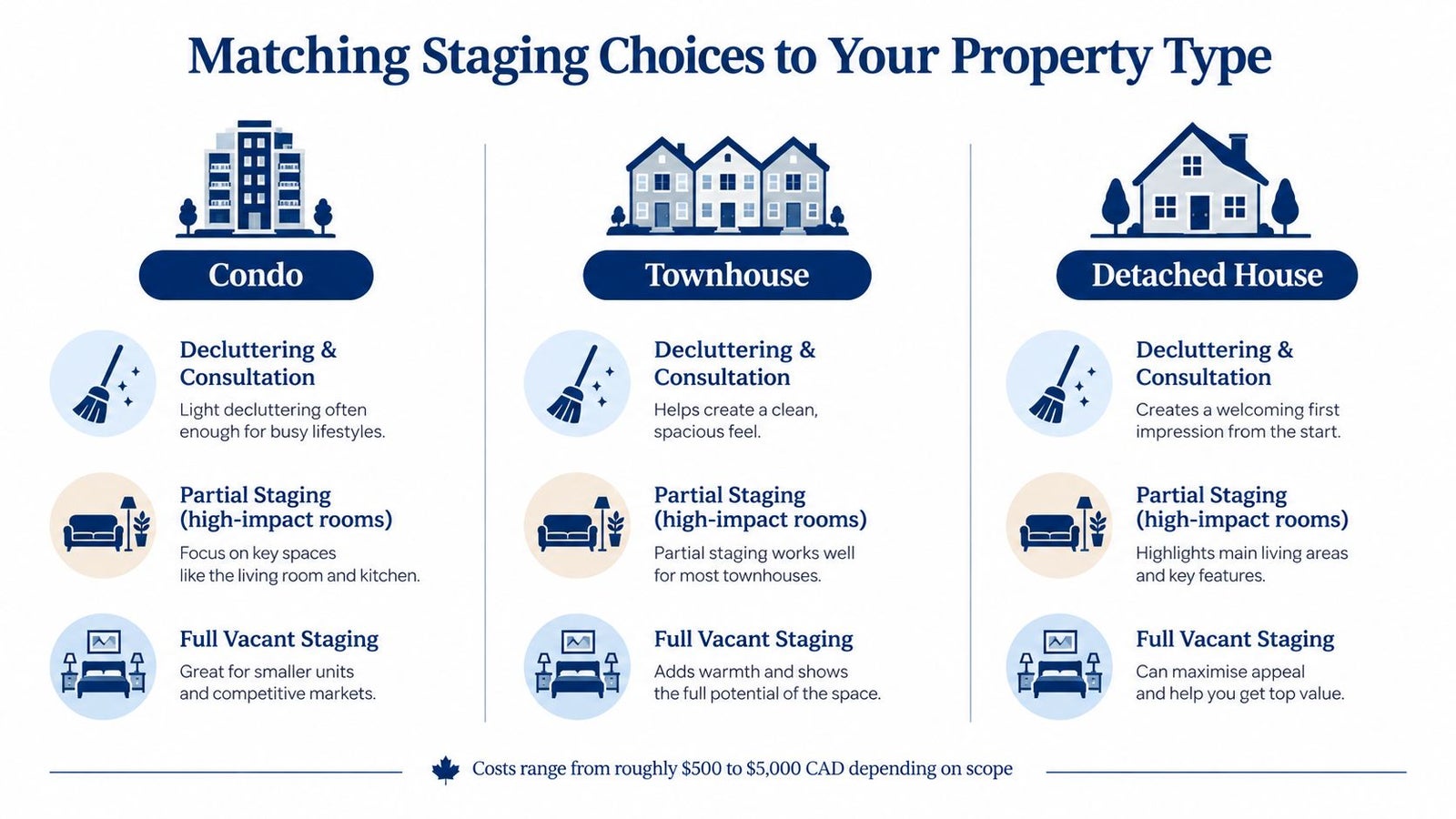
Start with decluttering and a consultation if the condo already has furniture of the right scale. Remove oversized pieces, extra seating, heavy storage, personal collections, and anything that cuts off windows or narrows circulation.
Partial staging usually makes the most sense when the living room feels undersized or a bedroom has no clear purpose. Rental furniture can define layout without crowding every corner. Professional photography then does its job, showing light, views, and how the main rooms connect.
Full vacant staging fits a condo that reads as an empty box in photos, or one where buyers keep misjudging room size and function. Even then, discipline matters. Too much furniture makes a small unit feel smaller.
Townhomes need room hierarchy. Buyers usually understand the main floor quickly, then hesitate over a lower-level room, a narrow dining zone, or a multipurpose area. Partial staging can define those spaces without furnishing every bedroom.
Spend the budget where buyers will question use. A desk can signal an office. Do not suggest a room is a legally conforming bedroom if it is not. The listing has to describe permitted or known use accurately.
Detached homes often need a wider presentation plan because buyers evaluate storage, entertaining flow, bedroom scale, basement utility, and outdoor living potential. Full staging can make sense when the home is vacant or when existing furniture fails to show the property's proportions and quality.
That does not mean every room needs a full package. A consultation, targeted edits to occupied furniture, selected rental pieces, deep cleaning, and strong media may fix the underlying problem more efficiently. If you want a second opinion on whether partial staging or a full package fits your floor plan, a staging consultation alongside a pricing analysis usually settles the question in one walkthrough.
Start with the rooms buyers read fastest. In Vancouver, that is usually the living room, the kitchen, and the primary bedroom, because those spaces tell the story of scale, flow, and daily livability before anything else does.
The living room carries the first visual burden. In a compact condo, size and furniture placement matter more than décor, because a sofa that is too large makes the whole unit feel tight, while a properly scaled layout shows circulation and usable floor area. The kitchen comes next, since buyers use it as a cue for cleanliness, function, storage, and how the home works day to day. Clear counters, correct lighting, and an open connection to the dining or living area usually do more than decorative extras.
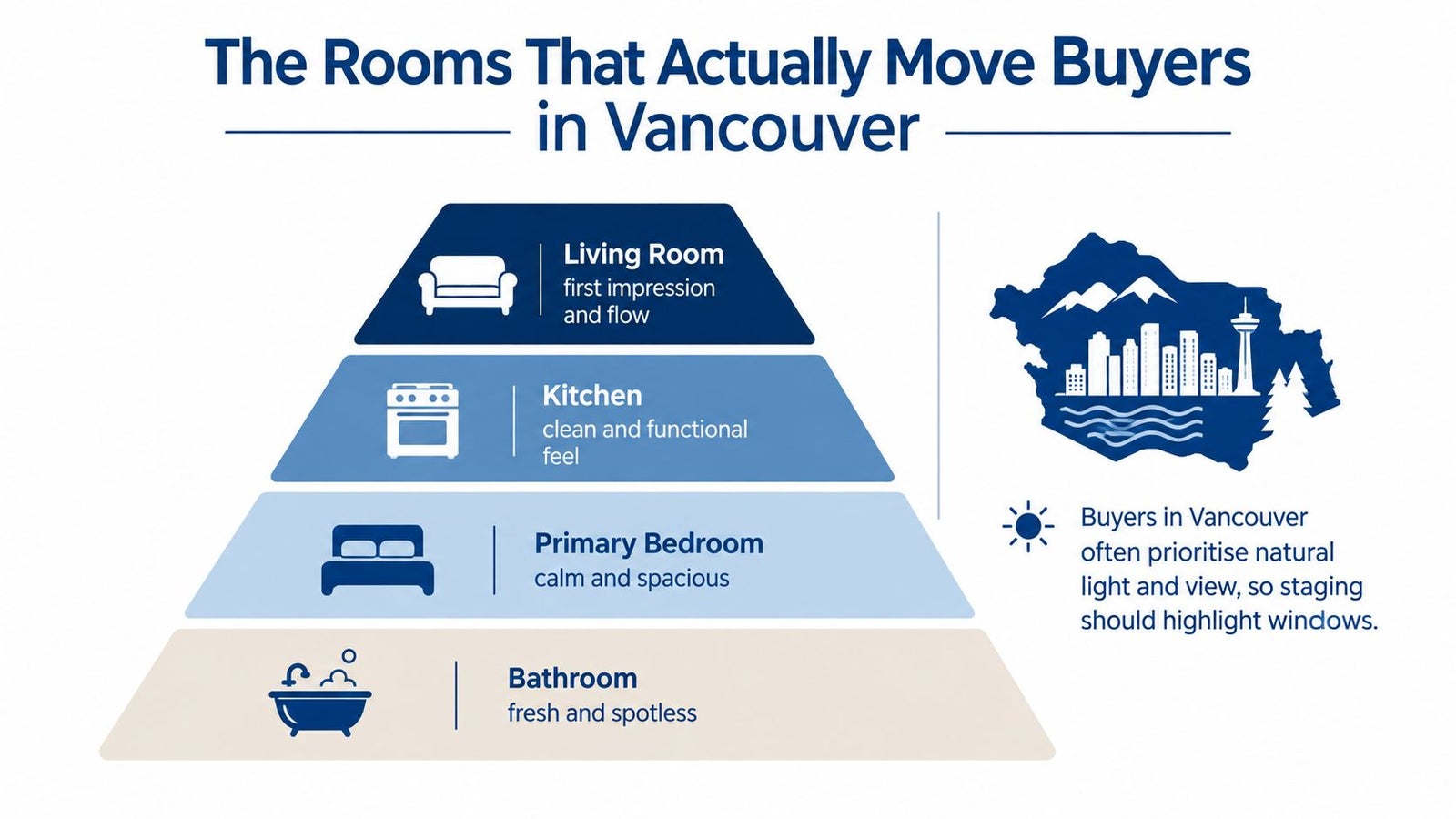
A staged listing should make a correctly positioned property easier to choose. It should not make an incorrectly priced property harder to question.
Before approving the invoice, name the market signal each dollar addresses: stronger first photos, clearer circulation, more confident showings, or less time exposed to competing inventory. If the recommendation has no specific mechanism, keep the money.
Matching Staging Choices to Your Property Type
Staging should answer the question buyers are already asking when they compare your listing with similar homes. A flat percentage of list price is the wrong test. A compact condo needs restraint. A detached house may need enough furniture to show scale across several rooms. A townhome often needs selective staging where split levels, flex spaces, or tight transitions create doubt.
Condos in Vancouver, Burnaby, and Richmond
Start with decluttering and a consultation if the condo already has furniture of the right scale. Remove oversized pieces, extra seating, heavy storage, personal collections, and anything that cuts off windows or narrows circulation.
Partial staging usually makes the most sense when the living room feels undersized or a bedroom has no clear purpose. Rental furniture can define layout without crowding every corner. Professional photography then does its job, showing light, views, and how the main rooms connect.
Full vacant staging fits a condo that reads as an empty box in photos, or one where buyers keep misjudging room size and function. Even then, discipline matters. Too much furniture makes a small unit feel smaller.
Townhomes across Greater Vancouver
Townhomes need room hierarchy. Buyers usually understand the main floor quickly, then hesitate over a lower-level room, a narrow dining zone, or a multipurpose area. Partial staging can define those spaces without furnishing every bedroom.
Spend the budget where buyers will question use. A desk can signal an office. Do not suggest a room is a legally conforming bedroom if it is not. The listing has to describe permitted or known use accurately.
Detached homes on the Westside and in North Vancouver
Detached homes often need a wider presentation plan because buyers evaluate storage, entertaining flow, bedroom scale, basement utility, and outdoor living potential. Full staging can make sense when the home is vacant or when existing furniture fails to show the property's proportions and quality.
That does not mean every room needs a full package. A consultation, targeted edits to occupied furniture, selected rental pieces, deep cleaning, and strong media may fix the underlying problem more efficiently. If you want a second opinion on whether partial staging or a full package fits your floor plan, a staging consultation alongside a pricing analysis usually settles the question in one walkthrough.
The Rooms That Actually Move Buyers in Vancouver
Start with the rooms buyers read fastest. In Vancouver, that is usually the living room, the kitchen, and the primary bedroom, because those spaces tell the story of scale, flow, and daily livability before anything else does.
The living room carries the first visual burden. In a compact condo, size and furniture placement matter more than décor, because a sofa that is too large makes the whole unit feel tight, while a properly scaled layout shows circulation and usable floor area. The kitchen comes next, since buyers use it as a cue for cleanliness, function, storage, and how the home works day to day. Clear counters, correct lighting, and an open connection to the dining or living area usually do more than decorative extras.
A buyer-agent survey ranked the living room, primary bedroom, and kitchen as the spaces sellers should prioritize most, with the living room at the top. That supports a selective staging budget, not a full-home furniture package in every listing. For more seller-focused context, this practical Vancouver home-staging guide lays out the same logic in plain terms.
Use the budget where buyers will question the home first.
Use the budget where buyers will question the home first.
- Living room: Show scale, seating, circulation, and the link to windows or views.
- Kitchen: Remove clutter and present a clean, usable workspace.
- Primary bedroom: Keep the room calm, balanced, and easy to read for storage and movement.
- Secondary rooms: Stage them only when the purpose is unclear or they add to the listing's story.
Detached homes often need more attention in the primary bedroom, because buyers compare that room closely against similar homes at the same price point. In a condo, the living room usually does the heaviest lifting, because the floor plan has to make sense almost instantly on a phone screen.
Natural light and views deserve special attention in Vancouver. Keep windows open, avoid blocking sightlines, and let the furniture support the outlook instead of fighting it. Pair selective staging with decluttering, accurate listing remarks, and strong photography. That combination usually solves more than filling every room with rental pieces.
Disclosure Comes Before Décor
A staged property can look finished while still carrying serious transaction risk. BCFSA states that sellers must disclose known material latent defects, meaning defects that can't be discovered through ordinary inspection, and that the disclosure must be made in writing. Sellers must also disclose known latent defects and must not provide false or misleading information when buyers ask about the property. BCFSA's consumer disclosure guidance sets out those obligations.
That changes the order of operations. Before furniture arrives, identify known issues, gather repair invoices, review relevant strata information, and discuss required written disclosures with your representative. If a hidden leak, recurring water ingress, unsafe condition, or other material defect exists, staging doesn't remove the obligation to address or disclose it.
Avoid misleading presentation
Staging must clarify a property's function without creating a false impression. A den should not be presented as a legally conforming bedroom if it lacks the required characteristics. A staged condo shouldn't make excluded appliances, fixtures, or furniture appear included in the sale.
Pay attention to what furniture blocks. Buyers need to inspect storage, access panels, windows, mechanical components, and signs of moisture. Attractive artwork and a carefully arranged sofa can't justify concealing a known limitation.
BCFSA's disclosure guidelines for real-estate professionals also emphasize written disclosure and confirmation that it was provided and received. For sellers, the practical lesson is straightforward: document the property, correct the sequence, and keep the marketing accurate.
Documenting means recording included fixtures, excluded staging items, known limitations, repairs, and outstanding questions. Correcting the sequence means investigating and disclosing before investing heavily in cosmetic presentation. Keeping the marketing accurate means photographs, room labels, listing remarks, and showing materials describe what buyers are purchasing.
A dollar spent on disclosure, repair investigation, or documentation may protect the transaction more effectively than a dollar spent on décor. Staging has value only after the property can be marketed openly.
Deciding Whether Staging Is Worth It on Your Listing
Use this checklist before approving a staging quote:
- Price accuracy: Does the asking price reflect comparable sales and the current competing inventory?
- Visible problem: Can you name the presentation weakness, such as poor furniture scale, clutter, empty rooms, or an unclear layout?
- Photography: Will staging materially improve the first images buyers see online?
- Scope: Is decluttering, consultation, or partial staging enough, or does the vacant property need a complete setup?
- Competition: Are nearby comparable listings more polished, better photographed, or easier to understand?
- Carrying cost: Could the staging spend reduce the risk of a stale listing, price reduction, or prolonged exposure?
- Disclosure: Have known defects, included items, excluded staging pieces, and room uses been documented accurately?
My recommendation is direct. Stage when presentation is the problem, price accurately when price is the problem, and investigate or repair when condition is the problem. A Vancouver condo, townhome, or detached home doesn't need the same package, and a generic staging percentage can't replace a property-specific comparison.
Jacky Levi - Vancouver Realtor offers seller representation, comparative market analysis, listing preparation, professional media coordination, and staging consultation across Greater Vancouver. Visit Jacky Levi - Vancouver Realtor to arrange a property-specific staging and pricing assessment before you commit to furniture, repairs, or a list price.