
The most popular advice about buying a house for parents is also the most dangerous: just buy the property, put everyone on title, and sort out the details later. In Vancouver, that approach can turn a generous family decision into a financing liability, a property transfer tax problem, or a home that becomes unsuitable as your parents' needs change.
A sound purchase starts with a different question: are you solving a housing need, or are you creating a tax and ownership problem? The right answer depends on who will live in the property, who will borrow, who will own it, how the money will move, and whether the home can support aging in place. This guide gives you the practical framework I'd use with a family considering an intergenerational purchase across Vancouver and Greater Vancouver.
Buying a home for parents can be an act of care, but the transaction itself isn't automatically simple or tax-free. A family may intend to provide stable housing, yet the legal result could involve multiple owners, mortgage obligations, property transfer tax, documentation requirements, and future disagreements about sale proceeds or refinancing.
The first mistake is treating a family trust as a substitute for written terms. If one person contributes the money, another signs the mortgage, and the parents occupy the property, everyone may have a different understanding of ownership. That understanding often remains untested until a parent needs care, a child separates from a spouse, someone wants to sell, or the mortgage must be renewed.

Before looking at listings, define the actual problem.
In British Columbia, a related-individual property transfer exemption isn't automatic. The BC property transfer tax rules for transfers to family members depend on the relationship, principal-residence status, and supporting documentation. If the exemption doesn't apply, full property transfer tax on a $2 million transfer is about $38,000, which is a substantial cost to discover after the structure has been chosen.
A child might buy a home in their own name and allow parents to live there. That may be appropriate, but it doesn't automatically make the parents owners or make the transaction eligible for a family transfer exemption. Conversely, putting parents on title may create ownership, financing, and estate issues that the family never intended.
If you're still defining the broader purchase strategy, review this guide to buying a home in Vancouver. The property search should follow the family plan, not replace it.
There are three common ways to support a parent-assisted purchase: gift the down payment, buy jointly, or lend privately. Co-signing or co-borrowing can sit alongside these options, but they create different risks. The best structure is the one that matches the actual financial arrangement, not the one that feels easiest on offer day.
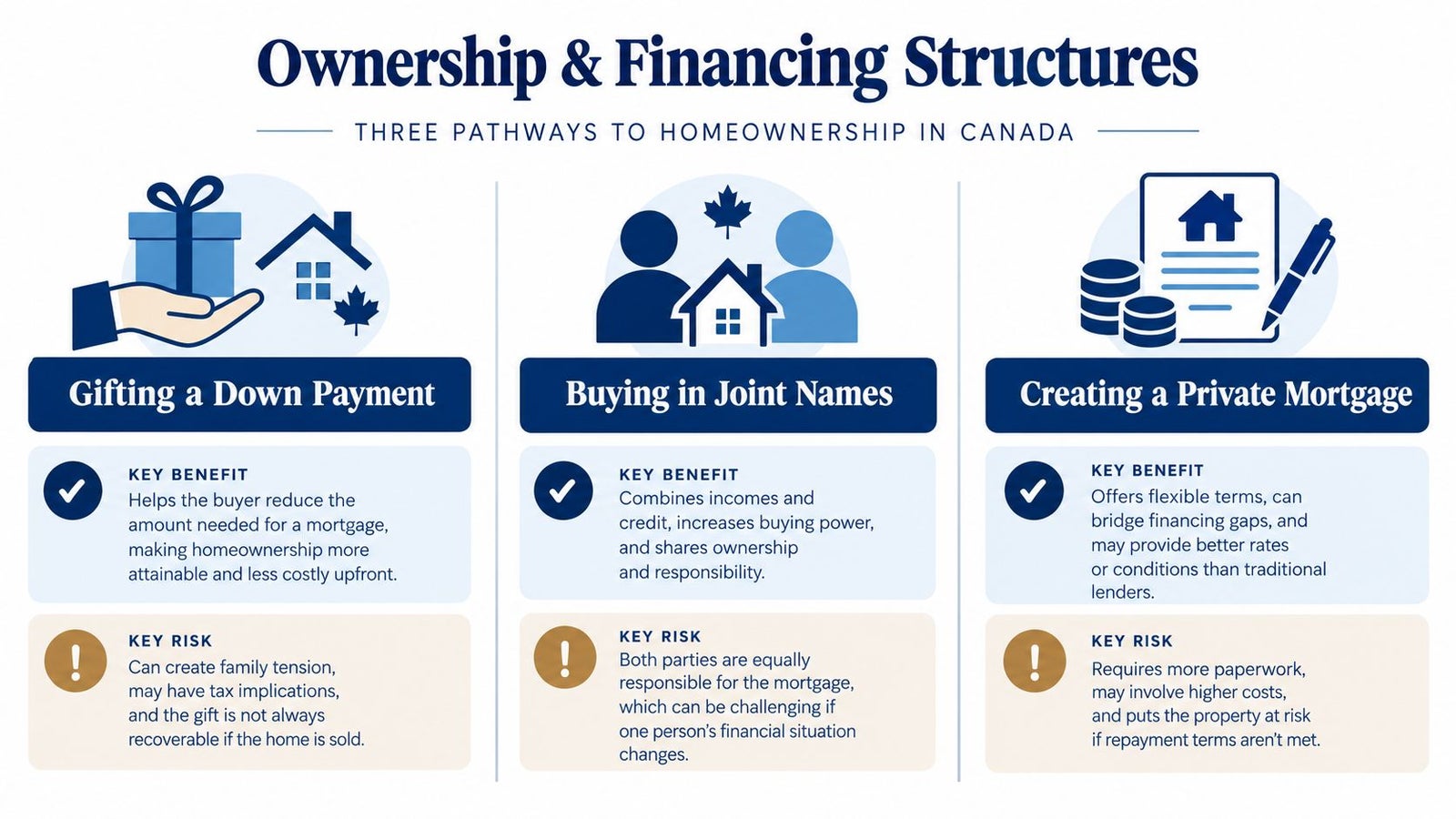
A gifted down payment is usually the cleanest option when the younger buyer can qualify for the mortgage and the parents don't need repayment or ownership rights. In Canada, a gifted contribution is non-repayable, and lenders generally require a signed gift letter plus evidence that the money was deposited. The Canadian gifted down payment rules describe the documentation lenders commonly request.
For example, if parents give $80,000 toward a Vancouver condo down payment, the buyer should keep the gift letter, transfer confirmation, and bank records. The letter should make clear that repayment isn't expected. I recommend preparing this part of the mortgage file before subject removal, not after the lender asks for it.
This structure preserves the buyer's independence, but it doesn't help if the buyer's income remains insufficient for qualification. It also doesn't give parents a registered ownership interest, so the family should be comfortable treating the contribution as a true gift.
The Bank of Canada's discussion of parental income support explains why a parent may be added to a mortgage application. Adding parental income can relax the payment-to-income constraint and raise the housing level affordable to the household. That can make a purchase possible when the child alone wouldn't qualify.
The distinction between a co-borrower and a co-signer matters. A co-borrower is fully liable for the mortgage and typically appears on title. A co-signer may assist with qualification, but still carries full repayment risk if the borrower defaults. Either way, the parents' future borrowing room and financial security can be affected.
A $1,000,000 Metro Vancouver property illustrates the financing issue. A 20% down payment would avoid high-ratio mortgage insurance, while a smaller parental gift could help the buyer reach that threshold, as explained in TD's guidance on helping children own a home. Run this calculation early with a lender.
Your real estate representative should also understand the intended structure before offer terms are drafted. Buyer representation involves more than arranging showings. It includes assessing whether the property, conditions, title arrangement, and timing fit the family's plan. This overview of buyer agency for Vancouver buyers is useful background before you choose representation.
The money trail must be organized before the offer becomes firm. Lenders need to know where the down payment came from, whether it must be repaid, and whether the proposed financing matches the application. Families create avoidable delays when they move money casually between accounts and try to explain it later.
Use this sequence.
Don't call a contribution a gift if everyone expects repayment. A genuine gift is non-repayable. A private loan should have written terms covering the principal, interest, payment schedule, default, security, and what happens if the property is sold.
A loan can protect a parent's capital, but it can also create family tension if the borrower struggles. A gift can be simpler, but parents must accept that the money may not come back. Put the decision in writing before funds move.
The gift letter should identify the donor's name, relationship, amount, date, and the fact that repayment isn't expected. Some lenders require gifted funds to remain in the buyer's account for at least 90 days before the mortgage application, and National Bank's down payment guidance highlights the importance of complete gift documentation.
For a Surrey townhouse, parents planning to provide cash should start the transfer timeline before finalizing the purchase offer. Keep statements showing the source and movement of funds, and ask the lender whether additional verification is required.
Federal relief may remain available even when parents assist. The CRA says the home buyers' amount can generate a tax credit of up to $1,500, while the first-time buyer's tax credit is based on a non-refundable credit on up to $10,000 of the home buyer's amount. Review the CRA housing benefits and homebuyer tax guidance with a tax professional before closing.
For eligible B.C. first-time buyers, the existing-home property transfer tax exemption increased on April 1, 2024. Homes worth up to $835,000 can qualify for at least partial relief, with tax eliminated on the first $500,000 and reduced between $500,001 and $835,000. The province says more qualifying first-time buyers can save up to $8,000 in property transfer taxes under the new thresholds. Confirm eligibility through the Province of British Columbia's home buying information.
The practical example is straightforward. If a qualifying younger buyer receives a parent gift and buys an existing home within the relevant threshold, parental assistance may help the family combine mortgage qualification, down payment strength, and tax relief. The buyer still needs to confirm every condition, including first-time buyer status and the property's eligibility.
For a focused review of provincial exemptions, use this BC property transfer tax exemption guide. The key recommendation is simple: obtain lender and tax advice before signing, then keep the documentation aligned with the structure.
The legal paperwork should reflect what the family intends. If parents are on title, determine whether they are true owners, bare trustees, borrowers, or occupants. If they aren't on title but contribute money, document whether the contribution is a gift, loan, or beneficial ownership arrangement.
A lawyer should review the structure before closing and prepare the documents that match it. Depending on the arrangement, that may include a co-ownership agreement, loan agreement, trust declaration, mortgage security, wills, and powers of attorney. A power of attorney can help someone manage financial or property matters if a parent later cannot handle them, but it doesn't replace clear ownership terms.
Joint title can create practical benefits, but it also exposes each registered owner to consequences connected with the property. Before adding a parent, discuss whether their ownership could affect future borrowing, estate administration, relationship breakdown, or a later sale. Before leaving a parent off title, document why they contributed and what rights, if any, they retain.
A co-ownership agreement should address contributions, expenses, repairs, insurance, occupancy, decision-making, refinancing, death, incapacity, and sale. It should also explain how disagreements get resolved. Families rarely regret having clear terms. They regret assuming that goodwill will answer technical questions later.
The related-individual property transfer tax exemption in B.C. depends on the relationship definition, principal-residence status, and supporting evidence. A family transfer doesn't qualify because the parties are related or because the transaction is intended to help an aging parent.
The same principle applies to other relief. Eligibility depends on the buyer, property, occupancy, timing, and paperwork. Ask the conveyancing lawyer to confirm the treatment before documents are signed, rather than budgeting on an exemption that hasn't been verified.
For a practical cost and tax discussion, review this guide to legal fees when buying a house in B.C.. Your lawyer, lender, accountant, and realtor should each understand the same structure. Contradictory instructions are a warning sign that the family hasn't finished planning.
A home bought for parents must work beyond possession day. The cheapest suitable property today can become the wrong property if it has stairs at every entrance, a bathroom that can't accommodate assistance, or no practical way to adapt a bedroom for changing mobility.
Statistics Canada's analysis of multigenerational households in Canada describes multigenerational living as a real and growing housing form, with B.C. among the provinces showing the highest rates. That matters because buying a house for parents is increasingly about flexibility, caregiving, and co-residence, not only title and financing.
Consider a parent who is fully mobile now but may later rely on a walker. A split-level home with bedrooms upstairs may feel manageable during the first viewing, yet become a daily obstacle. A main-floor bedroom, a full bathroom on the same level, level entry, and wider circulation routes can preserve independence and reduce the need for an urgent move.
Another family may need a caregiver or want an adult child to live nearby. A legal secondary-suite opportunity, separate entrance, parking, and acoustic separation can give the household options. Don't assume a suite is permitted or suitable. Verify zoning, permits, strata rules, building condition, and actual layout before assigning it value.

During showings, walk through ordinary tasks rather than admiring finishes.
A Vancouver condo may offer elevators and proximity to services, but strata bylaws, monthly costs, visitor parking, and renovation restrictions require careful review. A detached home may provide more adaptation potential, but maintenance, stairs, and distance can create a different burden.
The purchase should also account for future occupancy changes. If parents later move elsewhere, can the property house another family member, accommodate a suite, or remain marketable? A home that can absorb change protects the family better than one selected only for today's floor plan.
Use this checklist before you make an offer:
The most reliable purchase is not necessarily the one with the lowest price or the simplest title. It's the one that keeps the parents housed, protects the contributor, satisfies the lender, preserves available relief, and remains workable as the family changes.
Jacky Levi - Vancouver Realtor offers buyer representation, property-specific market analysis, offer strategy, and transaction coordination across Greater Vancouver. If you're buying a house for parents, visit Jacky Levi - Vancouver Realtor to discuss suitable homes, accessibility considerations, and a purchase plan that fits the family's ownership and financing structure.
A sound purchase starts with a different question: are you solving a housing need, or are you creating a tax and ownership problem? The right answer depends on who will live in the property, who will borrow, who will own it, how the money will move, and whether the home can support aging in place. This guide gives you the practical framework I'd use with a family considering an intergenerational purchase across Vancouver and Greater Vancouver.
Why Buying a Home for Parents Is Not Just a Gift
Buying a home for parents can be an act of care, but the transaction itself isn't automatically simple or tax-free. A family may intend to provide stable housing, yet the legal result could involve multiple owners, mortgage obligations, property transfer tax, documentation requirements, and future disagreements about sale proceeds or refinancing.
The first mistake is treating a family trust as a substitute for written terms. If one person contributes the money, another signs the mortgage, and the parents occupy the property, everyone may have a different understanding of ownership. That understanding often remains untested until a parent needs care, a child separates from a spouse, someone wants to sell, or the mortgage must be renewed.
Start with the housing need
Before looking at listings, define the actual problem.
- Stable occupancy: Do your parents need a long-term home, or are they moving temporarily while their current property is sold?
- Financial support: Are you contributing cash, helping them qualify, or taking responsibility for the entire purchase?
- Care planning: Could one parent eventually need mobility support, a live-in caregiver, or a different bedroom arrangement?
- Family access: Should the property be near your home, public transit, medical services, or other relatives?
- Exit planning: What happens if your parents move into assisted living or the family needs to sell?
In British Columbia, a related-individual property transfer exemption isn't automatic. The BC property transfer tax rules for transfers to family members depend on the relationship, principal-residence status, and supporting documentation. If the exemption doesn't apply, full property transfer tax on a $2 million transfer is about $38,000, which is a substantial cost to discover after the structure has been chosen.
Intent doesn't determine the tax result
A child might buy a home in their own name and allow parents to live there. That may be appropriate, but it doesn't automatically make the parents owners or make the transaction eligible for a family transfer exemption. Conversely, putting parents on title may create ownership, financing, and estate issues that the family never intended.
Practical rule: Decide the occupancy, ownership, contribution, and exit plan before making an offer. Don't ask the lawyer to reverse-engineer a structure after the deposit has been paid.
If you're still defining the broader purchase strategy, review this guide to buying a home in Vancouver. The property search should follow the family plan, not replace it.
Choosing the Right Ownership and Financing Structure
There are three common ways to support a parent-assisted purchase: gift the down payment, buy jointly, or lend privately. Co-signing or co-borrowing can sit alongside these options, but they create different risks. The best structure is the one that matches the actual financial arrangement, not the one that feels easiest on offer day.
Gifting the down payment
A gifted down payment is usually the cleanest option when the younger buyer can qualify for the mortgage and the parents don't need repayment or ownership rights. In Canada, a gifted contribution is non-repayable, and lenders generally require a signed gift letter plus evidence that the money was deposited. The Canadian gifted down payment rules describe the documentation lenders commonly request.
For example, if parents give $80,000 toward a Vancouver condo down payment, the buyer should keep the gift letter, transfer confirmation, and bank records. The letter should make clear that repayment isn't expected. I recommend preparing this part of the mortgage file before subject removal, not after the lender asks for it.
This structure preserves the buyer's independence, but it doesn't help if the buyer's income remains insufficient for qualification. It also doesn't give parents a registered ownership interest, so the family should be comfortable treating the contribution as a true gift.
Co-signing or co-borrowing
The Bank of Canada's discussion of parental income support explains why a parent may be added to a mortgage application. Adding parental income can relax the payment-to-income constraint and raise the housing level affordable to the household. That can make a purchase possible when the child alone wouldn't qualify.
The distinction between a co-borrower and a co-signer matters. A co-borrower is fully liable for the mortgage and typically appears on title. A co-signer may assist with qualification, but still carries full repayment risk if the borrower defaults. Either way, the parents' future borrowing room and financial security can be affected.
Choose the structure before choosing the home
A $1,000,000 Metro Vancouver property illustrates the financing issue. A 20% down payment would avoid high-ratio mortgage insurance, while a smaller parental gift could help the buyer reach that threshold, as explained in TD's guidance on helping children own a home. Run this calculation early with a lender.
Your real estate representative should also understand the intended structure before offer terms are drafted. Buyer representation involves more than arranging showings. It includes assessing whether the property, conditions, title arrangement, and timing fit the family's plan. This overview of buyer agency for Vancouver buyers is useful background before you choose representation.
Navigating Gifts, Loans, and Tax Benefits
The money trail must be organized before the offer becomes firm. Lenders need to know where the down payment came from, whether it must be repaid, and whether the proposed financing matches the application. Families create avoidable delays when they move money casually between accounts and try to explain it later.
Use this sequence.
1. Decide whether the money is a gift or a loan
Don't call a contribution a gift if everyone expects repayment. A genuine gift is non-repayable. A private loan should have written terms covering the principal, interest, payment schedule, default, security, and what happens if the property is sold.
A loan can protect a parent's capital, but it can also create family tension if the borrower struggles. A gift can be simpler, but parents must accept that the money may not come back. Put the decision in writing before funds move.
2. Build the lender file early
The gift letter should identify the donor's name, relationship, amount, date, and the fact that repayment isn't expected. Some lenders require gifted funds to remain in the buyer's account for at least 90 days before the mortgage application, and National Bank's down payment guidance highlights the importance of complete gift documentation.
For a Surrey townhouse, parents planning to provide cash should start the transfer timeline before finalizing the purchase offer. Keep statements showing the source and movement of funds, and ask the lender whether additional verification is required.
Lender instruction: Don't wait for subject removal to discover that the bank treats the contribution differently from the family.
3. Check federal and provincial relief
Federal relief may remain available even when parents assist. The CRA says the home buyers' amount can generate a tax credit of up to $1,500, while the first-time buyer's tax credit is based on a non-refundable credit on up to $10,000 of the home buyer's amount. Review the CRA housing benefits and homebuyer tax guidance with a tax professional before closing.
For eligible B.C. first-time buyers, the existing-home property transfer tax exemption increased on April 1, 2024. Homes worth up to $835,000 can qualify for at least partial relief, with tax eliminated on the first $500,000 and reduced between $500,001 and $835,000. The province says more qualifying first-time buyers can save up to $8,000 in property transfer taxes under the new thresholds. Confirm eligibility through the Province of British Columbia's home buying information.
The practical example is straightforward. If a qualifying younger buyer receives a parent gift and buys an existing home within the relevant threshold, parental assistance may help the family combine mortgage qualification, down payment strength, and tax relief. The buyer still needs to confirm every condition, including first-time buyer status and the property's eligibility.
For a focused review of provincial exemptions, use this BC property transfer tax exemption guide. The key recommendation is simple: obtain lender and tax advice before signing, then keep the documentation aligned with the structure.
Legal Documentation and Property Transfer Considerations
The legal paperwork should reflect what the family intends. If parents are on title, determine whether they are true owners, bare trustees, borrowers, or occupants. If they aren't on title but contribute money, document whether the contribution is a gift, loan, or beneficial ownership arrangement.
A lawyer should review the structure before closing and prepare the documents that match it. Depending on the arrangement, that may include a co-ownership agreement, loan agreement, trust declaration, mortgage security, wills, and powers of attorney. A power of attorney can help someone manage financial or property matters if a parent later cannot handle them, but it doesn't replace clear ownership terms.
Title is a decision, not a formality
Joint title can create practical benefits, but it also exposes each registered owner to consequences connected with the property. Before adding a parent, discuss whether their ownership could affect future borrowing, estate administration, relationship breakdown, or a later sale. Before leaving a parent off title, document why they contributed and what rights, if any, they retain.
A co-ownership agreement should address contributions, expenses, repairs, insurance, occupancy, decision-making, refinancing, death, incapacity, and sale. It should also explain how disagreements get resolved. Families rarely regret having clear terms. They regret assuming that goodwill will answer technical questions later.
Treat exemptions as conditional
The related-individual property transfer tax exemption in B.C. depends on the relationship definition, principal-residence status, and supporting evidence. A family transfer doesn't qualify because the parties are related or because the transaction is intended to help an aging parent.
The same principle applies to other relief. Eligibility depends on the buyer, property, occupancy, timing, and paperwork. Ask the conveyancing lawyer to confirm the treatment before documents are signed, rather than budgeting on an exemption that hasn't been verified.
Document the arrangement while everyone agrees. A short, carefully drafted agreement is far cheaper than an ownership dispute after a family relationship has become strained.
For a practical cost and tax discussion, review this guide to legal fees when buying a house in B.C.. Your lawyer, lender, accountant, and realtor should each understand the same structure. Contradictory instructions are a warning sign that the family hasn't finished planning.
Future-Proofing for Aging and Accessibility
A home bought for parents must work beyond possession day. The cheapest suitable property today can become the wrong property if it has stairs at every entrance, a bathroom that can't accommodate assistance, or no practical way to adapt a bedroom for changing mobility.
Statistics Canada's analysis of multigenerational households in Canada describes multigenerational living as a real and growing housing form, with B.C. among the provinces showing the highest rates. That matters because buying a house for parents is increasingly about flexibility, caregiving, and co-residence, not only title and financing.
Choose for the next stage, not only the current one
Consider a parent who is fully mobile now but may later rely on a walker. A split-level home with bedrooms upstairs may feel manageable during the first viewing, yet become a daily obstacle. A main-floor bedroom, a full bathroom on the same level, level entry, and wider circulation routes can preserve independence and reduce the need for an urgent move.
Another family may need a caregiver or want an adult child to live nearby. A legal secondary-suite opportunity, separate entrance, parking, and acoustic separation can give the household options. Don't assume a suite is permitted or suitable. Verify zoning, permits, strata rules, building condition, and actual layout before assigning it value.
Test the property as a care plan
During showings, walk through ordinary tasks rather than admiring finishes.
- Entry: Can your parent reach the door safely in poor weather?
- Bathroom: Is there enough space for future support and safer equipment?
- Kitchen: Can essential items be reached without climbing or bending?
- Bedroom: Could the sleeping area move to the main level?
- Outdoor space: Is there a secure route to a patio, garden, or vehicle?
- Services: Is the home reasonably convenient for healthcare, groceries, transit, and family support?
A Vancouver condo may offer elevators and proximity to services, but strata bylaws, monthly costs, visitor parking, and renovation restrictions require careful review. A detached home may provide more adaptation potential, but maintenance, stairs, and distance can create a different burden.
The purchase should also account for future occupancy changes. If parents later move elsewhere, can the property house another family member, accommodate a suite, or remain marketable? A home that can absorb change protects the family better than one selected only for today's floor plan.
Final Checklist for a Stress-Free Transaction
Use this checklist before you make an offer:
- Define the need: Confirm who will live in the home now and what care or occupancy changes may occur later.
- Choose the structure: Decide whether the support is a gift, joint ownership, co-signing, co-borrowing, or private loan.
- Get qualification advice: Have a lender assess income, debt-service capacity, down payment, insurance implications, and parental borrowing risk.
- Prepare the money trail: Complete the gift letter or loan documents, transfer funds properly, and preserve bank records.
- Verify tax relief: Confirm federal credits, B.C. first-time buyer eligibility, and any property transfer tax exemption before closing.
- Instruct the lawyer early: Review title, co-ownership terms, powers of attorney, wills, security, and exit provisions.
- Inspect for aging: Evaluate entrances, stairs, bathrooms, bedrooms, suite potential, maintenance, and proximity to essential services.
- Write the exit plan: Decide what happens if parents move, a contributor dies, someone needs repayment, or the property must be sold.
- Coordinate the transaction: Keep the lender, lawyer, accountant, and realtor working from the same written arrangement.
The most reliable purchase is not necessarily the one with the lowest price or the simplest title. It's the one that keeps the parents housed, protects the contributor, satisfies the lender, preserves available relief, and remains workable as the family changes.
Jacky Levi - Vancouver Realtor offers buyer representation, property-specific market analysis, offer strategy, and transaction coordination across Greater Vancouver. If you're buying a house for parents, visit Jacky Levi - Vancouver Realtor to discuss suitable homes, accessibility considerations, and a purchase plan that fits the family's ownership and financing structure.