
BC buyers should expect roughly $1,200 to $2,500 in standard legal and notary fees, on top of Property Transfer Tax that can exceed roughly $17,000 on a $950,000 purchase in BC. That's the part too many buyers miss. The legal bill usually isn't the financial shock. The tax bill is.
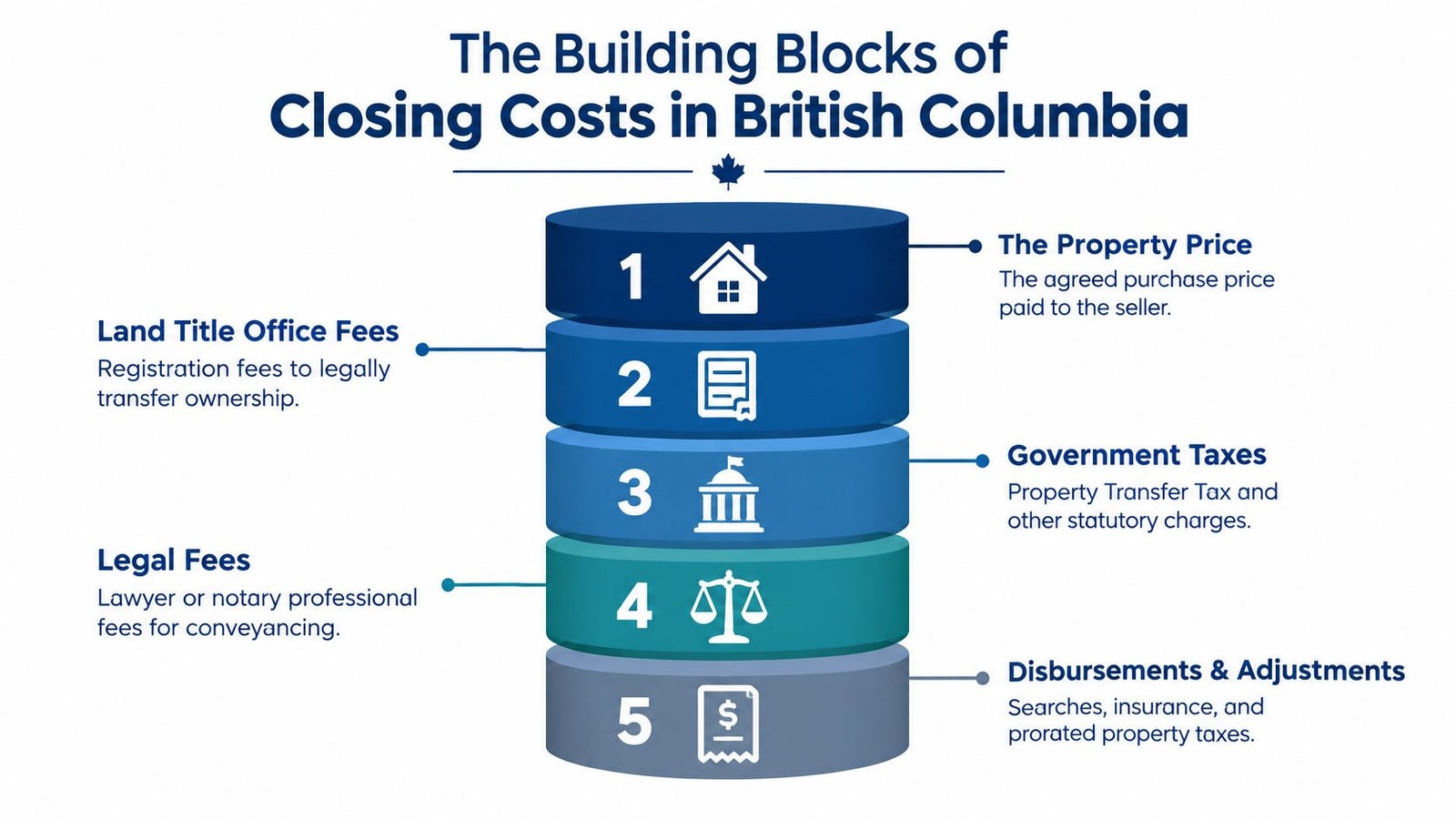
Read your completion statement in five parts. That is how buyers stop underestimating the cash they need.
This is the part most BC guides blur together. They quote one legal number and move on. That shortcut causes bad budgeting.
Your professional fee is one decision point. Your disbursements are another. A clean condo purchase with one straightforward mortgage can produce a modest legal bill. The same buyer can still see a higher total closing invoice because the file needed extra searches, title insurance, wire costs, or more registrations. The bill rises because the transaction is more involved, not because the property sits in Vancouver instead of Burnaby.
That distinction matters.
If you ask a lawyer or notary for a quote, ask for these categories separately:
Price drives Property Transfer Tax. Timing drives adjustments. Lender instructions and file issues can raise disbursements. Complexity pushes legal work higher.
That is why two buyers paying the same purchase price can still have different completion costs.
If you want a useful number before you remove subjects, ask for a draft closing-cost breakdown, not a one-line quote.
A buyer who budgets one flat “legal fee” usually underestimates the invoice.
The fix is simple. Split the bill into professional fees and pass-through disbursements before you compare quotes. That gives you a usable number and exposes where the total can climb.
In BC, legal and notary invoices are usually built the same way. One part pays the lawyer or notary for the conveyance work. The other part reimburses the out-of-pocket charges required to close the file.
The professional fee covers the actual handling of your purchase. The Society of Notaries Public of BC fee guide explains that fees vary by the work involved, which is exactly how buyers should read a quote. A clean resale condo with one standard mortgage sits near the lower end. Extra lender instructions, ownership issues, or unusual title work push it up.
Your professional fee usually covers:
Ask one more question. Is the quoted professional fee for the purchase only, or for the purchase plus mortgage work? Some offices separate those charges. Others bundle them.
Disbursements are not markup. They are the third-party costs attached to your file.
That distinction matters because buyers often react to a higher total quote without noticing that the professional fee was reasonable and the disbursements were doing the heavy lifting.
A quote that says “legal fees: $1,800” tells you almost nothing by itself. A quote that breaks out professional fees, disbursements, GST, and registration charges tells you whether you are comparing actual service cost or a mixed total.
Ask for four lines. Professional fee. Estimated disbursements. GST. Government registration charges.
If an office will not separate those items, keep shopping. A first-time buyer does not need a prettier quote. You need a clearer one.
Location isn't the main driver. Complexity is.
A straightforward Burnaby strata purchase can stay close to a standard quote. A trust sale, estate file, unusual title issue, or non-standard ownership structure can push the bill higher fast.
BC-focused guidance notes that standard files are often priced near $1,400 to $1,600, while more complex cases such as corporate buyers, Agricultural Land Reserve properties, foreign-buyer status, and strata wind-ups can start around $2,500 and up (Bronson Job BC closing cost guide).
That gap is the story.
A complex file often includes work that never appears in the buyer's first mental budget:
Non-standard seller capacity. A trust, estate, or corporate seller usually means more document review.
Extra lender instructions. Some lenders are simple. Others send detailed instructions and extra conditions.
Unusual contract terms. Reassignment clauses, holdbacks, occupancy arrangements, or bespoke undertakings increase legal time.
Title irregularities. Charges, easements, or registration issues can require more back-and-forth before completion.
The mistake buyers make is assuming a flat-fee quote means the entire file is routine. It doesn't. It usually means routine work is covered unless the file stops being routine.
Ask this before you hire anyone: Which parts of my Contract of Purchase and Sale fall outside a normal conveyance file?
That single question saves a lot of frustration.
Property Transfer Tax is the line item that blows up a first-time buyer budget in BC. Legal fees usually land in the low thousands. PTT can jump into five figures fast.
The province charges 1% on the first $200,000 of fair market value, 2% on the portion from $200,001 to $2,000,000, 3% from $2,000,001 to $3,000,000, and 5% above $3,000,000 for residential property (BC Property Transfer Tax rates and examples
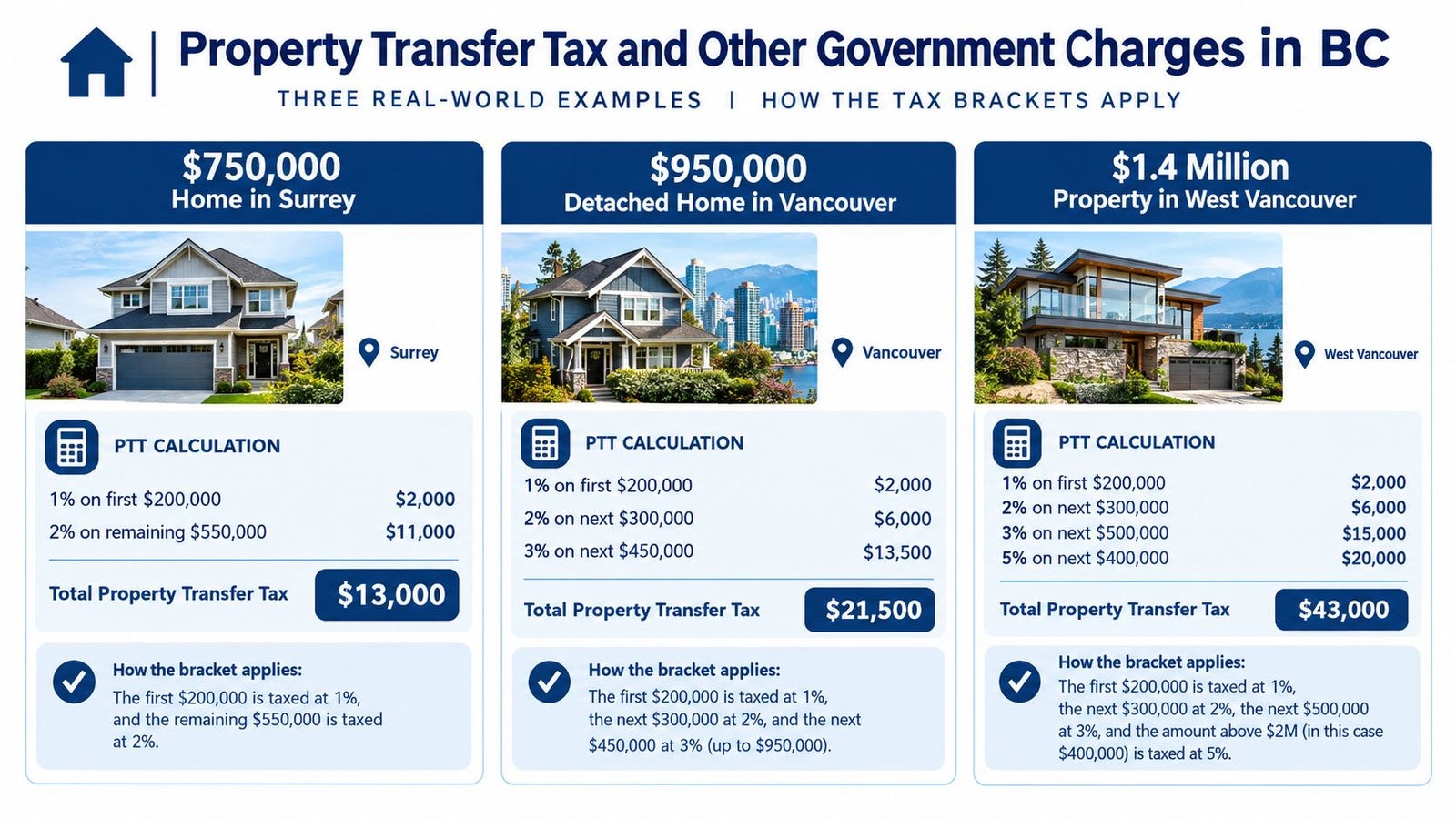
Use the bracket math before you write an offer, not after subjects are removed.
That is why buyers who focus only on legal fees miss the bigger closing cost. The tax bill is usually the heavyweight.
If you want a plain-English breakdown before you start shopping, review this guide to Property Transfer Tax in BC.
This section matters because BC buyers often lump everything into one bucket called "legal costs." That is the wrong way to budget.
Your lawyer or notary charges a professional fee for the conveyance. Government charges sit on top of that. So do pass-through disbursements and tax adjustments. Location does not usually make your legal bill spike. Complexity does. Government charges are different. They are driven by the property value, tax status, and what has already been paid on the property.
BC also charges an additional property transfer tax on foreign entities and taxable trustees in prescribed regions (BC additional property transfer tax rules).
Check ownership structure and residency status before you get close to completion. If a buyer, co-buyer, or beneficial owner triggers extra tax, this is not a minor paperwork issue. It can change the cash you need by a huge amount.
This short explainer is useful if you want a quick visual overview before running your own numbers.
PTT is the biggest government charge for many buyers, but it is not the only amount that can appear on your completion statement. You may also see prorated municipal property taxes, strata fee adjustments, utility adjustments, and registration-related charges tied to the file.
Budget for them separately. Do not treat them as part of the lawyer's fee quote.
My advice is simple. Build two closing-cost buckets from day one. One for your conveyancer's fee and disbursements. One for taxes and government charges. That single habit prevents a lot of last-minute panic.
A clean closing feels calm because the prep was done early. A chaotic closing usually starts with missing documents, late mortgage instructions, or a buyer who didn't understand adjustments.
Once your offer is accepted, the first sprint is subject removal. Financing, document review, strata review if applicable, and any due diligence need to happen on schedule.
After subjects come off, your lawyer or notary opens the file fully. They'll need the contract, lender details, identification, and property information. As completion gets closer, the lender sends mortgage instructions and the conveyancer prepares the transfer package.
In practical terms, buyers should expect to deliver the balance needed for closing before the registration day. That usually means arranging your bank draft or wire early enough that trust funds are in place when the office needs them.
Adjustments are prorated credits and debits between buyer and seller.
If the seller already paid a property expense that covers time after your completion date, you reimburse the seller for your share through the statement of adjustments. If something like rent or another credit belongs to the buyer from the closing date onward, the statement reflects that too.
Common adjustment categories include:
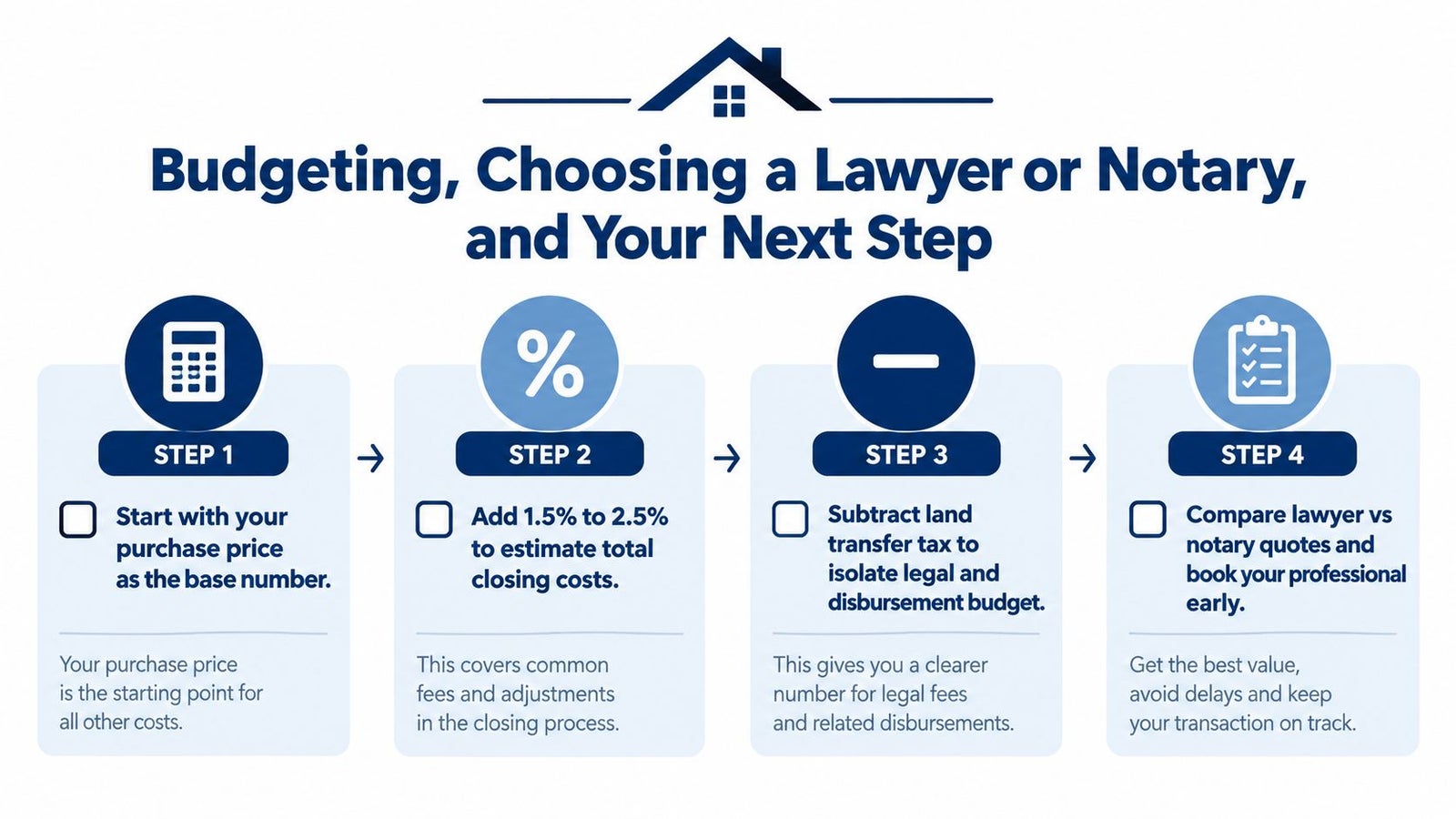
Before completion, make sure you have room for:
My advice is straightforward. Get three written quotes before you write the offer, or at minimum before subjects come off. Ask each office the same questions. Confirm they can handle your completion date. That gives you a real number to budget for, and it prevents the usual first-time buyer mistake of underestimating the legal side because one article gave you a single fee range.
If you want a buyer plan covering the offer, the subject period, the legal handoff, and the final completion cash you'll need, Jacky Levi - Vancouver Realtor helps Vancouver-area buyers coordinate those moving parts before they become last-minute problems. Visit Jacky Levi - Vancouver Realtor to get practical guidance on budgeting, contract strategy, and the professionals you'll need lined up before you buy.
I've seen buyers obsess over shaving a few hundred dollars off legal fees when buying a house while ignoring the much larger cash requirement that shows up right before completion. In BC, the better question isn't “What does a lawyer cost?” It's “What part of my closing statement is professional fees, what part is pass-through cost, and what gets more expensive when the deal gets messy?”
Why Legal and Closing Costs Catch BC Buyers Off Guard
A young couple in Burnaby gets an offer accepted at $925,000. They've stretched to assemble the down payment, they've paid for the inspection, and they think the hard part is over. Then the conveyancer's statement lands a few days before completion and the balance due isn't a few thousand dollars. It's a five-figure amount that has to be delivered fast.
That surprise happens because buyers often treat the down payment like the finish line. It isn't. It's only one part of the cash you need to close.
The statement arrives late in the process
Most first-time buyers don't see the final legal and closing numbers when they're emotionally deciding whether to write the offer. They see them after the deal is firm, when the lawyer or notary has mortgage instructions, title details, tax figures, and adjustment numbers.
That's why the math shifts at the end.
A BC purchase usually runs through a lawyer or notary, and the buyer should budget roughly $1,300 to $2,100 for standard legal or notarial work on a mortgage-backed purchase, including the common file disbursements that can add roughly $300 to $800 (Credit Resources closing cost breakdown). But even that isn't the line item that stings most buyers.
The bigger hit is often BC Property Transfer Tax, which must generally be paid when the property is registered and is typically handled at closing through the buyer's lawyer or notary. The tax can climb quickly under BC's marginal rate system, and one BC example puts the tax at roughly $17,000 on a $950,000 purchase (Lime Law BC closing costs overview).
Practical rule: If your budget only covers the down payment, your budget is incomplete.
Buyers need line items, not vague averages
Most guides throw out one legal fee number and stop there. That's not useful. Buyers need to know which charges are fixed, which are pass-through, and which ones increase because the file is more complex.
If you're planning your purchase, start with a proper home-buying roadmap so the legal side doesn't blindside you later. Jacky's Vancouver home-buying guide is a good place to get the process in order before you write the offer.
The Building Blocks of Closing Costs in British Columbia
A BC buyer can sign an accepted offer and still be short thousands at completion. The reason is simple. Closing costs are not one fee. They are a stack of separate charges, and each one behaves differently.
The five buckets buyers should expect
Read your completion statement in five parts. That is how buyers stop underestimating the cash they need.
- Purchase funds. This is the money applied to the price of the property. It includes your deposit, the rest of your down payment, and the mortgage funds if you are financing.
- Professional legal or notary fee. This is the charge for the lawyer's or notary's work. It covers the conveyance itself, including document preparation, lender paperwork, registrations, and closing the file. Keep this bucket separate from the next one, because this is the part you are paying the professional to do.
- Disbursements. These are pass-through expenses paid on your behalf. Common examples include Land Title filing charges, BC Online searches, courier costs, bank transfer fees, and title insurance if your lender requires it. Buyers often miss this distinction and assume every line belongs to the lawyer's fee. It does not.
- Government charges. Property Transfer Tax is usually the largest closing cost after the down payment. Other government registration charges can show up here too, depending on the file.
- Adjustments and lender-related costs. These are the balancing items that depend on timing and the property. They can include prepaid property taxes, strata fees, utility adjustments, appraisal costs, or lender-specific conditions.
Why buyers should split legal costs into two buckets
This is the part most BC guides blur together. They quote one legal number and move on. That shortcut causes bad budgeting.
Your professional fee is one decision point. Your disbursements are another. A clean condo purchase with one straightforward mortgage can produce a modest legal bill. The same buyer can still see a higher total closing invoice because the file needed extra searches, title insurance, wire costs, or more registrations. The bill rises because the transaction is more involved, not because the property sits in Vancouver instead of Burnaby.
That distinction matters.
If you ask a lawyer or notary for a quote, ask for these categories separately:
- professional fee
- expected disbursements
- GST
- Land Title and government registration charges
- title insurance, if applicable
Why each bucket moves differently
Price drives Property Transfer Tax. Timing drives adjustments. Lender instructions and file issues can raise disbursements. Complexity pushes legal work higher.
That is why two buyers paying the same purchase price can still have different completion costs.
The practical move is to budget each bucket on its own. A single blended estimate hides the charges most likely to surprise you.
If you want a useful number before you remove subjects, ask for a draft closing-cost breakdown, not a one-line quote.
Inside the Legal Fee Line Item
A buyer who budgets one flat “legal fee” usually underestimates the invoice.
The fix is simple. Split the bill into professional fees and pass-through disbursements before you compare quotes. That gives you a usable number and exposes where the total can climb.
Professional fee versus pass-through costs
In BC, legal and notary invoices are usually built the same way. One part pays the lawyer or notary for the conveyance work. The other part reimburses the out-of-pocket charges required to close the file.
The professional fee covers the actual handling of your purchase. The Society of Notaries Public of BC fee guide explains that fees vary by the work involved, which is exactly how buyers should read a quote. A clean resale condo with one standard mortgage sits near the lower end. Extra lender instructions, ownership issues, or unusual title work push it up.
Your professional fee usually covers:
- reviewing title and the contract
- preparing transfer and mortgage documents
- receiving and satisfying lender instructions
- registering the transfer and mortgage
- receiving purchase funds and paying out adjustments
- preparing your final reporting package
Ask one more question. Is the quoted professional fee for the purchase only, or for the purchase plus mortgage work? Some offices separate those charges. Others bundle them.
What disbursements are really paying for
Disbursements are not markup. They are the third-party costs attached to your file.
That distinction matters because buyers often react to a higher total quote without noticing that the professional fee was reasonable and the disbursements were doing the heavy lifting.
A few line items deserve plain-English treatment.
Land Title registration charges are government filing fees. They are not part of the lawyer's pay.
BC Online and title search charges cover records pulled to confirm the state of title and related registrations.
Wire, courier, and trust charges show up because money and signed documents have to move securely and on time.
Title insurance is often added on mortgage files and can be required by the lender.
Land Title registration charges are government filing fees. They are not part of the lawyer's pay.
BC Online and title search charges cover records pulled to confirm the state of title and related registrations.
Wire, courier, and trust charges show up because money and signed documents have to move securely and on time.
Title insurance is often added on mortgage files and can be required by the lender.
A quote that says “legal fees: $1,800” tells you almost nothing by itself. A quote that breaks out professional fees, disbursements, GST, and registration charges tells you whether you are comparing actual service cost or a mixed total.
The right question to ask
Ask for four lines. Professional fee. Estimated disbursements. GST. Government registration charges.
If an office will not separate those items, keep shopping. A first-time buyer does not need a prettier quote. You need a clearer one.
How Transaction Complexity Reshapes Your Legal Bill
Location isn't the main driver. Complexity is.
A straightforward Burnaby strata purchase can stay close to a standard quote. A trust sale, estate file, unusual title issue, or non-standard ownership structure can push the bill higher fast.
Side-by-side file comparison
BC-focused guidance notes that standard files are often priced near $1,400 to $1,600, while more complex cases such as corporate buyers, Agricultural Land Reserve properties, foreign-buyer status, and strata wind-ups can start around $2,500 and up (Bronson Job BC closing cost guide).
That gap is the story.
What usually makes the bill climb
A complex file often includes work that never appears in the buyer's first mental budget:
Non-standard seller capacity. A trust, estate, or corporate seller usually means more document review.
Extra lender instructions. Some lenders are simple. Others send detailed instructions and extra conditions.
Unusual contract terms. Reassignment clauses, holdbacks, occupancy arrangements, or bespoke undertakings increase legal time.
Title irregularities. Charges, easements, or registration issues can require more back-and-forth before completion.
The mistake buyers make is assuming a flat-fee quote means the entire file is routine. It doesn't. It usually means routine work is covered unless the file stops being routine.
Ask this before you hire anyone: Which parts of my Contract of Purchase and Sale fall outside a normal conveyance file?
That single question saves a lot of frustration.
Property Transfer Tax and Other Government Charges
Property Transfer Tax is the line item that blows up a first-time buyer budget in BC. Legal fees usually land in the low thousands. PTT can jump into five figures fast.
The province charges 1% on the first $200,000 of fair market value, 2% on the portion from $200,001 to $2,000,000, 3% from $2,000,001 to $3,000,000, and 5% above $3,000,000 for residential property (BC Property Transfer Tax rates and examples
Worked examples buyers can actually use
Use the bracket math before you write an offer, not after subjects are removed.
- $750,000 purchase: $2,000 on the first $200,000, plus $11,000 on the remaining $550,000. Total PTT: $13,000.
- $950,000 purchase: $2,000 on the first $200,000, plus $15,000 on the remaining $750,000. Total PTT: $17,000.
- $1.4 million purchase: $2,000 on the first $200,000, plus $24,000 on the remaining $1.2 million. Total PTT: $26,000.
That is why buyers who focus only on legal fees miss the bigger closing cost. The tax bill is usually the heavyweight.
If you want a plain-English breakdown before you start shopping, review this guide to Property Transfer Tax in BC.
Charges buyers confuse with legal fees
This section matters because BC buyers often lump everything into one bucket called "legal costs." That is the wrong way to budget.
Your lawyer or notary charges a professional fee for the conveyance. Government charges sit on top of that. So do pass-through disbursements and tax adjustments. Location does not usually make your legal bill spike. Complexity does. Government charges are different. They are driven by the property value, tax status, and what has already been paid on the property.
Extra tax exposure that needs an early check
BC also charges an additional property transfer tax on foreign entities and taxable trustees in prescribed regions (BC additional property transfer tax rules).
Check ownership structure and residency status before you get close to completion. If a buyer, co-buyer, or beneficial owner triggers extra tax, this is not a minor paperwork issue. It can change the cash you need by a huge amount.
This short explainer is useful if you want a quick visual overview before running your own numbers.
Other statutory and adjustment items
PTT is the biggest government charge for many buyers, but it is not the only amount that can appear on your completion statement. You may also see prorated municipal property taxes, strata fee adjustments, utility adjustments, and registration-related charges tied to the file.
Budget for them separately. Do not treat them as part of the lawyer's fee quote.
The tax system doesn't care that you already emptied your savings for the down payment. Completion funds still have to clear.
My advice is simple. Build two closing-cost buckets from day one. One for your conveyancer's fee and disbursements. One for taxes and government charges. That single habit prevents a lot of last-minute panic.
Timeline, Adjustments, and Documents You Will Sign
A clean closing feels calm because the prep was done early. A chaotic closing usually starts with missing documents, late mortgage instructions, or a buyer who didn't understand adjustments.
The timeline that matters
Once your offer is accepted, the first sprint is subject removal. Financing, document review, strata review if applicable, and any due diligence need to happen on schedule.
After subjects come off, your lawyer or notary opens the file fully. They'll need the contract, lender details, identification, and property information. As completion gets closer, the lender sends mortgage instructions and the conveyancer prepares the transfer package.
In practical terms, buyers should expect to deliver the balance needed for closing before the registration day. That usually means arranging your bank draft or wire early enough that trust funds are in place when the office needs them.
What adjustments mean in plain English
Adjustments are prorated credits and debits between buyer and seller.
If the seller already paid a property expense that covers time after your completion date, you reimburse the seller for your share through the statement of adjustments. If something like rent or another credit belongs to the buyer from the closing date onward, the statement reflects that too.
Common adjustment categories include:
- Property taxes already paid by the seller
- Strata fees allocated around the completion date
- Utilities or local charges if they're adjusted through the transaction
- Rental income on tenanted properties where income is allocated by date
The exact impact depends on timing. A mid-January closing and a late-August closing won't look the same because the prepaid expense picture is different.
Your legal package usually includes a stack of documents and confirmations, not just one signature page.
Expect to review or provide:
Documents most buyers will deal with
Your legal package usually includes a stack of documents and confirmations, not just one signature page.
Expect to review or provide:
- Statement of Adjustments showing who owes what at completion
- Property Transfer Tax return required for registration in BC
- Mortgage documents from your lender
- Title and transfer documents prepared by the lawyer or notary
- Strata forms, including Form B on condo or townhouse purchases
- GST or rebate paperwork where applicable on certain new housing transactions
- Government-issued ID for anti-money-laundering verification
For condo buyers, Jacky's explanation of the Form B Information Certificate for Vancouver condo buyers helps clarify one of the most commonly misunderstood strata documents.
A lot of BC buyers underestimate closing costs by thousands because they treat “legal fees” as one number. It is not one number. Your final bill has two parts: the professional fee your lawyer or notary charges for the work, and the disbursements and registration costs they pay out on your behalf. Complexity changes that bill far more than your city does.
For a planning benchmark, the RBC home buying costs guide notes that closing costs can run from 1.5% to 4% of the purchase price. Use that as your outside range. For first-pass budgeting, I'd be tighter and more practical. Build your cash plan with purchase price, down payment, Property Transfer Tax, and then a separate legal bucket that covers both professional fees and pass-through costs. That approach is a lot more accurate than grabbing one flat legal-fee number from a checklist.
Bring your insurance confirmation, your ID, and your mortgage details together early. Last-minute scrambling usually costs more than just stress.
Budgeting, Choosing a Lawyer or Notary, and Your Next Step
A lot of BC buyers underestimate closing costs by thousands because they treat “legal fees” as one number. It is not one number. Your final bill has two parts: the professional fee your lawyer or notary charges for the work, and the disbursements and registration costs they pay out on your behalf. Complexity changes that bill far more than your city does.
For a planning benchmark, the RBC home buying costs guide notes that closing costs can run from 1.5% to 4% of the purchase price. Use that as your outside range. For first-pass budgeting, I'd be tighter and more practical. Build your cash plan with purchase price, down payment, Property Transfer Tax, and then a separate legal bucket that covers both professional fees and pass-through costs. That approach is a lot more accurate than grabbing one flat legal-fee number from a checklist.
Your pre-completion cash checklist
Before completion, make sure you have room for:
- Down payment funds required under your contract
- Property Transfer Tax unless you qualify for an exemption
- Professional legal or notary fees
- Disbursements, registrations, and filing costs
- Adjustment items from the statement of adjustments
- GST if it applies to your purchase
- Lender-related closing charges tied to your mortgage instructions
This is also where good coordination saves money and stress. Buyers who understand the sequence early usually avoid last-minute wire issues, missing insurance confirmations, and rushed quote decisions. If you want a clear picture of who does what during the purchase, this guide to buyer agency and what Vancouver buyers should know explains how your agent fits alongside your lender and legal professional.
Ask for a written quote. Then read past the top line.
A useful quote separates the office's fee from the out-of-pocket costs they expect to incur for your file. If those items are blended together, you cannot tell whether one quote is cheaper or just less transparent.
Use this checklist:
Some warning signs are simple.
How to compare lawyer and notary quotes properly
Ask for a written quote. Then read past the top line.
A useful quote separates the office's fee from the out-of-pocket costs they expect to incur for your file. If those items are blended together, you cannot tell whether one quote is cheaper or just less transparent.
Use this checklist:
- Ask whether the professional fee is flat or can increase if the file gets more complicated
- Request a separate breakdown for disbursements so you can compare quotes properly
- Confirm whether the quote assumes a standard purchase or includes added work for strata, private lending, trusts, estates, or title issues
- Ask if title insurance is expected and whether it is included in the estimate
- Verify they regularly handle your property type because a condo, detached house, and estate sale do not produce the same legal work
- Confirm timing for signing, funding, and completion-day contact so you know how the office runs the file
Red flags I would treat seriously
Some warning signs are simple.
- A very low quote with no breakdown
- No clear split between professional fees and disbursements
- Vague answers about extra charges if the file gets complicated
- No discussion of your property type or mortgage setup
- Pressure to send funds before you understand the final statement
My advice is straightforward. Get three written quotes before you write the offer, or at minimum before subjects come off. Ask each office the same questions. Confirm they can handle your completion date. That gives you a real number to budget for, and it prevents the usual first-time buyer mistake of underestimating the legal side because one article gave you a single fee range.
If you want a buyer plan covering the offer, the subject period, the legal handoff, and the final completion cash you'll need, Jacky Levi - Vancouver Realtor helps Vancouver-area buyers coordinate those moving parts before they become last-minute problems. Visit Jacky Levi - Vancouver Realtor to get practical guidance on budgeting, contract strategy, and the professionals you'll need lined up before you buy.