
You're considering selling a Vancouver condo, townhouse, or detached home, but the usual question, “What's my property worth?” no longer has a simple answer. A recent sale nearby may look encouraging, while active listings are competing for the same buyers and asking prices are adjusting around you. You may also be wondering whether hiring a professional real estate agent is worth the fee when demand feels cautious.
In Greater Vancouver, the practical value of an agent isn't limited to finding a buyer. It's often about preventing an overly ambitious launch price, protecting your negotiating position, coordinating the work that makes a property marketable, and recognizing when a condo, detached home, or townhouse needs a different strategy. A buyer needs the same discipline in reverse, especially when comparing conditions, carrying costs, and competing homes.
This guide explains the role in plain language, starting with the regulated responsibilities behind the title. It then moves into pricing, market analysis, agent selection, marketing, negotiation, and transaction management. Along the way, you'll see practical Vancouver examples and clear actions you can take before choosing representation.
A homeowner in Vancouver might receive an online estimate, look at a neighbour's sold price, and decide to list slightly higher. That approach feels reasonable until buyers compare the home with newer listings, better-presented units, or properties in the same price band. If the first price misses current demand, the owner may spend valuable time defending a number that the market doesn't support.
That risk matters because British Columbia's real estate profession has expanded substantially. The number of licensed real estate agents rose from 20,825 to 29,416, an increase of almost 35%, while BCFSA recorded 29,441 total real estate licensees at year-end 2023. Business in Vancouver's reporting on the growth of BC real estate professionals shows why consumers face a crowded choice and why experience, process, and accountability deserve careful attention.
Greater Vancouver buyers and sellers aren't only paying for access to listings or a sign on the lawn. They need someone who can interpret local evidence, organize preparation, explain contractual choices, manage communication, and recognize when a negotiation is becoming expensive. A professional real estate agent acts more like a project manager and risk adviser than a person who opens doors.
By the end, you should be able to describe what an agent does, compare candidates sensibly, and prepare a useful first conversation. Your next step should be concrete: ask for a property-type and neighbourhood-specific comparative market analysis, then verify that the person advising you is licensed in British Columbia.
In British Columbia, a person who helps consumers buy, sell, or lease property must be licensed, must be at least 19 years old, and must meet BCFSA suitability requirements, including a criminal record check. BCFSA's licensing requirements provide the basic consumer protection behind the role.
The licensing pathway also requires specific education. Applicants complete the Real Estate Trading Services Licensing Course, pass the licensing exam with at least 70%, and finish the applied practice course for trading services. BCREA says course assignments take a minimum of 10 weeks, and many people complete the course and exam in about six months. BCREA's explanation of becoming a REALTOR® helps explain why the job involves more than informal property advice.
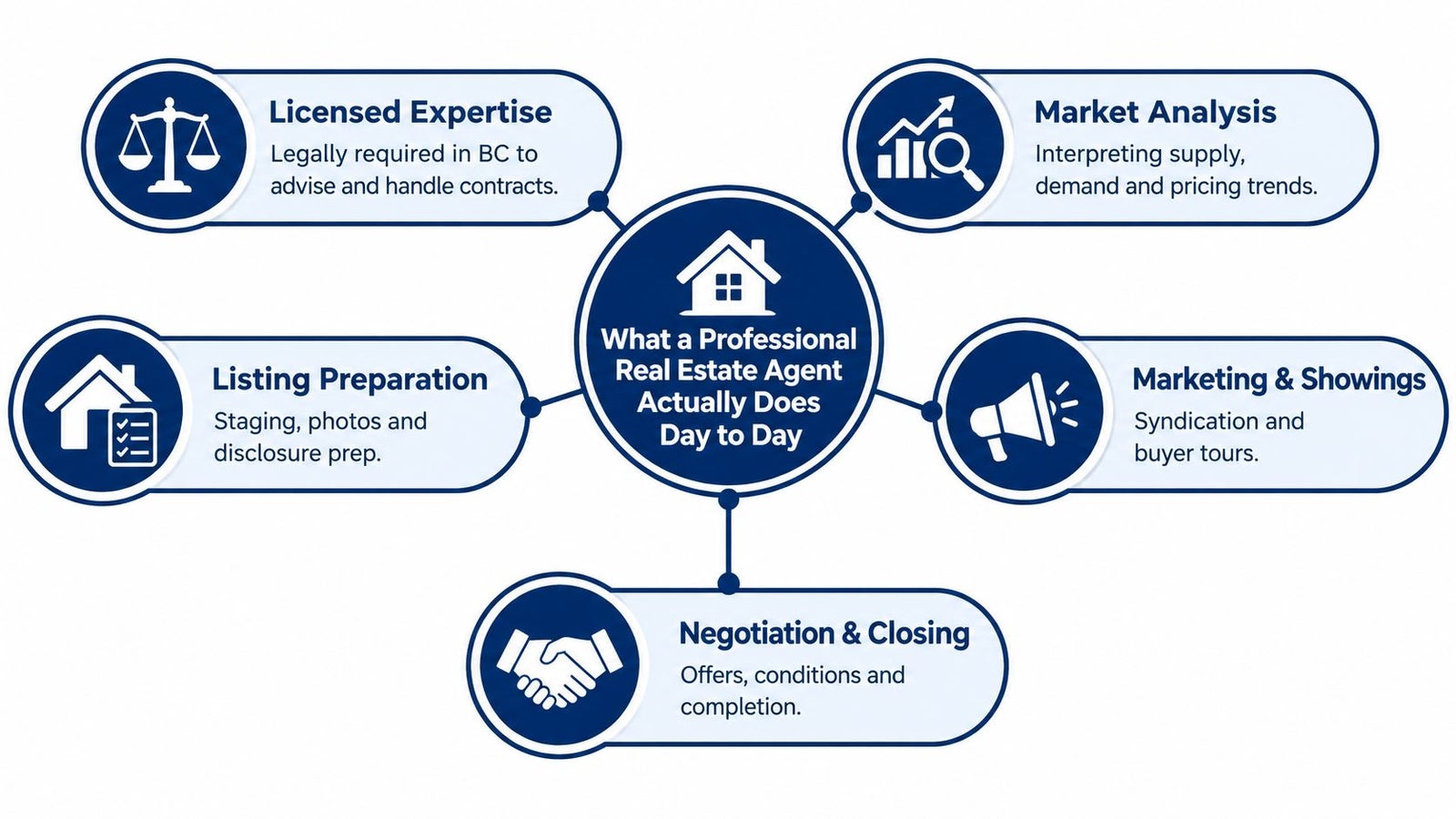
Think of the agent as the coordinator of a complicated project with a financial outcome. The work usually includes:
For a buyer, the same structure looks different. The agent helps narrow suitable properties, evaluates asking prices against comparable evidence, identifies practical concerns, prepares an offer, and manages conditions through completion. An informal opinion from a friend might be useful as a conversation, but it doesn't replace licensed advice, documentation, or transaction oversight.
Ask a prospective agent to describe what happens between your first meeting and closing. A clear answer should include decisions, timelines, documents, communication points, and the people responsible for each task.
Pricing is not a vote of confidence in your home. It's a positioning decision made against the listings buyers can choose today.
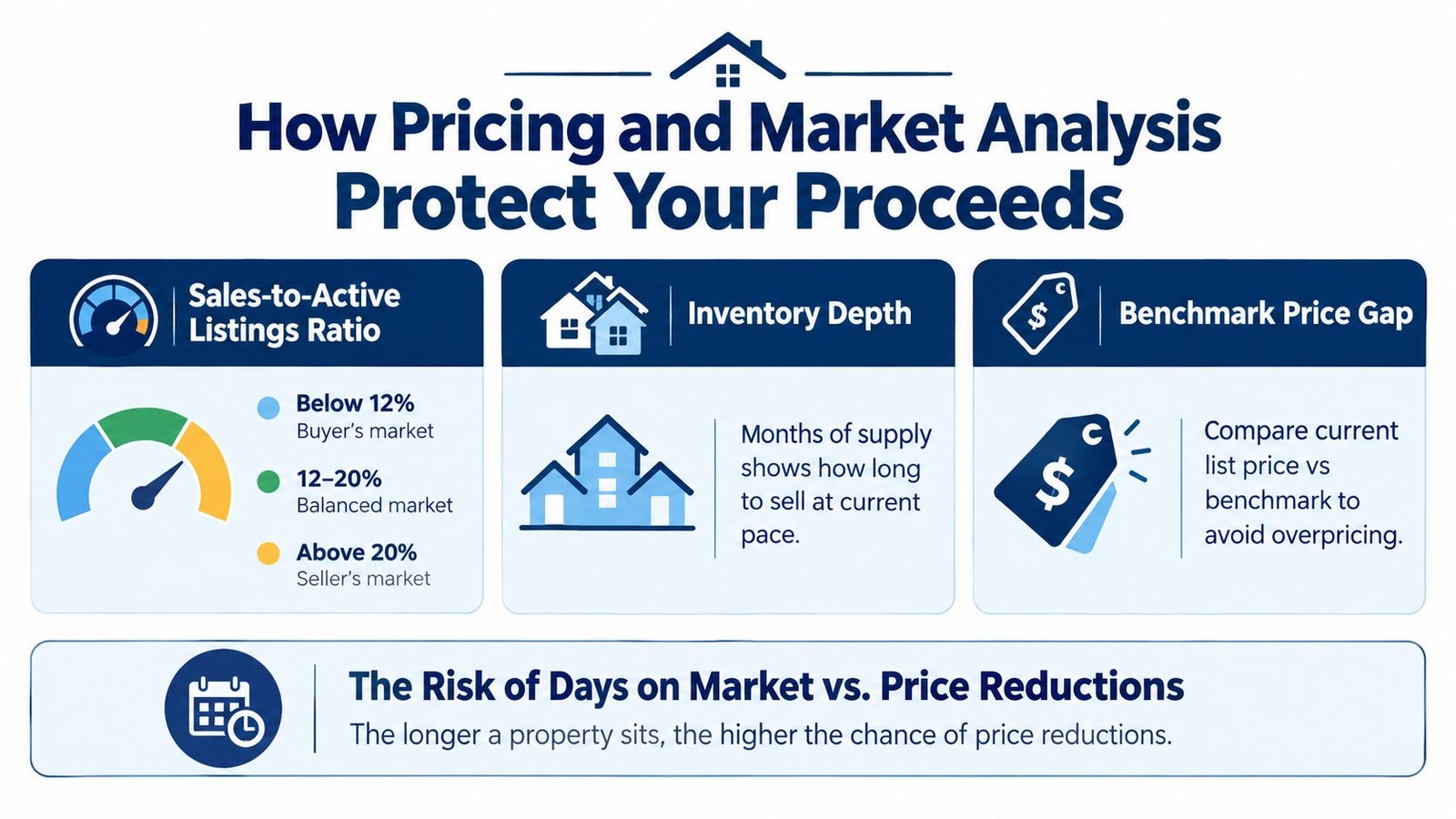
Greater Vancouver REALTORS® reported 16,476 active listings, 4,991 new listings, and a 13% sales-to-active-listings ratio in July 2026. The ratio was 10.5% for detached homes, 15.8% for attached homes, and 14% for apartments, while the composite MLS® HPI benchmark stood at $1,088,800, down 6.2% year over year. The Greater Vancouver REALTORS® MLS® statistics illustrate why recent sold properties alone can produce an incomplete pricing picture.
A sales-to-active-listings ratio helps describe how much buyer demand is absorbing available supply. A low-teens ratio can create more room for buyers to negotiate, particularly when a property competes with several similar homes. Inventory depth adds another layer, because a seller may be competing not only with last month's sales but also with current listings that haven't yet found a buyer.
Citywide averages can mislead. In June 2026, the Metro Vancouver MLS® HPI composite benchmark was $1,099,100, compared with approximately $1,822,900 for detached homes, $1,030,400 for townhouses, and $688,000 for apartments. Metro Vancouver benchmark data makes the practical point clear: a condo seller needs condo comparables, not a general market headline.
August 2026 conditions showed 15,798 active listings, 1,869 sales, and a 12.3% sales-to-active-listings ratio. The composite benchmark was $1,081,900, down 5.6% year over year, and inventory was 26.2% above the 10-year seasonal average. Market coverage connected to Greater Vancouver REALTORS® shows why strong presentation and timely feedback matter when buyers have substantial choice.
A practical comparative market analysis, or CMA, should examine the exact neighbourhood, property type, condition, exposure, floor plan, parking, outdoor space, and competing inventory. You can also read what a CMA means in real estate and why it matters before asking an agent to prepare one.
Before accepting a recommended list price, ask three questions:
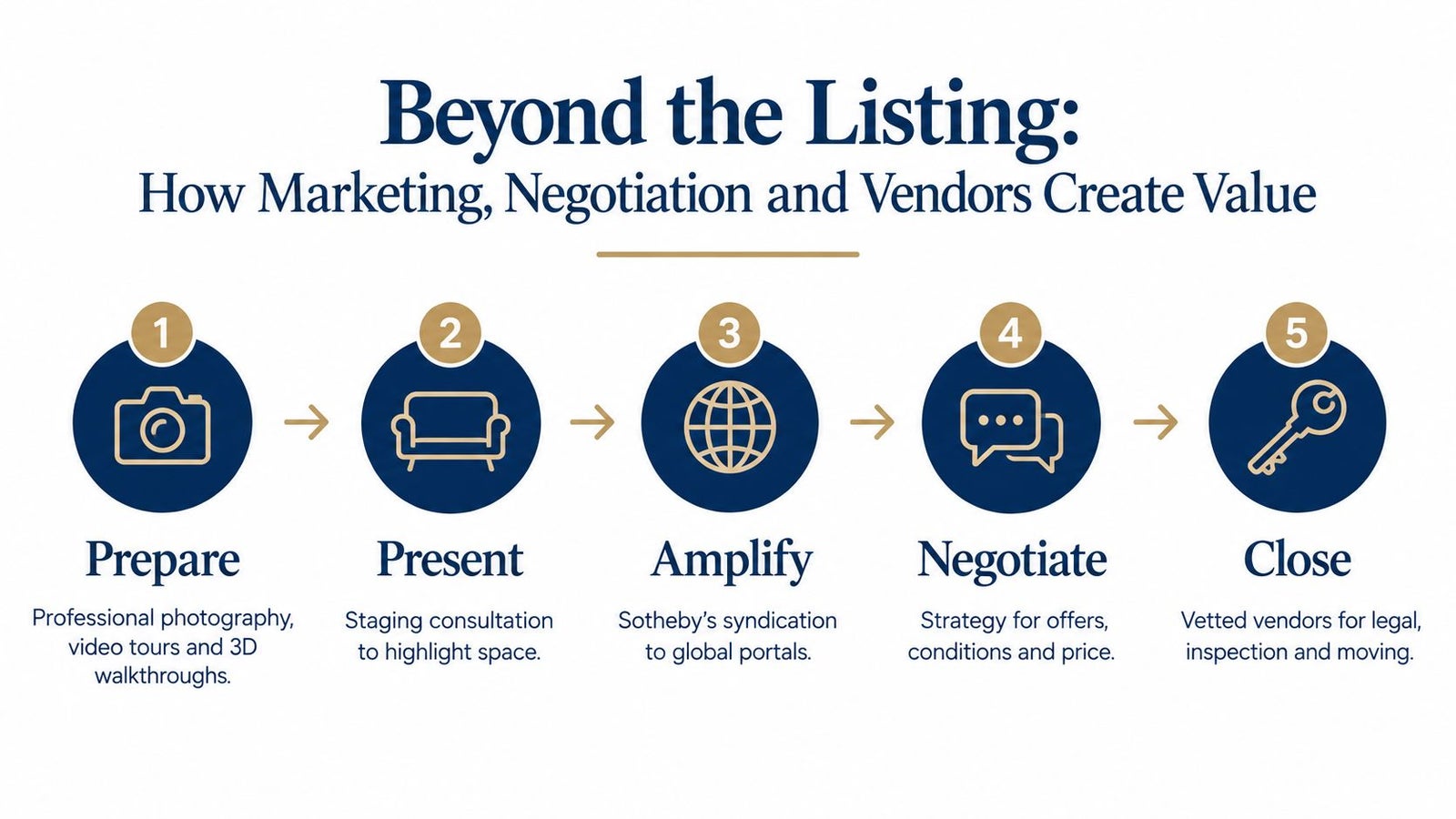
The agent's value comes from coordinating those pieces around a clear positioning decision. For example, if showings reveal that buyers understand the location but question storage, the agent can report that pattern, adjust the presentation, and help you decide whether the issue is marketing, price, or the property itself. These real estate marketing strategies for Vancouver sellers can help you assess whether a proposed plan is specific enough.
A coordinated seller workflow may include:

Now consider an owner living outside British Columbia. The property may need cleaning, minor repairs, staging, photography, and access for inspections, but the owner can't attend every appointment. The agent creates a checklist, coordinates trusted vendors, confirms the work, manages showings, and reports issues by video call or written update.
That owner still makes the important financial decisions. The agent provides local oversight so the seller isn't forced to manage a Vancouver property remotely through scattered messages and uncertain handoffs.
If you're selling a condo, request a CMA that includes building-specific and property-type comparables. If you're hiring remotely, verify the representative's BCFSA licence and ask exactly how access, vendors, feedback, and urgent decisions will be handled.
Choosing representation should come down to fit. You need an agent whose service matches the property, the geography, the complexity of the transaction, and the level of support you expect.
Jacky Levi is a licensed REALTOR® and Associate Broker with Sotheby's International Realty Canada, with over 20 years of experience in Greater Vancouver. The practice serves Vancouver Westside and East, North and West Vancouver, Burnaby, Richmond, Coquitlam, and surrounding communities, supporting sellers, buyers, and investors across condos, townhomes, and detached homes.
The service combines several elements discussed above: MLS-based pricing analysis, listing preparation, professional photography, video tours, 3D walkthroughs, staging consultation through Urban Presentations and related vendors, digital promotion, Sotheby's syndication, showings, feedback reporting, offer strategy, negotiation, and contract administration. It also includes referrals to mortgage specialists, lawyers, inspectors, cleaners, and packers, which can be especially useful for sellers managing a move or a property from outside the region.
The sensible next step isn't to commit during a first conversation. Ask for a property-specific CMA, a written launch plan, the proposed communication schedule, and an explanation of how competing listings will affect positioning. If you're comparing agents, verify licensing through BCFSA and ask who will manage the transaction from preparation through closing.
A focused consultation should leave you with a clearer price range, a practical preparation list, and an understanding of the decisions that will require your approval. That clarity is the starting point for a controlled Vancouver sale or purchase.
Jacky Levi - Vancouver Realtor offers Greater Vancouver buyers and sellers licensed representation, property-specific market analysis, coordinated listing preparation, marketing, negotiation, and closing support. Visit the site to book a consultation and request a comparative market analysis for your condo, townhouse, or detached home.
In Greater Vancouver, the practical value of an agent isn't limited to finding a buyer. It's often about preventing an overly ambitious launch price, protecting your negotiating position, coordinating the work that makes a property marketable, and recognizing when a condo, detached home, or townhouse needs a different strategy. A buyer needs the same discipline in reverse, especially when comparing conditions, carrying costs, and competing homes.
This guide explains the role in plain language, starting with the regulated responsibilities behind the title. It then moves into pricing, market analysis, agent selection, marketing, negotiation, and transaction management. Along the way, you'll see practical Vancouver examples and clear actions you can take before choosing representation.
Introduction Why Professional Guidance Matters in Greater Vancouver
A homeowner in Vancouver might receive an online estimate, look at a neighbour's sold price, and decide to list slightly higher. That approach feels reasonable until buyers compare the home with newer listings, better-presented units, or properties in the same price band. If the first price misses current demand, the owner may spend valuable time defending a number that the market doesn't support.
That risk matters because British Columbia's real estate profession has expanded substantially. The number of licensed real estate agents rose from 20,825 to 29,416, an increase of almost 35%, while BCFSA recorded 29,441 total real estate licensees at year-end 2023. Business in Vancouver's reporting on the growth of BC real estate professionals shows why consumers face a crowded choice and why experience, process, and accountability deserve careful attention.
Greater Vancouver buyers and sellers aren't only paying for access to listings or a sign on the lawn. They need someone who can interpret local evidence, organize preparation, explain contractual choices, manage communication, and recognize when a negotiation is becoming expensive. A professional real estate agent acts more like a project manager and risk adviser than a person who opens doors.
The practical question: Can this representative help you avoid a preventable pricing or negotiation mistake?
By the end, you should be able to describe what an agent does, compare candidates sensibly, and prepare a useful first conversation. Your next step should be concrete: ask for a property-type and neighbourhood-specific comparative market analysis, then verify that the person advising you is licensed in British Columbia.
What a Professional Real Estate Agent Actually Does Day to Day
In British Columbia, a person who helps consumers buy, sell, or lease property must be licensed, must be at least 19 years old, and must meet BCFSA suitability requirements, including a criminal record check. BCFSA's licensing requirements provide the basic consumer protection behind the role.
The licensing pathway also requires specific education. Applicants complete the Real Estate Trading Services Licensing Course, pass the licensing exam with at least 70%, and finish the applied practice course for trading services. BCREA says course assignments take a minimum of 10 weeks, and many people complete the course and exam in about six months. BCREA's explanation of becoming a REALTOR® helps explain why the job involves more than informal property advice.
The daily workflow
Think of the agent as the coordinator of a complicated project with a financial outcome. The work usually includes:
- Market analysis: Reviewing comparable sales, competing listings, supply, demand, and property-specific details rather than relying on a broad city average.
- Preparation: Recommending repairs, staging, photography, disclosure materials, and a launch schedule.
- Marketing and showings: Publishing the listing, arranging private tours, answering buyer questions, and collecting feedback.
- Offer strategy: Comparing price, deposit, financing, conditions, dates, and other terms.
- Negotiation and completion: Communicating with the other side, tracking deadlines, and coordinating with lawyers, inspectors, lenders, and other professionals.
For a buyer, the same structure looks different. The agent helps narrow suitable properties, evaluates asking prices against comparable evidence, identifies practical concerns, prepares an offer, and manages conditions through completion. An informal opinion from a friend might be useful as a conversation, but it doesn't replace licensed advice, documentation, or transaction oversight.
Ask a prospective agent to describe what happens between your first meeting and closing. A clear answer should include decisions, timelines, documents, communication points, and the people responsible for each task.
How Pricing and Market Analysis Protect Your Proceeds
Pricing is not a vote of confidence in your home. It's a positioning decision made against the listings buyers can choose today.
Greater Vancouver REALTORS® reported 16,476 active listings, 4,991 new listings, and a 13% sales-to-active-listings ratio in July 2026. The ratio was 10.5% for detached homes, 15.8% for attached homes, and 14% for apartments, while the composite MLS® HPI benchmark stood at $1,088,800, down 6.2% year over year. The Greater Vancouver REALTORS® MLS® statistics illustrate why recent sold properties alone can produce an incomplete pricing picture.
A sales-to-active-listings ratio helps describe how much buyer demand is absorbing available supply. A low-teens ratio can create more room for buyers to negotiate, particularly when a property competes with several similar homes. Inventory depth adds another layer, because a seller may be competing not only with last month's sales but also with current listings that haven't yet found a buyer.
Property type changes the answer
Citywide averages can mislead. In June 2026, the Metro Vancouver MLS® HPI composite benchmark was $1,099,100, compared with approximately $1,822,900 for detached homes, $1,030,400 for townhouses, and $688,000 for apartments. Metro Vancouver benchmark data makes the practical point clear: a condo seller needs condo comparables, not a general market headline.
August 2026 conditions showed 15,798 active listings, 1,869 sales, and a 12.3% sales-to-active-listings ratio. The composite benchmark was $1,081,900, down 5.6% year over year, and inventory was 26.2% above the 10-year seasonal average. Market coverage connected to Greater Vancouver REALTORS® shows why strong presentation and timely feedback matter when buyers have substantial choice.
A practical comparative market analysis, or CMA, should examine the exact neighbourhood, property type, condition, exposure, floor plan, parking, outdoor space, and competing inventory. You can also read what a CMA means in real estate and why it matters before asking an agent to prepare one.
Before accepting a recommended list price, ask three questions:
- Which active listings will buyers compare with mine?
- What evidence supports the proposed pricing range?
- What is the plan if showings generate interest but no acceptable offer?
That conversation can prevent the familiar pattern of launching high, waiting, reducing, and negotiating from a weaker position.
A good interview should test process, not personality alone. Two agents may both sound confident, but one may offer a detailed plan for your building and neighbourhood while the other relies on broad market language.
BCFSA reported that more than 5,800 people participated in licensing courses during 2023. Its quarterly statistics recorded 29,304 licensed real estate professionals on June 30, 2024, 29,402 on September 30, 2024, and 29,441 on December 31, 2024. WorkBC identified 19,785 people employed as real estate agents and salespersons in BC, including 14,510 in Mainland/Southwest BC, or 73.4% of provincial employment in the occupation. BCFSA's licensing and enforcement statistics show why local proof matters in the region where you're buying or selling.
Compare candidates with evidence
Licensing and professional standing
What to ask for: Can I verify your licence through BCFSA? How do you stay current with renewal requirements?
Why it matters in Vancouver: You're placing important decisions with a regulated representative.
How to Choose the Right Agent in Greater Vancouver
A good interview should test process, not personality alone. Two agents may both sound confident, but one may offer a detailed plan for your building and neighbourhood while the other relies on broad market language.
BCFSA reported that more than 5,800 people participated in licensing courses during 2023. Its quarterly statistics recorded 29,304 licensed real estate professionals on June 30, 2024, 29,402 on September 30, 2024, and 29,441 on December 31, 2024. WorkBC identified 19,785 people employed as real estate agents and salespersons in BC, including 14,510 in Mainland/Southwest BC, or 73.4% of provincial employment in the occupation. BCFSA's licensing and enforcement statistics show why local proof matters in the region where you're buying or selling.
Compare candidates with evidence
Licensing and professional standing
What to ask for: Can I verify your licence through BCFSA? How do you stay current with renewal requirements?
Why it matters in Vancouver: You're placing important decisions with a regulated representative.
Local proof
What to ask for: Which recent sales resemble my property in building, neighbourhood, and type?
Why it matters in Vancouver: A detached home, townhouse, and apartment can behave differently.
What to ask for: Which recent sales resemble my property in building, neighbourhood, and type?
Why it matters in Vancouver: A detached home, townhouse, and apartment can behave differently.
Pricing process
What to ask for: Can you show me the comparable sales and current competing listings?
Why it matters in Vancouver: The launch price needs to reflect present choice, not only historical results.
What to ask for: Can you show me the comparable sales and current competing listings?
Why it matters in Vancouver: The launch price needs to reflect present choice, not only historical results.
Marketing plan
What to ask for: Which photography, video, staging, syndication, and showing tools will you use?
Why it matters in Vancouver: Buyers need clear information before deciding whether to view.
What to ask for: Which photography, video, staging, syndication, and showing tools will you use?
Why it matters in Vancouver: Buyers need clear information before deciding whether to view.
Communication
What to ask for: Who reports feedback, how often, and in what format?
Why it matters in Vancouver: Fast adjustments are easier when information arrives in an organised way.
What to ask for: Who reports feedback, how often, and in what format?
Why it matters in Vancouver: Fast adjustments are easier when information arrives in an organised way.
Transaction management
What to ask for: Who tracks conditions, documents, dates, and professional referrals?
Why it matters in Vancouver: Small administrative gaps can create stress at the most time-sensitive stage.
What to ask for: Who tracks conditions, documents, dates, and professional referrals?
Why it matters in Vancouver: Small administrative gaps can create stress at the most time-sensitive stage.
You can use this guide to choose a Vancouver REALTOR® as a further interview reference, but your own questions should remain property-specific.
A brokerage can also matter. Ask whether the agent has support for contracts, marketing production, listing coordination, and complex transactions. If you're interviewing an associate broker, clarify what the broker personally handles and what assistants or vendors manage.
Verify the licence through BCFSA before signing a listing or representation agreement. Then ask the agent to explain how they maintain current knowledge of BC licensing, renewal, documentation, and transaction requirements. A polished presentation is useful, but verifiable competence and a repeatable process protect you more directly.
A listing becomes effective when several ordinary tasks work together. Professional photography attracts attention, video tours help buyers understand movement and layout, and a 3D walkthrough can give remote or time-constrained viewers a better sense of the space. Staging consultation can then address furniture scale, sightlines, colour, and the first impression created when buyers enter.
A brokerage can also matter. Ask whether the agent has support for contracts, marketing production, listing coordination, and complex transactions. If you're interviewing an associate broker, clarify what the broker personally handles and what assistants or vendors manage.
Verify the licence through BCFSA before signing a listing or representation agreement. Then ask the agent to explain how they maintain current knowledge of BC licensing, renewal, documentation, and transaction requirements. A polished presentation is useful, but verifiable competence and a repeatable process protect you more directly.
Beyond the Listing: How Marketing, Negotiation, and Vendors Create Value
A listing becomes effective when several ordinary tasks work together. Professional photography attracts attention, video tours help buyers understand movement and layout, and a 3D walkthrough can give remote or time-constrained viewers a better sense of the space. Staging consultation can then address furniture scale, sightlines, colour, and the first impression created when buyers enter.
The agent's value comes from coordinating those pieces around a clear positioning decision. For example, if showings reveal that buyers understand the location but question storage, the agent can report that pattern, adjust the presentation, and help you decide whether the issue is marketing, price, or the property itself. These real estate marketing strategies for Vancouver sellers can help you assess whether a proposed plan is specific enough.
Execution continues after the photos
A coordinated seller workflow may include:
- Preparation: Photography, video tours, 3D walkthroughs, disclosure preparation, and staging advice.
- Distribution: MLS exposure, digital promotion, and syndication through the Sotheby's International Realty network where appropriate.
- Feedback: Private showings, open houses, questions from buyer representatives, and organized reporting.
- Negotiation: Reviewing price alongside conditions, dates, financing language, deposits, and completion risk.
- Completion: Referrals to mortgage specialists, lawyers, inspectors, cleaners, packers, and other vendors.
Suppose a buyer offers a strong price but asks for conditions that create uncertainty. A professional agent can help you compare the entire offer rather than treating the headline number as the only issue. Another buyer may offer less but provide cleaner timing and fewer obstacles. The decision belongs to you, but clear comparison reduces emotional reactions.
For an out-of-town owner, the coordination becomes even more practical. Someone needs to arrange access, meet vendors, check that preparation is complete, communicate showing feedback, and escalate problems before they affect the transaction. Marketing creates attention, but transaction management converts attention into a controlled process.
Consider a Vancouver condo owner whose building has several similar units for sale. The owner sees a higher asking price in a nearby tower and wants to match it, but buyers are comparing monthly carrying costs, parking, storage, renovations, floor height, exposure, and strata documents. A professional agent studies the building's relevant sales and active competition, recommends a price band that reflects the unit's actual advantages, and uses staging and photography to make the floor plan easier to understand.
The owner's outcome isn't guaranteed, and no responsible agent can promise a particular sale price. The immediate benefit is better decision-making. Instead of treating every condo as interchangeable, the seller understands which features justify a premium, which objections may arise, and how quickly to respond if buyer feedback points to a positioning problem. This seven-step guide to a Vancouver condo sale offers a useful preparation reference.
For an out-of-town owner, the coordination becomes even more practical. Someone needs to arrange access, meet vendors, check that preparation is complete, communicate showing feedback, and escalate problems before they affect the transaction. Marketing creates attention, but transaction management converts attention into a controlled process.
Practical Examples From Condo Sellers to Out-of-Town Owners
Consider a Vancouver condo owner whose building has several similar units for sale. The owner sees a higher asking price in a nearby tower and wants to match it, but buyers are comparing monthly carrying costs, parking, storage, renovations, floor height, exposure, and strata documents. A professional agent studies the building's relevant sales and active competition, recommends a price band that reflects the unit's actual advantages, and uses staging and photography to make the floor plan easier to understand.
The owner's outcome isn't guaranteed, and no responsible agent can promise a particular sale price. The immediate benefit is better decision-making. Instead of treating every condo as interchangeable, the seller understands which features justify a premium, which objections may arise, and how quickly to respond if buyer feedback points to a positioning problem. This seven-step guide to a Vancouver condo sale offers a useful preparation reference.
Now consider an owner living outside British Columbia. The property may need cleaning, minor repairs, staging, photography, and access for inspections, but the owner can't attend every appointment. The agent creates a checklist, coordinates trusted vendors, confirms the work, manages showings, and reports issues by video call or written update.
That owner still makes the important financial decisions. The agent provides local oversight so the seller isn't forced to manage a Vancouver property remotely through scattered messages and uncertain handoffs.
Market lesson: In a slower market, the agent's job is often to prevent a pricing mistake before trying to recover from one.
If you're selling a condo, request a CMA that includes building-specific and property-type comparables. If you're hiring remotely, verify the representative's BCFSA licence and ask exactly how access, vendors, feedback, and urgent decisions will be handled.
Why Work With Jacky Levi and Your Next Steps in Vancouver
Choosing representation should come down to fit. You need an agent whose service matches the property, the geography, the complexity of the transaction, and the level of support you expect.
Jacky Levi is a licensed REALTOR® and Associate Broker with Sotheby's International Realty Canada, with over 20 years of experience in Greater Vancouver. The practice serves Vancouver Westside and East, North and West Vancouver, Burnaby, Richmond, Coquitlam, and surrounding communities, supporting sellers, buyers, and investors across condos, townhomes, and detached homes.
The service combines several elements discussed above: MLS-based pricing analysis, listing preparation, professional photography, video tours, 3D walkthroughs, staging consultation through Urban Presentations and related vendors, digital promotion, Sotheby's syndication, showings, feedback reporting, offer strategy, negotiation, and contract administration. It also includes referrals to mortgage specialists, lawyers, inspectors, cleaners, and packers, which can be especially useful for sellers managing a move or a property from outside the region.
The sensible next step isn't to commit during a first conversation. Ask for a property-specific CMA, a written launch plan, the proposed communication schedule, and an explanation of how competing listings will affect positioning. If you're comparing agents, verify licensing through BCFSA and ask who will manage the transaction from preparation through closing.
A focused consultation should leave you with a clearer price range, a practical preparation list, and an understanding of the decisions that will require your approval. That clarity is the starting point for a controlled Vancouver sale or purchase.
Jacky Levi - Vancouver Realtor offers Greater Vancouver buyers and sellers licensed representation, property-specific market analysis, coordinated listing preparation, marketing, negotiation, and closing support. Visit the site to book a consultation and request a comparative market analysis for your condo, townhouse, or detached home.