Detached houses accounted for 42.4% of occupied dwellings across British Columbia, but only 14.7% in the City of Vancouver, according to Statistics Canada's census housing summary. That contrast reframes the townhouse vs detached house decision: you're choosing within a local housing market, not between interchangeable buildings.
A townhouse isn't just a cheaper detached house. It trades some private maintenance for shared financial and governance risk. The useful comparison is between complete ownership budgets in the same municipality, with the documents, condition and daily routine attached to each property.
Townhouse and detached house compared on core ownership factors
The basic exchange is less land and less direct control for a lower entry price and coordinated upkeep. Detached ownership generally offers more space and independence, but you become the person who selects contractors, approves work and pays for every private repair.
Don't confuse architectural style with legal ownership. A separate front door, private garage and fenced garden don't establish who owns or maintains the roof. Equally, a freestanding house isn't proof that there's no strata corporation.
Consider a hypothetical couple with two children comparing a three-bedroom townhouse with a yard-sized patio against a three-bedroom detached house in the same municipality. Both homes may accommodate the family, but the bedrooms alone won't settle the choice.
In the townhouse, the parents should test whether the patio works for outdoor meals, where bicycles go, and whether the bedroom layout separates noisy activities from sleeping children. In the detached house, they should check whether the yard is useful or another maintenance obligation.
Listen during a showing. Stand beside shared walls and near garage doors. Ask about sound complaints rather than assuming newer finishes mean better acoustic separation.
Test ordinary routines. Carry groceries from the parking space to the kitchen and walk the route from the children's bedrooms to the bathroom.
Check alteration plans. A workshop, fence change or exterior equipment installation needs an ownership and approval check before it becomes part of your buying decision.
Neither category guarantees comfort. A well-planned townhouse can function better than a larger detached house with awkward circulation, while a usable private lot may justify substantial extra expense for a household that gardens, entertains or needs workspace. Price, repair obligations, resale prospects and lifestyle fit all need to support the same decision.
A townhouse's local competition matters as much as its building type. One beside established detached streets may attract different buyers from one surrounded by apartments and mixed-use development, even within the same municipality.
Statistics Canada's Census Profile reports that in the 2021 Vancouver metropolitan area, single-detached houses numbered 288,775, or 27.7% of occupied private dwellings. The figures also show how attached housing contributes to the region's mix.
Occupied dwellings by type, 2021 Census
The visual comparison makes the entry-price difference clear, but it doesn't establish either household's affordable payment.
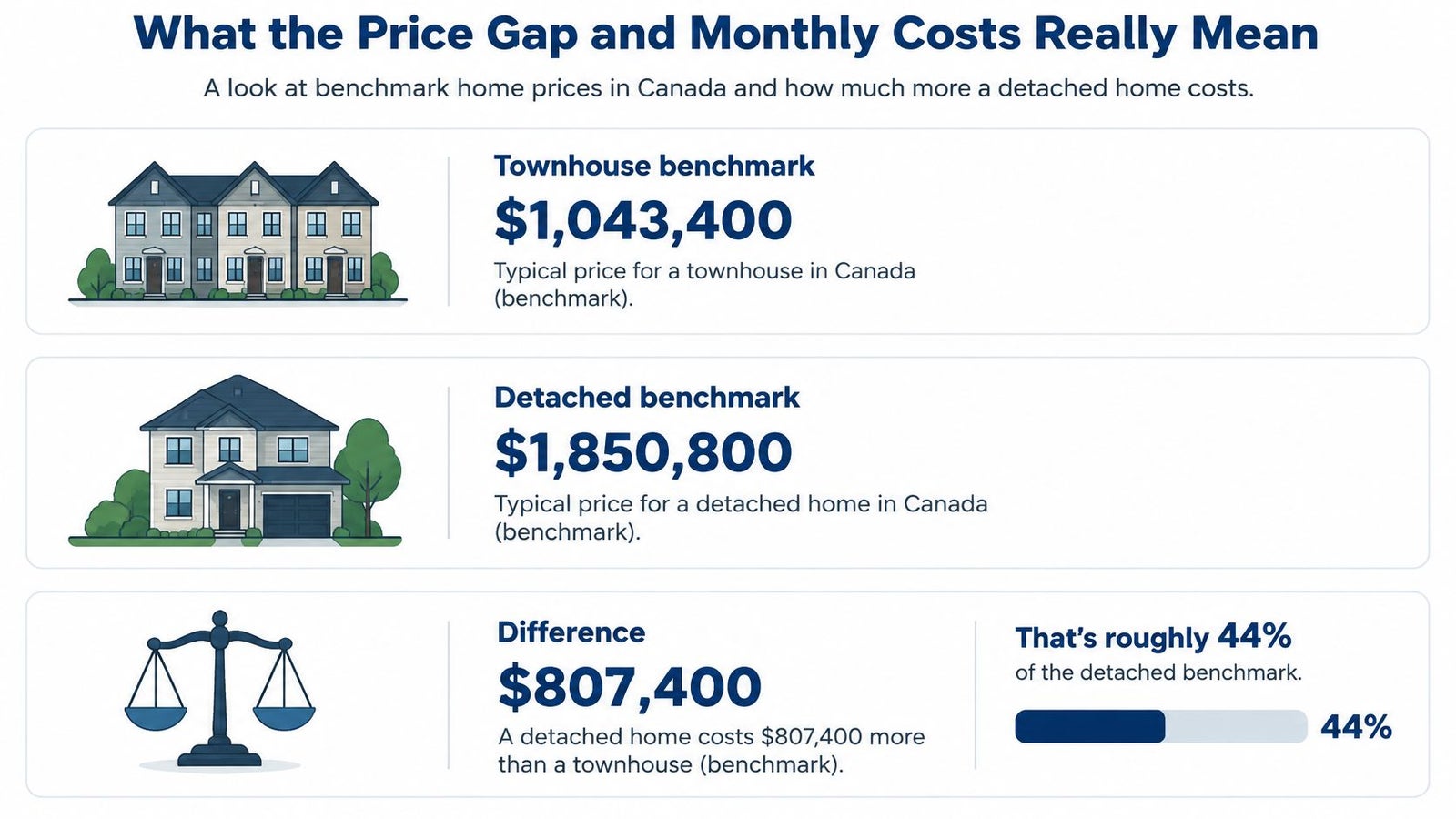
Start with the mortgage remaining after your down payment. Have the lender calculate the payment and confirm qualification rather than applying an advertised rate to the full asking price.
Then add the property-specific expenses. For the townhouse, include the strata fee, owner's insurance, utilities, property tax and a personal reserve for assessments. Read the budget before treating contingency-fund contributions as an additional monthly charge: those contributions may already be included in the strata fee.
Use the actual tax notice and applicable adjustments, supported by this Vancouver property tax guide, rather than assuming tax moves directly with the asking price.
Illustrative example, not a market quotation: compare a townhouse priced at $1,000,000 with a $500 monthly strata fee against a detached house priced at $1,800,000 with no strata fee. Hold the financing assumptions consistent, then give the detached property a realistic repair allowance for its roof, exterior and drainage. Leaving that allowance blank makes the detached budget look artificially lean.
Similar townhouse asking prices can hide very different obligations. A complex with an adequately funded maintenance plan isn't financially equivalent to one with deferred envelope repairs and unresolved insurance claims.
Check these cost categories separately:
The detached column assumes a non-strata property. For a townhouse, the strata plan and bylaws establish the ownership boundaries and repair obligations, while the depreciation report helps identify the assets and planned work. Don't use a general responsibility chart as a substitute for those documents.
This visual provides a starting checklist for the ownership review.
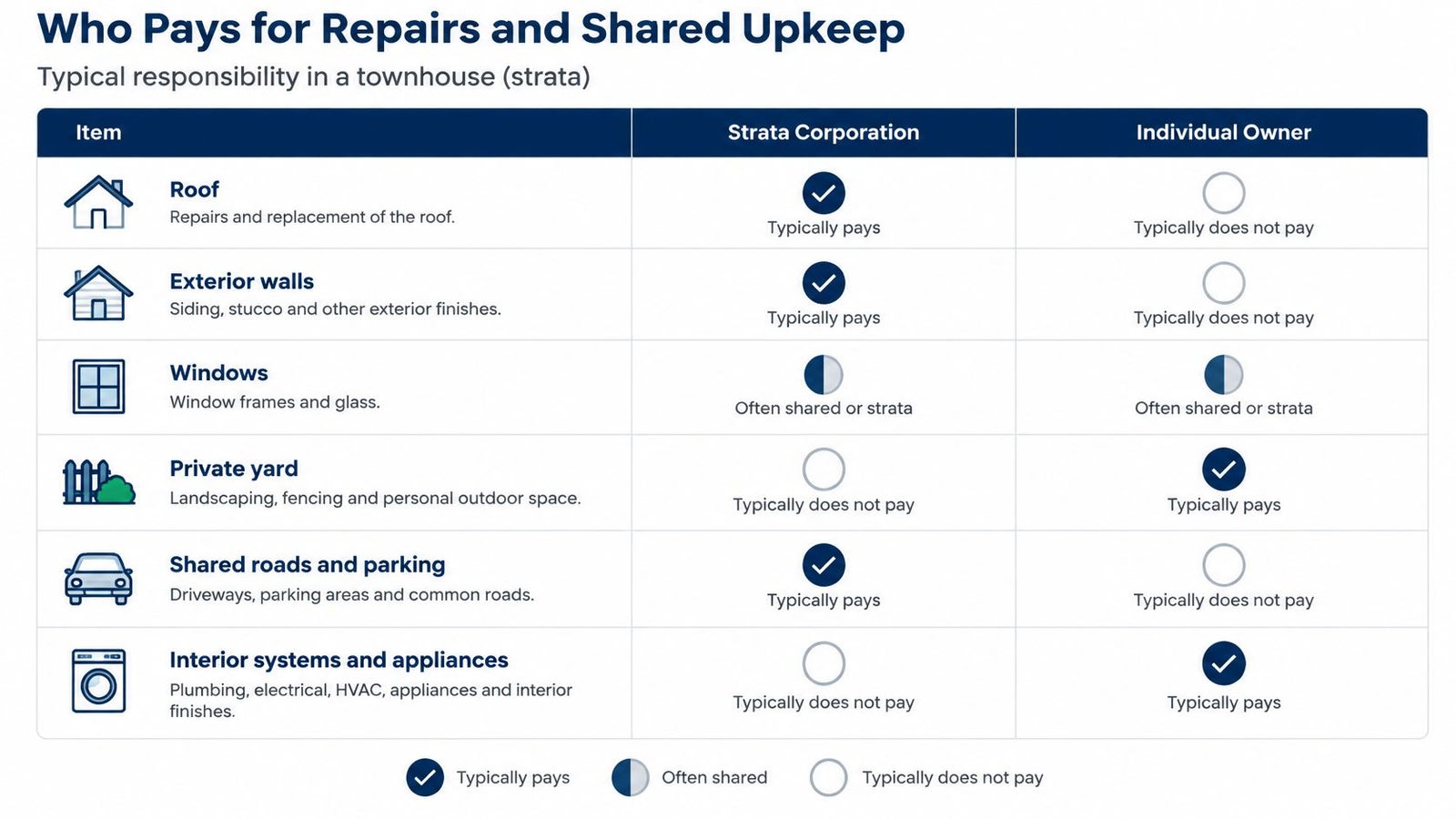
The B.C. government's depreciation-report guidance requires strata corporations with five or more strata lots to obtain a report on a five-year cycle, assessing common assets and anticipated repair or replacement costs over 30 years.
The report isn't evidence that the money is already available. Read its recommendations alongside the operating budget, contingency reserve balance and meeting minutes. Look for whether owners have approved funding, postponed projects or requested further investigation.
Consider a hypothetical complex whose report flags roofing and parkade work within five years. Regular contributions might fund the work, or owners might face a special levy. A buyer needs to understand the proposed funding approach, not merely note that a report exists.
A patio or balcony can also be assigned for a particular unit's use while remaining subject to strata rules. The provincial depreciation-report requirements identify the range of shared building and site assets that can require long-term assessment.
Obtain the strata plan, bylaws, latest depreciation report, recent meeting minutes, current budget, reserve balance, insurance information and details of proposed projects. Give your lawyer, inspector and insurer enough time to assess the records relevant to their work.
For a detached property, use the inspection to build a component-by-component plan rather than a generic maintenance percentage. This guide to maintaining a detached home in Vancouver helps organize the obligations that remain yours alone.
Confirm the following in writing during the review period:
A lower purchase price doesn't automatically mean weaker resale performance. Nor does owning more land guarantee a better return. Resale value depends on what competing buyers can purchase nearby and what obligations they'll inherit.
Townhouses can appeal to first-time buyers seeking more usable space and downsizers who don't want to organize every exterior repair. Detached homes attract buyers who prioritize private land, separation and the possibility of changing the property. Neither buyer pool is unlimited, and neither guarantees a particular result.
For a townhouse, review the reserve balance, depreciation report, pending levies, building age and maintenance history. Examine bylaws affecting the intended use, but have legal counsel confirm whether any apparent rental restriction is enforceable rather than accepting an old bylaw at face value.
For a detached home, assess lot dimensions, current zoning, renovation quality, sewer connection and drainage. Treat redevelopment potential as something to verify with the municipality, not as an automatic premium attached to a large yard.
Consider hypothetical townhouses with similar asking prices. One has documented roof work and a reserve aligned with its maintenance plan; the other has an approaching levy with unresolved scope. Buyers won't necessarily offer the same price or accept the same conditions.
Fix active roof leaks, investigate failing drainage and clarify outstanding levy obligations before spending heavily on decorative changes. Paint and fixtures can improve presentation, but they don't resolve uncertainty about water entry or structural repairs.
Don't assume every renovation pays for itself. We advise sellers which repairs and upgrades offer the best return on investment and whether upgrades make sense before listing.
Use a comparative market analysis to distinguish necessary preparation from speculative spending. Recent sales in the same complex, comparable neighbouring developments or the same street provide a stronger basis for pricing than a blanket belief that one housing form always appreciates better.
Choose the obligations you can manage, not just the floor plan you prefer. Budget, physical access, outdoor needs and tolerance for collective decisions can point in different directions.
The choice is easier when you pair each preference with the check that could overturn it.
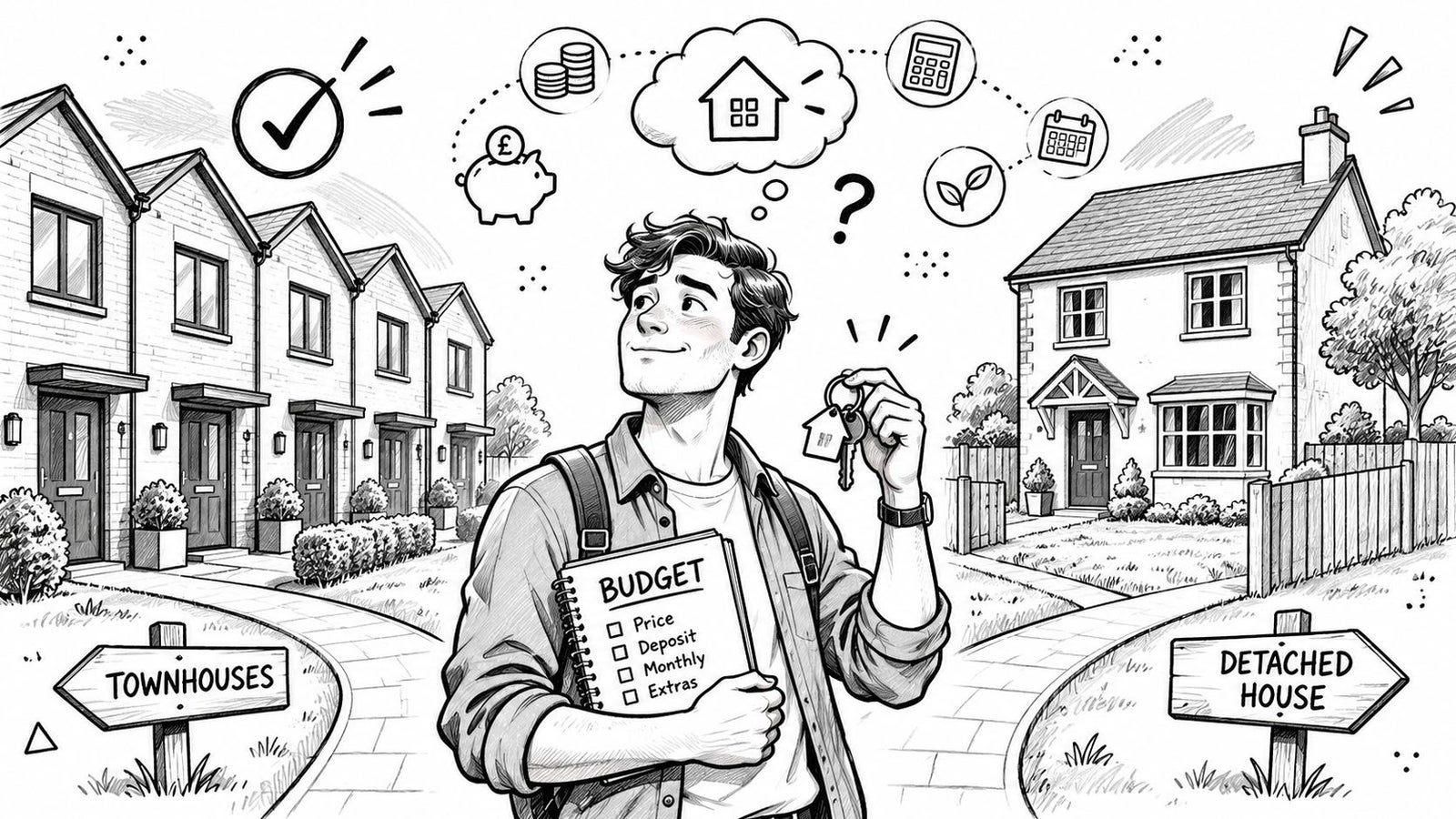
First-time buyer with a tight budget. A townhouse is often the more workable starting point if you accept shared walls and strata governance. The check that can reverse that choice is an unfunded project or upcoming levy that would consume your remaining savings.
Family needing outdoor space or a workshop. Start with detached homes when those uses are essential. Confirm usable lot area and zoning before paying for expansion plans that may not be permitted.
Investor seeking rental flexibility. Verify the intended rental use before comparing returns. Have a lawyer check current legislation, enforceable bylaws and municipal requirements, especially where short-term accommodation forms part of the plan.
Downsizer wanting easier upkeep. A townhouse can work, but don't confuse reduced yard work with accessible living. Check stairs, bedroom location, parking access and whether the building's condition suits your appetite for future disruption.
Buyer prioritising land. A detached property may fit if you're deliberately purchasing a desirable parcel. Test the land component against comparable sales rather than assuming local appreciation will continue.
Our clients include first-time homebuyers, seasoned investors and homeowners looking to sell. Their priorities differ, so a recommendation should identify the constraint that matters most rather than rank housing types in the abstract.
Consider a hypothetical couple with two children weighing a three-bedroom townhouse near work against a detached house in a farther suburb. The detached option might deliver the garden they want, but it also changes school travel, commuting, vehicle use and time available at home.
Compare the total monthly cost and travel routine together. Try the commute at the times you'd make it, and check how activities, childcare and grocery trips fit around it.
Use these questions to ask when buying a townhouse in Vancouver to test a shortlist before becoming attached to the finishes. There's no universal verdict: a townhouse with sound finances and suitable space can be a better purchase than a detached house with a failing roof, just as a manageable detached property can be better than a poorly governed complex.
Compare complete ownership budgets before choosing the housing form. The B.C. government's housing-affordability report for 2025 Q2 identified detached ownership as the province's most expensive ownership form, with monthly payments reaching 59% of median family after-tax income. That's a market-level indicator, not your personal qualification result.
Get a lender-approved payment range. Use your actual down payment, income and commitments. Establish the cash you'll retain after completion.
Collect property-specific obligations. For the townhouse, obtain the strata fee, depreciation report, reserve balance and minutes. For the detached home, estimate roof, exterior and drainage repairs from inspection findings and contractor advice.
Calculate the monthly totals. Include mortgage, property tax, insurance, utilities, strata fees where applicable, and appropriate repair or levy reserves. Keep immediate expenses separate from ongoing allowances.
Check comparable sales locally. Compare similar homes within the same municipality and neighbourhood, with explicit adjustments for condition, space and obligations.
Protect the review period. Have your realtor and lawyer structure appropriate document-review and inspection conditions before you commit.
If your detached-home plan includes adding a compact dwelling, CozyCube's tiny home kit investment guide can help frame questions about kit scope. It doesn't establish Vancouver-area permission, servicing feasibility or a complete installed budget.
Begin with a discovery meeting to share your plans and assess whether timing and market conditions align with your goals. Bring shortlisted properties and your lender's payment range so the discussion can move from preferences to a workable purchase strategy.
Jacky Levi - Vancouver Realtor helps clients buy or sell condos, townhouses, single detached homes and pre-sales across Greater Vancouver. Visit Jacky Levi - Vancouver Realtor to book a discovery meeting and test your timing, goals and both ownership budgets before an offer is written.
A townhouse isn't just a cheaper detached house. It trades some private maintenance for shared financial and governance risk. The useful comparison is between complete ownership budgets in the same municipality, with the documents, condition and daily routine attached to each property.
Townhouse vs Detached House at a Glance
Townhouse and detached house compared on core ownership factors
- Ownership form: A townhouse is usually an individually owned strata lot with shared common property. A detached house is often freehold, though some are strata-titled.
- Outdoor space: Townhouses usually have a smaller private yard or patio. Detached houses generally have a larger yard and lot, depending on the parcel.
- Exterior repairs: A strata corporation often coordinates shared townhouse repairs. The owner manages repairs directly for a non-strata detached house.
- Recurring charges: Both owners pay property tax, insurance and utilities. Townhouse owners also pay strata fees and may face special levies; non-strata detached homes have no strata fee.
- Privacy and noise: Townhouses have shared walls and common areas. Detached houses usually offer more separation from neighbours.
- Entry price: Townhouses generally have a lower local purchase price than detached houses.
The basic exchange is less land and less direct control for a lower entry price and coordinated upkeep. Detached ownership generally offers more space and independence, but you become the person who selects contractors, approves work and pays for every private repair.
Don't confuse architectural style with legal ownership. A separate front door, private garage and fenced garden don't establish who owns or maintains the roof. Equally, a freestanding house isn't proof that there's no strata corporation.
Start with how the space works
Consider a hypothetical couple with two children comparing a three-bedroom townhouse with a yard-sized patio against a three-bedroom detached house in the same municipality. Both homes may accommodate the family, but the bedrooms alone won't settle the choice.
In the townhouse, the parents should test whether the patio works for outdoor meals, where bicycles go, and whether the bedroom layout separates noisy activities from sleeping children. In the detached house, they should check whether the yard is useful or another maintenance obligation.
Listen during a showing. Stand beside shared walls and near garage doors. Ask about sound complaints rather than assuming newer finishes mean better acoustic separation.
Test ordinary routines. Carry groceries from the parking space to the kitchen and walk the route from the children's bedrooms to the bathroom.
Check alteration plans. A workshop, fence change or exterior equipment installation needs an ownership and approval check before it becomes part of your buying decision.
Practical rule: Buy the space you'll use, and understand the responsibilities you can't see during a showing.
Neither category guarantees comfort. A well-planned townhouse can function better than a larger detached house with awkward circulation, while a usable private lot may justify substantial extra expense for a household that gardens, entertains or needs workspace. Price, repair obligations, resale prospects and lifestyle fit all need to support the same decision.
How Metro Vancouver's Housing Mix Shapes the Choice
A townhouse's local competition matters as much as its building type. One beside established detached streets may attract different buyers from one surrounded by apartments and mixed-use development, even within the same municipality.
Statistics Canada's Census Profile reports that in the 2021 Vancouver metropolitan area, single-detached houses numbered 288,775, or 27.7% of occupied private dwellings. The figures also show how attached housing contributes to the region's mix.
Occupied dwellings by type, 2021 Census
- Single-detached houses: 288,775 occupied dwellings, or 27.7% of the metro total.
- Row houses: 105,965, or 10.2%.
- Semi-detached houses: 22,030, or 2.1%.
- Row and semi-detached combined: 127,995, or 12.3%.
Row housing is a useful census category that includes many townhouse-style properties. It does not establish the title or ownership structure of a specific home, so check those separately.
For a Westside townhouse, compare it with detached homes sold in the same neighbourhood over the past six months. Then identify the compromises needed to reach the townhouse's price range. This timeframe is a way to define a search, not a guarantee that enough comparable sales exist.
If sales are sparse, widen the period carefully before comparing another municipality. Differences in commute, school access or surrounding development can explain a price gap that might otherwise be attributed to the home type.
Keep the comparison focused:
Build a genuinely local comparison
For a Westside townhouse, compare it with detached homes sold in the same neighbourhood over the past six months. Then identify the compromises needed to reach the townhouse's price range. This timeframe is a way to define a search, not a guarantee that enough comparable sales exist.
If sales are sparse, widen the period carefully before comparing another municipality. Differences in commute, school access or surrounding development can explain a price gap that might otherwise be attributed to the home type.
Keep the comparison focused:
- Municipality and neighbourhood: Keep access to services, transport and everyday destinations reasonably consistent.
- Relevant sales: A small comparison set calls for caution rather than confident conclusions.
- Property types and features: Include townhouse and detached sales, adjusting for floor area, condition, parking and outdoor space.
A regional average can help orient a search, but it cannot price a particular patio, lot or street. Compare within the municipality first, then narrow to the neighbourhood. That makes it easier to distinguish the effect of location from the differences between the properties.
The January 2026 Greater Vancouver benchmarks were $1,043,400 for a townhouse and $1,850,800 for a detached home, a difference of $807,400, or roughly 44% of the detached benchmark, according to Greater Vancouver Realtors' market release.
Greater Vancouver benchmark prices, January 2026
Townhouse: January 2026 benchmark of $1,043,400, or $807,400 less than the detached benchmark. The price excludes strata fees, special levies and financing.
Detached house: January 2026 benchmark of $1,850,800. Land is included, but financing and full exterior upkeep are not.
Price gap: About 44% of the detached benchmark. This purchase-price comparison does not account for monthly ownership costs.
What the Price Gap and Monthly Costs Really Mean
The January 2026 Greater Vancouver benchmarks were $1,043,400 for a townhouse and $1,850,800 for a detached home, a difference of $807,400, or roughly 44% of the detached benchmark, according to Greater Vancouver Realtors' market release.
Greater Vancouver benchmark prices, January 2026
Townhouse: January 2026 benchmark of $1,043,400, or $807,400 less than the detached benchmark. The price excludes strata fees, special levies and financing.
Detached house: January 2026 benchmark of $1,850,800. Land is included, but financing and full exterior upkeep are not.
Price gap: About 44% of the detached benchmark. This purchase-price comparison does not account for monthly ownership costs.
The visual comparison makes the entry-price difference clear, but it doesn't establish either household's affordable payment.
Turn purchase prices into carrying costs
Start with the mortgage remaining after your down payment. Have the lender calculate the payment and confirm qualification rather than applying an advertised rate to the full asking price.
Then add the property-specific expenses. For the townhouse, include the strata fee, owner's insurance, utilities, property tax and a personal reserve for assessments. Read the budget before treating contingency-fund contributions as an additional monthly charge: those contributions may already be included in the strata fee.
Use the actual tax notice and applicable adjustments, supported by this Vancouver property tax guide, rather than assuming tax moves directly with the asking price.
Illustrative example, not a market quotation: compare a townhouse priced at $1,000,000 with a $500 monthly strata fee against a detached house priced at $1,800,000 with no strata fee. Hold the financing assumptions consistent, then give the detached property a realistic repair allowance for its roof, exterior and drainage. Leaving that allowance blank makes the detached budget look artificially lean.
Separate routine payments from financial exposure
Similar townhouse asking prices can hide very different obligations. A complex with an adequately funded maintenance plan isn't financially equivalent to one with deferred envelope repairs and unresolved insurance claims.
Check these cost categories separately:
- Predictable payments. Mortgage, property tax, utilities, insurance and the current strata fee.
- Project exposure. Proposed levies and identified roof, plumbing, envelope or parkade work.
- Insurance exposure. The strata's deductible, the owner's coverage and potential assessments following a claim.
A townhouse owner may face a share of an assessment used to fund a strata insurance deductible after a claim. Ask the insurer and lawyer how the particular policy, circumstances and governing documents affect that exposure, and budget a reserve alongside potential levy costs.
We provide advice on property values, comparable sales, buyer demand, competing listings and current Vancouver market conditions. Those local inputs should shape an offer range, not the regional benchmark alone.
Typical repair responsibility in a townhouse strata versus a detached house
We provide advice on property values, comparable sales, buyer demand, competing listings and current Vancouver market conditions. Those local inputs should shape an offer range, not the regional benchmark alone.
Who Pays for Repairs and Shared Upkeep
Typical repair responsibility in a townhouse strata versus a detached house
- Roof: Often the strata corporation's responsibility for a townhouse, subject to the strata plan. The detached owner is responsible.
- Exterior walls and siding: Often handled by the townhouse strata corporation, subject to the strata plan. The detached owner handles them directly.
- Windows and doors: Check the townhouse bylaws and ownership boundaries to determine responsibility. The detached owner is responsible.
- Private yard and fence: Often the townhouse owner's responsibility, subject to the strata plan and bylaws. The detached owner is responsible.
- Roads, parking and drainage: The strata corporation generally handles common infrastructure. A detached owner handles a private driveway, drainage and sewer connection.
- Interior repairs and appliances: The owner is generally responsible in either home, excluding applicable common systems in a townhouse.
The detached column assumes a non-strata property. For a townhouse, the strata plan and bylaws establish the ownership boundaries and repair obligations, while the depreciation report helps identify the assets and planned work. Don't use a general responsibility chart as a substitute for those documents.
This visual provides a starting checklist for the ownership review.
Read the maintenance plan alongside the bank balance
The B.C. government's depreciation-report guidance requires strata corporations with five or more strata lots to obtain a report on a five-year cycle, assessing common assets and anticipated repair or replacement costs over 30 years.
The report isn't evidence that the money is already available. Read its recommendations alongside the operating budget, contingency reserve balance and meeting minutes. Look for whether owners have approved funding, postponed projects or requested further investigation.
Consider a hypothetical complex whose report flags roofing and parkade work within five years. Regular contributions might fund the work, or owners might face a special levy. A buyer needs to understand the proposed funding approach, not merely note that a report exists.
A patio or balcony can also be assigned for a particular unit's use while remaining subject to strata rules. The provincial depreciation-report requirements identify the range of shared building and site assets that can require long-term assessment.
Request records before committing
Obtain the strata plan, bylaws, latest depreciation report, recent meeting minutes, current budget, reserve balance, insurance information and details of proposed projects. Give your lawyer, inspector and insurer enough time to assess the records relevant to their work.
For a detached property, use the inspection to build a component-by-component plan rather than a generic maintenance percentage. This guide to maintaining a detached home in Vancouver helps organize the obligations that remain yours alone.
Confirm the following in writing during the review period:
- Repair boundaries. Who handles roofs, windows, doors, fences and yard maintenance?
- Project status. Which works are proposed, approved, contracted or already payable?
- Funding responsibility. What amounts could fall to the buyer under the purchase contract?
- Alteration permissions. Which existing changes were approved, and what permissions would your planned changes require?
Shared upkeep reduces individual coordination. It doesn't remove the owner's obligation to understand how the work will be funded.
How Each Home Holds Its Value at Resale
A lower purchase price doesn't automatically mean weaker resale performance. Nor does owning more land guarantee a better return. Resale value depends on what competing buyers can purchase nearby and what obligations they'll inherit.
Townhouses can appeal to first-time buyers seeking more usable space and downsizers who don't want to organize every exterior repair. Detached homes attract buyers who prioritize private land, separation and the possibility of changing the property. Neither buyer pool is unlimited, and neither guarantees a particular result.
Compare the features buyers will scrutinize
For a townhouse, review the reserve balance, depreciation report, pending levies, building age and maintenance history. Examine bylaws affecting the intended use, but have legal counsel confirm whether any apparent rental restriction is enforceable rather than accepting an old bylaw at face value.
For a detached home, assess lot dimensions, current zoning, renovation quality, sewer connection and drainage. Treat redevelopment potential as something to verify with the municipality, not as an automatic premium attached to a large yard.
- Townhouse: Are major projects funded? Are records complete? Are there unresolved defects or assessments?
- Detached house: Is the lot useful? Were renovations permitted? What major repairs will the next owner inherit?
Consider hypothetical townhouses with similar asking prices. One has documented roof work and a reserve aligned with its maintenance plan; the other has an approaching levy with unresolved scope. Buyers won't necessarily offer the same price or accept the same conditions.
Prepare for inspection before refreshing finishes
Fix active roof leaks, investigate failing drainage and clarify outstanding levy obligations before spending heavily on decorative changes. Paint and fixtures can improve presentation, but they don't resolve uncertainty about water entry or structural repairs.
Don't assume every renovation pays for itself. We advise sellers which repairs and upgrades offer the best return on investment and whether upgrades make sense before listing.
Use a comparative market analysis to distinguish necessary preparation from speculative spending. Recent sales in the same complex, comparable neighbouring developments or the same street provide a stronger basis for pricing than a blanket belief that one housing form always appreciates better.
Which Home Fits Your Situation
Choose the obligations you can manage, not just the floor plan you prefer. Budget, physical access, outdoor needs and tolerance for collective decisions can point in different directions.
The choice is easier when you pair each preference with the check that could overturn it.
Match the property to the constraint
First-time buyer with a tight budget. A townhouse is often the more workable starting point if you accept shared walls and strata governance. The check that can reverse that choice is an unfunded project or upcoming levy that would consume your remaining savings.
Family needing outdoor space or a workshop. Start with detached homes when those uses are essential. Confirm usable lot area and zoning before paying for expansion plans that may not be permitted.
Investor seeking rental flexibility. Verify the intended rental use before comparing returns. Have a lawyer check current legislation, enforceable bylaws and municipal requirements, especially where short-term accommodation forms part of the plan.
Downsizer wanting easier upkeep. A townhouse can work, but don't confuse reduced yard work with accessible living. Check stairs, bedroom location, parking access and whether the building's condition suits your appetite for future disruption.
Buyer prioritising land. A detached property may fit if you're deliberately purchasing a desirable parcel. Test the land component against comparable sales rather than assuming local appreciation will continue.
Our clients include first-time homebuyers, seasoned investors and homeowners looking to sell. Their priorities differ, so a recommendation should identify the constraint that matters most rather than rank housing types in the abstract.
Test the compromise on an ordinary weekday
Consider a hypothetical couple with two children weighing a three-bedroom townhouse near work against a detached house in a farther suburb. The detached option might deliver the garden they want, but it also changes school travel, commuting, vehicle use and time available at home.
Compare the total monthly cost and travel routine together. Try the commute at the times you'd make it, and check how activities, childcare and grocery trips fit around it.
A larger yard isn't a bargain if the move leaves you without the money or time to enjoy it.
Use these questions to ask when buying a townhouse in Vancouver to test a shortlist before becoming attached to the finishes. There's no universal verdict: a townhouse with sound finances and suitable space can be a better purchase than a detached house with a failing roof, just as a manageable detached property can be better than a poorly governed complex.
Compare Two Full Budgets Before You Offer
Compare complete ownership budgets before choosing the housing form. The B.C. government's housing-affordability report for 2025 Q2 identified detached ownership as the province's most expensive ownership form, with monthly payments reaching 59% of median family after-tax income. That's a market-level indicator, not your personal qualification result.
Build an offer-ready comparison
Get a lender-approved payment range. Use your actual down payment, income and commitments. Establish the cash you'll retain after completion.
Collect property-specific obligations. For the townhouse, obtain the strata fee, depreciation report, reserve balance and minutes. For the detached home, estimate roof, exterior and drainage repairs from inspection findings and contractor advice.
Calculate the monthly totals. Include mortgage, property tax, insurance, utilities, strata fees where applicable, and appropriate repair or levy reserves. Keep immediate expenses separate from ongoing allowances.
Check comparable sales locally. Compare similar homes within the same municipality and neighbourhood, with explicit adjustments for condition, space and obligations.
Protect the review period. Have your realtor and lawyer structure appropriate document-review and inspection conditions before you commit.
If your detached-home plan includes adding a compact dwelling, CozyCube's tiny home kit investment guide can help frame questions about kit scope. It doesn't establish Vancouver-area permission, servicing feasibility or a complete installed budget.
Begin with a discovery meeting to share your plans and assess whether timing and market conditions align with your goals. Bring shortlisted properties and your lender's payment range so the discussion can move from preferences to a workable purchase strategy.
Jacky Levi - Vancouver Realtor helps clients buy or sell condos, townhouses, single detached homes and pre-sales across Greater Vancouver. Visit Jacky Levi - Vancouver Realtor to book a discovery meeting and test your timing, goals and both ownership budgets before an offer is written.