
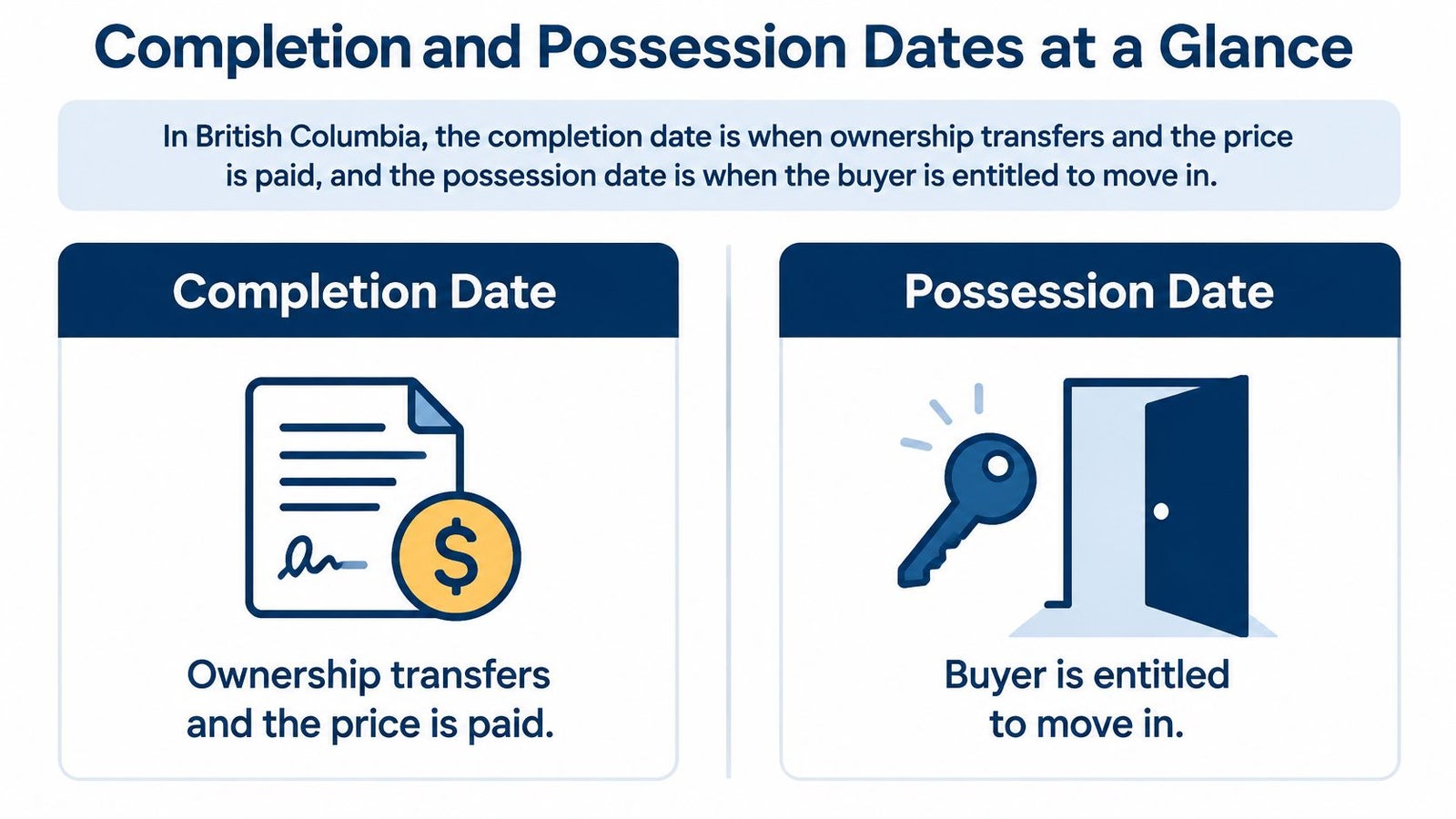
In British Columbia, the completion date is when ownership transfers and the purchase price is paid, while the possession date is when the buyer is entitled to move in. Those two moments can land on the same day or sit days apart, and only the written contract decides which.
You have movers pencilled in, a landlord notice half drafted, and a condo elevator slot you still haven't locked. The offer looks settled. Then someone says the keys come "after closing," and you can't tell whether that means the morning the lawyer registers the transfer or the afternoon the seller leaves. In a Vancouver townhouse or a West Side condo, that mix-up is where insurance, tax, and a truck at the curb start costing real money.
Possession date vs. completion date is the split between being on title and being allowed through the door. One date starts the bills. The other starts the move.
People mix the two dates up because both sit in the same Contract of Purchase and Sale, both get called closing day in conversation, and they often fall within a day or two of each other. They are not the same milestone.
The dates can match. A solid contract still names both, and it names a precise time for possession, such as noon, rather than "on or about" a day. In Greater Vancouver condos and townhomes the gap is often a day or two, long enough for registration and a clean-out. A detached rent-back can run for weeks while the seller finishes a purchase of their own.
Run this test on your own deal. Can you name the date the lawyer registers the transfer, and the clock time the keys are released? If either answer is a shrug, pull the contract before you book movers.
A $900,000 Vancouver townhouse registers on a Tuesday. The family moves on Thursday. On Wednesday, a pipe bursts in the kitchen. The buyer already owns the home. Unless the contract and the policy say otherwise, that water damage sits with the buyer, not with the seller, who still has boxes in the garage.
Completion, often called closing, is the legal and financial event. The buyer pays the purchase price, the seller transfers ownership, and the transfer is registered through the Land Title Office. The Land Title Act framework treats that registration as the point at which title becomes the buyer's. For most purchasers, the acquisition date for tax purposes is generally that closing date, because that is when the seller transfers ownership and becomes entitled to the buyer's money.
Ownership first. The buyer's lawyer or notary submits the transfer. Once the Land Title Office registers it, the buyer is the registered owner. Signing papers the week before does not transfer title.
Money next. The lender advances the mortgage to the lawyer's or notary's trust account. Sale proceeds go to the seller once registration is in order, and the seller's mortgage is paid out and discharged from those funds. A late advance holds registration. Everything that depends on a registered transfer waits with it.
Adjustments after that. Property tax, strata fees and utilities are prorated to the adjustment date written in the contract. That date is often the same day as completion, but it is its own line. Read it. A strata special levy sitting on the wrong side of the adjustment date is a bill nobody budgeted.
Risk of loss generally passes with ownership on the completion date, even while the seller's belongings are still inside. I recommend the buyer's insurance be in force from that date, not from the morning the truck arrives. The gap between registration and move-in is an insurance exposure, not spare time on a calendar.
The contract can set completion and possession on different days and at different times. A same-day handover is common. A later possession, or an earlier one, is also valid when the contract says so. Moving plans, insurance, utilities, a rent-back, tax ownership periods and who carries risk all follow that wording.
Once subject conditions are removed or satisfied, the deal can become a firm sale and moves into conveyancing, completion and possession. Legal fees and tax filing sit inside that conveyancing stretch, which is why buyers should price legal fees, taxes and closing costs in BC before completion week, not on the morning of registration.
Completion-day checklist:
After completion, the buyer holds registered title, a mortgage if there is one, and the insurance obligation. The seller holds the sale proceeds, net of the discharged mortgage and the adjustments, and no longer owns the home. Key release follows the possession clause. Registered title does not hand them over by itself.
Possession day is the physical handover. Vacant possession means the seller has removed belongings, cleaned, and left the home in the condition the contract requires. Furniture still in the den, or a garage full of paint cans, is not vacant possession.
The BC Financial Services Authority's clause guidance is clear on two points that trip people up. A seller who stays until a later possession date does not, by that fact alone, become a tenant under the Residential Tenancy Act. And a seller generally should not allow possession before the sale proceeds arrive. Key release follows confirmation that money has landed and the transfer is registered, not the calendar date by itself.
Before you collect anything, confirm the seller has received the sale proceeds and the lawyer or notary has registered the transfer. If that confirmation isn't in, do not push for early keys. The seller who hands them over early is taking a risk the guidance tells them not to take, and you don't want a fight about whether you were in the home before you had paid for it.
Collect the hardware and record the meters. Keys, fobs, garage remotes, manuals and warranty papers come in one handover. Photograph meter readings with the date visible. Those photos settle the first utility bill.
Write the holdover before it happens. If the seller may stay past the possession time, the daily charge, who insures the home, and who pays for damage belong in the contract, not in a text message on the driveway. A later possession date doesn't create a tenancy by itself, but a rent-back still needs detailed written terms and advice from your lawyer or notary.
If financing, an inspection, or review of strata documents is still open, the file is in the subject period. The buyer has to satisfy or waive those conditions by the deadlines in the contract, and a possession time nobody re-reads can sit on top of one of those deadlines. Once every required condition is removed or satisfied, the transaction can become a firm sale and move to conveyancing, completion and possession. The BoloSign guide for real estate agencies is a useful plain-language check on what "under contract" does and doesn't lock in while subjects are still open. For the BC form itself, the Vancouver house buying contract guide walks through where those date fields sit.
For a seller's offer, Jacky Levi reviews the purchase price, deposit, completion date, possession date, adjustment date, buyer conditions, included and excluded items, additional terms and offer expiry. During the condition period, Jacky Levi tracks the important dates and keeps the seller informed, so a financing deadline does not collide with a possession date. I recommend your own lawyer or notary review the terms before you sign. After acceptance, the realtor coordinates inspections, appraisals, document reviews and any other conditions in the contract. That coordination does not replace the legal review.
Book a consultation with Jacky Levi at jackylevi.com to review your dates, your timeline and the gap between completion and possession before a moving day is locked in.
Jacky Levi - Vancouver Realtor helps Greater Vancouver buyers and sellers set completion dates and possession dates so title, insurance and keys are not booked on the wrong morning. Visit Jacky Levi - Vancouver Realtor to book that review.
You have movers pencilled in, a landlord notice half drafted, and a condo elevator slot you still haven't locked. The offer looks settled. Then someone says the keys come "after closing," and you can't tell whether that means the morning the lawyer registers the transfer or the afternoon the seller leaves. In a Vancouver townhouse or a West Side condo, that mix-up is where insurance, tax, and a truck at the curb start costing real money.
Possession date vs. completion date is the split between being on title and being allowed through the door. One date starts the bills. The other starts the move.
Completion and Possession Dates at a Glance
People mix the two dates up because both sit in the same Contract of Purchase and Sale, both get called closing day in conversation, and they often fall within a day or two of each other. They are not the same milestone.
- What each date marks: Completion is when ownership transfers and the price is paid. Possession is when the buyer gets the right to occupy the home and take the keys.
- Legal effect: On completion, title is registered at the Land Title Office, and ownership and risk pass to the buyer. On possession, the buyer gets physical control under the contract's terms.
- Where to find them: Both dates are set in the Contract of Purchase and Sale. The possession clause should also state an exact time.
- Tax role: Property Transfer Tax is tied to registration on the completion date, not the possession date.
- Who coordinates them: Lawyers or notaries and the lender coordinate completion. Agents, the buyer, the seller, movers and building management coordinate possession.
- Main risk if mismanaged: Completion can be delayed by late funds or registration. Possession problems include unclear key release, seller holdover or uninsured damage.
The completion date moves ownership and money. The possession date moves the buyer in.
The dates can match. A solid contract still names both, and it names a precise time for possession, such as noon, rather than "on or about" a day. In Greater Vancouver condos and townhomes the gap is often a day or two, long enough for registration and a clean-out. A detached rent-back can run for weeks while the seller finishes a purchase of their own.
Run this test on your own deal. Can you name the date the lawyer registers the transfer, and the clock time the keys are released? If either answer is a shrug, pull the contract before you book movers.
What Happens on Completion Day
A $900,000 Vancouver townhouse registers on a Tuesday. The family moves on Thursday. On Wednesday, a pipe bursts in the kitchen. The buyer already owns the home. Unless the contract and the policy say otherwise, that water damage sits with the buyer, not with the seller, who still has boxes in the garage.
Completion, often called closing, is the legal and financial event. The buyer pays the purchase price, the seller transfers ownership, and the transfer is registered through the Land Title Office. The Land Title Act framework treats that registration as the point at which title becomes the buyer's. For most purchasers, the acquisition date for tax purposes is generally that closing date, because that is when the seller transfers ownership and becomes entitled to the buyer's money.
Order of the day
Ownership first. The buyer's lawyer or notary submits the transfer. Once the Land Title Office registers it, the buyer is the registered owner. Signing papers the week before does not transfer title.
Money next. The lender advances the mortgage to the lawyer's or notary's trust account. Sale proceeds go to the seller once registration is in order, and the seller's mortgage is paid out and discharged from those funds. A late advance holds registration. Everything that depends on a registered transfer waits with it.
Adjustments after that. Property tax, strata fees and utilities are prorated to the adjustment date written in the contract. That date is often the same day as completion, but it is its own line. Read it. A strata special levy sitting on the wrong side of the adjustment date is a bill nobody budgeted.
Risk of loss generally passes with ownership on the completion date, even while the seller's belongings are still inside. I recommend the buyer's insurance be in force from that date, not from the morning the truck arrives. The gap between registration and move-in is an insurance exposure, not spare time on a calendar.
The contract can set completion and possession on different days and at different times. A same-day handover is common. A later possession, or an earlier one, is also valid when the contract says so. Moving plans, insurance, utilities, a rent-back, tax ownership periods and who carries risk all follow that wording.
Once subject conditions are removed or satisfied, the deal can become a firm sale and moves into conveyancing, completion and possession. Legal fees and tax filing sit inside that conveyancing stretch, which is why buyers should price legal fees, taxes and closing costs in BC before completion week, not on the morning of registration.
Completion-day checklist:
- Funds confirmed: Mortgage advance and your cash to close are in trust before the registration slot.
- Registration time: You know when the lawyer or notary is submitting, not just the calendar date.
- Insurance certificate: The policy effective time is the completion date.
- Statement of adjustments: You have signed it and you understand every prorated line.
After completion, the buyer holds registered title, a mortgage if there is one, and the insurance obligation. The seller holds the sale proceeds, net of the discharged mortgage and the adjustments, and no longer owns the home. Key release follows the possession clause. Registered title does not hand them over by itself.
Possession Day, Keys and Vacant Possession
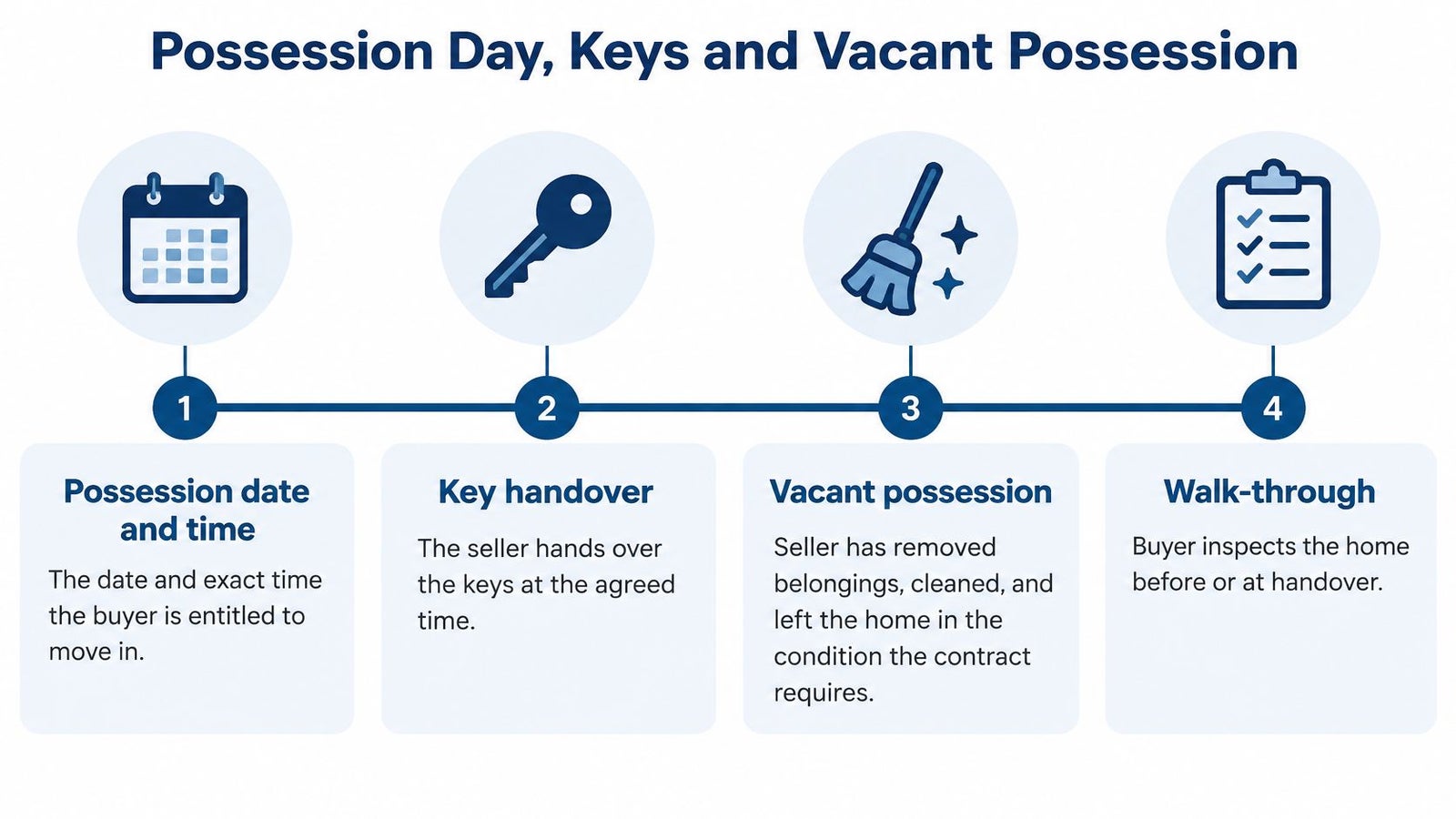
Possession day is the physical handover. Vacant possession means the seller has removed belongings, cleaned, and left the home in the condition the contract requires. Furniture still in the den, or a garage full of paint cans, is not vacant possession.
The BC Financial Services Authority's clause guidance is clear on two points that trip people up. A seller who stays until a later possession date does not, by that fact alone, become a tenant under the Residential Tenancy Act. And a seller generally should not allow possession before the sale proceeds arrive. Key release follows confirmation that money has landed and the transfer is registered, not the calendar date by itself.
Handover routine
- Read the clock, not just the day. If the contract says keys at 12 noon, confirm that time with both agents the day before. A 9 a.m. crew booked against a noon release pays to sit in the truck. That wait is on the buyer who didn't read the line.
- Walk the home the morning of possession. Compare every room to the inclusions and exclusions list. Missing a washer that was supposed to stay is much easier to fix before you sign for the keys than three days later.
- Treat a condo like a building, not a house. Confirm the strata move-in booking, the elevator slot, fob or key handover, and any damage deposit. A one-day gap feels small until the elevator is already booked by another suite.
- Switch utilities on the contract date. Hydro, gas and internet should move into the buyer's name on the date the contract states, which is usually tied to possession, not to the morning you feel like calling.
Before you collect anything, confirm the seller has received the sale proceeds and the lawyer or notary has registered the transfer. If that confirmation isn't in, do not push for early keys. The seller who hands them over early is taking a risk the guidance tells them not to take, and you don't want a fight about whether you were in the home before you had paid for it.
Collect the hardware and record the meters. Keys, fobs, garage remotes, manuals and warranty papers come in one handover. Photograph meter readings with the date visible. Those photos settle the first utility bill.
Write the holdover before it happens. If the seller may stay past the possession time, the daily charge, who insures the home, and who pays for damage belong in the contract, not in a text message on the driveway. A later possession date doesn't create a tenancy by itself, but a rent-back still needs detailed written terms and advice from your lawyer or notary.
Leave with three things: the keys, a signed walkthrough, and dated photos of the condition. Without the photos, a scratched floor becomes a story neither side can prove.
The awkward stretch is the risk-and-insurance window between completion and possession, especially when the seller is still in the home for one to three days after title transfers. The BCREA legally speaking note on standard contract clauses warns that risk transfers at 12:01 a.m. on completion even though the seller may still occupy the property. That is a different problem from a simple "closing versus move-in" label.
You own the home from completion. Insurance starts that morning, not on move-in day. Damage after completion and before you get the keys falls on you unless the contract and the policy push it somewhere else. If the seller stays past the possession time, you can be paying mortgage interest and carrying costs on a home you can't occupy, so the delayed-access remedy has to be written before anyone signs. Movers book to the possession time. Utilities and building access follow that same time. A later possession date isn't a courtesy buffer. It can leave you paying for a property you don't control.
After the offer is accepted, timelines only hold if buyers, agents, lawyers and lenders are working off the same two dates. That coordination is what keeps a firm deal moving from acceptance to completion without a truck arriving on the wrong morning.
Same-day possession still isn't a morning move. Funds and registration have to clear before keys move. Book the crew for after that confirmation, or pay them to wait.
A two-day condo gap, completion on June 28 and possession on June 30, makes you the owner for two nights you don't sleep there. Insurance runs from June 28. The strata elevator and the damage deposit are booked to June 30. Miss either and the legal gap becomes an operational one.
Townhouse holdover from July 15 to July 17 is only two days, and two days is enough for a daily occupancy charge, a named insurance responsibility, and a utilities transfer that doesn't leave the seller on your hydro account.
A detached rent-back from September 1 to September 30 is 29 days of someone else living in a home you own and insure. I would not accept that on a handshake. You want a written rent-back, a deposit, a move-out condition standard, and a daily amount if they stay past September 30.
An out-of-town buyer with completion on July 15 and possession on July 22 needs a hotel or a short rental, a local person at the walkthrough, and movers aimed at July 22. Completion day is for the lawyer. Possession day is for the truck.
Property Transfer Tax follows registration, not the day you get the keys. The tax is based on the property's fair market value on the day the interest is registered at the Land Title Office, and the Land Title Office may refuse registration if the tax has not been paid. Your lawyer or notary normally files the return and the payment as part of completion. Keys two days later do not move that deadline.
Take a $900,000 Vancouver townhouse that completes and registers on July 15, with possession on July 17. The Province's Property Transfer Tax rules make July 15 the tax-registration event. Have the funds with your lawyer before that appointment. Waiting until the 17th is how a clean file gets refused at the counter. Read how Property Transfer Tax works in BC before you lock the completion date. The tax is calculated on value at registration, not on the price you hoped to see.
The home flipping tax uses the same closing logic for a different count. A taxable property must generally be owned for more than 729 days to avoid the tax, subject to the rules and exemptions that apply. The Province's days-of-ownership guidance treats the closing date as the usual acquisition date, because that is when the seller transfers ownership and becomes entitled to the purchase money.
If ownership transfers on September 1 and you get possession on September 3, the ownership clock generally starts on September 1. Counting from move-in day makes the period look shorter than the law will treat it, so a seller should measure from the transfer date shown in the legal documents, not from the day they moved out. Use that shorter count, and you can list a resale believing the 729-day mark has passed when the transfer date says it has not.
Presale contracts, assignments and listed exemptions can move that start date. I would not guess at it. A tax professional should confirm the position before you list a resale, especially if the original buy was a presale that sat for years before the building registered.
Pick the arrangement for the life you have, then write the dates to match. The gap table above is the exposure list. What follows is how I'd set the dates for five common Vancouver files.

First-time buyer leaving a rental. Aim for same-day possession, or a two-day gap at most. Give the landlord notice against the possession date, not the completion date. Notice tied to completion leaves you paying rent on an empty suite, or worse, moved out before you can enter the new place.
Seller who still needs a week to pack. Negotiate a short written rent-back with a daily charge, insurance named in the agreement, and a condition standard at move-out. A vague "we'll be out by the weekend" is how Friday becomes the following Wednesday with nobody sure who pays.
Relocating professional who isn't in the city. Set possession three to five days after completion so movers and a short stay have room, and put a local person on the walkthrough. Completion can happen with you on a plane. Possession shouldn't.
Investor buying a condo to rent. Set possession so it lines up with the tenant's start date, and track the ownership clock from completion. A tenant who arrives before vacant possession is your problem and the seller's, and the flipping-tax count won't wait for the first rent cheque.
Downsizing seller, completion Friday, possession Monday. Plan the weekend as a written holdover, and pin the Monday key-release time before either side books a truck. A Friday registration with a Monday noon release is a normal Vancouver pattern. An unwritten one is where the buyer shows up at 9 a.m. and the seller is still labelling boxes.
Three questions settle the choice. How long do you need to move? Who controls the keys until that moment? What date does your insurance start? If the third answer isn't the completion date, fix the policy before you fix the moving quote.
A buyer books the elevator and the truck for Friday, then finds the Contract of Purchase and Sale still says possession "on or before," with no hour. The building will not hold a freight elevator for that phrase. The mover bills the missed slot. Fixing the contract costs less.
Put these eight items in writing before anyone takes a deposit on a truck.
Reading the Gap Between Completion and Possession
The awkward stretch is the risk-and-insurance window between completion and possession, especially when the seller is still in the home for one to three days after title transfers. The BCREA legally speaking note on standard contract clauses warns that risk transfers at 12:01 a.m. on completion even though the seller may still occupy the property. That is a different problem from a simple "closing versus move-in" label.
You own the home from completion. Insurance starts that morning, not on move-in day. Damage after completion and before you get the keys falls on you unless the contract and the policy push it somewhere else. If the seller stays past the possession time, you can be paying mortgage interest and carrying costs on a home you can't occupy, so the delayed-access remedy has to be written before anyone signs. Movers book to the possession time. Utilities and building access follow that same time. A later possession date isn't a courtesy buffer. It can leave you paying for a property you don't control.
After the offer is accepted, timelines only hold if buyers, agents, lawyers and lenders are working off the same two dates. That coordination is what keeps a firm deal moving from acceptance to completion without a truck arriving on the wrong morning.
Who carries the exposure?
Same-day possession still isn't a morning move. Funds and registration have to clear before keys move. Book the crew for after that confirmation, or pay them to wait.
A two-day condo gap, completion on June 28 and possession on June 30, makes you the owner for two nights you don't sleep there. Insurance runs from June 28. The strata elevator and the damage deposit are booked to June 30. Miss either and the legal gap becomes an operational one.
Townhouse holdover from July 15 to July 17 is only two days, and two days is enough for a daily occupancy charge, a named insurance responsibility, and a utilities transfer that doesn't leave the seller on your hydro account.
A detached rent-back from September 1 to September 30 is 29 days of someone else living in a home you own and insure. I would not accept that on a handshake. You want a written rent-back, a deposit, a move-out condition standard, and a daily amount if they stay past September 30.
An out-of-town buyer with completion on July 15 and possession on July 22 needs a hotel or a short rental, a local person at the walkthrough, and movers aimed at July 22. Completion day is for the lawyer. Possession day is for the truck.
The longer the gap, the more the contract has to say in writing. A one-day condo gap needs insurance and an elevator. A month-long rent-back needs a small occupancy agreement.
Why Completion Date Drives Tax and Ownership Clocks
Property Transfer Tax follows registration, not the day you get the keys. The tax is based on the property's fair market value on the day the interest is registered at the Land Title Office, and the Land Title Office may refuse registration if the tax has not been paid. Your lawyer or notary normally files the return and the payment as part of completion. Keys two days later do not move that deadline.
Take a $900,000 Vancouver townhouse that completes and registers on July 15, with possession on July 17. The Province's Property Transfer Tax rules make July 15 the tax-registration event. Have the funds with your lawyer before that appointment. Waiting until the 17th is how a clean file gets refused at the counter. Read how Property Transfer Tax works in BC before you lock the completion date. The tax is calculated on value at registration, not on the price you hoped to see.
The ownership clock
The home flipping tax uses the same closing logic for a different count. A taxable property must generally be owned for more than 729 days to avoid the tax, subject to the rules and exemptions that apply. The Province's days-of-ownership guidance treats the closing date as the usual acquisition date, because that is when the seller transfers ownership and becomes entitled to the purchase money.
If ownership transfers on September 1 and you get possession on September 3, the ownership clock generally starts on September 1. Counting from move-in day makes the period look shorter than the law will treat it, so a seller should measure from the transfer date shown in the legal documents, not from the day they moved out. Use that shorter count, and you can list a resale believing the 729-day mark has passed when the transfer date says it has not.
Presale contracts, assignments and listed exemptions can move that start date. I would not guess at it. A tax professional should confirm the position before you list a resale, especially if the original buy was a presale that sat for years before the building registered.
Choosing Timing for Your Situation
Pick the arrangement for the life you have, then write the dates to match. The gap table above is the exposure list. What follows is how I'd set the dates for five common Vancouver files.
First-time buyer leaving a rental. Aim for same-day possession, or a two-day gap at most. Give the landlord notice against the possession date, not the completion date. Notice tied to completion leaves you paying rent on an empty suite, or worse, moved out before you can enter the new place.
Seller who still needs a week to pack. Negotiate a short written rent-back with a daily charge, insurance named in the agreement, and a condition standard at move-out. A vague "we'll be out by the weekend" is how Friday becomes the following Wednesday with nobody sure who pays.
Relocating professional who isn't in the city. Set possession three to five days after completion so movers and a short stay have room, and put a local person on the walkthrough. Completion can happen with you on a plane. Possession shouldn't.
Investor buying a condo to rent. Set possession so it lines up with the tenant's start date, and track the ownership clock from completion. A tenant who arrives before vacant possession is your problem and the seller's, and the flipping-tax count won't wait for the first rent cheque.
Downsizing seller, completion Friday, possession Monday. Plan the weekend as a written holdover, and pin the Monday key-release time before either side books a truck. A Friday registration with a Monday noon release is a normal Vancouver pattern. An unwritten one is where the buyer shows up at 9 a.m. and the seller is still labelling boxes.
Three questions settle the choice. How long do you need to move? Who controls the keys until that moment? What date does your insurance start? If the third answer isn't the completion date, fix the policy before you fix the moving quote.
Confirm Both Dates in Your Contract Before You Book Movers
A buyer books the elevator and the truck for Friday, then finds the Contract of Purchase and Sale still says possession "on or before," with no hour. The building will not hold a freight elevator for that phrase. The mover bills the missed slot. Fixing the contract costs less.
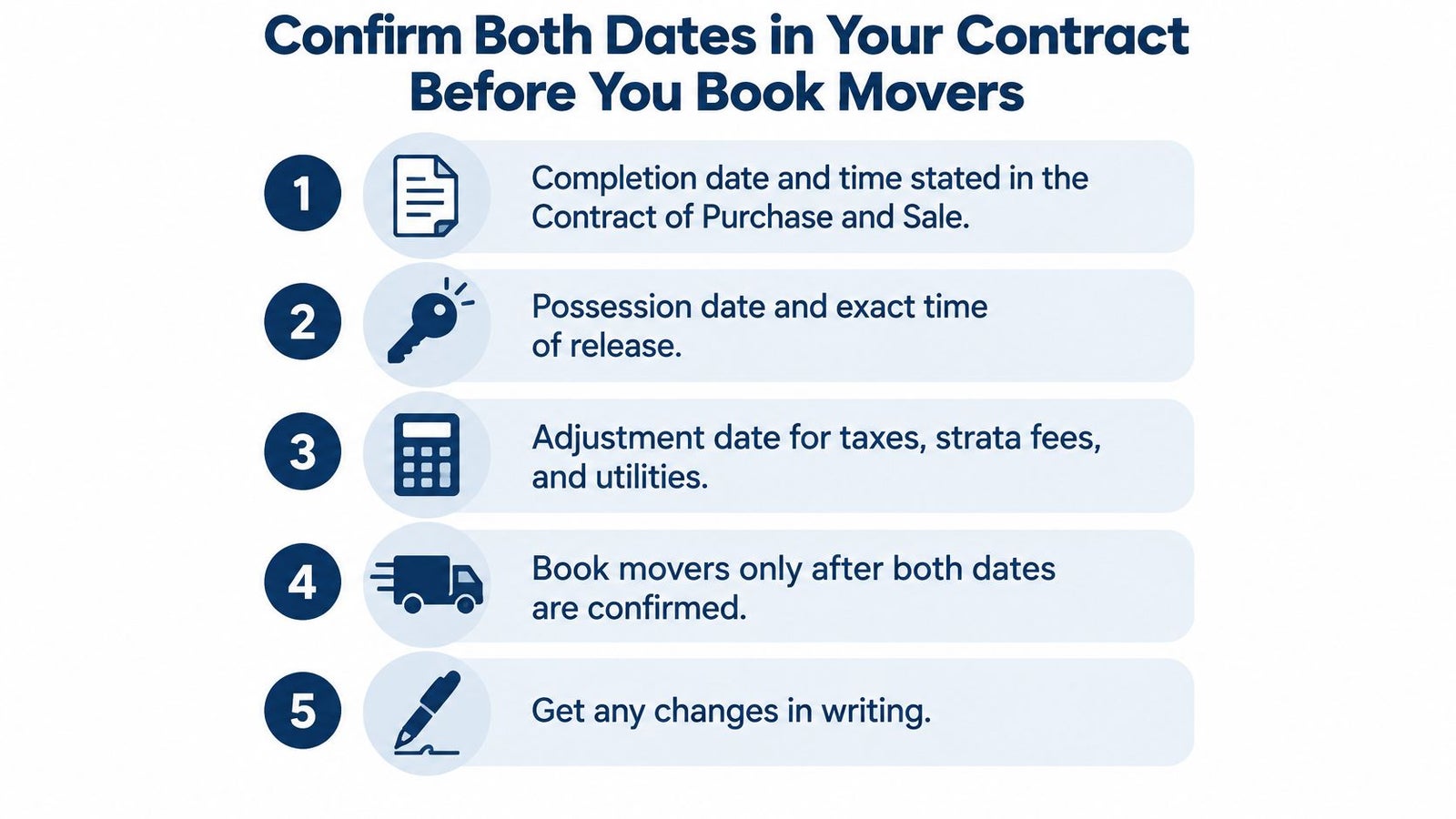
Put these eight items in writing before anyone takes a deposit on a truck.
- Completion date and time are stated in the Contract of Purchase and Sale, not left as "on or before."
- Possession date and the exact release time are on their own line, down to the hour.
- Adjustment date covers property taxes, strata fees and utilities, so each day has an owner.
- Vacant possession describes the condition the seller must leave, including cleaning and removal of belongings.
- Holdover or rent-back sets any daily charge, the end time, and what happens if that time is missed.
- Insurance effective date is the completion date, including the hours before you sleep there.
- Delayed access has a remedy in the contract, not a plan to sort it out on the day.
- Inclusions and exclusions match the walkthrough list you will use on possession morning.
If financing, an inspection, or review of strata documents is still open, the file is in the subject period. The buyer has to satisfy or waive those conditions by the deadlines in the contract, and a possession time nobody re-reads can sit on top of one of those deadlines. Once every required condition is removed or satisfied, the transaction can become a firm sale and move to conveyancing, completion and possession. The BoloSign guide for real estate agencies is a useful plain-language check on what "under contract" does and doesn't lock in while subjects are still open. For the BC form itself, the Vancouver house buying contract guide walks through where those date fields sit.
For a seller's offer, Jacky Levi reviews the purchase price, deposit, completion date, possession date, adjustment date, buyer conditions, included and excluded items, additional terms and offer expiry. During the condition period, Jacky Levi tracks the important dates and keeps the seller informed, so a financing deadline does not collide with a possession date. I recommend your own lawyer or notary review the terms before you sign. After acceptance, the realtor coordinates inspections, appraisals, document reviews and any other conditions in the contract. That coordination does not replace the legal review.
Book a consultation with Jacky Levi at jackylevi.com to review your dates, your timeline and the gap between completion and possession before a moving day is locked in.
Jacky Levi - Vancouver Realtor helps Greater Vancouver buyers and sellers set completion dates and possession dates so title, insurance and keys are not booked on the wrong morning. Visit Jacky Levi - Vancouver Realtor to book that review.