You own a Vancouver condo or a house in your name alone, and someone has suggested you add an adult child to title so the family can skip court. The idea sounds tidy. The home is most of what you own, and a grant feels slow. Before you sign anything, ask what you are giving up: control of a sale, a spouse's protection, and a fair split among your children.
How to avoid probate in BC is a control, family, and risk decision. A smaller court bill can still leave a worse estate if the shortcut starts a fight or a tax problem. I would price the fee first, then pick a structure that matches who should receive the home.
Take a Greater Vancouver estate worth $1,000,000 where the whole amount still needs a court grant. British Columbia's Probate Fee Act, as set out by Equity Law Group, charges nothing on the first $25,000, then $6 for every $1,000 up to $50,000, and $14 for every $1,000 above $50,000, plus a $200 application fee when a grant is sought. On that $1,000,000 example the value-based fee is $150 on the $25,000 band plus $13,300 on the $950,000 above $50,000, which is $13,450 before the application fee. Some published BC examples misstate that total. Run the bands yourself.
Use this table before anyone talks about retitling. It covers assets that still pass through a BC estate.
In a typical Vancouver estate, the family home is the largest asset, so its value drives most of this calculation.
A will does not keep a home out of probate. The will is the document the court is asked to verify. Probate attaches to assets held in one name with no surviving co-owner and no named beneficiary. The planning job is to sort which assets fall into that group.
Say you hold a Kitsilano townhouse in your name alone, and your RRSP names your spouse. The RRSP can pass to that spouse outside the estate. The townhouse cannot. A buyer, the lender, and the land title office still need someone with authority to sign, and that authority usually comes from a grant.
Tenancy in common belongs in the comparison because people treat it as joint ownership. It is not. Your share stays yours to give by will, which is exactly why it can still need probate.
List every asset this week and mark how it passes today: survivorship, beneficiary, trust, or estate. That list is the only honest starting point for how to avoid probate in BC.
In British Columbia, probate is the court process that checks that a will is genuine and confirms the executor's authority. For a house or condo, that grant is often what lets an executor transfer or sell. Holding as joint tenants with a surviving co-owner, rather than as tenants in common, is one way to keep the home outside the estate. It is not automatic, and it is not always the right fit.
This short flow is the title check to finish before anyone signs a transfer.
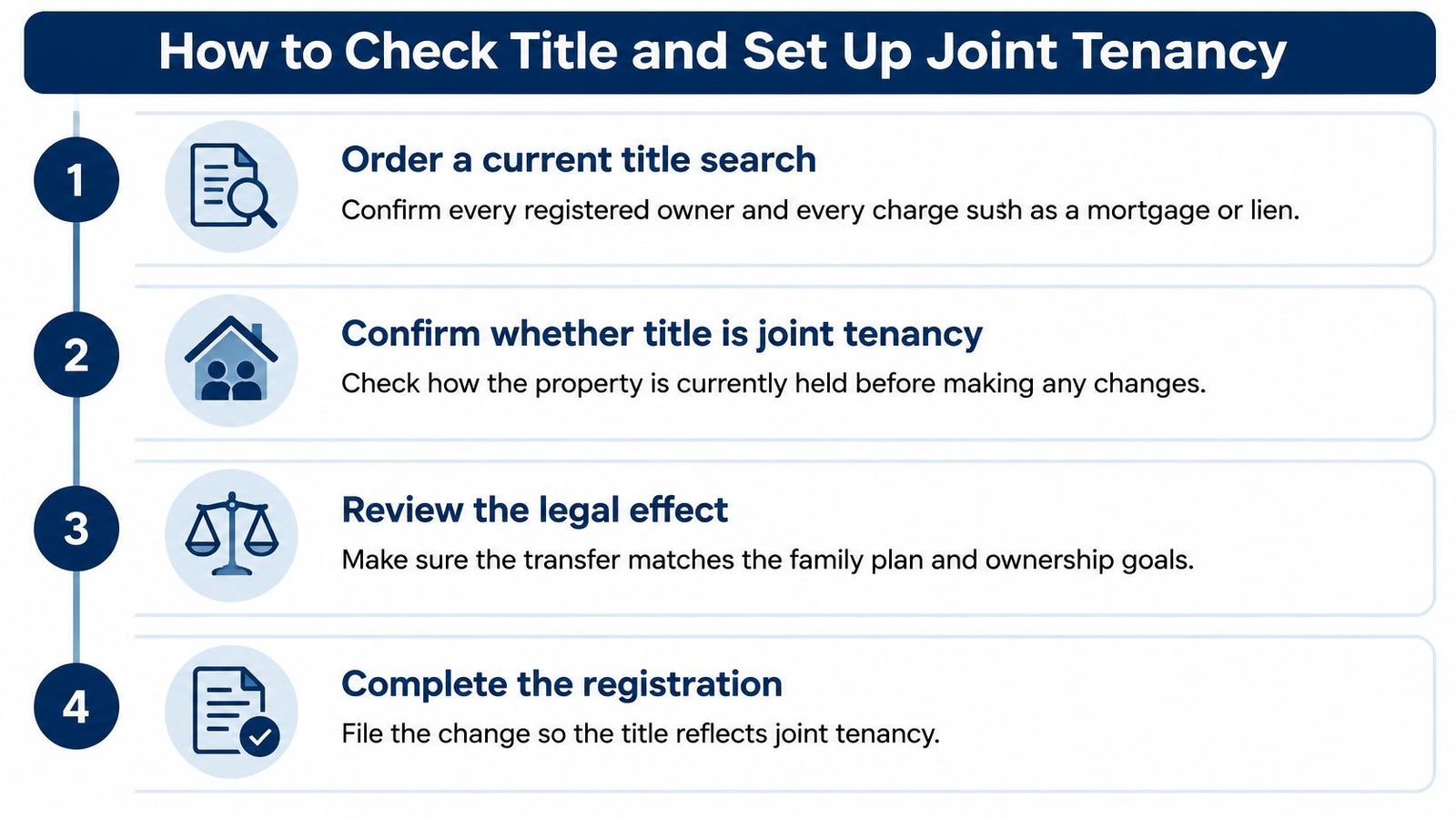
Order a current title search. You need every registered owner and every charge, including a mortgage or lien. An old statement from a sale years ago is not good enough.
Confirm joint tenancy or tenancy in common. Only joint tenancy generally sends the share to the survivor outside the estate. Names side by side on a title do not always mean joint tenancy. Moving from a tenancy in common takes a registered transfer, and that transfer can attract property transfer tax in BC.
Write down who should receive the home. If that person is not the surviving joint tenant, joint tenancy fights the will.
Get independent legal advice for each owner. Adding someone changes control, creditor exposure, family-law claims, tax, and how sale proceeds are split. A BC lawyer or notary should confirm the change matches what you intend.
Update the will and the beneficiary forms together. Documents that disagree are how families end up in court after a "simple" transfer.
Re-check after life changes. Marriage, separation, a new child, a refinance, or a change in ownership can undo the plan you thought was finished.
Under the Wills, Estates and Succession Act, jointly held property generally passes to the surviving joint tenant outside the estate, subject to the documents and the facts. If two joint tenants die and it cannot be shown that one survived the other by 5 days, the Act uses special distribution rules instead of ordinary survivorship. That five-day rule is why title and the will should be read together, especially on a Vancouver home with substantial equity.
If you want a plain-language look at why a grant exists at all, this overview sits well beside the title search.
A finished check is three things in one folder: a current title record, a will that matches that title, and a dated note of who is meant to receive the home.
A $400,000 RRIF naming an adult child can reach that child without ever touching the estate. Registered plans and life insurance work this way when the designation is valid: an RRSP, a RRIF, a TFSA, a pension, and a life insurance policy. The asset goes to the person named on the contract rather than through the will.
That convenience depends on the paperwork doing real legal work. Under the Wills, Estates and Succession Act, a beneficiary designation generally has to be in writing and signed, and an irrevocable designation carries additional filing requirements. Think carefully before signing anything irrevocable. You are giving up the ability to change your mind later, which is a control trade-off worth making on purpose rather than by accident.
A designation also outranks the will for that asset. If the will divides everything among three children and the RRIF names only one, that one receives it in full. The probate saving is real, but so is the family argument it can start.
Name a contingent beneficiary in case the first person dies before you. A blank contingent line sends the plan back into the estate, probate fees included. And probate savings do not cancel the tax: the $400,000 RRIF transfers outside the estate, yet its value is generally still taxable on your death unless a rollover to a spouse applies.
I would diary an annual review, the same week you renew house insurance. Fifteen minutes with the statements beats a grant application for an account you thought was already dealt with.
Two lifetime trusts can hold a BC home outside the estate. An inter vivos trust is made while you are alive. An alter ego trust is available to a Canadian resident aged 65 or older, and it can let you keep the benefit of the property during your life.
Go back to that Kitsilano townhouse held in one name. A trust is worth a look when you should not add a child to title, and when you still want the land title office to deal with a trustee rather than wait for a grant.
Put the cost in the same conversation. Setup, accounting, and tax can exceed the $13,450 value-based fee on a probate-bound $1,000,000 estate, before the $200 application fee. Once a lawyer confirms the trust can hold the home, funding it is a separate job from signing the deed. This guide on how to fund your living trust from HeyAtty is a practical checklist of what still has to be retitled, though a BC land transfer still needs local legal advice.
The better fit is a high-value Vancouver property, a blended family, or an owner who should not put a child on title. A modest condo with a straightforward spouse on title rarely needs this machinery.
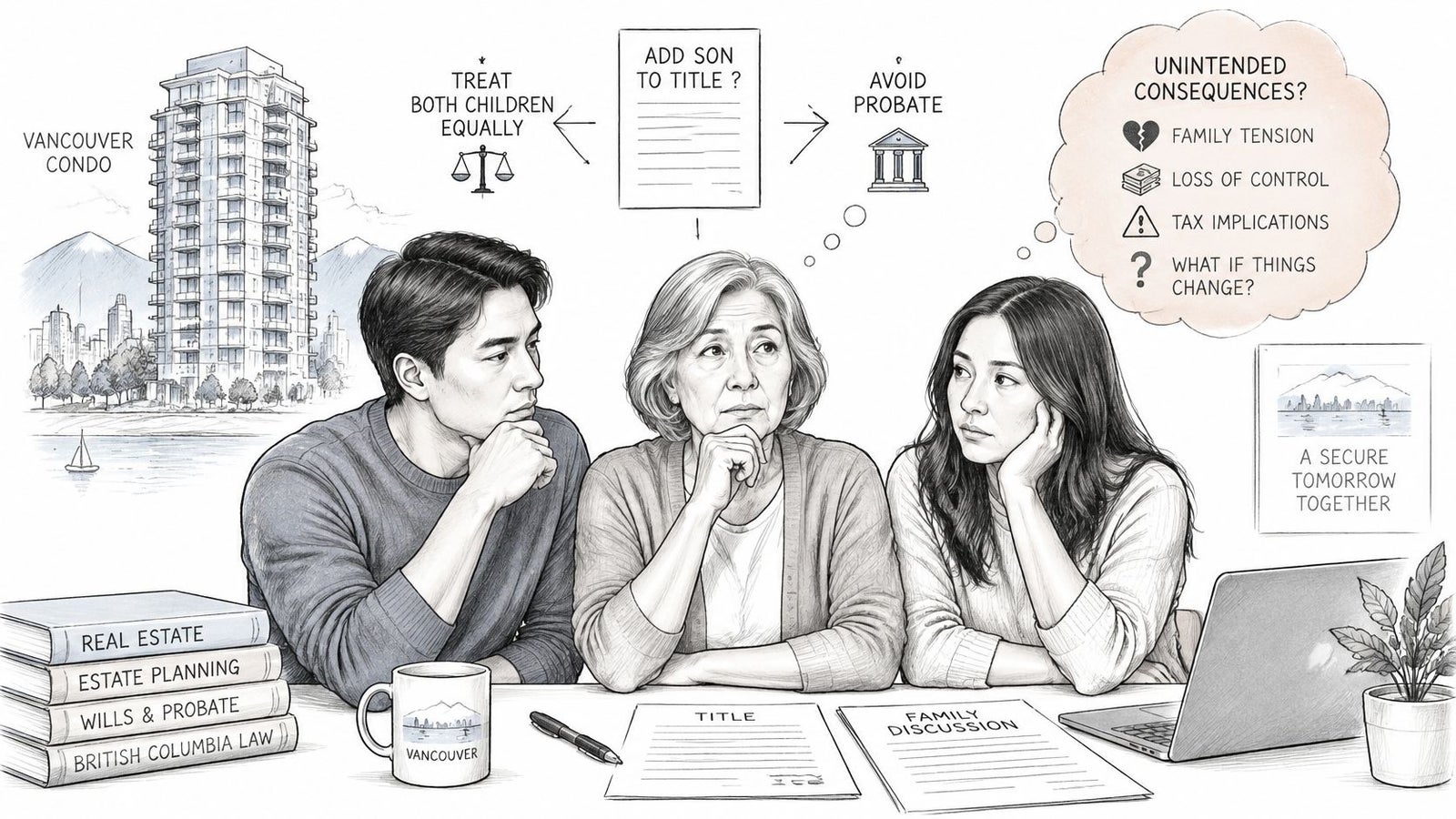
A parent adds an adult son to a Vancouver condo so both children are "treated equally" and probate is skipped. Equality is not what the land title office records. The son can receive a present interest. The condo can be exposed to his creditors, a bankruptcy, or a separation. The parent can lose the ability to sell without his signature.
Legal title does not always decide who owns the benefit. A survivor may hold the deceased owner's share in trust for the estate, and a challenge can follow if the paperwork fights the will. The Parkinson Society British Columbia estate planning help sheet is clear that a surviving joint tenant may receive the property automatically, yet the question is whether that person was meant to take the benefit or only to help with administration. Parents who add one child to a condo, townhome, or detached home, while meaning equal treatment, often create the dispute they hoped to avoid. Registered plans and life insurance can still bypass probate, but tax can remain and the designation has to stay current.
Under British Columbia's Family Law Act, on separation, each spouse has a right to an undivided half interest in family property as a tenant in common, and each is equally responsible for family debt. Retitling a Vancouver residence to dodge probate can change control of the home, creditor exposure, and how value is split.
Say one spouse in Burnaby adds an adult child to a detached house. The parent expects the child to take the house at death. Instead, the child has ownership now, and arguments start over who paid the mortgage, who may live there, and who can force a sale. If deaths fall close together, joint ownership also meets the five-day survival rule, so "it just goes to the survivor" is not a safe assumption.
Compare that shortcut with an updated will, an enduring power of attorney, current beneficiary designations, and a trust. Then ask three questions.
A smaller probate bill that starts a dispute is worse than the probate you avoided. A dispute over who can list also stalls the home selling process. A realtor can help pull property records. A BC estates lawyer, and, where needed, a family-law or tax adviser, has to approve the transfer.
Book the lawyer or notary before you change title or beneficiary forms. I would not sign a transfer, a trust deed, or an irrevocable designation on the strength of a fee table.
Get that advice when you are adding anyone to title, setting up a trust, dealing with a blended family, sharing a property with a spouse, naming a complicated beneficiary on a registered plan, or looking at an estate above the $25,000 fee threshold. Bring three questions.
Realtors in British Columbia are licensed professionals regulated by the British Columbia Financial Services Authority (BCFSA). We can explain the documents on a seller's property, what you are asked to sign, and when a lawyer, notary, accountant, or other professional should be involved. Ownership and succession advice still comes from that lawyer or notary. House-side professional fees are a different bill from probate, and legal fees, taxes, and tips when buying a house in BC show how those costs sit beside a contract. Once the estate plan is settled and a home is to be sold or transferred, a realtor can explain the sale documents and the timing.
List the probate-bound assets this week, then book the lawyer.
Jacky Levi is a Vancouver Realtor and Associate Broker with Sotheby's International Realty Canada, and the practice covers condos, townhomes, and detached homes across Greater Vancouver. After your lawyer has settled title and succession, we can walk through a property review, the sale documents, and a timing plan that fits the ownership you have. Visit Jacky Levi - Vancouver Realtor when you are ready to talk through that next step.
How to avoid probate in BC is a control, family, and risk decision. A smaller court bill can still leave a worse estate if the shortcut starts a fight or a tax problem. I would price the fee first, then pick a structure that matches who should receive the home.
What Probate Costs on a Vancouver Estate
Take a Greater Vancouver estate worth $1,000,000 where the whole amount still needs a court grant. British Columbia's Probate Fee Act, as set out by Equity Law Group, charges nothing on the first $25,000, then $6 for every $1,000 up to $50,000, and $14 for every $1,000 above $50,000, plus a $200 application fee when a grant is sought. On that $1,000,000 example the value-based fee is $150 on the $25,000 band plus $13,300 on the $950,000 above $50,000, which is $13,450 before the application fee. Some published BC examples misstate that total. Run the bands yourself.
Fee bands you can check
Use this table before anyone talks about retitling. It covers assets that still pass through a BC estate.
- $25,000 estate: $0 value-based fee; $200 including the application fee.
- $50,000 estate: $150 value-based fee; $350 including the application fee.
- $100,000 estate: $850 value-based fee; $1,050 including the application fee.
- $500,000 estate: $6,450 value-based fee; $6,650 including the application fee.
- $1,000,000 estate: $13,450 value-based fee; $13,650 including the application fee.
A $25,000 estate pays no value-based fee. At $50,000, the value-based fee is $150, which is $6 on each of the 25 thousand in that band. At $100,000, you add $700 ($14 on each of the next 50 thousands), so the value-based fee is $850. At $500,000, the same method produces $6,450 before the application fee.
Estimate value at death. Use fair market value for the home and other assets, not the price you paid years ago.
Subtract what already passes outside the estate. Survivorship and a valid beneficiary designation do not sit in the probate value.
Compare the remaining fee with the cost of change. Legal work, tax, land title charges, and a family dispute can dwarf a four-figure court fee. If a sale is part of the plan, put realtor commission and other selling costs on the same page as the probate bill.
Three steps before you restructure
Estimate value at death. Use fair market value for the home and other assets, not the price you paid years ago.
Subtract what already passes outside the estate. Survivorship and a valid beneficiary designation do not sit in the probate value.
Compare the remaining fee with the cost of change. Legal work, tax, land title charges, and a family dispute can dwarf a four-figure court fee. If a sale is part of the plan, put realtor commission and other selling costs on the same page as the probate bill.
The fee is a reason to look at options. It is not, on its own, a reason to change title.
In a typical Vancouver estate, the family home is the largest asset, so its value drives most of this calculation.
Five Ways to Avoid Probate in BC Compared
A will does not keep a home out of probate. The will is the document the court is asked to verify. Probate attaches to assets held in one name with no surviving co-owner and no named beneficiary. The planning job is to sort which assets fall into that group.
- Joint tenancy with right of survivorship: Moves a home or other jointly held land outside the estate. The survivor takes the whole interest, and an added owner gains present rights. Best suited to spouses or partners who want the home to pass automatically.
- Beneficiary designation: Moves RRSPs, RRIFs, TFSAs, pensions, and life insurance outside the estate. Tax may still apply, and designations need to stay current. Best suited to registered plans and insurance with named beneficiaries.
- Inter vivos or alter ego trust: Moves a home or investments transferred into the trust outside the estate. Setup, accounting, and possible tax on transfer can exceed the probate fee. An alter ego trust may fit a Canadian resident aged 65 or older; a trust may also suit an owner who needs staged control.
- Lifetime transfer of title: Moves a home or investments outside the estate, but a gift can trigger tax, loss of control, and creditor exposure. Rarely the first choice; get legal advice before any transfer.
- Tenancy in common with a will: Does not move the owner's share outside the estate. The share may need probate. It can suit owners who want to leave separate shares to different heirs.
A Kitsilano split
Say you hold a Kitsilano townhouse in your name alone, and your RRSP names your spouse. The RRSP can pass to that spouse outside the estate. The townhouse cannot. A buyer, the lender, and the land title office still need someone with authority to sign, and that authority usually comes from a grant.
Tenancy in common belongs in the comparison because people treat it as joint ownership. It is not. Your share stays yours to give by will, which is exactly why it can still need probate.
List every asset this week and mark how it passes today: survivorship, beneficiary, trust, or estate. That list is the only honest starting point for how to avoid probate in BC.
How to Check Title and Set Up Joint Tenancy
In British Columbia, probate is the court process that checks that a will is genuine and confirms the executor's authority. For a house or condo, that grant is often what lets an executor transfer or sell. Holding as joint tenants with a surviving co-owner, rather than as tenants in common, is one way to keep the home outside the estate. It is not automatic, and it is not always the right fit.
This short flow is the title check to finish before anyone signs a transfer.
The six steps and why each one exists
Order a current title search. You need every registered owner and every charge, including a mortgage or lien. An old statement from a sale years ago is not good enough.
Confirm joint tenancy or tenancy in common. Only joint tenancy generally sends the share to the survivor outside the estate. Names side by side on a title do not always mean joint tenancy. Moving from a tenancy in common takes a registered transfer, and that transfer can attract property transfer tax in BC.
Write down who should receive the home. If that person is not the surviving joint tenant, joint tenancy fights the will.
Get independent legal advice for each owner. Adding someone changes control, creditor exposure, family-law claims, tax, and how sale proceeds are split. A BC lawyer or notary should confirm the change matches what you intend.
Update the will and the beneficiary forms together. Documents that disagree are how families end up in court after a "simple" transfer.
Re-check after life changes. Marriage, separation, a new child, a refinance, or a change in ownership can undo the plan you thought was finished.
Under the Wills, Estates and Succession Act, jointly held property generally passes to the surviving joint tenant outside the estate, subject to the documents and the facts. If two joint tenants die and it cannot be shown that one survived the other by 5 days, the Act uses special distribution rules instead of ordinary survivorship. That five-day rule is why title and the will should be read together, especially on a Vancouver home with substantial equity.
If you want a plain-language look at why a grant exists at all, this overview sits well beside the title search.
A finished check is three things in one folder: a current title record, a will that matches that title, and a dated note of who is meant to receive the home.
Setting Up Beneficiary Designations Correctly
A $400,000 RRIF naming an adult child can reach that child without ever touching the estate. Registered plans and life insurance work this way when the designation is valid: an RRSP, a RRIF, a TFSA, a pension, and a life insurance policy. The asset goes to the person named on the contract rather than through the will.
That convenience depends on the paperwork doing real legal work. Under the Wills, Estates and Succession Act, a beneficiary designation generally has to be in writing and signed, and an irrevocable designation carries additional filing requirements. Think carefully before signing anything irrevocable. You are giving up the ability to change your mind later, which is a control trade-off worth making on purpose rather than by accident.
A designation also outranks the will for that asset. If the will divides everything among three children and the RRIF names only one, that one receives it in full. The probate saving is real, but so is the family argument it can start.
Name a contingent beneficiary in case the first person dies before you. A blank contingent line sends the plan back into the estate, probate fees included. And probate savings do not cancel the tax: the $400,000 RRIF transfers outside the estate, yet its value is generally still taxable on your death unless a rollover to a spouse applies.
A checklist you can finish this week
- Name a contingent on every form. One name is not a plan if that person dies first.
- Keep copies with the will. The executor should not have to phone five institutions to learn who was named.
- Use the plan provider's own form. A handwritten note in a drawer is not a designation the institution will follow.
- Check the TFSA label. A spouse is often better named as successor holder than as a beneficiary. Those are different roles.
- Review after major life events. Marriage, separation, divorce, and a new child all make old forms stale.
Outdated forms are the most common reason a plan fails to do what its owner intended.
I would diary an annual review, the same week you renew house insurance. Fifteen minutes with the statements beats a grant application for an account you thought was already dealt with.
Using a Trust to Keep a Home Outside the Estate
Two lifetime trusts can hold a BC home outside the estate. An inter vivos trust is made while you are alive. An alter ego trust is available to a Canadian resident aged 65 or older, and it can let you keep the benefit of the property during your life.
Go back to that Kitsilano townhouse held in one name. A trust is worth a look when you should not add a child to title, and when you still want the land title office to deal with a trustee rather than wait for a grant.
- List what would otherwise need a grant. The townhouse is on that list. The RRSP with a spouse named on it is not.
- Ask whether you can stay trustee and lifetime beneficiary. If you cannot, you have given away control to save a court fee. That is usually a bad trade.
- Transfer title only after tax advice. Moving the home into the trust can be a disposition. The tax can arrive now, not at death.
- Name who receives the home on death. The trustee then has a document to take to the land title office for that asset without a grant.
- Update the will for whatever stays outside the trust. Bank accounts, a car, and personal items still need instructions.
Put the cost in the same conversation. Setup, accounting, and tax can exceed the $13,450 value-based fee on a probate-bound $1,000,000 estate, before the $200 application fee. Once a lawyer confirms the trust can hold the home, funding it is a separate job from signing the deed. This guide on how to fund your living trust from HeyAtty is a practical checklist of what still has to be retitled, though a BC land transfer still needs local legal advice.
The better fit is a high-value Vancouver property, a blended family, or an owner who should not put a child on title. A modest condo with a straightforward spouse on title rarely needs this machinery.
When Avoiding Probate Backfires for a Family
A parent adds an adult son to a Vancouver condo so both children are "treated equally" and probate is skipped. Equality is not what the land title office records. The son can receive a present interest. The condo can be exposed to his creditors, a bankruptcy, or a separation. The parent can lose the ability to sell without his signature.
Legal title does not always decide who owns the benefit. A survivor may hold the deceased owner's share in trust for the estate, and a challenge can follow if the paperwork fights the will. The Parkinson Society British Columbia estate planning help sheet is clear that a surviving joint tenant may receive the property automatically, yet the question is whether that person was meant to take the benefit or only to help with administration. Parents who add one child to a condo, townhome, or detached home, while meaning equal treatment, often create the dispute they hoped to avoid. Registered plans and life insurance can still bypass probate, but tax can remain and the designation has to stay current.
What the Family Law Act does to a retitle
Under British Columbia's Family Law Act, on separation, each spouse has a right to an undivided half interest in family property as a tenant in common, and each is equally responsible for family debt. Retitling a Vancouver residence to dodge probate can change control of the home, creditor exposure, and how value is split.
Say one spouse in Burnaby adds an adult child to a detached house. The parent expects the child to take the house at death. Instead, the child has ownership now, and arguments start over who paid the mortgage, who may live there, and who can force a sale. If deaths fall close together, joint ownership also meets the five-day survival rule, so "it just goes to the survivor" is not a safe assumption.
Questions to ask before you sign
Compare that shortcut with an updated will, an enduring power of attorney, current beneficiary designations, and a trust. Then ask three questions.
- Who is on title today, and who would be after the transfer?
- What would a spouse receive on separation, and does this change cut that protection?
- If the child is sued, separates, or goes bankrupt, is the home available to those claims?
A smaller probate bill that starts a dispute is worse than the probate you avoided. A dispute over who can list also stalls the home selling process. A realtor can help pull property records. A BC estates lawyer, and, where needed, a family-law or tax adviser, has to approve the transfer.
Book Legal Advice Before You Change Title
Book the lawyer or notary before you change title or beneficiary forms. I would not sign a transfer, a trust deed, or an irrevocable designation on the strength of a fee table.
Get that advice when you are adding anyone to title, setting up a trust, dealing with a blended family, sharing a property with a spouse, naming a complicated beneficiary on a registered plan, or looking at an estate above the $25,000 fee threshold. Bring three questions.
- Which assets need a grant today?
- What does each option cost, and what tax does it trigger?
- How does the change interact with the will?
Realtors in British Columbia are licensed professionals regulated by the British Columbia Financial Services Authority (BCFSA). We can explain the documents on a seller's property, what you are asked to sign, and when a lawyer, notary, accountant, or other professional should be involved. Ownership and succession advice still comes from that lawyer or notary. House-side professional fees are a different bill from probate, and legal fees, taxes, and tips when buying a house in BC show how those costs sit beside a contract. Once the estate plan is settled and a home is to be sold or transferred, a realtor can explain the sale documents and the timing.
List the probate-bound assets this week, then book the lawyer.
Jacky Levi is a Vancouver Realtor and Associate Broker with Sotheby's International Realty Canada, and the practice covers condos, townhomes, and detached homes across Greater Vancouver. After your lawyer has settled title and succession, we can walk through a property review, the sale documents, and a timing plan that fits the ownership you have. Visit Jacky Levi - Vancouver Realtor when you are ready to talk through that next step.