
Your phone lights up with the message you've been hoping for: the seller has accepted your offer. You're sitting in your Vancouver living room, mentally arranging furniture in a home that suddenly feels within reach. Then the questions arrive: Can you celebrate? Should you send the deposit? What needs to happen before you get the keys?
Understanding what happens after an offer is accepted starts with separating the deadlines, not rushing through them. In British Columbia, the rescission period, subject-removal process, and completion schedule serve different purposes. Treat them as separate calendar entries, and the next steps become much easier to manage.
Suppose you've offered on a Vancouver condo. The seller counters, you agree to the revised terms, and both sides receive the accepted agreement. You feel relieved, but you're also looking at financing and inspection clauses that still need attention.
Your first task isn't choosing moving boxes. It's making sure everyone is working from the same final, signed agreement, including the accepted counteroffer and any attached schedules. Ask your agent to walk through the dates and explain which actions belong to you, your lender, and your legal representative.
Create a shared tracker rather than relying on a string of text messages. Give each task an owner, a deadline, and a place to record written confirmation.
Keep the contract, lender correspondence, inspection report, and strata documents in an organized folder. When someone asks whether an item is finished, you should be able to point to a document rather than remember a conversation.
For sellers, the equivalent task is checking what access, information, or documents the buyer needs. Prompt responses help the buyer investigate the property without avoidable delays.
If you're still comparing potential offer terms, a Greater Vancouver house-offer strategy should account for this follow-through, not just the price. An offer needs a workable path from acceptance to handover, with enough time to investigate the home and arrange the money.
An accepted offer with subjects isn't the same as an unconditional purchase. But that doesn't mean the agreement has no legal effect while you investigate the property.
The distinction matters because buyers sometimes hear "subject to financing" and assume they can change their minds. BCFSA explains that buyers must use every reasonable effort to satisfy their conditions, and that an unsuccessful condition doesn't automatically mean a deposit can be released without the required formalities. Sellers may also continue considering other offers while subjects remain outstanding, unless their contract restricts that conduct, according to BCFSA's guidance on offers to sellers.
The diagram separates acceptance from the steps needed to reach a firm agreement.
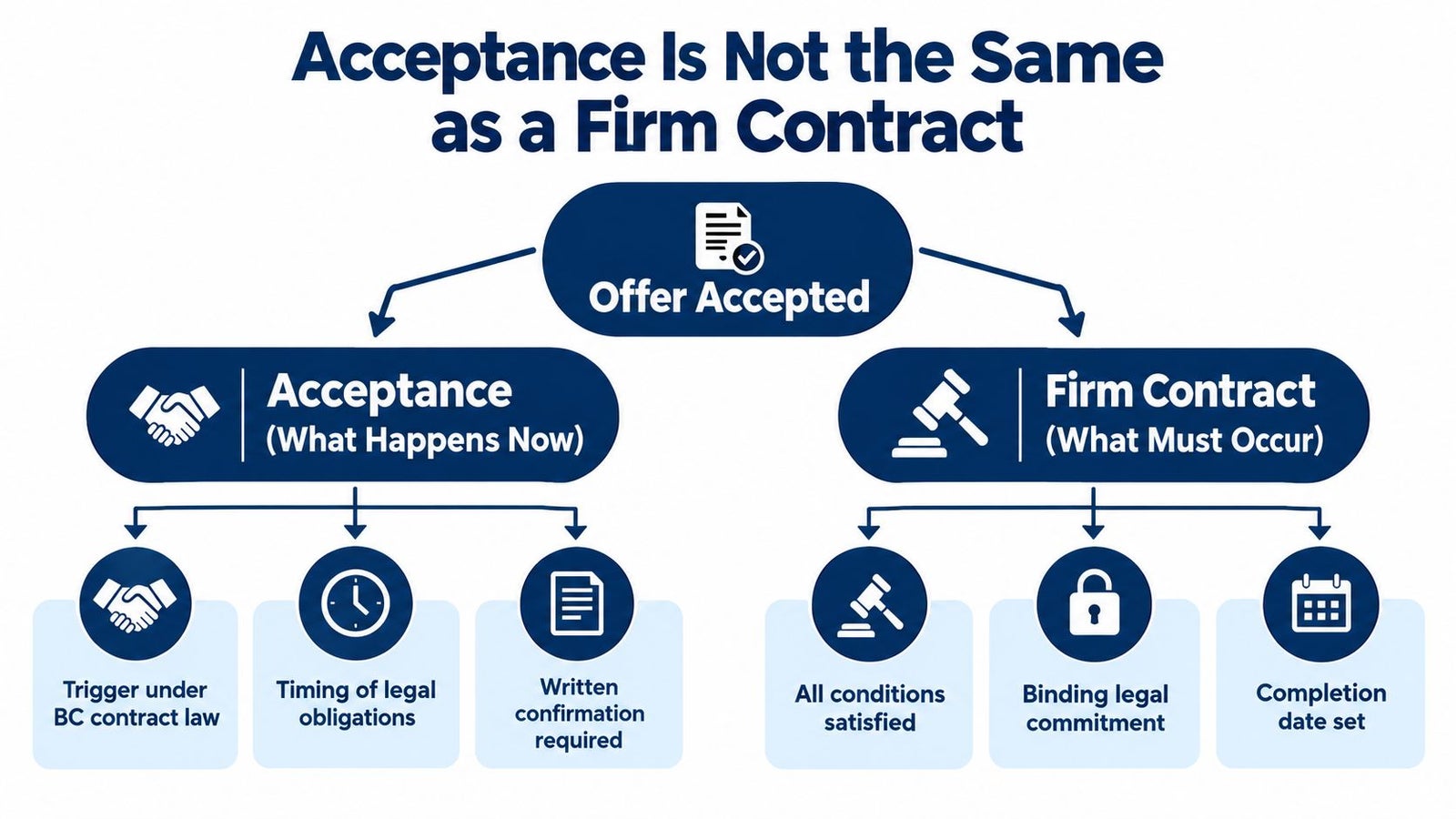
Think of a conditional agreement as a route with gates, not an unrestricted exit. Your financing clause gives you a particular investigation to complete. It isn't a substitute for reviewing whether you still like the neighbourhood.
Some clauses also create a more specific legal structure. The BC Real Estate Association describes how an accepted offer containing purchaser's conditions can operate as an option until the subject-removal deadline, with consequences that depend on the wording, including any specified non-refundable amount. Its legal explanation of offers and options is a useful reminder that not every conditional agreement works identically.
Before acting, ask your agent or lawyer:
Once the required subjects are properly removed, you should plan to complete, not treat the purchase as another decision still to be made. Any remaining statutory right needs separate consideration.
This is why generic advice from outside BC can mislead. Familiar terms such as “under contract” don't replace the wording of your own Contract of Purchase and Sale.
The Home Buyer Rescission Period is separate from your subjects. Since January 2023, BC's statutory framework has allowed buyers to cancel an applicable residential purchase within three business days after acceptance, with the period starting the next business day and a fee of 0.25% of the purchase price, as explained in BCFSA's guidance on offers from buyers.
Under that same guidance, rescinding a $1,000,000 purchase costs $2,500. If a brokerage holds the deposit, it pays the seller's rescission fee from those funds and returns the balance; a separate deposit-release agreement isn't required for a valid rescission.
Use the graphic to orient yourself to the timing, but remember that statutory rescission is not penalty-free.
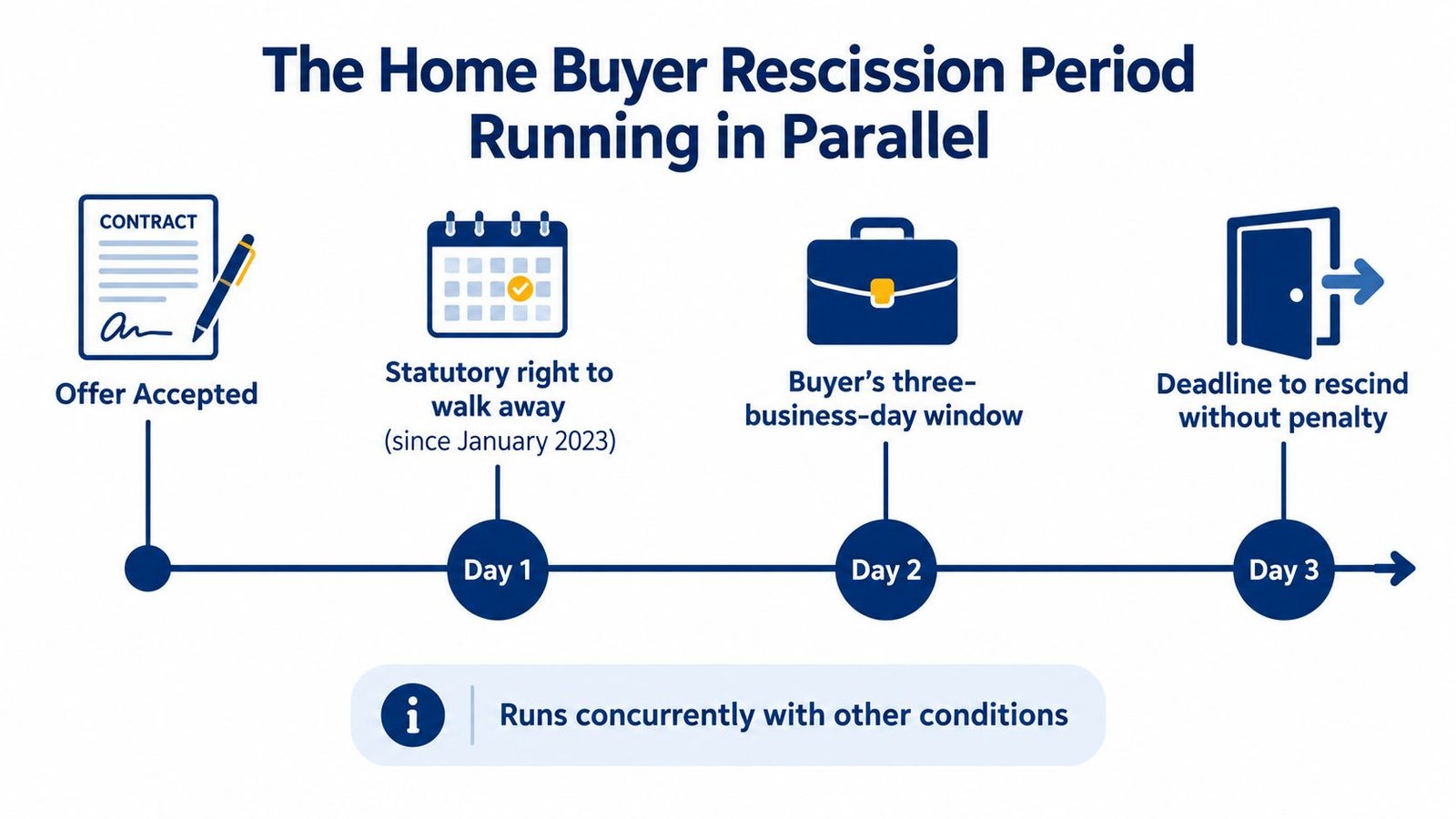
The rescission window runs at the same time as your financing, inspection, and other subject deadlines. It doesn't wait for you to finish investigating the home, and it doesn't restart when you remove subjects.
Practically, that means you should keep contacting your lender and arranging due diligence while you consider your decision. Waiting until the rescission window closes to start those tasks can leave you short of time under the contract.
Avoid using "backing out" as a catch-all description. It conceals the legal route you're taking.
For example, an unresolved financing concern may require a conversation about the financing clause, not an automatic rescission notice. Conversely, changing your mind about the purchase isn't necessarily a financing issue. Explain your concern to your agent and lawyer so they can assess the appropriate route rather than trying to fit it into the wrong clause.
Treat your subject period as active investigation time, not a pause in the purchase. BCFSA describes it as typically about one week, while recognizing that more complicated inquiries may need a different period; its deposit and subject-removal guidance also explains the importance of the contractual deadline and written notice.
Your signed agreement controls the actual schedule. If required written notice isn't delivered by the deadline, the agreement may terminate under its terms, so don't confuse finishing your research with formally removing the subjects.
Use this checklist to organize the work, then adapt it to your clauses.
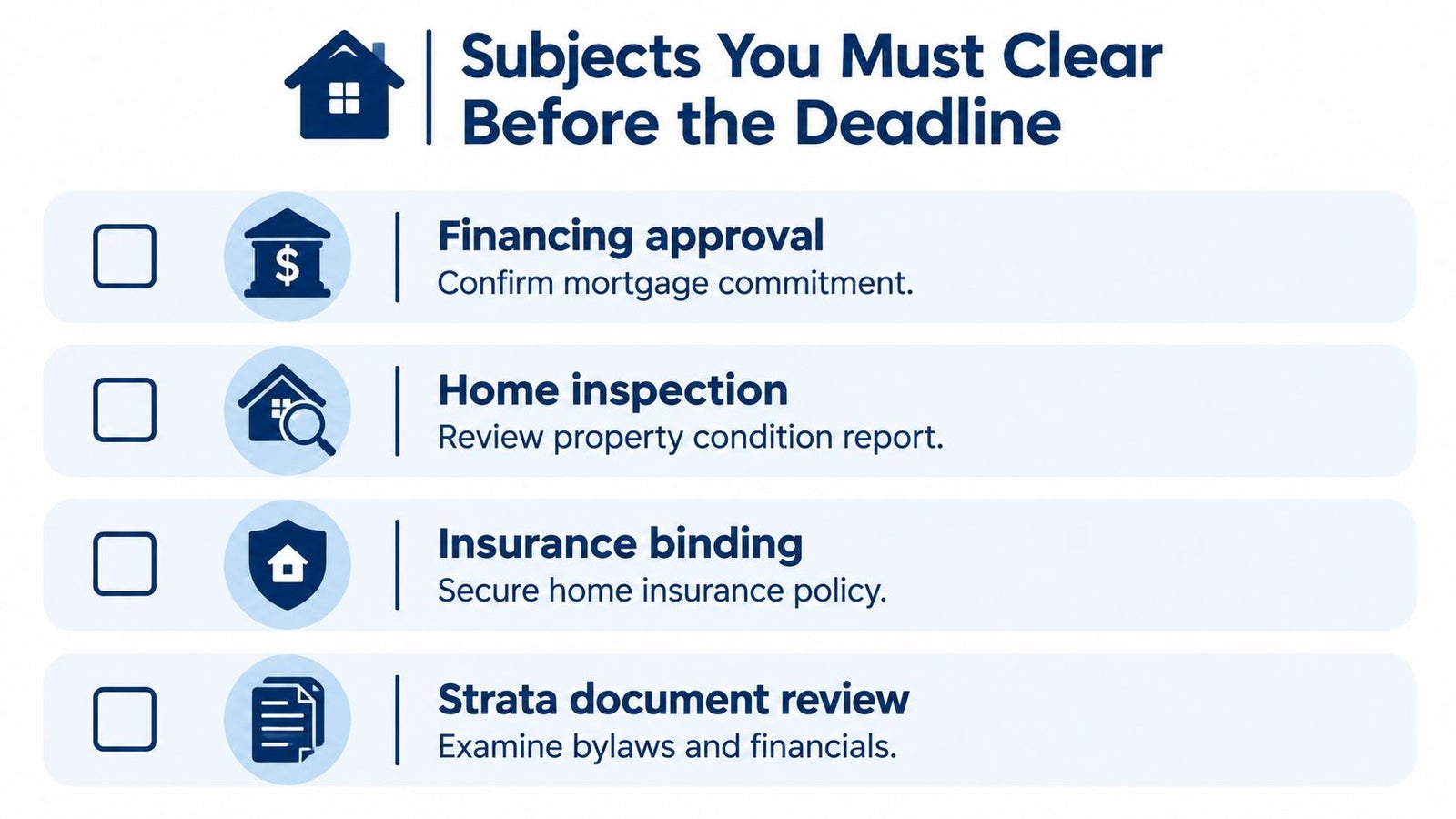
Send the accepted contract to your mortgage professional promptly. Ask what remains outstanding before they can confirm financing for this buyer and this property, and request a clear explanation of any remaining conditions.
A helpful question is: “What still needs to happen before I can make an informed decision about removing my financing subject?” That's more useful than asking whether the application looks promising.
Book the inspection early enough to read the report and ask follow-up questions. The home inspection guide for buyers can help you prepare for the appointment and organize what to discuss afterwards.
An inspection finding is a decision point, not a repair agreement. If you want the seller to address something, have your agent document any negotiated change rather than relying on an informal understanding.
For a condo purchase, the inspection and strata review answer different questions. You may feel comfortable with the unit's physical condition while still needing clarification about the building's documents.
Removing subjects changes the work, but it doesn't finish it. The focus moves from deciding whether the purchase can proceed to preparing the legal transfer and making sure the funds arrive as required.
Your lawyer or notary needs the firm agreement and supporting information in time to organize the conveyance. Their work includes reviewing title, preparing transfer documents, coordinating mortgage funds, and arranging the balance of the purchase price and adjustments. The provincial Buying a Home consumer guide explains the legal and financial milestones involved.
Completion is when ownership transfers and the purchase money changes hands. Possession is when the buyer is entitled to physically take the home under the contract.
Those dates aren't interchangeable. A buyer can be the registered owner while still waiting for the agreed possession time, so don't book movers solely because you've identified the completion date.
For example, suppose your contract schedules possession after completion. Your lawyer may confirm that the legal transfer has occurred, but your moving crew still needs to follow the later access arrangements. Ask your agent to confirm when and how keys will be released.
Ask your legal representative for a written breakdown of the money you need to provide. Compare that with what your lender expects to advance and what you've already paid as a deposit.
Your guide to legal fees when buying a house in BC can help frame the questions, but the transaction-specific statement should guide your arrangements. If an amount is unclear, ask before sending funds.
There isn't a universal accepted-offer-to-completion timetable to apply to every Vancouver purchase. The agreed dates, financing arrangements, and legal work determine your schedule.
Sellers should remain responsive too. Signing a document isn't the same as confirmation that registration and payment have been completed. Keep your agent and legal representative informed about anything that could affect the scheduled handover, and wait for their confirmation rather than assuming the transaction is finished.
Consider a Vancouver condo purchase funded with a mortgage, the buyer's savings, and a deposit already paid. The useful calculation is the remaining cash required to complete, not the purchase price less the mortgage.
The deposit is credited toward the price rather than added as a separate purchase cost. Taxes, legal charges, and adjustments still need to be accounted for, with transaction-specific amounts confirmed by your legal representative.
Review BC Property Transfer Tax considerations with your adviser rather than inserting an assumed exemption into your budget. An adjustment in the seller's favour increases what the buyer owes; one in the buyer's favour reduces it.
For new housing, GST generally becomes payable on the earlier of ownership or possession transferring under the agreement, according to the CRA's new-housing GST guidance. Ask for written confirmation of the GST amount and rebate treatment.
Don't count an anticipated benefit as available cash before checking eligibility. Review the CRA's first-time home buyers' GST/HST rebate requirements, and have your mortgage professional or tax adviser verify any planned RRSP withdrawal. Model the funds required with and without the expected benefit.
The final preparation is about matching practical arrangements to the contract. Confirm responsibilities in writing so neither side discovers an unresolved task when the moving truck arrives.
A simple final check helps: who confirms completion, who authorizes key release, and who contacts you if something changes? Knowing those answers is more useful than assuming everyone else has the details.
Keep the signed agreement and your representatives' contact information accessible until possession is complete. The goal is a documented handover, not just a relieved exchange of keys.
For buyers and sellers who want help coordinating these milestones, Jacky Levi - Vancouver Realtor offers Greater Vancouver representation, contract administration, and referrals to mortgage, inspection, and legal professionals. Book a planning call to review your subject deadlines, completion and possession dates, and outstanding documents before time-sensitive decisions need to be made.
Understanding what happens after an offer is accepted starts with separating the deadlines, not rushing through them. In British Columbia, the rescission period, subject-removal process, and completion schedule serve different purposes. Treat them as separate calendar entries, and the next steps become much easier to manage.
The Moment Your Offer Is Accepted in Vancouver
Suppose you've offered on a Vancouver condo. The seller counters, you agree to the revised terms, and both sides receive the accepted agreement. You feel relieved, but you're also looking at financing and inspection clauses that still need attention.
Your first task isn't choosing moving boxes. It's making sure everyone is working from the same final, signed agreement, including the accepted counteroffer and any attached schedules. Ask your agent to walk through the dates and explain which actions belong to you, your lender, and your legal representative.
Turn the agreement into a working calendar
Create a shared tracker rather than relying on a string of text messages. Give each task an owner, a deadline, and a place to record written confirmation.
- Rescission deadline: Have your agent confirm the applicable cancellation window and notice requirements.
- Subject-removal deadline: Record the contractual date and time beside every outstanding condition.
- Deposit instructions: Confirm the amount, due date, recipient, and payment arrangements from the agreement.
- Completion and possession: Enter both dates separately so legal and moving arrangements don't get mixed together.
Keep the contract, lender correspondence, inspection report, and strata documents in an organized folder. When someone asks whether an item is finished, you should be able to point to a document rather than remember a conversation.
Practical rule: A reassuring phone call is useful. Written confirmation is what you should organize your next decision around.
For sellers, the equivalent task is checking what access, information, or documents the buyer needs. Prompt responses help the buyer investigate the property without avoidable delays.
If you're still comparing potential offer terms, a Greater Vancouver house-offer strategy should account for this follow-through, not just the price. An offer needs a workable path from acceptance to handover, with enough time to investigate the home and arrange the money.
Acceptance Is Not the Same as a Firm Contract
An accepted offer with subjects isn't the same as an unconditional purchase. But that doesn't mean the agreement has no legal effect while you investigate the property.
The distinction matters because buyers sometimes hear "subject to financing" and assume they can change their minds. BCFSA explains that buyers must use every reasonable effort to satisfy their conditions, and that an unsuccessful condition doesn't automatically mean a deposit can be released without the required formalities. Sellers may also continue considering other offers while subjects remain outstanding, unless their contract restricts that conduct, according to BCFSA's guidance on offers to sellers.
The diagram separates acceptance from the steps needed to reach a firm agreement.
Why the exact clause matters
Think of a conditional agreement as a route with gates, not an unrestricted exit. Your financing clause gives you a particular investigation to complete. It isn't a substitute for reviewing whether you still like the neighbourhood.
Some clauses also create a more specific legal structure. The BC Real Estate Association describes how an accepted offer containing purchaser's conditions can operate as an option until the subject-removal deadline, with consequences that depend on the wording, including any specified non-refundable amount. Its legal explanation of offers and options is a useful reminder that not every conditional agreement works identically.
Before acting, ask your agent or lawyer:
- What must I investigate? Identify the obligation attached to each subject.
- What notice is required? Confirm how fulfilment or waiver must be communicated.
- What happens to the deposit? Read the actual clause rather than assuming a universal refund rule.
Once the required subjects are properly removed, you should plan to complete, not treat the purchase as another decision still to be made. Any remaining statutory right needs separate consideration.
This is why generic advice from outside BC can mislead. Familiar terms such as “under contract” don't replace the wording of your own Contract of Purchase and Sale.
The Home Buyer Rescission Period Running in Parallel
The Home Buyer Rescission Period is separate from your subjects. Since January 2023, BC's statutory framework has allowed buyers to cancel an applicable residential purchase within three business days after acceptance, with the period starting the next business day and a fee of 0.25% of the purchase price, as explained in BCFSA's guidance on offers from buyers.
Under that same guidance, rescinding a $1,000,000 purchase costs $2,500. If a brokerage holds the deposit, it pays the seller's rescission fee from those funds and returns the balance; a separate deposit-release agreement isn't required for a valid rescission.
Use the graphic to orient yourself to the timing, but remember that statutory rescission is not penalty-free.
Parallel doesn't mean consecutive
The rescission window runs at the same time as your financing, inspection, and other subject deadlines. It doesn't wait for you to finish investigating the home, and it doesn't restart when you remove subjects.
Practically, that means you should keep contacting your lender and arranging due diligence while you consider your decision. Waiting until the rescission window closes to start those tasks can leave you short of time under the contract.
Different decisions have different consequences
Avoid using "backing out" as a catch-all description. It conceals the legal route you're taking.
Before sending a cancellation message, ask your representative to identify the right you're exercising and the notice it requires.
For example, an unresolved financing concern may require a conversation about the financing clause, not an automatic rescission notice. Conversely, changing your mind about the purchase isn't necessarily a financing issue. Explain your concern to your agent and lawyer so they can assess the appropriate route rather than trying to fit it into the wrong clause.
Subjects You Must Clear Before the Deadline
Treat your subject period as active investigation time, not a pause in the purchase. BCFSA describes it as typically about one week, while recognizing that more complicated inquiries may need a different period; its deposit and subject-removal guidance also explains the importance of the contractual deadline and written notice.
Your signed agreement controls the actual schedule. If required written notice isn't delivered by the deadline, the agreement may terminate under its terms, so don't confuse finishing your research with formally removing the subjects.
Use this checklist to organize the work, then adapt it to your clauses.
Financing and inspection need actual answers
Send the accepted contract to your mortgage professional promptly. Ask what remains outstanding before they can confirm financing for this buyer and this property, and request a clear explanation of any remaining conditions.
A helpful question is: “What still needs to happen before I can make an informed decision about removing my financing subject?” That's more useful than asking whether the application looks promising.
Book the inspection early enough to read the report and ask follow-up questions. The home inspection guide for buyers can help you prepare for the appointment and organize what to discuss afterwards.
An inspection finding is a decision point, not a repair agreement. If you want the seller to address something, have your agent document any negotiated change rather than relying on an informal understanding.
Insurance and strata review deserve equal attention
- Insurance confirmation: Ask an insurer to assess the property and explain coverage availability, requirements, and the proposed effective date. Don't leave an insurance subject unresolved because you've received only an initial quote.
- Strata investigation: Gather the documents required by your clause and review the bylaws, financial information, and other relevant records. Flag unclear items for your agent or lawyer instead of assuming silence means there's no concern.
- Written decision: Record whether each condition has been satisfied, waived, or remains unresolved. Arrange the required notice before the deadline rather than at the last moment.
For a condo purchase, the inspection and strata review answer different questions. You may feel comfortable with the unit's physical condition while still needing clarification about the building's documents.
Deadline discipline: If information is missing, discuss your options before time expires. Don't assume an extension exists unless the parties have properly agreed to it.
From Firm Contract to Completion Day
Removing subjects changes the work, but it doesn't finish it. The focus moves from deciding whether the purchase can proceed to preparing the legal transfer and making sure the funds arrive as required.
Your lawyer or notary needs the firm agreement and supporting information in time to organize the conveyance. Their work includes reviewing title, preparing transfer documents, coordinating mortgage funds, and arranging the balance of the purchase price and adjustments. The provincial Buying a Home consumer guide explains the legal and financial milestones involved.
Completion and possession are different appointments
Completion is when ownership transfers and the purchase money changes hands. Possession is when the buyer is entitled to physically take the home under the contract.
Those dates aren't interchangeable. A buyer can be the registered owner while still waiting for the agreed possession time, so don't book movers solely because you've identified the completion date.
For example, suppose your contract schedules possession after completion. Your lawyer may confirm that the legal transfer has occurred, but your moving crew still needs to follow the later access arrangements. Ask your agent to confirm when and how keys will be released.
Keep the funding conversation open
Ask your legal representative for a written breakdown of the money you need to provide. Compare that with what your lender expects to advance and what you've already paid as a deposit.
Your guide to legal fees when buying a house in BC can help frame the questions, but the transaction-specific statement should guide your arrangements. If an amount is unclear, ask before sending funds.
There isn't a universal accepted-offer-to-completion timetable to apply to every Vancouver purchase. The agreed dates, financing arrangements, and legal work determine your schedule.
Sellers should remain responsive too. Signing a document isn't the same as confirmation that registration and payment have been completed. Keep your agent and legal representative informed about anything that could affect the scheduled handover, and wait for their confirmation rather than assuming the transaction is finished.
What Closing Actually Costs in a Vancouver Example
Consider a Vancouver condo purchase funded with a mortgage, the buyer's savings, and a deposit already paid. The useful calculation is the remaining cash required to complete, not the purchase price less the mortgage.
The deposit is credited toward the price rather than added as a separate purchase cost. Taxes, legal charges, and adjustments still need to be accounted for, with transaction-specific amounts confirmed by your legal representative.
Review BC Property Transfer Tax considerations with your adviser rather than inserting an assumed exemption into your budget. An adjustment in the seller's favour increases what the buyer owes; one in the buyer's favour reduces it.
For new housing, GST generally becomes payable on the earlier of ownership or possession transferring under the agreement, according to the CRA's new-housing GST guidance. Ask for written confirmation of the GST amount and rebate treatment.
Don't count an anticipated benefit as available cash before checking eligibility. Review the CRA's first-time home buyers' GST/HST rebate requirements, and have your mortgage professional or tax adviser verify any planned RRSP withdrawal. Model the funds required with and without the expected benefit.
Buyer and Seller Obligations Up to Key Handover
The final preparation is about matching practical arrangements to the contract. Confirm responsibilities in writing so neither side discovers an unresolved task when the moving truck arrives.
- Buyers: Confirm mortgage documents are signed, funds are ready, and insurance takes effect as advised for the transaction. Coordinate movers and utility arrangements with the actual possession schedule.
- Sellers: Review the property-condition and handover obligations in the agreement, provide outstanding documentation, and arrange keys and access devices. Confirm insurance timing with your insurer and legal representative rather than cancelling automatically on completion.
- Both parties: Tell your representatives promptly about damage, access problems, missing documents, or anything else that could interfere with the agreed handover.
A simple final check helps: who confirms completion, who authorizes key release, and who contacts you if something changes? Knowing those answers is more useful than assuming everyone else has the details.
Keep the signed agreement and your representatives' contact information accessible until possession is complete. The goal is a documented handover, not just a relieved exchange of keys.
For buyers and sellers who want help coordinating these milestones, Jacky Levi - Vancouver Realtor offers Greater Vancouver representation, contract administration, and referrals to mortgage, inspection, and legal professionals. Book a planning call to review your subject deadlines, completion and possession dates, and outstanding documents before time-sensitive decisions need to be made.