
You're looking at two listings that seem interchangeable. The Burnaby side-by-side duplex has the extra privacy and a second entrance you could rent out. The Richmond townhouse is newer, shows better, and appears easier to maintain. Both sit in a similar price range, so the obvious question is: which one is the better buy?
That's the wrong first question. “Duplex” and “townhouse” describe the building, not the ownership underneath it. The decisive issue is whether you're buying fee simple land, a bare-land strata, or a conventional strata interest. That structure determines who controls the roof, who insures the exterior, who pays for the driveway, how much of your monthly cost is predictable, and how easily the property may resell.
As a Vancouver REALTOR® who has worked with buyers and sellers across Burnaby, Richmond, and the North Shore, I don't treat duplex or townhouse as a lifestyle-only decision. I treat it as an ownership-structure decision with lifestyle consequences.
The Burnaby buyer has a young family, wants a ground-oriented home, and likes the idea of having no strata council between the household and a future renovation. The Richmond townhouse has a practical floor plan, shared landscaping, and a newer building envelope. On paper, both work.
The duplex offers apparent control. There may be no monthly strata fee, no council approval for ordinary interior changes, and a more direct relationship with the land. But the owner may also carry more responsibility for the roof, exterior walls, drainage, insurance coordination, and unexpected repairs. If the other half of the duplex is separately owned, cooperation can matter even without a strata corporation.
The townhouse offers a different trade-off. A conventional strata may collect monthly contributions, maintain shared components, arrange insurance, and manage common property. That can reduce the number of repair decisions an individual owner handles. It can also introduce bylaws, depreciation-report concerns, special levies, rental restrictions, and approval requirements.
A Richmond townhouse isn't automatically lower-cost, and a Burnaby duplex isn't automatically a stronger investment. The title tells you more than the floor plan.
A buyer searching for Burnaby property can use this Burnaby real estate market and buyers guide for neighbourhood context, but the listing page won't answer the ownership question by itself. You need the title, plan, disclosure documents, insurance information, and a proper comparison with similar homes in the same sub-market.
The rest of the decision should follow that order. Identify the structure first, model the carrying cost second, then assess rental flexibility, renovation control, future competition, and resale liquidity.
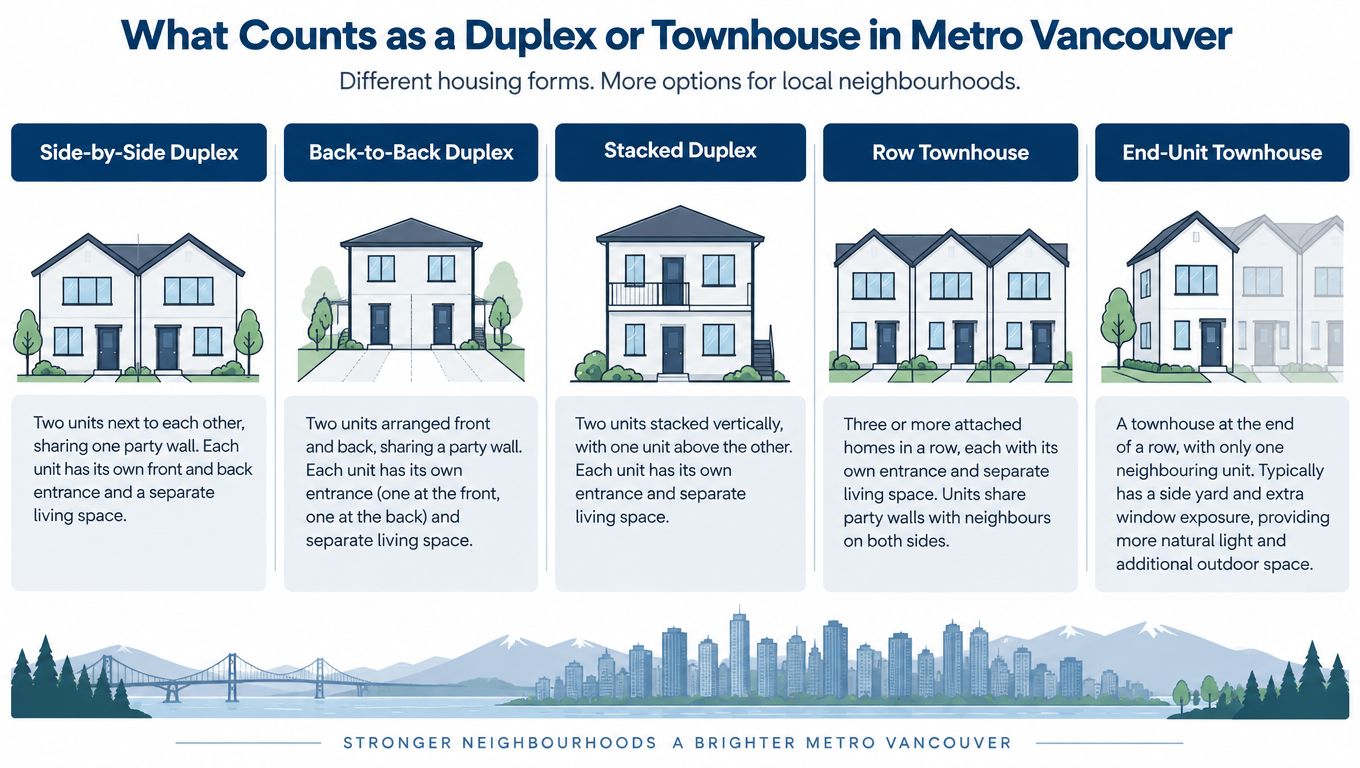
A duplex contains two dwelling units in one building or connected arrangement. In Metro Vancouver listings, that can mean very different things:
The physical description doesn't tell you the title. A side-by-side duplex may be held as fee simple, or the two homes may form part of a strata arrangement. A townhouse may be fee simple, bare-land strata, or conventional strata.
Fee simple usually gives the owner direct title to the land and improvements, subject to municipal rules, easements, covenants, and other registered interests. A fee-simple duplex may give you substantial control, but it also leaves you responsible for more of the property's upkeep. Shared walls and coordinated repairs still require careful review.
Bare-land strata gives the owner a strata lot that may include the house and the land within defined boundaries. The strata can still manage shared roads, landscaping, drainage, or other common elements. This structure often sits between a freehold duplex and a conventional townhouse strata, so buyers need to read the plan and bylaws rather than rely on the marketing language.
Conventional strata generally means you own the interior space defined as your strata lot and share ownership of common property with other owners. The strata corporation may oversee the roof, exterior, building systems, landscaping, and insurance, depending on the plan and bylaws. Your fee pays for shared obligations, but you trade some individual control for collective management.
A listing that says “townhouse” doesn't confirm any of these categories. Ask for the registered strata plan, title search, bylaws, most recent financial statements, insurance documents, and depreciation report where applicable. Buyers can also use these Vancouver townhouse search tools to locate options, but the search process is only the start.
Statistics Canada separates housing forms such as semi-detached homes, row houses, and condominium forms. That distinction matters because appraisers, lenders, insurers, and buyers may treat similar-looking properties differently. The home's appearance is useful for understanding how you'll live in it. The legal structure is what you buy.
A duplex and a townhouse can post similar asking prices, then cost you very different amounts to own. In Metro Vancouver, that gap usually comes from the ownership structure, not the listing photos. If you compare a fee-simple duplex against a full-strata townhouse without pricing the structure behind each one, you are not doing a serious comparison.
That table is the starting point. The decision gets clearer once you ask who controls the work, who pays first, and how easily the cost can be forecast.
A fee-simple duplex often attracts buyers because there is no monthly strata bill. Fine. But no strata fee does not mean low carrying cost. It means you are self-funding the reserve plan, whether you formally call it that or not. Roof, envelope, drainage, fencing, retaining walls, and insurance changes still show up. They just hit you directly, and sometimes all at once.
A conventional townhouse flips that structure. You pay monthly, but part of that payment may be buying predictability. In a well-run strata, the corporation collects contributions, schedules common work, and spreads major expenses over time. In a weak strata, the low monthly fee that looked attractive on listing day can turn into underfunded reserves, deferred maintenance, and special levies at the worst moment. I would rather see an honest fee with a clear maintenance record than an artificially low fee hiding future problems.
Bare-land strata usually sits in the middle. Owners may hold more direct responsibility for the home itself while still paying into shared elements such as roads, landscaping, or site infrastructure. That mix can work well, but only if the plan and bylaws clearly divide obligations. If they do not, buyers end up guessing, and guesswork gets expensive.
The California Energy Commission's 2025 Single-Family Residential Compliance Manual is not a rulebook for British Columbia buyers. It is still a useful reminder that permit class, building type, and legal classification affect how you assess operating and construction-related costs. Before you compare one duplex or townhouse against another, confirm what the property is on title.
Older properties need extra discipline. This breakdown of detached-home maintenance costs in Vancouver is a good reminder that ownership costs do not disappear just because there is no strata corporation. Apply the same standard to an older duplex, especially if one side has deferred work, shared components are aging, or the adjacent owner approaches maintenance very differently than you do.
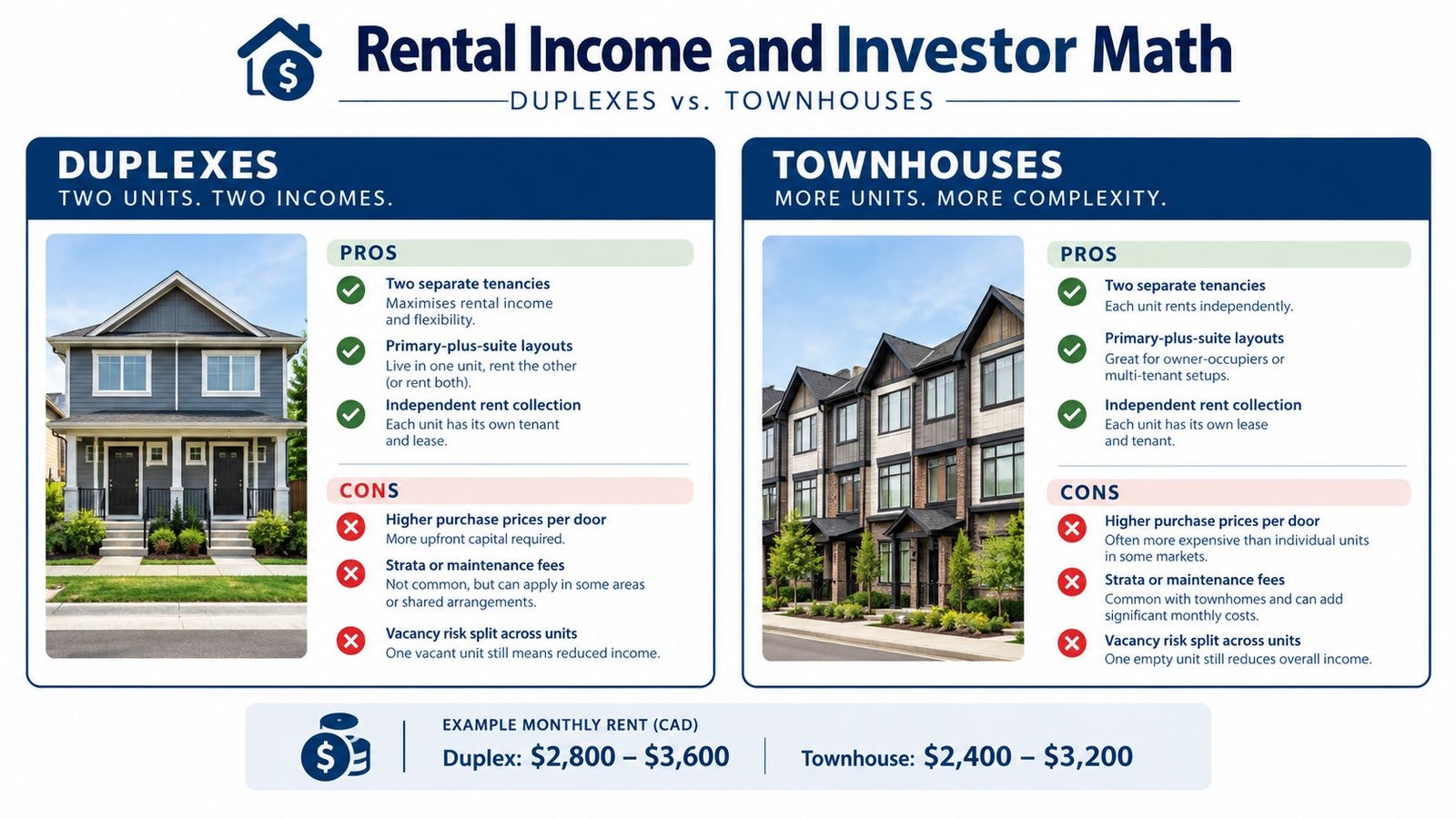
A side-by-side duplex usually gives an investor more operating choices than a townhouse. You may occupy one side and rent the other, rent both homes, or use a primary residence with a separate suite where the zoning, permits, layout, and lender approval support it.
That flexibility can improve income resilience, but it also creates two units to manage. One vacancy doesn't necessarily remove all rental income, yet the property may have higher acquisition costs per door, more maintenance exposure, and more complicated insurance and financing review.
A townhouse normally operates as one rental home. It can appeal strongly to a family tenant who wants bedrooms, parking, outdoor space, and a neighbourhood setting. A stacked townhouse may attract a different tenant profile, while a compact upper-level unit can compete more directly with apartment inventory.
Fee-simple duplex: The owner generally has more direct control over tenant selection, maintenance scheduling, and use of the building, subject to local law and financing terms. The same control brings more responsibility for insurance, repairs, utilities, and vacancy planning.
Bare-land strata townhouse: The property may provide a ground-oriented rental with fewer exterior tasks handled personally, but the owner must review strata bylaws, rental permissions, use restrictions, and shared-cost obligations.
Conventional strata townhouse: The home can be operationally simple as a long-term rental, but restrictions may affect short-term use, occupants, pets, renovations, parking, or the number of rented units. The strata documents are part of the investment underwriting, not paperwork to review after the offer.
Lenders may treat rental income differently depending on whether the property is a freehold duplex, a stratified home, or a principal residence with a suite. Ask the lender to confirm how much income they will recognize before you calculate affordability. Don't build an offer around rent that hasn't been verified.
Use this checklist for each candidate:
For a Vancouver investor, this guide to absorption rate in real estate provides useful market vocabulary. The property-specific question remains more important: how many directly competing homes are available, how quickly they move, and whether your title structure limits the buyer pool?
Renovation control is one of the clearest differences between a duplex and townhouse, but buyers often overestimate both sides.
A fee-simple duplex usually gives an owner more direct control over interior improvements. Structural work, exterior changes, additions, secondary suites, parking alterations, and envelope work still require permits and may require coordination with the adjoining unit or municipal approvals. “No strata” doesn't mean “no rules.”
A conventional strata townhouse adds another approval layer. A kitchen renovation may be straightforward, while moving plumbing, changing windows, altering flooring, removing walls, installing air conditioning, or modifying a patio can trigger strata requirements. The council, bylaws, alteration agreements, insurance conditions, and municipal permits all matter.
Bare-land strata requires a closer reading. Some owners control the home and lot more directly, while shared roads, landscaping, drainage, and exterior obligations remain collective. Never infer responsibility from the development's appearance.
The University of California, Berkeley Terner Center estimated duplex hard-construction costs of approximately $252 to $339 per square foot across its modelled scenarios, excluding land, permits and fees, financing, and warranty reserves, in its missing-middle development analysis. The report also estimated a roughly 10% construction-cost premium for projects subject to the commercial building code, all else equal. Those are California development figures, not a Vancouver renovation budget. They do reinforce the importance of confirming whether a project is legally treated as two units or a larger multifamily development.
Future supply is a resale question, not a slogan. CMHC reported that Vancouver missing-middle housing starts fell 56% between 2018 and 2024, while missing-middle starts nationally increased by more than 44% from 2023 to 2024, as described in its analysis of missing-middle housing development. CMHC also described stronger Vancouver construction activity alongside constraints from high costs and land scarcity.
That combination means policy support doesn't guarantee a wave of identical competing homes. A specific duplex or townhouse may remain differentiated if it offers a larger layout, a ground-level yard, practical parking, a desirable school catchment, a strong transit connection, or a title structure buyers understand.
Assess future competition by municipality and product type. Burnaby may offer different redevelopment pressure from Richmond. North Shore buyers may value topography, views, access, and family layouts in ways that don't translate directly to a newer stacked project.
Before buying, ask:
The strongest resale position isn't always the newest home. It's the home whose legal structure, physical utility, and maintenance record remain clear to the next buyer.
There isn't one universal winner in the duplex or townhouse decision. The right choice depends on how you use the home, how much repair volatility you can tolerate, and whether you need rental flexibility or low-maintenance ownership.
Choose a well-run conventional townhouse when predictable maintenance and a usable family layout matter more than complete control. A Burnaby or Richmond townhouse can provide outdoor space and parking without making you the sole decision-maker for every exterior component.
Before offering, review the depreciation report, insurance, meeting minutes, contingency reserve, and rental bylaws. Have the lender include the strata fee and any required insurance costs in the affordability calculation. If the documents show chronic disputes or looming capital work, move on.
A bare-land or conventional townhouse on the North Shore can fit a family that wants bedrooms, outdoor space, and less direct exterior maintenance. In North Vancouver, West Vancouver, or a comparable Burnaby neighbourhood, compare the actual yard, parking, storage, stairs, school access, and commute rather than relying on the “townhome” label.
Prioritize an end unit when the added windows and side access materially improve daily life. Confirm alteration rules before assuming you can enclose a patio, add cooling, or change flooring.
A side-by-side duplex in a maturing Burnaby or Richmond neighbourhood is usually the stronger format when independent rent collection, two tenancy options, and future owner-occupier demand drive the strategy. Underwrite each unit separately and include maintenance reserves, insurance, vacancy, property tax, and financing constraints.
Don't buy a duplex just because it has two doors. Confirm legal unit status, suite approvals, utility arrangements, parking, tenant demand, and the likely resale buyer.
A well-managed townhouse usually suits a downsizer who wants fewer exterior responsibilities and a straightforward home base. Look for one-level living or a practical elevator-free layout only if stairs are acceptable, then inspect storage, guest space, parking, and monthly obligations.
An end unit can improve light and privacy, but it may carry a different maintenance profile. Read the bylaws and recent minutes before trading a detached home for supposed simplicity.
The Bay Area offers a useful comparative perspective. An Association of Bay Area Governments analysis found middle housing represented approximately 18% to 28% of housing stock in most Bay Area counties, with San Francisco County at about 51%, and found median townhouse sale prices consistently below detached-home medians across the region, as reported in the ABAG middle-housing market analysis. California isn't Metro Vancouver, but the comparison reinforces why attached housing deserves its own comparable set rather than being measured against detached homes alone.
Before you choose a duplex or townhouse, obtain:
Bring those documents to your lender, lawyer, inspector, and REALTOR®. A property-specific worksheet will reveal whether the apparent bargain is a predictable home or a deferred-cost project.
Jacky Levi - Vancouver Realtor offers buyer and seller representation, MLS-based comparative market analysis, offer strategy, and transaction coordination across Vancouver, Burnaby, Richmond, Coquitlam, and the North Shore. If you're comparing a duplex or townhouse, Jacky Levi - Vancouver Realtor can help you review the title structure, carrying costs, comparable sales, and resale positioning before you commit.
That's the wrong first question. “Duplex” and “townhouse” describe the building, not the ownership underneath it. The decisive issue is whether you're buying fee simple land, a bare-land strata, or a conventional strata interest. That structure determines who controls the roof, who insures the exterior, who pays for the driveway, how much of your monthly cost is predictable, and how easily the property may resell.
As a Vancouver REALTOR® who has worked with buyers and sellers across Burnaby, Richmond, and the North Shore, I don't treat duplex or townhouse as a lifestyle-only decision. I treat it as an ownership-structure decision with lifestyle consequences.
A Burnaby Duplex or a Richmond Townhouse
The Burnaby buyer has a young family, wants a ground-oriented home, and likes the idea of having no strata council between the household and a future renovation. The Richmond townhouse has a practical floor plan, shared landscaping, and a newer building envelope. On paper, both work.
The duplex offers apparent control. There may be no monthly strata fee, no council approval for ordinary interior changes, and a more direct relationship with the land. But the owner may also carry more responsibility for the roof, exterior walls, drainage, insurance coordination, and unexpected repairs. If the other half of the duplex is separately owned, cooperation can matter even without a strata corporation.
The townhouse offers a different trade-off. A conventional strata may collect monthly contributions, maintain shared components, arrange insurance, and manage common property. That can reduce the number of repair decisions an individual owner handles. It can also introduce bylaws, depreciation-report concerns, special levies, rental restrictions, and approval requirements.
A Richmond townhouse isn't automatically lower-cost, and a Burnaby duplex isn't automatically a stronger investment. The title tells you more than the floor plan.
The practical question: Who controls the asset, who pays when it fails, and how clearly can the next buyer understand those obligations?
A buyer searching for Burnaby property can use this Burnaby real estate market and buyers guide for neighbourhood context, but the listing page won't answer the ownership question by itself. You need the title, plan, disclosure documents, insurance information, and a proper comparison with similar homes in the same sub-market.
The rest of the decision should follow that order. Identify the structure first, model the carrying cost second, then assess rental flexibility, renovation control, future competition, and resale liquidity.
What Counts as a Duplex or Townhouse in Metro Vancouver
A duplex contains two dwelling units in one building or connected arrangement. In Metro Vancouver listings, that can mean very different things:
- Side-by-side duplex: Two homes share a party wall, with each unit extending across the lot.
- Back-to-back duplex: Two homes are positioned behind one another and share a separating wall or structural relationship.
- Stacked duplex: One dwelling sits above the other, with separate entrances and living areas.
- Row townhouse: A home forms part of a continuous line of attached units.
- End-unit townhouse: A townhouse at the end of the row, often with more windows, a side yard, or fewer immediately adjoining walls.
The physical description doesn't tell you the title. A side-by-side duplex may be held as fee simple, or the two homes may form part of a strata arrangement. A townhouse may be fee simple, bare-land strata, or conventional strata.
The three ownership structures
Fee simple usually gives the owner direct title to the land and improvements, subject to municipal rules, easements, covenants, and other registered interests. A fee-simple duplex may give you substantial control, but it also leaves you responsible for more of the property's upkeep. Shared walls and coordinated repairs still require careful review.
Bare-land strata gives the owner a strata lot that may include the house and the land within defined boundaries. The strata can still manage shared roads, landscaping, drainage, or other common elements. This structure often sits between a freehold duplex and a conventional townhouse strata, so buyers need to read the plan and bylaws rather than rely on the marketing language.
Conventional strata generally means you own the interior space defined as your strata lot and share ownership of common property with other owners. The strata corporation may oversee the roof, exterior, building systems, landscaping, and insurance, depending on the plan and bylaws. Your fee pays for shared obligations, but you trade some individual control for collective management.
A listing that says “townhouse” doesn't confirm any of these categories. Ask for the registered strata plan, title search, bylaws, most recent financial statements, insurance documents, and depreciation report where applicable. Buyers can also use these Vancouver townhouse search tools to locate options, but the search process is only the start.
Statistics Canada separates housing forms such as semi-detached homes, row houses, and condominium forms. That distinction matters because appraisers, lenders, insurers, and buyers may treat similar-looking properties differently. The home's appearance is useful for understanding how you'll live in it. The legal structure is what you buy.
Comparing Carrying Costs Side by Side
A duplex and a townhouse can post similar asking prices, then cost you very different amounts to own. In Metro Vancouver, that gap usually comes from the ownership structure, not the listing photos. If you compare a fee-simple duplex against a full-strata townhouse without pricing the structure behind each one, you are not doing a serious comparison.
That table is the starting point. The decision gets clearer once you ask who controls the work, who pays first, and how easily the cost can be forecast.
A fee-simple duplex often attracts buyers because there is no monthly strata bill. Fine. But no strata fee does not mean low carrying cost. It means you are self-funding the reserve plan, whether you formally call it that or not. Roof, envelope, drainage, fencing, retaining walls, and insurance changes still show up. They just hit you directly, and sometimes all at once.
A conventional townhouse flips that structure. You pay monthly, but part of that payment may be buying predictability. In a well-run strata, the corporation collects contributions, schedules common work, and spreads major expenses over time. In a weak strata, the low monthly fee that looked attractive on listing day can turn into underfunded reserves, deferred maintenance, and special levies at the worst moment. I would rather see an honest fee with a clear maintenance record than an artificially low fee hiding future problems.
Bare-land strata usually sits in the middle. Owners may hold more direct responsibility for the home itself while still paying into shared elements such as roads, landscaping, or site infrastructure. That mix can work well, but only if the plan and bylaws clearly divide obligations. If they do not, buyers end up guessing, and guesswork gets expensive.
The California Energy Commission's 2025 Single-Family Residential Compliance Manual is not a rulebook for British Columbia buyers. It is still a useful reminder that permit class, building type, and legal classification affect how you assess operating and construction-related costs. Before you compare one duplex or townhouse against another, confirm what the property is on title.
My rule for buyers: Never compare a strata fee with “no strata fee” until you've priced the repairs the fee may be covering.
Older properties need extra discipline. This breakdown of detached-home maintenance costs in Vancouver is a good reminder that ownership costs do not disappear just because there is no strata corporation. Apply the same standard to an older duplex, especially if one side has deferred work, shared components are aging, or the adjacent owner approaches maintenance very differently than you do.
Rental Income and Investor Math
A side-by-side duplex usually gives an investor more operating choices than a townhouse. You may occupy one side and rent the other, rent both homes, or use a primary residence with a separate suite where the zoning, permits, layout, and lender approval support it.
That flexibility can improve income resilience, but it also creates two units to manage. One vacancy doesn't necessarily remove all rental income, yet the property may have higher acquisition costs per door, more maintenance exposure, and more complicated insurance and financing review.
A townhouse normally operates as one rental home. It can appeal strongly to a family tenant who wants bedrooms, parking, outdoor space, and a neighbourhood setting. A stacked townhouse may attract a different tenant profile, while a compact upper-level unit can compete more directly with apartment inventory.
What changes the investor calculation
Fee-simple duplex: The owner generally has more direct control over tenant selection, maintenance scheduling, and use of the building, subject to local law and financing terms. The same control brings more responsibility for insurance, repairs, utilities, and vacancy planning.
Bare-land strata townhouse: The property may provide a ground-oriented rental with fewer exterior tasks handled personally, but the owner must review strata bylaws, rental permissions, use restrictions, and shared-cost obligations.
Conventional strata townhouse: The home can be operationally simple as a long-term rental, but restrictions may affect short-term use, occupants, pets, renovations, parking, or the number of rented units. The strata documents are part of the investment underwriting, not paperwork to review after the offer.
Lenders may treat rental income differently depending on whether the property is a freehold duplex, a stratified home, or a principal residence with a suite. Ask the lender to confirm how much income they will recognize before you calculate affordability. Don't build an offer around rent that hasn't been verified.
Use this checklist for each candidate:
- Confirm legal units: Match the title, permits, floor plan, and actual entrances.
- Verify rental rules: Read the bylaws and amendments, not just the listing remarks.
- Separate gross from usable income: Deduct vacancy, insurance, property tax, repairs, utilities, strata fees, and financing.
- Test tenant demand: Compare family-oriented ground-level homes with stacked or apartment-style alternatives.
- Model the exit: Ask who the next buyer will be, an owner-occupier, an investor, or a family seeking a larger home.
For a Vancouver investor, this guide to absorption rate in real estate provides useful market vocabulary. The property-specific question remains more important: how many directly competing homes are available, how quickly they move, and whether your title structure limits the buyer pool?
Zoning, Renovations, and Future Supply Risk
Renovation control is one of the clearest differences between a duplex and townhouse, but buyers often overestimate both sides.
A fee-simple duplex usually gives an owner more direct control over interior improvements. Structural work, exterior changes, additions, secondary suites, parking alterations, and envelope work still require permits and may require coordination with the adjoining unit or municipal approvals. “No strata” doesn't mean “no rules.”
A conventional strata townhouse adds another approval layer. A kitchen renovation may be straightforward, while moving plumbing, changing windows, altering flooring, removing walls, installing air conditioning, or modifying a patio can trigger strata requirements. The council, bylaws, alteration agreements, insurance conditions, and municipal permits all matter.
Bare-land strata requires a closer reading. Some owners control the home and lot more directly, while shared roads, landscaping, drainage, and exterior obligations remain collective. Never infer responsibility from the development's appearance.
The University of California, Berkeley Terner Center estimated duplex hard-construction costs of approximately $252 to $339 per square foot across its modelled scenarios, excluding land, permits and fees, financing, and warranty reserves, in its missing-middle development analysis. The report also estimated a roughly 10% construction-cost premium for projects subject to the commercial building code, all else equal. Those are California development figures, not a Vancouver renovation budget. They do reinforce the importance of confirming whether a project is legally treated as two units or a larger multifamily development.
Testing resale scarcity
Future supply is a resale question, not a slogan. CMHC reported that Vancouver missing-middle housing starts fell 56% between 2018 and 2024, while missing-middle starts nationally increased by more than 44% from 2023 to 2024, as described in its analysis of missing-middle housing development. CMHC also described stronger Vancouver construction activity alongside constraints from high costs and land scarcity.
That combination means policy support doesn't guarantee a wave of identical competing homes. A specific duplex or townhouse may remain differentiated if it offers a larger layout, a ground-level yard, practical parking, a desirable school catchment, a strong transit connection, or a title structure buyers understand.
Assess future competition by municipality and product type. Burnaby may offer different redevelopment pressure from Richmond. North Shore buyers may value topography, views, access, and family layouts in ways that don't translate directly to a newer stacked project.
Before buying, ask:
- Is the home easy to compare with new construction, or does it offer a distinct family-oriented layout?
- Could nearby lots support multiplexes or row homes?
- Does the strata permit the improvements buyers will expect later?
- Are current owners maintaining the property, or is deferred work creating a future discount?
- Will a future buyer qualify for this title and its carrying costs?
The strongest resale position isn't always the newest home. It's the home whose legal structure, physical utility, and maintenance record remain clear to the next buyer.
Matching the Home to the Buyer Profile
There isn't one universal winner in the duplex or townhouse decision. The right choice depends on how you use the home, how much repair volatility you can tolerate, and whether you need rental flexibility or low-maintenance ownership.
First-time buyer
Choose a well-run conventional townhouse when predictable maintenance and a usable family layout matter more than complete control. A Burnaby or Richmond townhouse can provide outdoor space and parking without making you the sole decision-maker for every exterior component.
Before offering, review the depreciation report, insurance, meeting minutes, contingency reserve, and rental bylaws. Have the lender include the strata fee and any required insurance costs in the affordability calculation. If the documents show chronic disputes or looming capital work, move on.
Family upsizer
A bare-land or conventional townhouse on the North Shore can fit a family that wants bedrooms, outdoor space, and less direct exterior maintenance. In North Vancouver, West Vancouver, or a comparable Burnaby neighbourhood, compare the actual yard, parking, storage, stairs, school access, and commute rather than relying on the “townhome” label.
Prioritize an end unit when the added windows and side access materially improve daily life. Confirm alteration rules before assuming you can enclose a patio, add cooling, or change flooring.
Long-term investor
A side-by-side duplex in a maturing Burnaby or Richmond neighbourhood is usually the stronger format when independent rent collection, two tenancy options, and future owner-occupier demand drive the strategy. Underwrite each unit separately and include maintenance reserves, insurance, vacancy, property tax, and financing constraints.
Don't buy a duplex just because it has two doors. Confirm legal unit status, suite approvals, utility arrangements, parking, tenant demand, and the likely resale buyer.
Downsizer
A well-managed townhouse usually suits a downsizer who wants fewer exterior responsibilities and a straightforward home base. Look for one-level living or a practical elevator-free layout only if stairs are acceptable, then inspect storage, guest space, parking, and monthly obligations.
An end unit can improve light and privacy, but it may carry a different maintenance profile. Read the bylaws and recent minutes before trading a detached home for supposed simplicity.
The Bay Area offers a useful comparative perspective. An Association of Bay Area Governments analysis found middle housing represented approximately 18% to 28% of housing stock in most Bay Area counties, with San Francisco County at about 51%, and found median townhouse sale prices consistently below detached-home medians across the region, as reported in the ABAG middle-housing market analysis. California isn't Metro Vancouver, but the comparison reinforces why attached housing deserves its own comparable set rather than being measured against detached homes alone.
Your Due Diligence Checklist and Next Steps
Before you choose a duplex or townhouse, obtain:
- Title and plan: Confirm fee simple, bare-land strata, or conventional strata ownership.
- Strata records: Read bylaws, minutes, financial statements, insurance, depreciation report, and recent project records.
- Insurance quote: Price both owner coverage and any strata deductible exposure.
- Rental rules: Confirm permitted use, restrictions, parking rules, and suite legality.
- Maintenance history: Ask about roofs, windows, drainage, exterior work, plumbing, and special levies.
- Comparable sales: Compare the same ownership structure and sub-market, not just similar square footage.
Bring those documents to your lender, lawyer, inspector, and REALTOR®. A property-specific worksheet will reveal whether the apparent bargain is a predictable home or a deferred-cost project.
Jacky Levi - Vancouver Realtor offers buyer and seller representation, MLS-based comparative market analysis, offer strategy, and transaction coordination across Vancouver, Burnaby, Richmond, Coquitlam, and the North Shore. If you're comparing a duplex or townhouse, Jacky Levi - Vancouver Realtor can help you review the title structure, carrying costs, comparable sales, and resale positioning before you commit.