You've found a Vancouver condo that looks affordable, but the lender's pre-approval is lower than the listing price. Then you realize the down payment isn't your only cash requirement. You'll also need money for taxes, legal work, inspections, adjustments, and the period between signing and moving in.
That's where many buyers get caught. The home buying process step by step isn't just a checklist from viewing to keys. In British Columbia, timing affects your financing, your deposit, your tax relief, and your ability to cancel safely. Treat each stage as a decision with a deadline, not as paperwork that someone else will handle.
Start with your savings history, not with property listings. In Canada, buyers needed an average of 4.4 years to save for a down payment, while first-time buyers needed 4.7 years on average, according to CMHC's 2026 Mortgage Consumer Survey. The same survey found that 72% of first-time buyers were renting before purchasing, while 27% were living with family or friends. In Greater Vancouver, that extended period of renting, saving, and preparing is often part of the purchase journey, not a temporary inconvenience.
The practical lesson is simple. Don't judge your readiness by whether you can assemble the minimum down payment. Judge it by whether you can fund the purchase while keeping enough liquidity for the transaction and the home's ongoing costs.
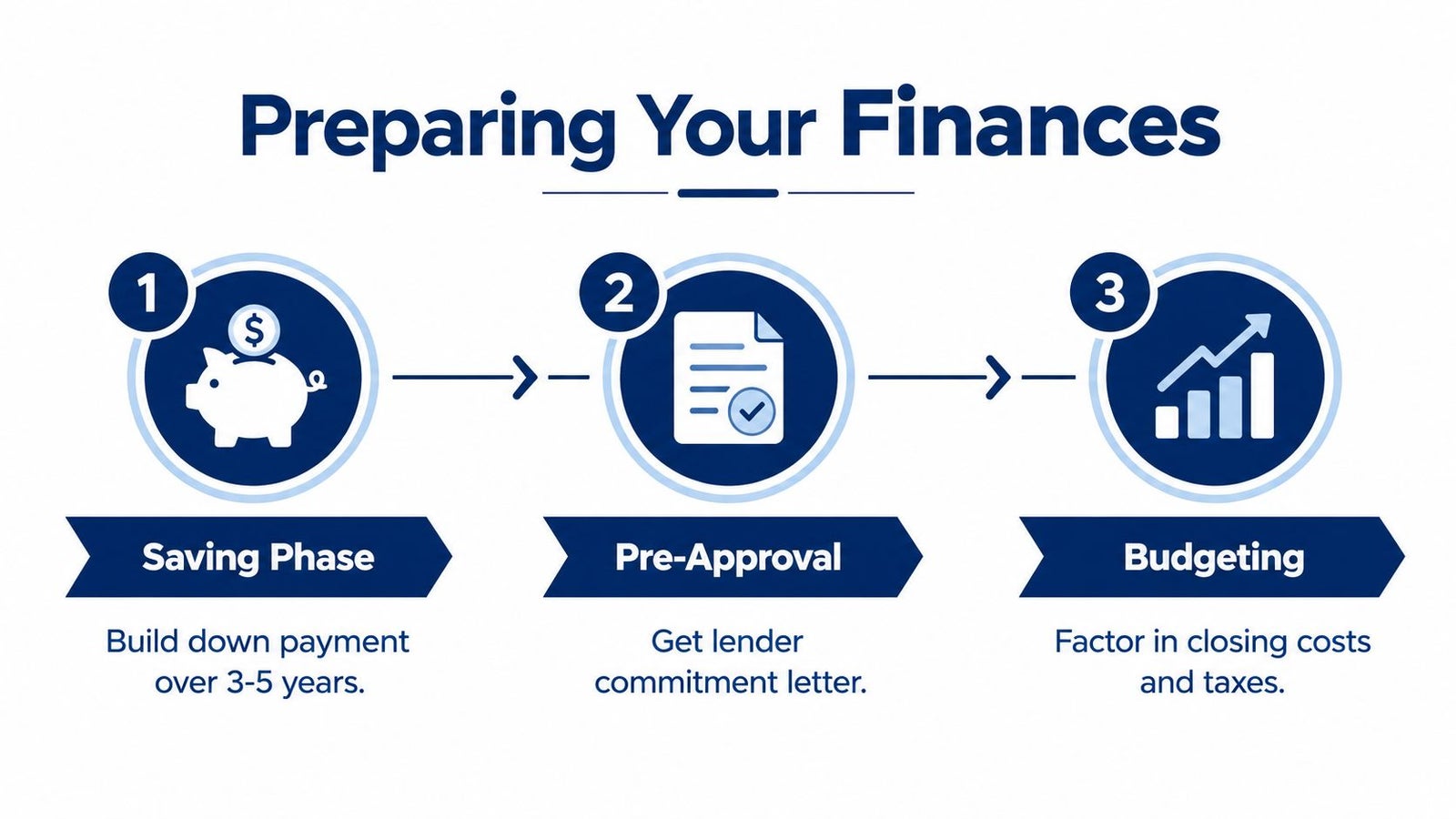
For a Canadian purchase, the minimum down payment is tied to price bands. Buyers need 5% of the first $500,000 and 10% of the portion above $500,000 up to $1.5 million, according to federal down payment guidance. A $750,000 purchase would therefore require at least $50,000 down, subject to the applicable mortgage rules.
That figure doesn't represent the full amount you need in cash. Closing costs commonly run 1.5% to 4% of the purchase price, and a Vancouver buyer purchasing a $750,000 home may face roughly $20,000 to $26,000 in closing costs, according to this Canadian closing cost breakdown. The largest expenses can include property transfer tax, legal fees, title insurance, and property adjustments.
Create separate buckets for:
Down payment: The funds used to meet the lender's minimum and your chosen financing structure.
Closing costs: Property transfer tax, legal work, title-related expenses, and adjustments.
Post-completion liquidity: Money left after closing for repairs, moving, utilities, and unexpected ownership costs.
You can review the legal and tax components in this guide to buying a house in BC, but your lawyer or notary should confirm the exact amount required for your purchase.
Mortgage pre-approval belongs before serious shopping because it tells you how much borrowing the lender is prepared to consider. It doesn't mean you should spend up to that limit.
Buyers with less than 20% down generally need mortgage default insurance. They must also pass the federal qualifying rule at the greater of the contract rate plus 2 percentage points or 5.25%, as explained in CMHC's mortgage qualification guidance. That qualification rate reduces purchasing power because the lender tests whether your income can support a higher payment than the rate you may receive.
Ask your mortgage specialist to show you three figures:
If a condition can't be satisfied, act before the deadline and get legal advice. Don't send a casual email saying you're walking away and assume that resolves the deposit. The correct process protects your money and creates a clear record.
The buyer, lender, inspector, REALTOR®, and lawyer each control different parts of this phase. Delays often happen when one person assumes someone else has ordered a document, confirmed insurance, or communicated a decision.
Use one written checklist with the property address, condition, responsible person, required document, deadline, and status. That simple discipline is more valuable than relying on memory during a compressed transaction.
On completion day, a buyer can have financing approved and still face a problem if the funds, insurance, or legal documents are not ready. In BC, closing is a coordinated legal and financial transfer, not a key exchange. After the contract conditions are met, the title search and land survey are completed, the lender sends mortgage funds to the lawyer or notary, and the property is registered in the buyer's name. Your legal professional should confirm the sequence and deadlines in writing.
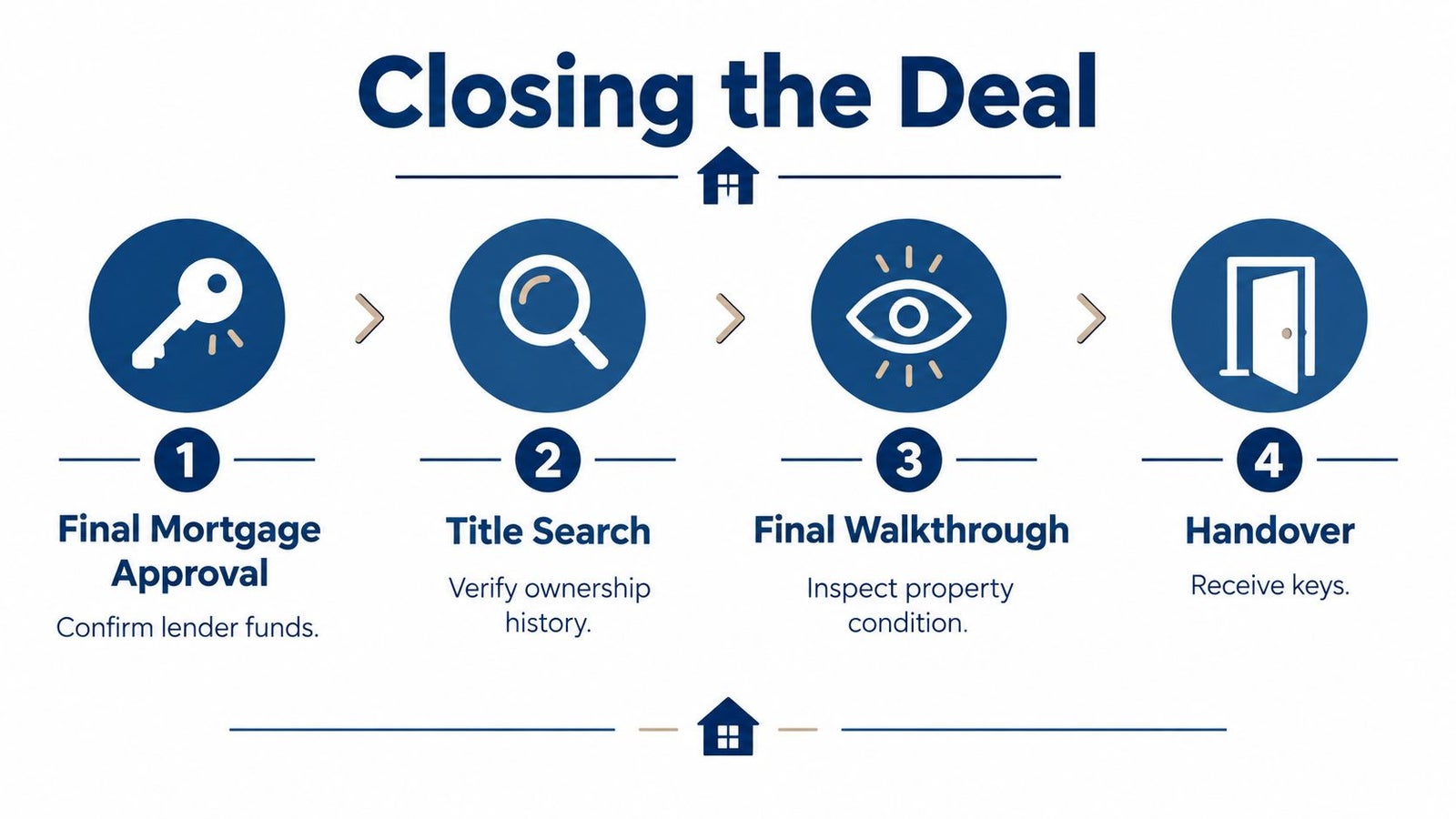
Your lawyer or notary coordinates the legal transfer with the lender and the seller's representative. Provide identification and funds by every stated deadline, keep your employment and credit position stable, arrange required insurance, and review the closing statement line by line.
Follow this order:
Use this BC property transfer tax resource to plan for the tax and ask your lawyer or notary to confirm the amount that applies to your transaction.
BC's first-time homebuyer program has occupancy requirements that buyers must plan around. Eligible buyers must move into the property within 92 days of title registration and live there as a principal residence for at least one year, according to BC first-time home buyer guidance.
Arrange the move before completion. If you plan to renovate, rent out the home, relocate later, or delay occupancy, ask your legal professional whether that plan affects the relief. Eligibility at signing does not guarantee that the benefit remains available if your post-completion actions fail to meet the requirements.
Closing costs typically run 1.5% to 4% of the purchase price, and they generally need to be available in cash at closing, as explained in this Canadian closing cost breakdown. The deposit and down payment do not automatically cover every completion expense.
Keep a written cash schedule showing the deposit already paid, remaining down payment, property transfer tax, legal fees, title insurance, adjustments, lender requirements, and moving costs. Confirm the final amount before completion day, not after the transfer has been registered.
The safest way to manage the home buying process step by step is to track decisions, deadlines, and documents in one place. You don't need a complicated system. You need a current checklist that your lender, REALTOR®, inspector, and lawyer or notary can work from.
Review comparable properties and recent sales, then assess the home's condition and the seller's timing. Decide what conditions you need before you discuss price. A lower offer with sensible protections can be safer than a higher offer that removes the information you need.
Confirm the deposit amount, payment deadline, completion date, possession arrangements, included items, and subject removal date. Check whether the home is a condo or townhome requiring strata document review, and ask your lender whether the building creates any financing or insurance concerns.
Confirm the lender's funding instructions, provide your legal professional with all requested information, review the statement of adjustments, and arrange your move. Complete the final walk-through and compare the property with the agreement.
A local REALTOR® should bring more than listing access. You want someone who can compare property types, interpret market evidence, coordinate inspectors and legal professionals, negotiate terms, and keep the transaction organized when deadlines converge. The right support won't remove every risk, but it will make the risks visible early enough for you to act.
Jacky Levi - Vancouver Realtor offers buyer representation across Greater Vancouver, including property search strategy, market analysis, offer negotiation, and transaction coordination through closing. Visit the site to discuss your budget, property goals, and the BC deadlines that need to be protected before you make an offer.
That's where many buyers get caught. The home buying process step by step isn't just a checklist from viewing to keys. In British Columbia, timing affects your financing, your deposit, your tax relief, and your ability to cancel safely. Treat each stage as a decision with a deadline, not as paperwork that someone else will handle.
Preparing Your Finances for the Vancouver Market
Start with your savings history, not with property listings. In Canada, buyers needed an average of 4.4 years to save for a down payment, while first-time buyers needed 4.7 years on average, according to CMHC's 2026 Mortgage Consumer Survey. The same survey found that 72% of first-time buyers were renting before purchasing, while 27% were living with family or friends. In Greater Vancouver, that extended period of renting, saving, and preparing is often part of the purchase journey, not a temporary inconvenience.
The practical lesson is simple. Don't judge your readiness by whether you can assemble the minimum down payment. Judge it by whether you can fund the purchase while keeping enough liquidity for the transaction and the home's ongoing costs.
Build the cash plan before the property plan
For a Canadian purchase, the minimum down payment is tied to price bands. Buyers need 5% of the first $500,000 and 10% of the portion above $500,000 up to $1.5 million, according to federal down payment guidance. A $750,000 purchase would therefore require at least $50,000 down, subject to the applicable mortgage rules.
That figure doesn't represent the full amount you need in cash. Closing costs commonly run 1.5% to 4% of the purchase price, and a Vancouver buyer purchasing a $750,000 home may face roughly $20,000 to $26,000 in closing costs, according to this Canadian closing cost breakdown. The largest expenses can include property transfer tax, legal fees, title insurance, and property adjustments.
Create separate buckets for:
Down payment: The funds used to meet the lender's minimum and your chosen financing structure.
Closing costs: Property transfer tax, legal work, title-related expenses, and adjustments.
Post-completion liquidity: Money left after closing for repairs, moving, utilities, and unexpected ownership costs.
You can review the legal and tax components in this guide to buying a house in BC, but your lawyer or notary should confirm the exact amount required for your purchase.
Treat pre-approval as a limit, not a target
Mortgage pre-approval belongs before serious shopping because it tells you how much borrowing the lender is prepared to consider. It doesn't mean you should spend up to that limit.
Buyers with less than 20% down generally need mortgage default insurance. They must also pass the federal qualifying rule at the greater of the contract rate plus 2 percentage points or 5.25%, as explained in CMHC's mortgage qualification guidance. That qualification rate reduces purchasing power because the lender tests whether your income can support a higher payment than the rate you may receive.
Ask your mortgage specialist to show you three figures:
- The maximum purchase price the lender will approve.
- The monthly payment at the actual mortgage rate.
- The monthly payment and qualification impact under the stress-test rule.
Then subtract the costs your lender may not fully capture, including strata fees, property taxes, insurance, utilities, maintenance, and the possibility that your search takes longer than expected.
Once your finances are organized, stop treating every Vancouver property as an equivalent product. A detached home, townhome, and condo can sit in the same broad market but create very different affordability, maintenance, and search decisions.
Greater Vancouver had 15,262 active listings, a $1,178,000 median price, and 59 days on market in July 2026, according to the BC housing affordability update. Those figures describe a high-priced market with meaningful choice and a slower decision environment, not a market where you should abandon due diligence to win a property.
The same source reports that the mortgage payment-to-income ratio improved in 2026, decreasing by 3.2 percentage points across housing types and by 6.9 points for detached homes. That improvement wasn't uniform enough to erase the structural affordability gap between property types. Detached homes still require a different income, cash reserve, and maintenance strategy than condos or townhomes.

A condo may offer a lower entry price than a detached home, but strata fees and building obligations become part of the monthly calculation. A townhome can provide more space while still placing shared-roof, exterior, or common-property decisions within a strata structure. A detached property gives you more control, but you also carry more responsibility for the roof, exterior, systems, and future maintenance.
Must have Flexible preference
Maximum all-in monthly cost; exact floor plan
Commute and transit access; cosmetic finishes
Acceptable building or property condition; specific floor level
Strata documents that meet your risk tolerance; updated kitchen or bathroom
Space required for work or family; particular street
Practical rule: A pre-approval tells you what a lender may permit. Your personal budget decides what you should buy.
House Hunting and Evaluating Vancouver Neighbourhoods
Once your finances are organized, stop treating every Vancouver property as an equivalent product. A detached home, townhome, and condo can sit in the same broad market but create very different affordability, maintenance, and search decisions.
Greater Vancouver had 15,262 active listings, a $1,178,000 median price, and 59 days on market in July 2026, according to the BC housing affordability update. Those figures describe a high-priced market with meaningful choice and a slower decision environment, not a market where you should abandon due diligence to win a property.
The same source reports that the mortgage payment-to-income ratio improved in 2026, decreasing by 3.2 percentage points across housing types and by 6.9 points for detached homes. That improvement wasn't uniform enough to erase the structural affordability gap between property types. Detached homes still require a different income, cash reserve, and maintenance strategy than condos or townhomes.
Match the home type to the financial reality
A condo may offer a lower entry price than a detached home, but strata fees and building obligations become part of the monthly calculation. A townhome can provide more space while still placing shared-roof, exterior, or common-property decisions within a strata structure. A detached property gives you more control, but you also carry more responsibility for the roof, exterior, systems, and future maintenance.
Must have Flexible preference
Maximum all-in monthly cost; exact floor plan
Commute and transit access; cosmetic finishes
Acceptable building or property condition; specific floor level
Strata documents that meet your risk tolerance; updated kitchen or bathroom
Space required for work or family; particular street
This prevents a common mistake: rejecting financially suitable homes because they lack a preferred finish, then stretching for a property that creates pressure every month.
Visit neighbourhoods at the times you'll use them. Check the route to work, access to daily services, noise, parking conditions, building entry, and the immediate surroundings. For condos and townhomes, review the building's documentation carefully. Look for information that affects future expenses, restrictions, insurance, maintenance, and the practical use of the property.
A slower market can give you more time to compare. It doesn't give you permission to assume every seller will accept a large discount or that every listing represents equal value. Use comparable sales, current competition, property condition, and days on market together.
If you're choosing representation, review how a Vancouver Realtor can support your search, particularly when you're comparing neighbourhood-level pricing and different property types. Your agent should help you eliminate unsuitable options before you spend time and money on inspections, financing reviews, and offers.
In Vancouver, an accepted offer can turn a viewing into a binding financial commitment quickly. Your offer must protect your decision, not just announce interest. Price is only one part of the contract. Financing conditions, inspection rights, strata document review, insurance, completion dates, included items, and deposit terms can determine whether the purchase remains workable.
BC contracts also run on strict deadlines. Before signing, confirm what must happen, who is responsible, and when each decision is due. Once the seller accepts, treat the document as a legal commitment. Do not sign terms you have not reviewed with your REALTOR®, mortgage specialist, and lawyer or notary.
For market context, see Royal LePage's overview of how first-time buyers are approaching the market. Your own offer still needs to reflect the property, your financing, and the contract dates.
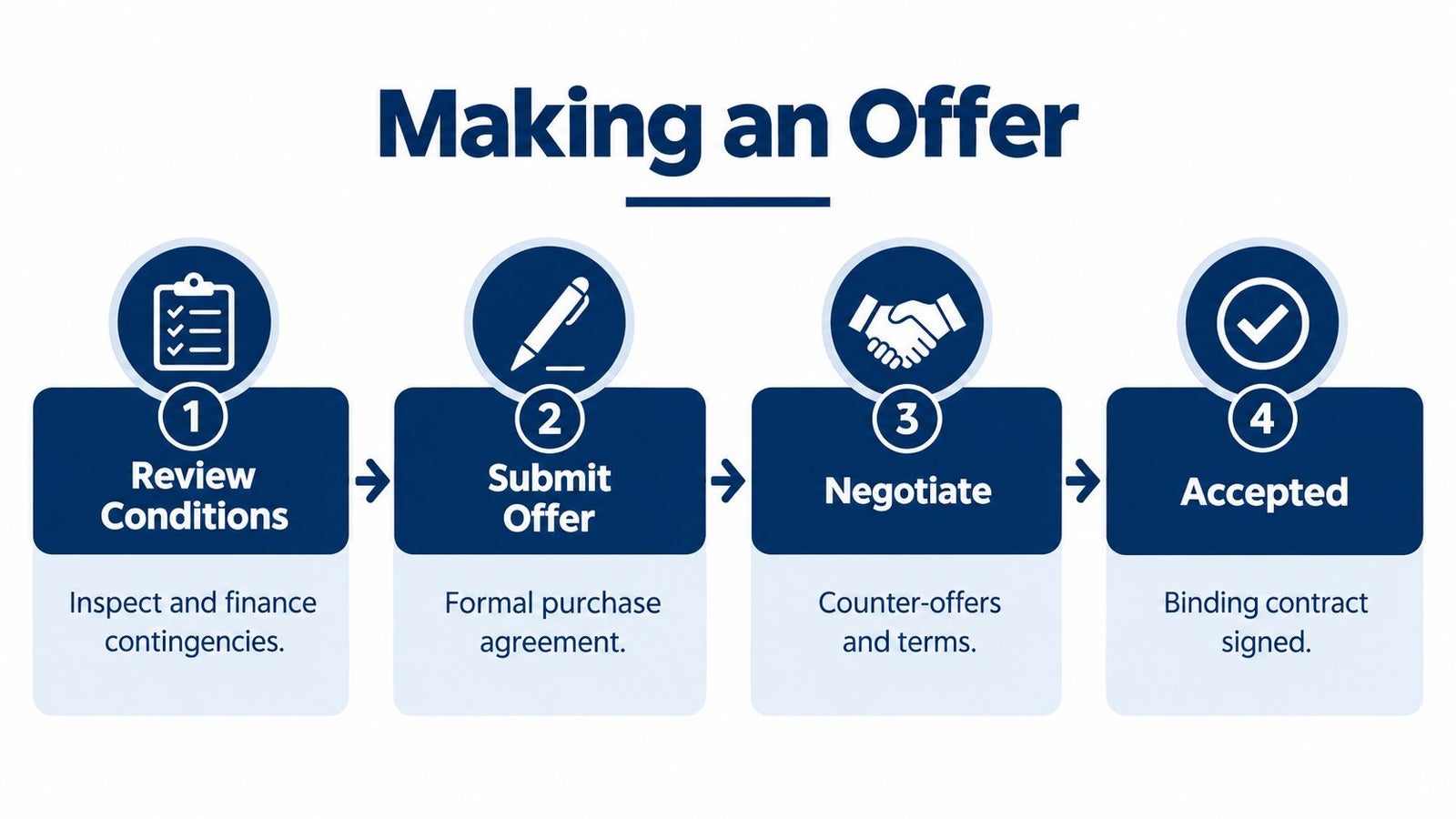
Build conditions around the facts you must verify before committing your funds. Depending on the property, that may include approval for the specific home, a professional inspection, strata document review, insurance confirmation, and legal review.
Write each condition clearly. State what must occur, who handles it, and the deadline for the decision. Vague wording creates uncertainty when the parties need to know whether a condition has been satisfied or removed.
A strong offer is not necessarily the one with the fewest protections. An attractive price without a practical way to verify financing or property condition can leave you exposed. A carefully drafted conditional offer gives you information while you still have a contractual way to reassess the purchase.
BC's statutory home buyer rescission period took effect on January 3, 2023. It gives a buyer three business days after acceptance to cancel an offer on residential real property. Using that right requires payment to the seller of 0.25% of the purchase price. If a deposit is held, the fee comes from the deposit and the balance returns to the buyer, according to BCFSA's rescission period information.
This deadline is a limited protection, not a substitute for proper conditions. If financing or inspection results could change your decision, address that risk in the offer and get professional advice before signing. An impulsive offer can still create real costs and pressure.
BC property transfer tax is based on fair market value at registration. The general rate is 1% on the first $200,000, 2% on the portion over $200,000 up to $2,000,000, and 3% on the portion over $2,000,000, as set out in the provincial property transfer tax rules.
Ask your legal professional whether an exemption applies and which documents are required. Include property transfer tax and other completion costs in your affordability review before making the offer, not during the final rush before completion.
An accepted offer is not the moment to relax. It's the point at which your team must verify the property, financing, documents, and obligations quickly enough to meet the contract dates.
Arrange the inspection promptly, send the accepted contract to your mortgage specialist, and give your lawyer or notary the documents needed for review. Condo and townhome buyers should pay close attention to strata records, insurance information, meeting minutes, budgets, contingency planning, and any evidence of upcoming work.
Use this home inspection guide for buyers to prepare questions before the inspection. The inspector's job is to identify condition and risk. Your REALTOR® and legal professional can then help you understand how those findings affect the contract and your decision.
The common assumption is that a buyer can refuse to remove subjects and receive the deposit back. BC rules don't work that way. When subject clauses aren't removed, both sides generally must sign a separate release form unless the buyer is using the statutory rescission right, according to BCFSA's guidance on deposits.
That distinction matters. The deposit is not an informal holding payment that disappears from the legal process once an issue arises. It's money subject to the contract and the applicable release procedure.
Ask these questions before the subject period ends:
What is the exact subject removal deadline? Put it in your calendar and confirm who is tracking it.
Has the lender approved this property? A general pre-approval may not be enough for the specific building or home.
Have the inspection and document reviews been completed? Don't remove conditions merely because the deadline is approaching.
What happens if the deal doesn't proceed? Confirm the required notice, release documentation, and deposit process with your legal professional.
Search for evidence, not just atmosphere
Visit neighbourhoods at the times you'll use them. Check the route to work, access to daily services, noise, parking conditions, building entry, and the immediate surroundings. For condos and townhomes, review the building's documentation carefully. Look for information that affects future expenses, restrictions, insurance, maintenance, and the practical use of the property.
A slower market can give you more time to compare. It doesn't give you permission to assume every seller will accept a large discount or that every listing represents equal value. Use comparable sales, current competition, property condition, and days on market together.
If you're choosing representation, review how a Vancouver Realtor can support your search, particularly when you're comparing neighbourhood-level pricing and different property types. Your agent should help you eliminate unsuitable options before you spend time and money on inspections, financing reviews, and offers.
Making an Offer and Navigating BC Contract Rules
In Vancouver, an accepted offer can turn a viewing into a binding financial commitment quickly. Your offer must protect your decision, not just announce interest. Price is only one part of the contract. Financing conditions, inspection rights, strata document review, insurance, completion dates, included items, and deposit terms can determine whether the purchase remains workable.
BC contracts also run on strict deadlines. Before signing, confirm what must happen, who is responsible, and when each decision is due. Once the seller accepts, treat the document as a legal commitment. Do not sign terms you have not reviewed with your REALTOR®, mortgage specialist, and lawyer or notary.
For market context, see Royal LePage's overview of how first-time buyers are approaching the market. Your own offer still needs to reflect the property, your financing, and the contract dates.
Write conditions around real risks
Build conditions around the facts you must verify before committing your funds. Depending on the property, that may include approval for the specific home, a professional inspection, strata document review, insurance confirmation, and legal review.
Write each condition clearly. State what must occur, who handles it, and the deadline for the decision. Vague wording creates uncertainty when the parties need to know whether a condition has been satisfied or removed.
A strong offer is not necessarily the one with the fewest protections. An attractive price without a practical way to verify financing or property condition can leave you exposed. A carefully drafted conditional offer gives you information while you still have a contractual way to reassess the purchase.
Use the rescission period correctly
BC's statutory home buyer rescission period took effect on January 3, 2023. It gives a buyer three business days after acceptance to cancel an offer on residential real property. Using that right requires payment to the seller of 0.25% of the purchase price. If a deposit is held, the fee comes from the deposit and the balance returns to the buyer, according to BCFSA's rescission period information.
This deadline is a limited protection, not a substitute for proper conditions. If financing or inspection results could change your decision, address that risk in the offer and get professional advice before signing. An impulsive offer can still create real costs and pressure.
Calculate tax before you sign
BC property transfer tax is based on fair market value at registration. The general rate is 1% on the first $200,000, 2% on the portion over $200,000 up to $2,000,000, and 3% on the portion over $2,000,000, as set out in the provincial property transfer tax rules.
Ask your legal professional whether an exemption applies and which documents are required. Include property transfer tax and other completion costs in your affordability review before making the offer, not during the final rush before completion.
Satisfying Conditions and Managing the Deposit
An accepted offer is not the moment to relax. It's the point at which your team must verify the property, financing, documents, and obligations quickly enough to meet the contract dates.
Arrange the inspection promptly, send the accepted contract to your mortgage specialist, and give your lawyer or notary the documents needed for review. Condo and townhome buyers should pay close attention to strata records, insurance information, meeting minutes, budgets, contingency planning, and any evidence of upcoming work.
Use this home inspection guide for buyers to prepare questions before the inspection. The inspector's job is to identify condition and risk. Your REALTOR® and legal professional can then help you understand how those findings affect the contract and your decision.
Don't assume the deposit comes back automatically
The common assumption is that a buyer can refuse to remove subjects and receive the deposit back. BC rules don't work that way. When subject clauses aren't removed, both sides generally must sign a separate release form unless the buyer is using the statutory rescission right, according to BCFSA's guidance on deposits.
That distinction matters. The deposit is not an informal holding payment that disappears from the legal process once an issue arises. It's money subject to the contract and the applicable release procedure.
Ask these questions before the subject period ends:
What is the exact subject removal deadline? Put it in your calendar and confirm who is tracking it.
Has the lender approved this property? A general pre-approval may not be enough for the specific building or home.
Have the inspection and document reviews been completed? Don't remove conditions merely because the deadline is approaching.
What happens if the deal doesn't proceed? Confirm the required notice, release documentation, and deposit process with your legal professional.
If a condition can't be satisfied, act before the deadline and get legal advice. Don't send a casual email saying you're walking away and assume that resolves the deposit. The correct process protects your money and creates a clear record.
Keep the transaction moving
The buyer, lender, inspector, REALTOR®, and lawyer each control different parts of this phase. Delays often happen when one person assumes someone else has ordered a document, confirmed insurance, or communicated a decision.
Use one written checklist with the property address, condition, responsible person, required document, deadline, and status. That simple discipline is more valuable than relying on memory during a compressed transaction.
Closing the Deal and Moving In
On completion day, a buyer can have financing approved and still face a problem if the funds, insurance, or legal documents are not ready. In BC, closing is a coordinated legal and financial transfer, not a key exchange. After the contract conditions are met, the title search and land survey are completed, the lender sends mortgage funds to the lawyer or notary, and the property is registered in the buyer's name. Your legal professional should confirm the sequence and deadlines in writing.
Follow the closing sequence
Your lawyer or notary coordinates the legal transfer with the lender and the seller's representative. Provide identification and funds by every stated deadline, keep your employment and credit position stable, arrange required insurance, and review the closing statement line by line.
Follow this order:
- Confirm final mortgage funding. The lender must be ready to release funds for the specific property and completion date. Do not make new large purchases or change employment before funding without discussing it with the lender.
- Complete the title search and legal work. Your legal professional verifies ownership, checks registered interests, and prepares the documents needed for registration.
- Review adjustments and cash requirements. Property taxes, strata fees, utilities, and other adjustments can change the amount required at completion.
- Complete the final walk-through. Check that the property's condition, fixtures, appliances, and included items match the contract before possession.
- Register the transfer and receive possession. The title is registered after the legal and financial requirements are met, then the keys can be released under the possession arrangements.
Use this BC property transfer tax resource to plan for the tax and ask your lawyer or notary to confirm the amount that applies to your transaction.
Protect first-time buyer relief
BC's first-time homebuyer program has occupancy requirements that buyers must plan around. Eligible buyers must move into the property within 92 days of title registration and live there as a principal residence for at least one year, according to BC first-time home buyer guidance.
Arrange the move before completion. If you plan to renovate, rent out the home, relocate later, or delay occupancy, ask your legal professional whether that plan affects the relief. Eligibility at signing does not guarantee that the benefit remains available if your post-completion actions fail to meet the requirements.
Budget beyond the deposit
Closing costs typically run 1.5% to 4% of the purchase price, and they generally need to be available in cash at closing, as explained in this Canadian closing cost breakdown. The deposit and down payment do not automatically cover every completion expense.
Keep a written cash schedule showing the deposit already paid, remaining down payment, property transfer tax, legal fees, title insurance, adjustments, lender requirements, and moving costs. Confirm the final amount before completion day, not after the transfer has been registered.
Vancouver Home Buyer Checklist and Next Steps
The safest way to manage the home buying process step by step is to track decisions, deadlines, and documents in one place. You don't need a complicated system. You need a current checklist that your lender, REALTOR®, inspector, and lawyer or notary can work from.
Before you shop
- Set your true budget: Include the monthly mortgage payment, strata fees, property taxes, insurance, utilities, maintenance, and search-related costs.
- Separate your cash: Keep the down payment, closing costs, and post-completion reserve distinct.
- Obtain mortgage pre-approval: Ask the lender to explain the stress-test impact and the conditions attached to the approval.
- Define your property criteria: Separate essential needs from finishes and features you can adjust.
- Choose your professional team: Confirm who will advise on financing, inspection, legal work, tax, and negotiation.
Before you offer
Review comparable properties and recent sales, then assess the home's condition and the seller's timing. Decide what conditions you need before you discuss price. A lower offer with sensible protections can be safer than a higher offer that removes the information you need.
Confirm the deposit amount, payment deadline, completion date, possession arrangements, included items, and subject removal date. Check whether the home is a condo or townhome requiring strata document review, and ask your lender whether the building creates any financing or insurance concerns.
After acceptance
- Start the financing review: Move from general pre-approval to approval for the property you're buying.
- Book the inspection: Complete it early enough to act before the condition deadline.
- Review documents: Give strata, title, contract, and tax documents to the appropriate professionals.
- Track the deposit: Understand where it's held and what release process applies if the transaction doesn't proceed.
- Record every deadline: Keep written confirmation of subject removal, rescission, completion, possession, and move-in obligations.
Before possession
Confirm the lender's funding instructions, provide your legal professional with all requested information, review the statement of adjustments, and arrange your move. Complete the final walk-through and compare the property with the agreement.
A local REALTOR® should bring more than listing access. You want someone who can compare property types, interpret market evidence, coordinate inspectors and legal professionals, negotiate terms, and keep the transaction organized when deadlines converge. The right support won't remove every risk, but it will make the risks visible early enough for you to act.
Jacky Levi - Vancouver Realtor offers buyer representation across Greater Vancouver, including property search strategy, market analysis, offer negotiation, and transaction coordination through closing. Visit the site to discuss your budget, property goals, and the BC deadlines that need to be protected before you make an offer.