
A Vancouver condo seller who wants a fast result is entering a market measured in weeks, not days. Greater Vancouver condos recorded 42 days on market in April 2026, 45 in May, 53 in June, and 54 in July, while median prices remained relatively stable between C$699,000 and C$718,800. Active condo listings ranged from 6,250 in March to 7,095 in May and 6,648 in July, giving buyers enough choice to compare condition, price, paperwork, and presentation before they commit. Zealty's July 2026 market reporting
That changes the answer to how to sell a condo fast. The solution isn't accepting a lower price or putting a sign outside the building. You need to remove the quiet sources of delay, including stale pricing, incomplete strata documents, weak photography, limited showing access, and positioning that ignores competition from completed unsold new builds.
A September 2026 snapshot recorded 113 condo sales from 922 active listings, producing a 12% sales ratio overall. Coal Harbour reached 15%, while Yaletown reached 14%. Buyers had several choices for every completed sale, so a listing needed to earn attention quickly rather than depend on scarcity. WOWA's Vancouver housing market update
Greater Vancouver ended August 2026 with 15,798 properties listed for sale, and inventory stood 26.2% above the 10-year seasonal average of 12,522, according to the same update. That supply extends beyond direct condo comparables. Buyers can compare resales with townhomes, newer projects, and completed units that developers still need to sell.
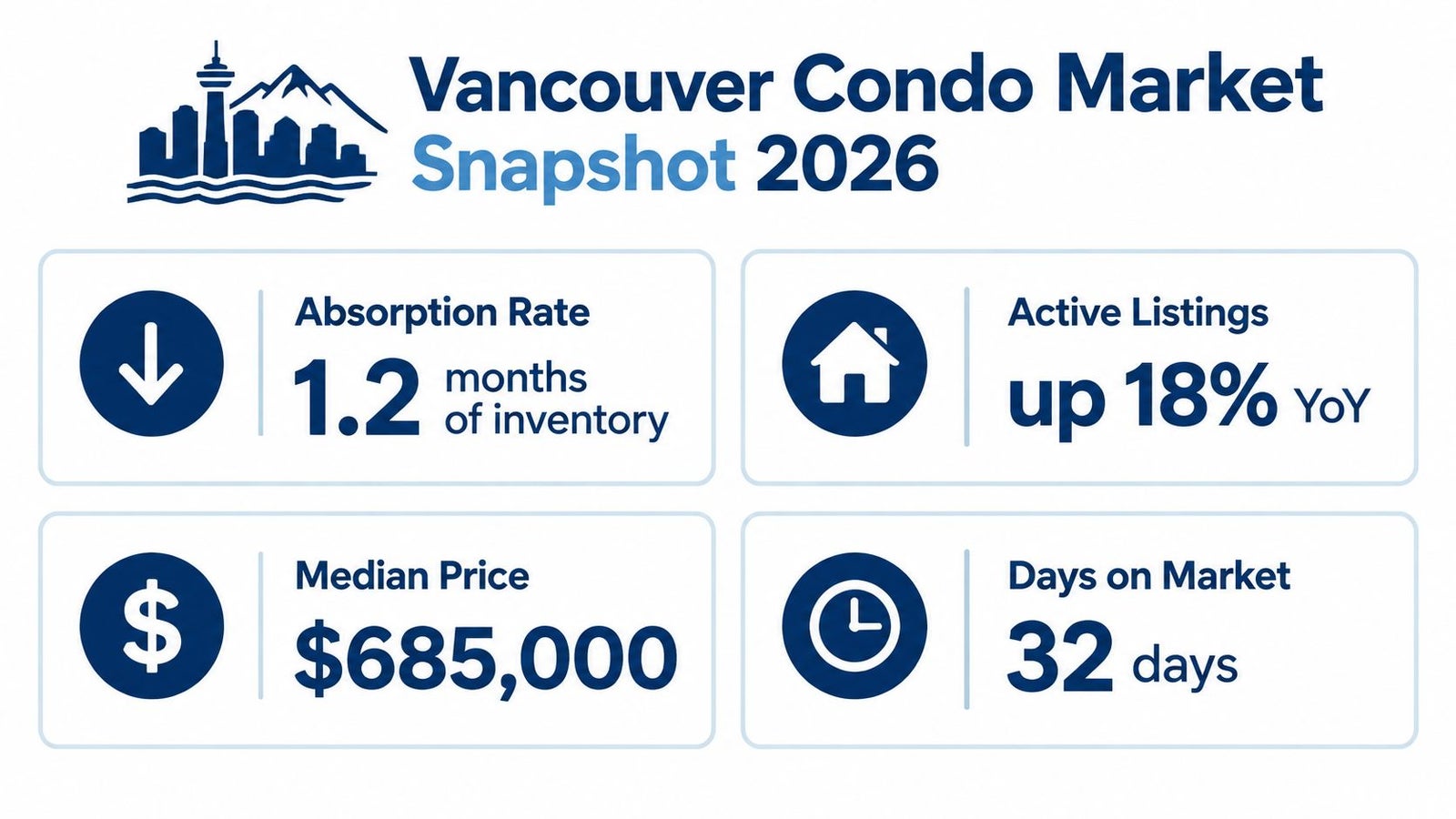
An infographic showing the 2026 Vancouver condo market statistics including inventory, listings, price, and market time.
A resale seller competes with more than neighbouring units. CMHC-based reporting recorded 4,376 completed and unabsorbed condo apartments in May 2026, compared with 2,488 a year earlier, a 76% increase. The Globe and Mail described the new-build glut as reaching a level not seen since 1995, as reported in this Metro Vancouver unsold-condo analysis.
Completed new builds may offer fresh finishes, incentives, or a developer-managed purchase process. A resale can still win through a better layout, established building operations, a stronger view, useful storage, immediate occupancy, or a more realistic all-in cost. Identify that advantage before listing, then make it visible in the pricing and marketing.
TD Economics has projected that Vancouver condo prices could fall around 7% to 8% in 2026. That projection makes waiting for a broad rebound risky. Sellers focused on speed should prioritise launch quality, realistic pricing, and clean terms instead of expecting market improvement to correct an overpriced listing.
Strata paperwork can create another delay. Buyers and their agents may need time to review minutes, the depreciation report, insurance information, budgets, bylaws, and pending assessments. Organising those records before launch reduces avoidable hesitation, especially when a competing new unit can be presented with a straightforward sales package.
For a building-level comparison, review Vancouver condo sales trends, prices, and 2026 insights alongside your immediate competitors. A fast launch depends on giving buyers fewer reasons to pause.
In June 2026, Greater Vancouver condos had 7,077 active listings, a median price of $699,000, and 53 days on market. By August, the median was still $699,000, while days on market had reached 62. That combination shows why a flat price can lose momentum as buyer caution and available supply increase. The figures are reported in Zealty's June 2026 BC housing market report.
A high supply of completed new builds adds pressure to resale sellers. Fresh finishes, developer incentives, and a straightforward purchase process can make a new unit easier to compare and act on. A resale condo must offer a clear reason to choose it, such as a better layout, established building operations, a stronger view, useful storage, immediate occupancy, or a more realistic all-in cost. Identify that advantage before setting the list price.
Start with the freshest comparable sales, not the price paid or the highest sale in the building. The comparison set should account for:
Physical preparation works alongside paperwork. Complete cleaning, touch-up repairs, decluttering, lighting upgrades, and practical maintenance before the photographer arrives. Buyers compare similar condos quickly, and dated fixtures, crowded rooms, visible damage, or missing documents can create reasons to wait.
A pre-inspection can help identify problems before a buyer does. Resolve manageable issues, document the work, and keep invoices available where appropriate. The objective isn't to conceal imperfections. It's to make the property easy to understand and prevent small concerns from becoming points in a negotiation.
For a Vancouver-specific explanation of the document buyers expect, review what Vancouver condo buyers need to know about Form B. Also plan for the post-offer process. BC real-estate guidance citing the Property Law Act describes Form B as a document that must be provided within a short post-offer window, so waiting until an offer arrives creates avoidable pressure. This Form B interpretation guide supports preparing the package before going live.
A condo competes on a screen before a buyer ever enters the lobby. In a market with substantial resale and new-build choice, weak images can eliminate the property from consideration before its layout, view, or building advantages receive a fair hearing.
Professional photography should show scale, light, flow, storage, outdoor space, parking, and the relationship between rooms. A wide-angle image that makes a small room look distorted may generate clicks but create disappointment at the showing. Accurate, well-composed images attract buyers whose expectations match the actual condo.

A complete launch should normally include:
A broker open house can introduce the condo to agents who already understand active buyers and competing inventory. It works best when the property is fully ready, the documents are available, and feedback is collected immediately rather than treated as a courtesy.
Suppose several buyers like the view but question the dated lighting. That isn't the same problem as buyers rejecting the price before viewing. Separate presentation objections, building objections, and value objections. The response might be a repair, clearer marketing copy, a document explanation, or a price adjustment.
Don't make a large change after one casual comment. Look for repeated feedback from qualified visitors and compare it with showing volume. A high number of views but few second showings usually points to a mismatch between presentation, condition, or price. Few appointments may indicate that the listing isn't reaching the right audience or that buyers dismiss it at the search stage.
A fast sale isn't complete when an offer arrives. It's complete when the seller accepts terms that the buyer can satisfy and the transaction can move through due diligence without avoidable friction.
Evaluate the offer as a package. Price matters, but so do financing confidence, deposit, conditions, closing date, possession timing, inclusions, and the buyer's response to the strata documents. A higher offer with uncertain financing or expansive conditions may create more delay than a slightly lower offer with clear evidence of readiness.
Ask the buyer's representative for the information needed to assess execution risk. Proof of funds, mortgage pre-approval, deposit details, and the intended use of conditions can clarify whether the offer reflects genuine readiness or exploratory interest.
The checklist below captures the core questions:
That changes the answer to how to sell a condo fast. The solution isn't accepting a lower price or putting a sign outside the building. You need to remove the quiet sources of delay, including stale pricing, incomplete strata documents, weak photography, limited showing access, and positioning that ignores competition from completed unsold new builds.
Understanding the Current Vancouver Condo Market
A September 2026 snapshot recorded 113 condo sales from 922 active listings, producing a 12% sales ratio overall. Coal Harbour reached 15%, while Yaletown reached 14%. Buyers had several choices for every completed sale, so a listing needed to earn attention quickly rather than depend on scarcity. WOWA's Vancouver housing market update
Greater Vancouver ended August 2026 with 15,798 properties listed for sale, and inventory stood 26.2% above the 10-year seasonal average of 12,522, according to the same update. That supply extends beyond direct condo comparables. Buyers can compare resales with townhomes, newer projects, and completed units that developers still need to sell.
An infographic showing the 2026 Vancouver condo market statistics including inventory, listings, price, and market time.
Why new-build competition matters
A resale seller competes with more than neighbouring units. CMHC-based reporting recorded 4,376 completed and unabsorbed condo apartments in May 2026, compared with 2,488 a year earlier, a 76% increase. The Globe and Mail described the new-build glut as reaching a level not seen since 1995, as reported in this Metro Vancouver unsold-condo analysis.
Completed new builds may offer fresh finishes, incentives, or a developer-managed purchase process. A resale can still win through a better layout, established building operations, a stronger view, useful storage, immediate occupancy, or a more realistic all-in cost. Identify that advantage before listing, then make it visible in the pricing and marketing.
TD Economics has projected that Vancouver condo prices could fall around 7% to 8% in 2026. That projection makes waiting for a broad rebound risky. Sellers focused on speed should prioritise launch quality, realistic pricing, and clean terms instead of expecting market improvement to correct an overpriced listing.
Strata paperwork can create another delay. Buyers and their agents may need time to review minutes, the depreciation report, insurance information, budgets, bylaws, and pending assessments. Organising those records before launch reduces avoidable hesitation, especially when a competing new unit can be presented with a straightforward sales package.
Practical rule: In a high-choice market, buyers do not need to overlook friction. They can move to the next listing.
For a building-level comparison, review Vancouver condo sales trends, prices, and 2026 insights alongside your immediate competitors. A fast launch depends on giving buyers fewer reasons to pause.
Pricing Strategy for Immediate Buyer Traction
In June 2026, Greater Vancouver condos had 7,077 active listings, a median price of $699,000, and 53 days on market. By August, the median was still $699,000, while days on market had reached 62. That combination shows why a flat price can lose momentum as buyer caution and available supply increase. The figures are reported in Zealty's June 2026 BC housing market report.
A high supply of completed new builds adds pressure to resale sellers. Fresh finishes, developer incentives, and a straightforward purchase process can make a new unit easier to compare and act on. A resale condo must offer a clear reason to choose it, such as a better layout, established building operations, a stronger view, useful storage, immediate occupancy, or a more realistic all-in cost. Identify that advantage before setting the list price.
Build the price from current evidence
Start with the freshest comparable sales, not the price paid or the highest sale in the building. The comparison set should account for:
- Building and strata profile: Review depreciation reports, amenities, maintenance history, parking, storage, and fee structure. Nearby towers are not automatically equivalent.
- Physical attributes: Match floor level, outlook, exposure, floor plan, renovation quality, outdoor space, and natural light.
- Buyer alternatives: Include competing resales and relevant completed new builds, particularly units with similar size and occupancy timing.
- Current absorption: Check active listings and recent sales in the neighbourhood. Coal Harbour and Yaletown had different sales ratios in the September snapshot, so a citywide average cannot set the price for both areas.
A practical approach is to price at or slightly below the freshest comparable-sales cluster when speed matters. This does not mean giving the condo away. It makes the listing relevant on launch day, while the condition, layout, and terms support the negotiation.
Treat the first 7 to 10 days as the main demand window. The condo needs complete photography, video, a 3D tour, accurate measurements, organised documents, and immediate showing availability when it goes live. This Vancouver home-pricing guide offers useful context for aligning the list price with current buyer behaviour instead of relying on aspiration.
A listing that misses its opening wave can become a 60-plus-day listing, consistent with the market pattern above. Price reductions at that point may signal that the original strategy missed the market, rather than creating the urgency the seller wanted at launch. Price for the buyers who are actively comparing today, then remove practical reasons for them to delay.
The fastest condo sale often begins before the listing is public. Buyers need to understand the unit, the building, and the financial obligations attached to ownership. If the seller can't answer those questions promptly, the buyer may delay an offer, add broader conditions, or choose a competing condo with a cleaner file.
In British Columbia, Form B, the Information Certificate, discloses important details including current monthly strata fees, arrears owed by the owner, approved special levies and payment dates, reserve fund balance, pending bylaw amendments, and outstanding legal proceedings. The Province of British Columbia's Form B guidance explains why this document matters to both buyers and sellers.
For example, if the condo has a $650 monthly strata fee and a pending $12,000 special levy, those facts need to be surfaced clearly before they disrupt the transaction. A buyer who discovers a levy late may renegotiate, delay the deal, or walk away. A seller who provides the information early can address the issue with pricing and terms instead of dealing with surprise objections after acceptance.
Gather the broader package as well. The province directs buyers and sellers to review relevant strata documentation, including money the owner may owe to the strata corporation, and its record-keeping guidance confirms that strata records can include disclosure statements. BC's strata information and record-keeping guidance is a useful starting point.
Financial records: Collect the budget, financial statements, current fee information, and details of approved or anticipated expenditures.
Governance records: Include bylaws, rules, meeting minutes, and disclosure statements that may affect use, pets, rentals, renovations, or occupancy.
Outstanding issues: Identify unpaid fines, repair assessments, balcony work, insurance matters, or amendments that haven't yet been filed.
Treat the opening window seriously
Treat the first 7 to 10 days as the main demand window. The condo needs complete photography, video, a 3D tour, accurate measurements, organised documents, and immediate showing availability when it goes live. This Vancouver home-pricing guide offers useful context for aligning the list price with current buyer behaviour instead of relying on aspiration.
A listing that misses its opening wave can become a 60-plus-day listing, consistent with the market pattern above. Price reductions at that point may signal that the original strategy missed the market, rather than creating the urgency the seller wanted at launch. Price for the buyers who are actively comparing today, then remove practical reasons for them to delay.
Pre-Market Preparation and Strata Documentation
The fastest condo sale often begins before the listing is public. Buyers need to understand the unit, the building, and the financial obligations attached to ownership. If the seller can't answer those questions promptly, the buyer may delay an offer, add broader conditions, or choose a competing condo with a cleaner file.
Assemble the strata package early
In British Columbia, Form B, the Information Certificate, discloses important details including current monthly strata fees, arrears owed by the owner, approved special levies and payment dates, reserve fund balance, pending bylaw amendments, and outstanding legal proceedings. The Province of British Columbia's Form B guidance explains why this document matters to both buyers and sellers.
For example, if the condo has a $650 monthly strata fee and a pending $12,000 special levy, those facts need to be surfaced clearly before they disrupt the transaction. A buyer who discovers a levy late may renegotiate, delay the deal, or walk away. A seller who provides the information early can address the issue with pricing and terms instead of dealing with surprise objections after acceptance.
Gather the broader package as well. The province directs buyers and sellers to review relevant strata documentation, including money the owner may owe to the strata corporation, and its record-keeping guidance confirms that strata records can include disclosure statements. BC's strata information and record-keeping guidance is a useful starting point.
Financial records: Collect the budget, financial statements, current fee information, and details of approved or anticipated expenditures.
Governance records: Include bylaws, rules, meeting minutes, and disclosure statements that may affect use, pets, rentals, renovations, or occupancy.
Outstanding issues: Identify unpaid fines, repair assessments, balcony work, insurance matters, or amendments that haven't yet been filed.
Make the condo photograph as move-in ready
Physical preparation works alongside paperwork. Complete cleaning, touch-up repairs, decluttering, lighting upgrades, and practical maintenance before the photographer arrives. Buyers compare similar condos quickly, and dated fixtures, crowded rooms, visible damage, or missing documents can create reasons to wait.
A pre-inspection can help identify problems before a buyer does. Resolve manageable issues, document the work, and keep invoices available where appropriate. The objective isn't to conceal imperfections. It's to make the property easy to understand and prevent small concerns from becoming points in a negotiation.
Buyers don't separate the condo from the building. They evaluate the home, the strata finances, and the future obligations as one purchase.
For a Vancouver-specific explanation of the document buyers expect, review what Vancouver condo buyers need to know about Form B. Also plan for the post-offer process. BC real-estate guidance citing the Property Law Act describes Form B as a document that must be provided within a short post-offer window, so waiting until an offer arrives creates avoidable pressure. This Form B interpretation guide supports preparing the package before going live.
Professional Media and Global Syndication
A condo competes on a screen before a buyer ever enters the lobby. In a market with substantial resale and new-build choice, weak images can eliminate the property from consideration before its layout, view, or building advantages receive a fair hearing.
Professional photography should show scale, light, flow, storage, outdoor space, parking, and the relationship between rooms. A wide-angle image that makes a small room look distorted may generate clicks but create disappointment at the showing. Accurate, well-composed images attract buyers whose expectations match the actual condo.
Use media that answers questions before the showing
A complete launch should normally include:
- Professional still photography: Present the home in a logical sequence, from entry and living areas through bedrooms, amenities, parking, and storage.
- Video tour: Show movement, sightlines, natural light, and the practical connection between spaces.
- 3D walkthrough: Let out-of-town or time-constrained buyers assess the layout before arranging a visit.
- Accurate feature copy: State what the unit includes, what the strata permits, and what the buyer must verify.
A 3D tour isn't a replacement for an in-person showing. It is a filter that helps serious buyers decide whether the condo deserves their time. That can improve the quality of inquiries and reduce wasted appointments caused by inaccurate expectations.
Digital syndication matters because Vancouver attracts relocating professionals, investors, and buyers who may not be attending local open houses immediately. Distribution through the Sotheby's International Realty Canada network can give a listing access to a broader audience, while disciplined local positioning keeps the marketing relevant to the building and neighbourhood.
Global exposure won't compensate for an unrealistic price or incomplete paperwork. It amplifies the first impression, so the underlying strategy still needs to be correct. Cutting media costs while competing against polished resale listings and finished developer inventory is usually a false economy.
Review professional real estate photography for Vancouver listings when planning the asset list. The practical standard is simple: the buyer should understand the condo's strongest features, likely objections, and next step before contacting the listing representative.
A condo showing can fail for reasons unrelated to the property. The elevator may need a booking, the concierge may require advance notice, visitor parking may be unclear, or a buyer may arrive during a narrow window and find access unavailable. Each obstacle reduces the chance of a second look.
Consider a seller in a tower where the elevator requires coordination and the building has strict move-in procedures. The listing should include clear instructions for agents, a reliable contact process with concierge, and confirmed access before appointments are accepted. If parking is available, provide precise directions rather than assuming a visitor knows which entrance to use.
The seller doesn't need to leave the condo open indefinitely. The schedule needs to be dependable.
Extend reach beyond the immediate neighbourhood
Digital syndication matters because Vancouver attracts relocating professionals, investors, and buyers who may not be attending local open houses immediately. Distribution through the Sotheby's International Realty Canada network can give a listing access to a broader audience, while disciplined local positioning keeps the marketing relevant to the building and neighbourhood.
Global exposure won't compensate for an unrealistic price or incomplete paperwork. It amplifies the first impression, so the underlying strategy still needs to be correct. Cutting media costs while competing against polished resale listings and finished developer inventory is usually a false economy.
Review professional real estate photography for Vancouver listings when planning the asset list. The practical standard is simple: the buyer should understand the condo's strongest features, likely objections, and next step before contacting the listing representative.
Managing Showings and Open House Logistics
A condo showing can fail for reasons unrelated to the property. The elevator may need a booking, the concierge may require advance notice, visitor parking may be unclear, or a buyer may arrive during a narrow window and find access unavailable. Each obstacle reduces the chance of a second look.
Consider a seller in a tower where the elevator requires coordination and the building has strict move-in procedures. The listing should include clear instructions for agents, a reliable contact process with concierge, and confirmed access before appointments are accepted. If parking is available, provide precise directions rather than assuming a visitor knows which entrance to use.
Design availability around buyer behaviour
The seller doesn't need to leave the condo open indefinitely. The schedule needs to be dependable.
- Create showing blocks: Group appointments into practical windows so the property stays clean and the seller avoids repeated interruptions.
- Prepare for short notice: Keep counters clear, beds made, lights working, blinds set, and personal items stored so the condo can be shown without a long reset.
- Coordinate building access: Confirm elevator, fob, concierge, parking, and amenity access before the first appointment.
- Offer a private alternative: Buyers who can't attend an open house may still be serious. Make individual appointments easy to arrange.
A broker open house can introduce the condo to agents who already understand active buyers and competing inventory. It works best when the property is fully ready, the documents are available, and feedback is collected immediately rather than treated as a courtesy.
Turn feedback into decisions
Suppose several buyers like the view but question the dated lighting. That isn't the same problem as buyers rejecting the price before viewing. Separate presentation objections, building objections, and value objections. The response might be a repair, clearer marketing copy, a document explanation, or a price adjustment.
Don't make a large change after one casual comment. Look for repeated feedback from qualified visitors and compare it with showing volume. A high number of views but few second showings usually points to a mismatch between presentation, condition, or price. Few appointments may indicate that the listing isn't reaching the right audience or that buyers dismiss it at the search stage.
Make access easy enough that a serious buyer never has to work around the listing.
Offer Evaluation and Fast Closing Tactics
A fast sale isn't complete when an offer arrives. It's complete when the seller accepts terms that the buyer can satisfy and the transaction can move through due diligence without avoidable friction.
Evaluate the offer as a package. Price matters, but so do financing confidence, deposit, conditions, closing date, possession timing, inclusions, and the buyer's response to the strata documents. A higher offer with uncertain financing or expansive conditions may create more delay than a slightly lower offer with clear evidence of readiness.
Look beyond the headline number
Ask the buyer's representative for the information needed to assess execution risk. Proof of funds, mortgage pre-approval, deposit details, and the intended use of conditions can clarify whether the offer reflects genuine readiness or exploratory interest.
The checklist below captures the core questions:
- Price and terms: Does the offer reflect current comparable sales and account for the condo's documented obligations?
- Buyer pre-approval: Has the buyer taken meaningful steps with a lender, and does the financing position fit the purchase?
- Contingency waivers: Are conditions limited, clearly written, and capable of being satisfied promptly?
- Flexible closing date: Can the buyer work with the seller's moving, legal, and strata timelines?
- Proof of funds: Is there documentation supporting the down payment and deposit?
A low offer shouldn't be dismissed automatically. It may reveal a buyer's concern about a levy, building repair, fee level, or competing new-build incentive. Ask what supports the number, then decide whether the objection can be addressed with documents, terms, repairs, or a counteroffer.
Have the Form B package and strata records ready for the buyer's review. Confirm lawyer or notary details, keep communication centralized, and respond quickly to questions. If a buyer requests a concession based on a disclosed issue, compare the cost of resolving it now with the risk of delaying or losing the transaction.
The seller should also verify that the contract reflects the intended inclusions, parking and storage designations, dates, and responsibility for known strata obligations. A careful review before signing is faster than correcting an ambiguity later.
Keep the transaction clean after acceptance
Have the Form B package and strata records ready for the buyer's review. Confirm lawyer or notary details, keep communication centralized, and respond quickly to questions. If a buyer requests a concession based on a disclosed issue, compare the cost of resolving it now with the risk of delaying or losing the transaction.
The seller should also verify that the contract reflects the intended inclusions, parking and storage designations, dates, and responsibility for known strata obligations. A careful review before signing is faster than correcting an ambiguity later.
The practical sequence is straightforward: price from current evidence, prepare the condo and documents before launch, publish complete media, make showings easy, and evaluate certainty as carefully as price. Sellers who do those things reduce the reasons buyers hesitate in a market where alternatives are plentiful.
Jacky Levi - Vancouver Realtor offers pricing analysis, pre-listing preparation, professional media coordination, showing management, and offer negotiation for Vancouver condo sellers. Visit Jacky Levi - Vancouver Realtor to arrange a practical review of your condo, strata documents, launch strategy, and target closing timeline.
Jacky Levi - Vancouver Realtor offers pricing analysis, pre-listing preparation, professional media coordination, showing management, and offer negotiation for Vancouver condo sellers. Visit Jacky Levi - Vancouver Realtor to arrange a practical review of your condo, strata documents, launch strategy, and target closing timeline.