
You've found the right house, your financing is nearly organized, and the listing agent has announced multiple offers for later today. The natural reaction is to ask, “How much higher do I need to go?” In Greater Vancouver, that question is often too narrow. Buyers lose homes not only because they bid less, but because their financing timeline, deposit, conditions, completion date, or escalation language creates more risk for the seller.
A defensible offer starts before the showing. You need a current view of comparable sales, a lender who understands the property and your deadline, accessible deposit funds, and a clear decision about which risks you're willing to carry. The objective isn't to write the most aggressive offer imaginable. It's to present the strongest package you can afford without turning a successful bid into an unsafe purchase.
The Burnaby East detached-home bidding moment looked ordinary at first. Two buyers landed within $5,000 of each other, and their headline prices were close enough that neither bid appeared to have an obvious advantage. Both had a similar deposit, and both used familiar subjects for financing and inspection.
The losing offer was perfectly reasonable on paper. It gave the buyer a 21-day financing subject, retained standard inspection protection, and proposed a deposit that didn't materially change after subjects were removed. Nothing was reckless, but the package asked the seller to carry uncertainty for longer.
The successful buyer had prepared before walking through the open house. Their financing subject ran for 14 days, the deposit increased from 5% to 10% when subjects were removed, and the offer included a clean escalation clause capped at the buyer's appraised-value tolerance. The closing date matched the seller's preferred possession schedule.
The winning offer wasn't necessarily dramatically richer. It made the seller's next steps easier and reduced the chance of a late surprise. That distinction matters under British Columbia's multiple-offer process. If more than one written offer is available before acceptance, all written offers must be presented to the seller. The seller can reject all offers, accept one, or invite new offers by a specified date while disclosing that a multiple-offer situation exists, as explained by the BCFSA guidance on multiple offers and brokerage practice.
BCFSA's brokerage sample recorded multiple offers in 22% of transactions in 2025, down from under 30% in both 2023 and 2024, and about 56% of multiple-offer transactions went to the highest-priced offer, according to that same BCFSA transaction-data summary. The figures point to an important conclusion: price usually matters, but it doesn't decide every file.
A house offer strategy should therefore answer four questions before you bid:
Competition can appear in pockets of North Vancouver, Burnaby, Richmond, or other neighbourhoods while nearby listings sit and negotiate. The buyer who prepares for both situations won't use the same offer structure everywhere.
List price is a reference point, not a valuation. In August 2026, the Metro Vancouver benchmark home price was $1,081,900, down 5.6% year over year and 13.6% below the all-time high of $1,252,800 set in April 2022, according to August 2026 Vancouver housing-market data. The detached benchmark was $1,799,400, while the average detached-sale price was $1,977,064.
Those figures describe different measurements. A benchmark attempts to represent a typical property profile, while an average reflects the actual mix of homes sold. A negotiated price may differ from both. The same Metro Vancouver market update reports that the benchmark price rose only 6.7% over 10 years, which reinforces why buyers shouldn't treat the previous peak as an automatic floor.
Start with recent sold comparables in the same neighbourhood and property category. A practical workflow is:
BCREA recorded residential unit sales building from 4,221 in January 2025 to 7,162 in June 2025, with June sales up 1.3% from June 2024, as shown in its British Columbia market statistics. That seasonal build can increase competition for well-priced homes, but it doesn't prove that every listing deserves an aggressive bid.
Neighbourhood-level absorption matters more than a broad regional slogan. Buyers comparing a renovated detached home in Kitsilano with one in Langley should expect different comparable sets, buyer pools, and negotiation conditions. The Vancouver absorption-rate guide can help buyers understand why active inventory and the pace of sold listings belong in the pricing conversation.
Metro Vancouver
Kitsilano
Langley
The list above keeps the final two areas qualitative on purpose. The verified regional data doesn't establish separate August 2026 HPI benchmark, average-price, or 10-year appreciation figures for Kitsilano and Langley, so those numbers shouldn't be invented.
Your ceiling should also account for Canada's mortgage stress test. New purchasers must qualify at the higher of the contract rate plus 2 percentage points or 5.25%, as described in the market context provided by the Greater Vancouver market update. If an escalation clause reaches beyond what the lender and appraisal support, the buyer must supply the difference or renegotiate. That's why your cap should be a financial limit, not an emotional response to another bid.
A deposit communicates commitment, but it also creates a cash-flow obligation. In British Columbia, practice commonly uses a deposit of about 5% of the purchase price, typically due within 24 hours of subject removal, with the deposit later credited toward the buyer's down payment at completion, according to this Surrey offer and deposit guide.
The timing matters. You shouldn't write a deposit promise that your bank, lawyer, family member, or investment account can't fulfil on schedule. Confirm the source of funds before submitting, and understand whether the contract requires an initial amount followed by a top-up.
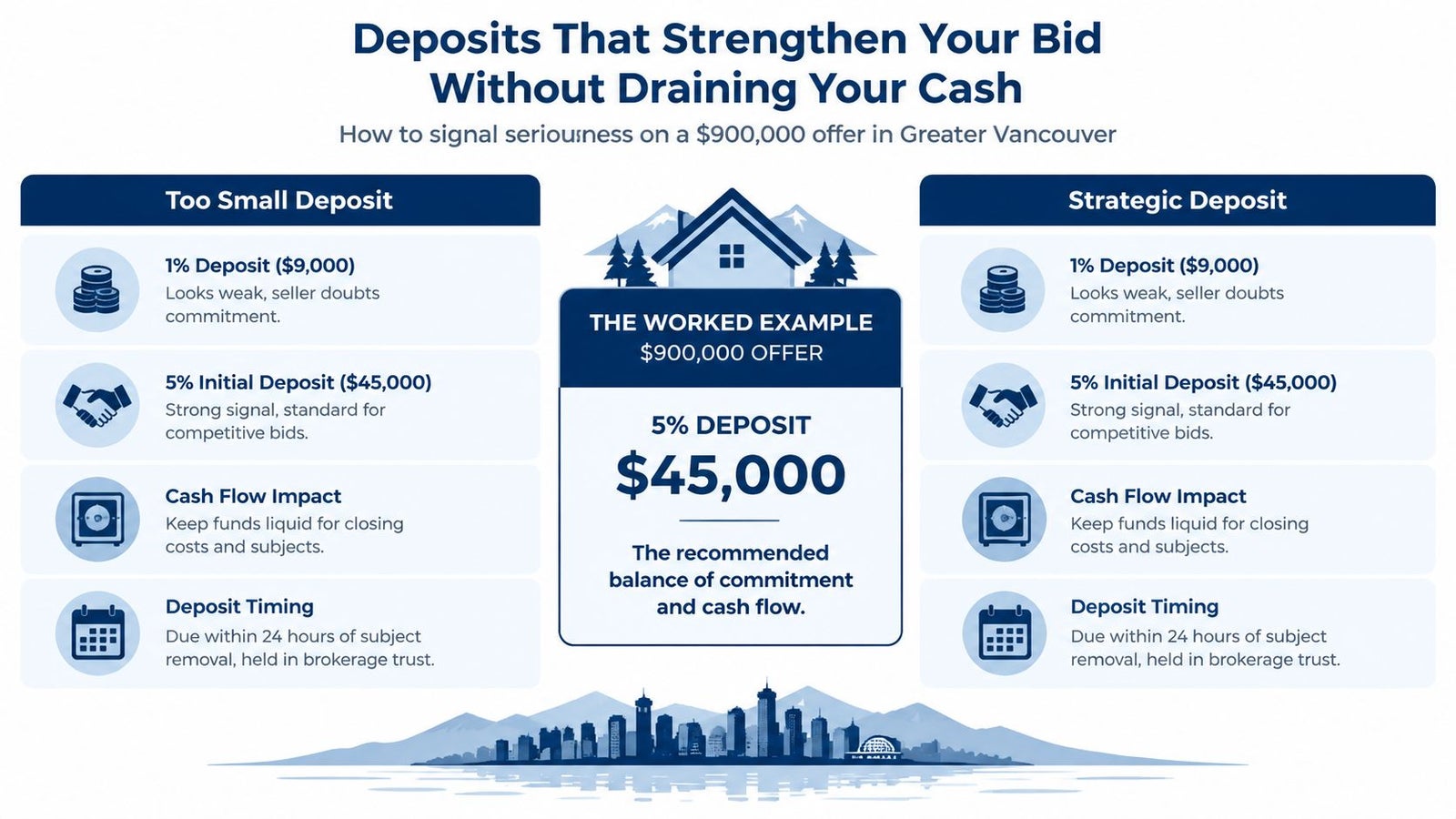
On a $900,000 purchase, a 5% deposit is $45,000. One possible structure is an initial $25,000 deposit within 24 hours of acceptance, followed by a top-up to $45,000 when subjects are removed. That structure must be written correctly in the contract and confirmed with your REALTOR® and legal professional.
A buyer competing in Burnaby or West Vancouver might consider increasing the deposit to 10%, but a larger deposit isn't automatically safer or more persuasive. It can strengthen the seller's perception of commitment while reducing the cash available for closing costs, moving expenses, repairs, or an appraisal shortfall.
The deposit is held in the brokerage trust account under the applicable arrangement, rather than treated as casual hand money. If subjects fail and the transaction doesn't proceed, the release and consequences depend on the contract and circumstances. That's why you shouldn't over-deposit to look strong.
Before writing, ask your representative to show you the exact deposit clause, the deadline, the account instructions, and the consequences of missing the deadline. Strong offer strategy means the seller sees certainty, while you retain enough liquidity to complete the purchase responsibly.
Conditions are not a sign that you're an unserious buyer. They allocate risk between buyer and seller. The right package depends on the property, your financing, the inspection evidence, and how much uncertainty you can absorb after acceptance.
In BC, a purchase contract becomes binding once the buyer removes the included conditions. Common subjects include financing, inspection, strata-document review, sale of an existing home, and insurance confirmation, as outlined in this BC guide to subject removal for home buyers.
Financing plus inspection
Inspection only
Subject-free
Sale of existing property
An inspection subject protects you, but BCFSA states that a seller doesn't have to accept an offer containing a property-inspection clause, according to the BCFSA consumer guide on property inspections. In a competitive detached-home offer, buyers sometimes reduce the risk by arranging an inspection before writing, shortening the inspection window, or setting aside a repair reserve.
Waiving financing can be defensible only when your lender has properly reviewed your income, assets, debt, intended loan structure, and the property. A pre-approval isn't a substitute for understanding appraisal risk. If the lender values the home below your contract price, you may need additional cash.
The subject-removal window also tells you something about the seller's expectations. A five-business-day window creates a faster due-diligence sprint than seven business days. Don't select the shorter period merely to look competitive if your lender, inspector, or lawyer can't meet it.
For strata properties, document review may reveal insurance, depreciation report, meeting minutes, levy, or building-maintenance concerns. Buyers considering a Vancouver condo should know how to read the Form B information certificate and related strata records before deciding whether a document subject is negotiable.
An escalation clause can keep your offer competitive without starting at your absolute ceiling. The clause generally sets an opening price, an increment above a bona fide competing offer, a maximum cap, and a requirement for evidence of the competing bid. The exact wording matters, so have your REALTOR® and legal adviser review the clause rather than copying language from another transaction.
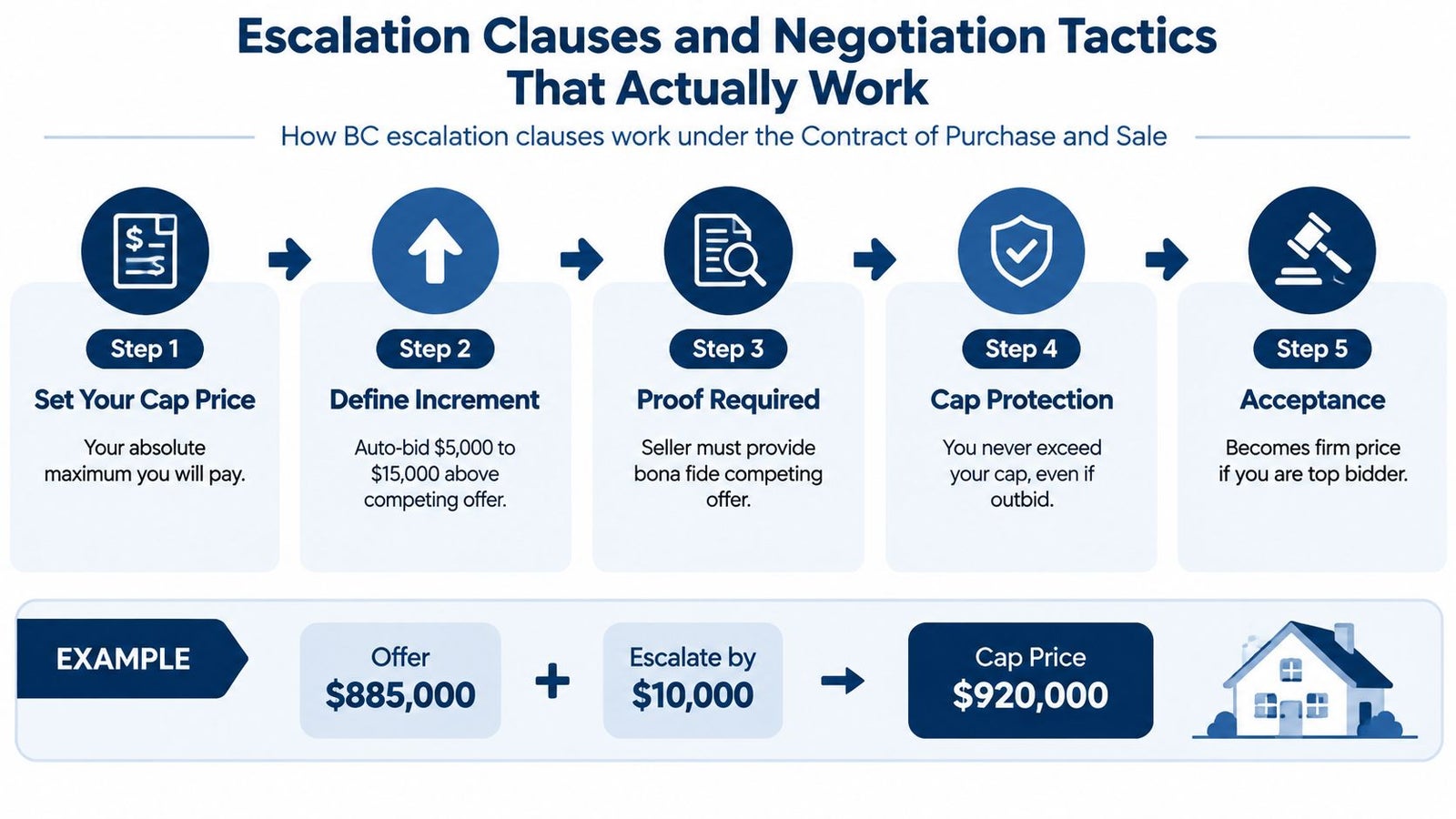
For detached stock, an increment in the range of $5,000 to $15,000 may be considered, but the right amount depends on the property and competing field. Consider a $1.1 million opening offer with a $25,000 escalation cap. Against a bona fide competing offer at $1.14 million, the clause could move your price to $1.15 million, depending on the drafted increment and other terms.
That result is useful only if $1.15 million remains acceptable after lender review and appraisal. If the appraisal supports less, the clause doesn't remove the gap. You must decide in advance whether you'd provide extra cash, revise the contract, or walk away if the seller won't adjust.
The BC escalation-clause buyer's guide provides further context on the mechanics and drafting issues. Remember that an escalation clause may be less attractive if the seller dislikes complex terms, the competing offer is close to your cap, or the seller wants a clean, easy-to-compare best price.
A flat offer can outperform an escalation when you know your best number, the competition is thin, or the listing agent expects transparent bidding. Ask how competing offers will be verified and whether the seller will accept an escalation structure.
The seller may also counter only one offer at a time. BCFSA recommends this approach because countering multiple offers can create legal risk, as described in the BCFSA multiple-offer guidance. Your REALTOR® should explain what information can be shared and what remains confidential.
Acceptance starts a process, not a pause. Your offer may be accepted in the evening, but the financing department, inspector, lawyer, insurer, and listing brokerage still need clear instructions. Organize those contacts before you write so the clock doesn't expose a weakness in an otherwise strong offer.
The deposit deadline is particularly important. The common BC practice described in the deposit guidance for Surrey buyers is payment within 24 hours of subject removal, not automatically 24 hours after acceptance. Your contract controls, and you should confirm the exact deadline in writing.
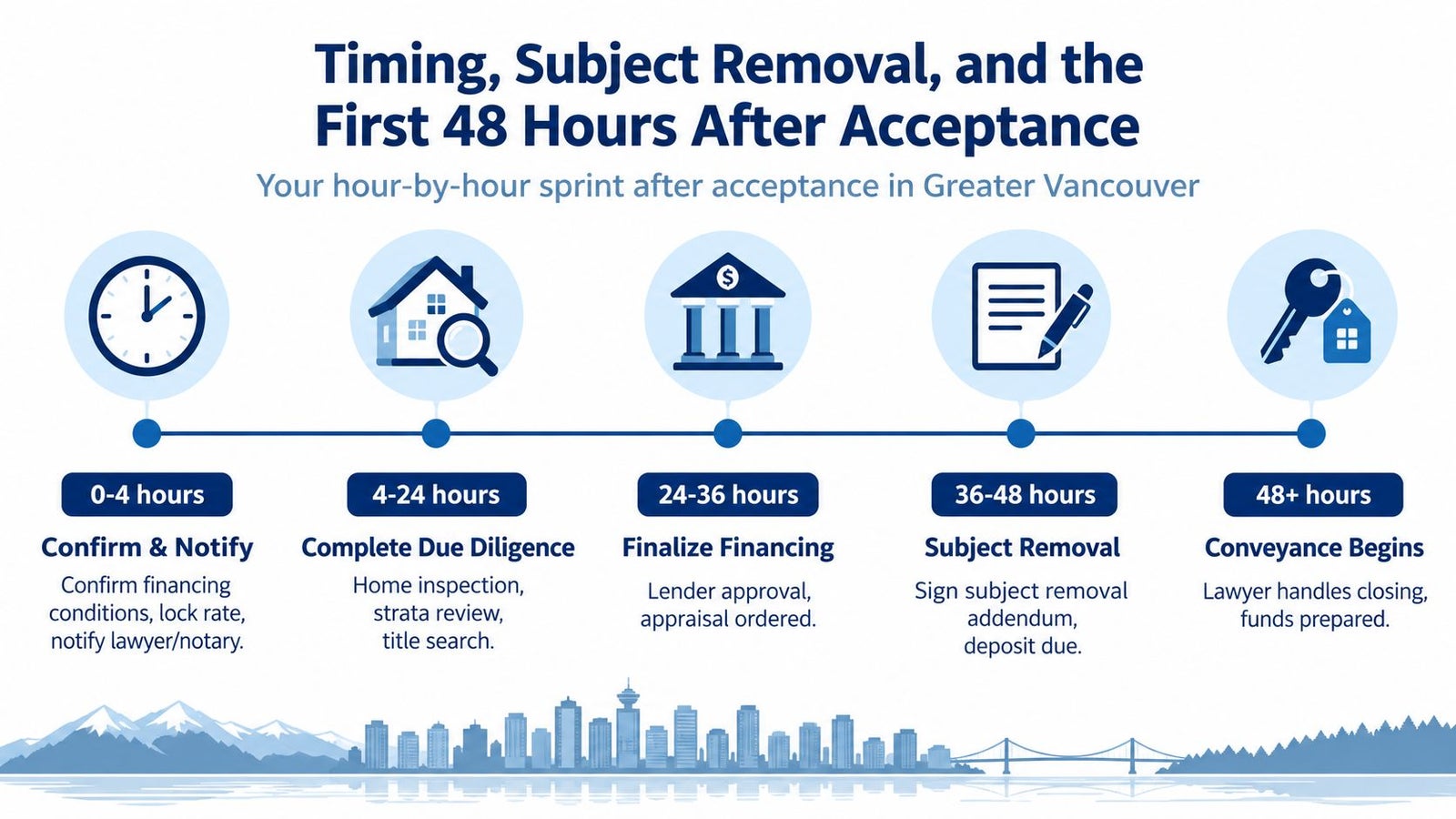
Hour 0 to 4: Send the accepted contract to your lender and lawyer or notary. Confirm the financing subject, identify any missing documents, confirm the rate strategy, and ask where the deposit must be delivered. Don't assume an emailed approval means the lender has approved the specific property.
Hour 4 to 24: Book the inspector, request strata documents if applicable, confirm insurance availability, and provide the lender with the listing details needed for appraisal. If you're using a short subject period, tell every professional the actual deadline.
Hour 24 to 48: Review the Property Disclosure Statement, title information, insurance response, financing confirmation, inspection report, and any strata records. Decide whether each subject is satisfied, needs clarification, or should remain in place until the contract permits removal.
The legal consequences of failing to perform can be serious. If you're uncertain about a condition, don't remove it because another buyer might be waiting. Ask your REALTOR® and lawyer or notary for advice before sending written subject removal.
A fast transaction isn't automatically a good transaction. The best sprint is organised, documented, and paced so you know what you're removing before you make the deal firm.
The most reliable offers are assembled before the deadline. Before you submit, make sure the following decisions are complete:
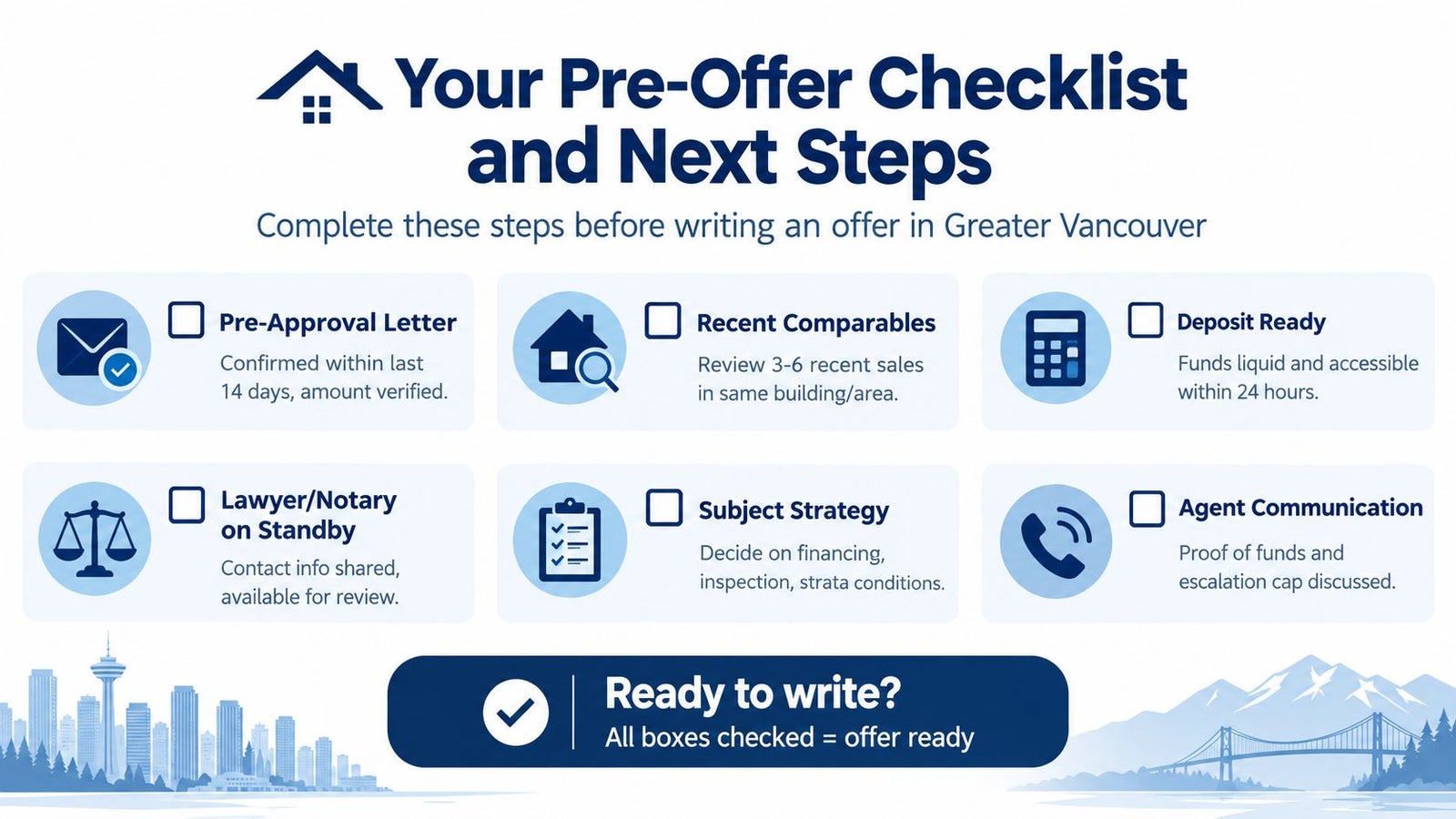
A defensible offer starts before the showing. You need a current view of comparable sales, a lender who understands the property and your deadline, accessible deposit funds, and a clear decision about which risks you're willing to carry. The objective isn't to write the most aggressive offer imaginable. It's to present the strongest package you can afford without turning a successful bid into an unsafe purchase.
What Winning an Offer in Greater Vancouver Really Looks Like
The Burnaby East detached-home bidding moment looked ordinary at first. Two buyers landed within $5,000 of each other, and their headline prices were close enough that neither bid appeared to have an obvious advantage. Both had a similar deposit, and both used familiar subjects for financing and inspection.
The losing offer was perfectly reasonable on paper. It gave the buyer a 21-day financing subject, retained standard inspection protection, and proposed a deposit that didn't materially change after subjects were removed. Nothing was reckless, but the package asked the seller to carry uncertainty for longer.
The successful buyer had prepared before walking through the open house. Their financing subject ran for 14 days, the deposit increased from 5% to 10% when subjects were removed, and the offer included a clean escalation clause capped at the buyer's appraised-value tolerance. The closing date matched the seller's preferred possession schedule.
Practical rule: A seller doesn't compare price in isolation. They compare the probability, timing, and inconvenience of getting to completion.
The winning offer wasn't necessarily dramatically richer. It made the seller's next steps easier and reduced the chance of a late surprise. That distinction matters under British Columbia's multiple-offer process. If more than one written offer is available before acceptance, all written offers must be presented to the seller. The seller can reject all offers, accept one, or invite new offers by a specified date while disclosing that a multiple-offer situation exists, as explained by the BCFSA guidance on multiple offers and brokerage practice.
BCFSA's brokerage sample recorded multiple offers in 22% of transactions in 2025, down from under 30% in both 2023 and 2024, and about 56% of multiple-offer transactions went to the highest-priced offer, according to that same BCFSA transaction-data summary. The figures point to an important conclusion: price usually matters, but it doesn't decide every file.
A house offer strategy should therefore answer four questions before you bid:
- What is the property worth today?
- Which conditions protect you without making the seller doubt completion?
- How much cash can you commit, and when?
- Which terms solve a real problem for this seller?
Competition can appear in pockets of North Vancouver, Burnaby, Richmond, or other neighbourhoods while nearby listings sit and negotiate. The buyer who prepares for both situations won't use the same offer structure everywhere.
Setting the Right Offer Price in a Cyclical Market
List price is a reference point, not a valuation. In August 2026, the Metro Vancouver benchmark home price was $1,081,900, down 5.6% year over year and 13.6% below the all-time high of $1,252,800 set in April 2022, according to August 2026 Vancouver housing-market data. The detached benchmark was $1,799,400, while the average detached-sale price was $1,977,064.
Those figures describe different measurements. A benchmark attempts to represent a typical property profile, while an average reflects the actual mix of homes sold. A negotiated price may differ from both. The same Metro Vancouver market update reports that the benchmark price rose only 6.7% over 10 years, which reinforces why buyers shouldn't treat the previous peak as an automatic floor.
Build the ceiling before you see the competition
Start with recent sold comparables in the same neighbourhood and property category. A practical workflow is:
- Pull recent solds that are comparable, preferably within a 10% size band, while checking the sale date and market direction.
- Adjust for physical differences, including a view, lane access, lot utility, renovation quality, layout, parking, and suite potential.
- Separate benchmark, average, list, and sold prices instead of blending them into one estimate.
- Check current inventory and sales momentum using BCREA's statistical releases and market dashboards.
- Set an absolute ceiling based on your carrying-cost comfort, lender qualification, available reserves, and tolerance for an appraisal gap.
BCREA recorded residential unit sales building from 4,221 in January 2025 to 7,162 in June 2025, with June sales up 1.3% from June 2024, as shown in its British Columbia market statistics. That seasonal build can increase competition for well-priced homes, but it doesn't prove that every listing deserves an aggressive bid.
Neighbourhood-level absorption matters more than a broad regional slogan. Buyers comparing a renovated detached home in Kitsilano with one in Langley should expect different comparable sets, buyer pools, and negotiation conditions. The Vancouver absorption-rate guide can help buyers understand why active inventory and the pace of sold listings belong in the pricing conversation.
Metro Vancouver
- HPI benchmark, detached: $1,799,400
- Detached average price: $1,977,064
- 10-year appreciation: 6.7% benchmark rise over 10 years
Kitsilano
- HPI benchmark, detached: Use current neighbourhood comparables
- Detached average price: Use current neighbourhood comparables
- 10-year appreciation: Use Metro Vancouver trend only as context
Langley
- HPI benchmark, detached: Use current neighbourhood comparables
- Detached average price: Use current neighbourhood comparables
- 10-year appreciation: Use Metro Vancouver trend only as context
The list above keeps the final two areas qualitative on purpose. The verified regional data doesn't establish separate August 2026 HPI benchmark, average-price, or 10-year appreciation figures for Kitsilano and Langley, so those numbers shouldn't be invented.
Your ceiling should also account for Canada's mortgage stress test. New purchasers must qualify at the higher of the contract rate plus 2 percentage points or 5.25%, as described in the market context provided by the Greater Vancouver market update. If an escalation clause reaches beyond what the lender and appraisal support, the buyer must supply the difference or renegotiate. That's why your cap should be a financial limit, not an emotional response to another bid.
Deposits That Strengthen Your Bid Without Draining Your Cash
A deposit communicates commitment, but it also creates a cash-flow obligation. In British Columbia, practice commonly uses a deposit of about 5% of the purchase price, typically due within 24 hours of subject removal, with the deposit later credited toward the buyer's down payment at completion, according to this Surrey offer and deposit guide.
The timing matters. You shouldn't write a deposit promise that your bank, lawyer, family member, or investment account can't fulfil on schedule. Confirm the source of funds before submitting, and understand whether the contract requires an initial amount followed by a top-up.
A $900,000 example
On a $900,000 purchase, a 5% deposit is $45,000. One possible structure is an initial $25,000 deposit within 24 hours of acceptance, followed by a top-up to $45,000 when subjects are removed. That structure must be written correctly in the contract and confirmed with your REALTOR® and legal professional.
A buyer competing in Burnaby or West Vancouver might consider increasing the deposit to 10%, but a larger deposit isn't automatically safer or more persuasive. It can strengthen the seller's perception of commitment while reducing the cash available for closing costs, moving expenses, repairs, or an appraisal shortfall.
Small deposit
- Competitive signal: May appear less committed in a multiple-offer setting
- Cash-flow concern: Preserves liquidity
About 5%
- Competitive signal: Common, recognizable commitment level
- Cash-flow concern: Requires funds to be ready at the contractual deadline
Higher deposit
- Competitive signal: Can improve certainty for a seller
- Cash-flow concern: Ties up more cash and increases exposure if the transaction fails
The deposit is held in the brokerage trust account under the applicable arrangement, rather than treated as casual hand money. If subjects fail and the transaction doesn't proceed, the release and consequences depend on the contract and circumstances. That's why you shouldn't over-deposit to look strong.
Before writing, ask your representative to show you the exact deposit clause, the deadline, the account instructions, and the consequences of missing the deadline. Strong offer strategy means the seller sees certainty, while you retain enough liquidity to complete the purchase responsibly.
Choosing Subjects and Conditions That Match Your Risk Tolerance
Conditions are not a sign that you're an unserious buyer. They allocate risk between buyer and seller. The right package depends on the property, your financing, the inspection evidence, and how much uncertainty you can absorb after acceptance.
In BC, a purchase contract becomes binding once the buyer removes the included conditions. Common subjects include financing, inspection, strata-document review, sale of an existing home, and insurance confirmation, as outlined in this BC guide to subject removal for home buyers.
Financing plus inspection
- Competitiveness: Moderate
- Risk if subjects fail: The buyer can walk away if financing or condition is unsatisfactory, subject to the contract
- Best used when: Financing and physical condition both need confirmation
Inspection only
- Competitiveness: Stronger for a financed buyer
- Risk if subjects fail: Financing risk remains with the buyer after removal
- Best used when: The lender has reviewed the borrower and property sufficiently
Subject-free
- Competitiveness: Highest apparent certainty
- Risk if subjects fail: Buyer carries financing, inspection, insurance, and appraisal risk
- Best used when: The buyer has verified funding and completed meaningful due diligence
Sale of existing property
- Competitiveness: Usually weaker in a seller-leaning situation
- Risk if subjects fail: The new purchase may depend on selling the current home
- Best used when: The buyer cannot safely carry both properties
Choose the protection you can actually manage
An inspection subject protects you, but BCFSA states that a seller doesn't have to accept an offer containing a property-inspection clause, according to the BCFSA consumer guide on property inspections. In a competitive detached-home offer, buyers sometimes reduce the risk by arranging an inspection before writing, shortening the inspection window, or setting aside a repair reserve.
Waiving financing can be defensible only when your lender has properly reviewed your income, assets, debt, intended loan structure, and the property. A pre-approval isn't a substitute for understanding appraisal risk. If the lender values the home below your contract price, you may need additional cash.
The subject-removal window also tells you something about the seller's expectations. A five-business-day window creates a faster due-diligence sprint than seven business days. Don't select the shorter period merely to look competitive if your lender, inspector, or lawyer can't meet it.
For strata properties, document review may reveal insurance, depreciation report, meeting minutes, levy, or building-maintenance concerns. Buyers considering a Vancouver condo should know how to read the Form B information certificate and related strata records before deciding whether a document subject is negotiable.
Escalation Clauses and Negotiation Tactics That Actually Work
An escalation clause can keep your offer competitive without starting at your absolute ceiling. The clause generally sets an opening price, an increment above a bona fide competing offer, a maximum cap, and a requirement for evidence of the competing bid. The exact wording matters, so have your REALTOR® and legal adviser review the clause rather than copying language from another transaction.
Make the cap a financial boundary
For detached stock, an increment in the range of $5,000 to $15,000 may be considered, but the right amount depends on the property and competing field. Consider a $1.1 million opening offer with a $25,000 escalation cap. Against a bona fide competing offer at $1.14 million, the clause could move your price to $1.15 million, depending on the drafted increment and other terms.
That result is useful only if $1.15 million remains acceptable after lender review and appraisal. If the appraisal supports less, the clause doesn't remove the gap. You must decide in advance whether you'd provide extra cash, revise the contract, or walk away if the seller won't adjust.
The cap should reflect your maximum defensible purchase price, not the maximum amount you can imagine paying while standing in the room.
The BC escalation-clause buyer's guide provides further context on the mechanics and drafting issues. Remember that an escalation clause may be less attractive if the seller dislikes complex terms, the competing offer is close to your cap, or the seller wants a clean, easy-to-compare best price.
A flat offer can outperform an escalation when you know your best number, the competition is thin, or the listing agent expects transparent bidding. Ask how competing offers will be verified and whether the seller will accept an escalation structure.
Three terms can improve your position without increasing the price:
- Flexible completion: Match the seller's move, financing, or possession requirements where practical.
- Larger subject-removal deposit: Increase certainty only after confirming that your funds remain available.
- Selective condition changes: Don't waive protections blindly. If a titled property's document review is complete, discuss whether that condition can be removed.
The seller may also counter only one offer at a time. BCFSA recommends this approach because countering multiple offers can create legal risk, as described in the BCFSA multiple-offer guidance. Your REALTOR® should explain what information can be shared and what remains confidential.
Timing, Subject Removal, and the First 48 Hours After Acceptance
Acceptance starts a process, not a pause. Your offer may be accepted in the evening, but the financing department, inspector, lawyer, insurer, and listing brokerage still need clear instructions. Organize those contacts before you write so the clock doesn't expose a weakness in an otherwise strong offer.
The deposit deadline is particularly important. The common BC practice described in the deposit guidance for Surrey buyers is payment within 24 hours of subject removal, not automatically 24 hours after acceptance. Your contract controls, and you should confirm the exact deadline in writing.
A practical sprint
Hour 0 to 4: Send the accepted contract to your lender and lawyer or notary. Confirm the financing subject, identify any missing documents, confirm the rate strategy, and ask where the deposit must be delivered. Don't assume an emailed approval means the lender has approved the specific property.
Hour 4 to 24: Book the inspector, request strata documents if applicable, confirm insurance availability, and provide the lender with the listing details needed for appraisal. If you're using a short subject period, tell every professional the actual deadline.
Hour 24 to 48: Review the Property Disclosure Statement, title information, insurance response, financing confirmation, inspection report, and any strata records. Decide whether each subject is satisfied, needs clarification, or should remain in place until the contract permits removal.
The legal consequences of failing to perform can be serious. If you're uncertain about a condition, don't remove it because another buyer might be waiting. Ask your REALTOR® and lawyer or notary for advice before sending written subject removal.
Pre-completion checklist
- Title search: Confirm registered owners, charges, easements, covenants, and other matters with your legal professional.
- Tax adjustments: Ask how property taxes and other adjustments will be calculated on the statement of adjustments.
- Insurance: Confirm the policy can bind before completion and that the lender's requirements are met.
- Funds: Verify the down payment, deposit credit, closing costs, and any required bank drafts or transfers.
- Property Transfer Tax: Ask your lawyer or notary which BC forms apply and what must be filed within the first 30 days of completion.
- Final review: Arrange a completion or possession walk-through if the contract and representative recommend it.
A fast transaction isn't automatically a good transaction. The best sprint is organised, documented, and paced so you know what you're removing before you make the deal firm.
Your Pre-Offer Checklist and Next Steps
The most reliable offers are assembled before the deadline. Before you submit, make sure the following decisions are complete:
- Financing: Obtain a confirmed pre-approval letter within the last 14 days, verify the amount, and discuss appraisal risk with the lender.
- Comparables: Review recent sales in the specific neighbourhood, not just a broad Metro Vancouver average.
- Deposit: Confirm that funds are liquid, accessible within the contractual deadline, and available for any agreed top-up.
- Professional support: Give your lawyer or notary the property details and confirm availability during the subject period.
- Subjects: Decide whether financing, inspection, strata-document review, insurance, or sale-of-property protection is essential.
- Escalation: Set the cap before competing, and align it with your appraisal-gap tolerance and cash reserves.
- Offer summary: Have your REALTOR® review price, deposit, dates, subjects, inclusions, exclusions, and completion terms on one page.
A pre-approval letter doesn't replace property-specific underwriting, and recent comparables don't guarantee an appraisal. They give you a disciplined starting point. The buyer who knows their ceiling, conditions, deposit path, and response time can act quickly without confusing urgency with recklessness.
First-time buyers should also confirm their Property Transfer Tax exemption status and any applicable first-time buyer rebates before finalizing the price ceiling. Those items can change the effective affordability calculation, so discuss them with a qualified legal or tax professional.
For broader preparation, review this 2026 Vancouver homes buyer's guide and then test the framework against the actual listing, its documents, seller timing, and nearby competition.
First-time buyers should also confirm their Property Transfer Tax exemption status and any applicable first-time buyer rebates before finalizing the price ceiling. Those items can change the effective affordability calculation, so discuss them with a qualified legal or tax professional.
For broader preparation, review this 2026 Vancouver homes buyer's guide and then test the framework against the actual listing, its documents, seller timing, and nearby competition.
Jacky Levi - Vancouver Realtor offers buyer representation, comparative-market analysis, offer structuring, negotiation, and transaction coordination across Greater Vancouver. Book a 30-minute strategy session through Jacky Levi - Vancouver Realtor to pressure-test your price ceiling, subjects, deposit, dates, and escalation plan against a specific listing before you compete.