
A Vancouver condo selling for $695,200 in June 2026 was down 7.1% year over year, yet only 0.4% below the previous month. That combination matters more than either number alone. It suggests the market has moved from rapid repricing toward a fragile price floor, while unsold new units and a growing resale selection continue to pressure the prices sellers can achieve. (Daily Hive's June 2026 market statistics)
The headline version of the Vancouver condo price trend is simple: values are softer than they were a year earlier, condos are lagging other housing segments, and buyers have more room to negotiate. The more useful version is harder. Benchmark prices, average selling prices, listing supply, and the eventual clearing price are no longer telling exactly the same story.
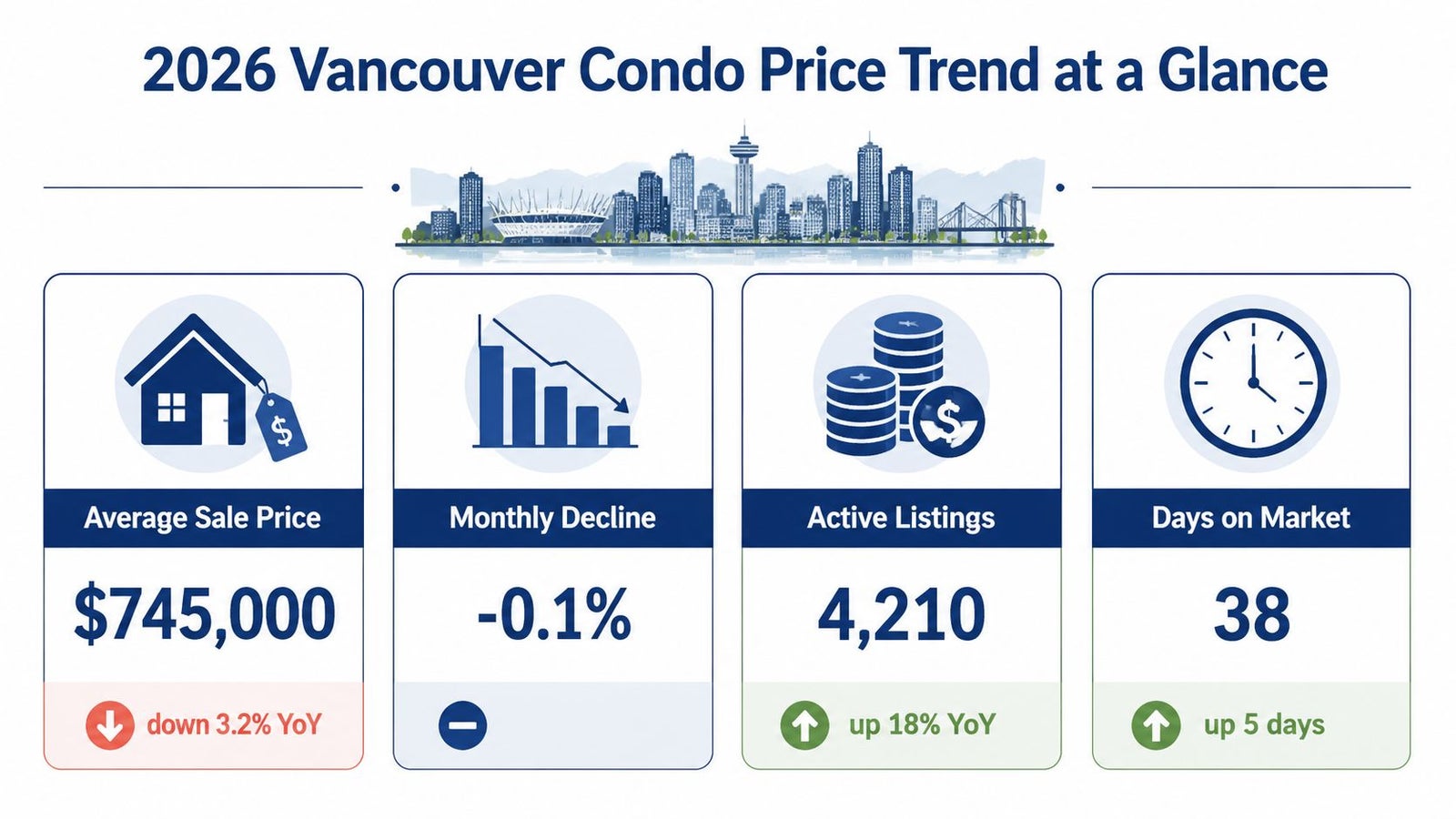
The June 2026 average condo selling price was $695,200, down 7.1% year over year and 0.4% month over month, according to Daily Hive's June 2026 market statistics. The modest monthly decline suggests that the pace of repricing has slowed. It does not show that last year's values have returned, or that every building has found a firm floor.
MLS® average sale prices were higher in several monthly reports, reaching $739,258 in February 2026, $740,518 in March, $771,899 in May, and $771,217 in June. The Metro Vancouver apartment benchmark was $688,000 in February and $697,800 in May, as reported in the Greater Vancouver REALTORS® June 2026 statistics package. The gap reflects methodology and sales mix. An average changes with the units that transact, while a benchmark models a representative property type.
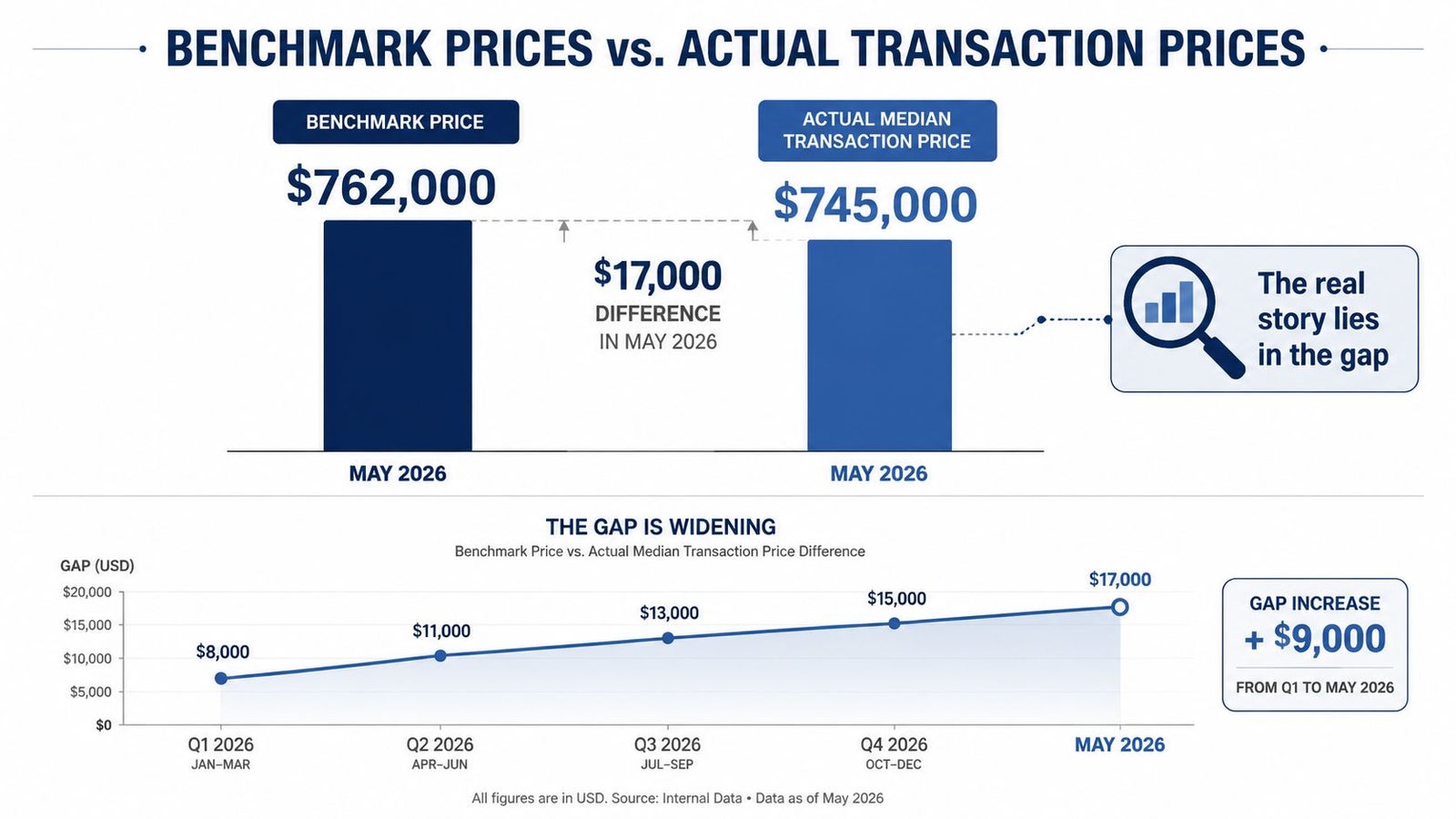
The clearing price is the level at which a listing attracts a committed buyer under current conditions. It can sit below a benchmark even when the benchmark appears stable, because sellers may initially list at yesterday's expectations and reduce only after showings fail to produce an offer.
June brought a different signal. The average condo selling price was $695,200, down 7.1% year over year but just 0.4% month over month, and the Greater Vancouver condo median held around $699,000 for two consecutive months. (Nesto's Vancouver housing market outlook) Monthly declines compress when buyers and sellers begin meeting within a narrower range. That doesn't guarantee an immediate rebound. It does mean that accurate positioning may matter more than trying to predict the month when the market turns.
Consider two otherwise similar units. One is listed above the recent selling range because the owner wants to “test” the market. The other is positioned close to the price supported by current comparable sales, with clean photography, complete documents, and flexible showing access. In a slower market, the second listing is more likely to generate serious engagement because buyers can compare it against competing inventory without feeling pressure to act immediately.
Sellers should therefore track the asking-to-selling relationship, the age of competing listings, and the terms attached to accepted offers. A practical guide to the difference between asking and selling prices can help owners avoid confusing an ambitious list price with evidence of market value. (Asking price versus selling price for Vancouver home sellers)
More supply gives buyers choice, but it can also lower the price a resale unit must meet to attract attention. The main pressure comes from shadow inventory, units that are not yet competing as standard resale listings but could enter the market through unsold developer stock, investor-held properties, or owners who receive completed homes and decide not to occupy them.
Recent Vancouver coverage identified more than 2,000 new condos sitting unsold and empty, alongside the highest listing levels in over a decade. (Nesto's Vancouver real estate outlook) These units can weigh on resale pricing before every one appears in public listing searches. A buyer comparing a ten-year-old building with a completed new condo may assign value to the newer unit's warranty, amenities, or developer incentives.
Between 2022 and the first quarter of 2025, average resale condo prices in Vancouver declined 2.7%, while broader supply pressures weakened resale price growth. (CMHC's condominium apartment market risk discussion) The relevant distinction is between construction economics and resale economics. A project may proceed on pre-sale assumptions, while completed units reach buyers under different financing, rental, and demand conditions.
Pressure can arrive after completion. A pre-sale purchaser may face higher carrying costs or a changed personal situation. An investor may sell rather than rent. A developer may offer incentives to clear remaining inventory without lowering the published price. Those incentives can reduce the effective price advantage of comparable resale units, even when headline prices appear stable.
The resale floor does not reset equally for every building. New construction competes most directly with older condos in the same neighbourhood and price range. Properties with dated interiors, high strata fees, unresolved maintenance concerns, or inefficient layouts may lose negotiating power sooner than well-maintained units with views or functional floor plans.
New supply also affects rentals. If vacant condos enter the rental pool, landlords may face more competition for tenants, weakening income assumptions for investors. A lower purchase price may therefore fail to improve the investment case if rent expectations decline at the same time.
The 2026 Vancouver new-condo project guide helps purchasers identify which new projects may compete with an existing resale condo. The comparison should cover more than age. Buyers should assess layout, completion timing, incentives, strata costs, building quality, and rental alternatives before deciding whether a resale discount is large enough.
Citywide averages can mislead condo owners because they combine housing types with different buyer pools, price points, and supply conditions. In May 2026, the Greater Vancouver composite benchmark was $1,100,700, while the condominium benchmark was $697,800. Attached and detached homes occupied substantially higher valuation bands, as shown in the Storeys' June 2026 Vancouver housing update.
Buyers face two separate questions: does a specific condo justify its current transaction price, and would waiting improve the entry point? Those decisions should be assessed independently rather than reduced to a single market-timing call.
The market remains vulnerable, although the monthly pace of decline has moderated. TD Economics projects a roughly 15% peak-to-trough decline from the 2023 high by mid-2027, so further downside remains possible even if monthly changes become less severe, as outlined in its Vancouver condo market outlook.
Start with liquidity. A neighbourhood may look stable because a few well-positioned units sell while weaker listings accumulate. Examine completed transactions in the same building and nearby comparable buildings. The relevant question is whether the unit type is clearing at current prices or merely attracting views and inquiries.
Compare the replacement options. Unsold new and nearly new condos create shadow inventory that can reset the resale floor. Compare the full package, including parking, storage, strata obligations, warranty position, layout, completion status, and any developer incentive. A resale unit priced below its original expectation may still offer poor value if the buyer assumes significant future building costs or gives up features available in newer supply.
The comparison should focus on actual clearing prices, not only benchmark movements or asking prices. A benchmark can remain above the price at which marginal units transact, especially when sellers resist reductions and buyers have more substitutes.
Stress-test the financing. The purchase must fit the buyer's income, reserves, and expected holding period. A possible future recovery does not offset a payment structure that leaves no room for repairs, strata increases, vacancy, or employment changes.
Investors should test rent against the purchase price, operating costs, taxes, financing, strata fees, insurance, and realistic vacancy assumptions. Completion waves may add rental homes, giving tenants more choice and forcing landlords to compete on condition and price. Projected income is therefore sensitive to the building's location, layout, amenities, and incoming competition.
For a property-by-property framework, buyers can consult this 2026 guide to Vancouver condos for sale. The sound approach is to negotiate from verified transaction evidence, then determine whether the condo's long-term use or investment case still works if prices take longer to recover.
Aggregate statistics establish direction, but they can't tell you what a specific condo will sell for. Two units in the same market can produce different outcomes because of floor level, orientation, renovation quality, floor plan, parking, storage, strata finances, building reputation, and the strength of competing listings.
A useful comparative market analysis should therefore do more than attach a citywide benchmark to a unit. It should examine recent sales in the same building and immediate area, compare original list prices with final sale prices, review days on market, and account for unsold new-construction competition. That process is particularly important when benchmark prices and actual transactions are moving at different speeds.
For sellers, the result should be a realistic pricing range and a launch plan that explains what evidence would justify holding firm or adjusting quickly. For buyers, the same work can identify whether a listing reflects genuine value or a stale price that hasn't caught up with current clearing conditions.
Jacky Levi - Sotheby's Realty Advisor & Realtor provides residential brokerage services across Greater Vancouver, including condo valuation, buyer representation, listing preparation, marketing coordination, negotiation, and transaction management. The practice also covers Vancouver, Burnaby, Richmond, Coquitlam, North Vancouver, and surrounding communities, where building-level inventory can differ sharply from the regional headline.
A no-obligation market analysis can give you a property-specific view of the Vancouver condo price trend before you choose a list price, submit an offer, or decide to wait.
Jacky Levi - Sotheby's Realty Advisor & Realtor offers MLS-grounded comparative market analysis, listing preparation, professional marketing, and negotiation support for Vancouver condo sellers, buyers, and investors. Visit the site to request a no-obligation valuation suited to your building, unit, and goals, and make your next pricing decision with transaction-level evidence rather than a citywide headline.
The headline version of the Vancouver condo price trend is simple: values are softer than they were a year earlier, condos are lagging other housing segments, and buyers have more room to negotiate. The more useful version is harder. Benchmark prices, average selling prices, listing supply, and the eventual clearing price are no longer telling exactly the same story.
The 2026 Vancouver Condo Price Trend at a Glance
The June 2026 average condo selling price was $695,200, down 7.1% year over year and 0.4% month over month, according to Daily Hive's June 2026 market statistics. The modest monthly decline suggests that the pace of repricing has slowed. It does not show that last year's values have returned, or that every building has found a firm floor.
MLS® average sale prices were higher in several monthly reports, reaching $739,258 in February 2026, $740,518 in March, $771,899 in May, and $771,217 in June. The Metro Vancouver apartment benchmark was $688,000 in February and $697,800 in May, as reported in the Greater Vancouver REALTORS® June 2026 statistics package. The gap reflects methodology and sales mix. An average changes with the units that transact, while a benchmark models a representative property type.
The broader Greater Vancouver benchmark was near $1.10 million during this period. Condos therefore remained the region's more accessible ownership category, but affordability did not shield them from competition. Resale sellers faced alternatives from comparable units, completed developer inventory, and buyers willing to delay a purchase while negotiating.
Condo year-over-year declines stayed roughly within the 7% to 8% range across several spring and summer 2026 reports. A seller using early 2025 pricing as a reference is comparing today's unit with a higher valuation environment. That mismatch can produce longer marketing times and sharper negotiations, particularly when newer listings offer better finishes, incentives, or vacant possession.
January had already pointed lower. The Greater Vancouver condo benchmark was about $704,600, down roughly 5.9% year over year and below the prior month, according to Mortgage Sandbox's January 2026 market report. Later stability therefore represents slower deterioration, not a confirmed recovery.
For buyers, the benchmark and the actual clearing price require separate attention. A unit priced near recent sales in its building may offer value, while a stale listing can remain overpriced despite a large headline discount. The January 2026 Vancouver real estate sales report provides useful context for comparing citywide activity with one condo's selling history. Unfunded new units and completed inventory can also pressure resale pricing, because buyers gain alternatives without needing a comparable resale seller to reduce the asking price first.
A benchmark is a useful market thermometer, but it isn't a cheque written to a seller. It estimates the value of a representative apartment, while an actual transaction reflects the unit's floor, outlook, condition, parking, storage, building reputation, seller urgency, and the alternatives available to the buyer that week.
May 2026 shows why the distinction matters. The apartment benchmark fell to $697,800, down 7.9% year over year and 0.7% month over month, while apartment sales fell 7.2% year over year to 1,009 units. (Raincity Properties' May 2026 market update) Prices and transactions weakened together. Fewer buyers were clearing listings, and the buyers who remained had greater influence over the final price.
What the annual decline tells sellers
Condo year-over-year declines stayed roughly within the 7% to 8% range across several spring and summer 2026 reports. A seller using early 2025 pricing as a reference is comparing today's unit with a higher valuation environment. That mismatch can produce longer marketing times and sharper negotiations, particularly when newer listings offer better finishes, incentives, or vacant possession.
January had already pointed lower. The Greater Vancouver condo benchmark was about $704,600, down roughly 5.9% year over year and below the prior month, according to Mortgage Sandbox's January 2026 market report. Later stability therefore represents slower deterioration, not a confirmed recovery.
"Practical reading: A slower monthly decline indicates a narrower valuation band, not a universal price floor."
For buyers, the benchmark and the actual clearing price require separate attention. A unit priced near recent sales in its building may offer value, while a stale listing can remain overpriced despite a large headline discount. The January 2026 Vancouver real estate sales report provides useful context for comparing citywide activity with one condo's selling history. Unfunded new units and completed inventory can also pressure resale pricing, because buyers gain alternatives without needing a comparable resale seller to reduce the asking price first.
Benchmark Prices Versus Actual Transaction Prices
A benchmark is a useful market thermometer, but it isn't a cheque written to a seller. It estimates the value of a representative apartment, while an actual transaction reflects the unit's floor, outlook, condition, parking, storage, building reputation, seller urgency, and the alternatives available to the buyer that week.
May 2026 shows why the distinction matters. The apartment benchmark fell to $697,800, down 7.9% year over year and 0.7% month over month, while apartment sales fell 7.2% year over year to 1,009 units. (Raincity Properties' May 2026 market update) Prices and transactions weakened together. Fewer buyers were clearing listings, and the buyers who remained had greater influence over the final price.
Why the clearing price deserves more attention
The clearing price is the level at which a listing attracts a committed buyer under current conditions. It can sit below a benchmark even when the benchmark appears stable, because sellers may initially list at yesterday's expectations and reduce only after showings fail to produce an offer.
June brought a different signal. The average condo selling price was $695,200, down 7.1% year over year but just 0.4% month over month, and the Greater Vancouver condo median held around $699,000 for two consecutive months. (Nesto's Vancouver housing market outlook) Monthly declines compress when buyers and sellers begin meeting within a narrower range. That doesn't guarantee an immediate rebound. It does mean that accurate positioning may matter more than trying to predict the month when the market turns.
Consider two otherwise similar units. One is listed above the recent selling range because the owner wants to “test” the market. The other is positioned close to the price supported by current comparable sales, with clean photography, complete documents, and flexible showing access. In a slower market, the second listing is more likely to generate serious engagement because buyers can compare it against competing inventory without feeling pressure to act immediately.
"The benchmark describes the market's direction. The transaction price reveals where a particular unit can clear."
Sellers should therefore track the asking-to-selling relationship, the age of competing listings, and the terms attached to accepted offers. A practical guide to the difference between asking and selling prices can help owners avoid confusing an ambitious list price with evidence of market value. (Asking price versus selling price for Vancouver home sellers)
How New Condo Supply Is Reshaping the Resale Market
More supply gives buyers choice, but it can also lower the price a resale unit must meet to attract attention. The main pressure comes from shadow inventory, units that are not yet competing as standard resale listings but could enter the market through unsold developer stock, investor-held properties, or owners who receive completed homes and decide not to occupy them.
Recent Vancouver coverage identified more than 2,000 new condos sitting unsold and empty, alongside the highest listing levels in over a decade. (Nesto's Vancouver real estate outlook) These units can weigh on resale pricing before every one appears in public listing searches. A buyer comparing a ten-year-old building with a completed new condo may assign value to the newer unit's warranty, amenities, or developer incentives.
The pre-sale and resale split
Between 2022 and the first quarter of 2025, average resale condo prices in Vancouver declined 2.7%, while broader supply pressures weakened resale price growth. (CMHC's condominium apartment market risk discussion) The relevant distinction is between construction economics and resale economics. A project may proceed on pre-sale assumptions, while completed units reach buyers under different financing, rental, and demand conditions.
Pressure can arrive after completion. A pre-sale purchaser may face higher carrying costs or a changed personal situation. An investor may sell rather than rent. A developer may offer incentives to clear remaining inventory without lowering the published price. Those incentives can reduce the effective price advantage of comparable resale units, even when headline prices appear stable.
The resale floor does not reset equally for every building. New construction competes most directly with older condos in the same neighbourhood and price range. Properties with dated interiors, high strata fees, unresolved maintenance concerns, or inefficient layouts may lose negotiating power sooner than well-maintained units with views or functional floor plans.
"The pricing question is whether upcoming completions compete directly with the unit being considered."
New supply also affects rentals. If vacant condos enter the rental pool, landlords may face more competition for tenants, weakening income assumptions for investors. A lower purchase price may therefore fail to improve the investment case if rent expectations decline at the same time.
The 2026 Vancouver new-condo project guide helps purchasers identify which new projects may compete with an existing resale condo. The comparison should cover more than age. Buyers should assess layout, completion timing, incentives, strata costs, building quality, and rental alternatives before deciding whether a resale discount is large enough.
Condos Versus Other Housing Segments in Greater Vancouver
Citywide averages can mislead condo owners because they combine housing types with different buyer pools, price points, and supply conditions. In May 2026, the Greater Vancouver composite benchmark was $1,100,700, while the condominium benchmark was $697,800. Attached and detached homes occupied substantially higher valuation bands, as shown in the Storeys' June 2026 Vancouver housing update.
Condos recorded the sharpest annual decline at 7.9%, compared with 5.1% for attached homes and 6.9% for detached homes. The apartment segment was therefore the weakest of the three listed categories in this report. Its performance should not be treated as a proxy for the entire Greater Vancouver market.
A condo owner who relies on the composite benchmark may assume the property should track a market valued around $1.10 million. The condo benchmark was $697,800, creating a gap of more than $400,000. That difference changes the relevant buyer pool, financing discussion, competitive set, and likely negotiation range.
The divergence also matters when comparing benchmark prices with actual transactions. A benchmark describes a standardized segment, while an individual sale reflects the building, unit condition, exposure, floor plan, fees, and the alternatives available to buyers at that moment. In a soft market, unsold new condos can add pressure below the benchmark by giving purchasers another option and anchoring negotiations against incentives or newer finishes.
Buyers can make the same error from the opposite direction. Comparing condo performance with detached homes may suggest that a smaller decline signals recovery across all housing types. The segment data support a different reading: each category needs its own comparable sales, inventory review, and assessment of buyer behaviour.
A condo seller should compare the unit with apartments that share its tenure, building age, strata profile, layout, parking situation, and immediate location. A detached-home benchmark may describe regional sentiment, but it cannot price a one-bedroom apartment. Segment-specific comparables are more useful than broad market averages when deciding whether to list, offer, or hold.
A seller cannot control new completions, competing listings, or the benchmark. The controllable decisions are the launch price, preparation, access, documentation, and response time after buyers provide feedback. Those decisions matter more when the benchmark diverges from the price a specific unit can achieve.
TD Economics' Vancouver condo market outlook expects Vancouver condo prices to decline about 7% to 8% in 2026 and projects a roughly 15% peak-to-trough drop from the 2023 high by mid-2027. For sellers, that projection separates a property's current clearing price from its purchase price, desired recovery target, or citywide benchmark.
Active condo listings were reported above 6,600, while days on market stretched into the mid-50s. A listing can therefore remain visible for weeks as newer, better-positioned, or incentivized alternatives appear beside it. Unsold new condos create shadow inventory, giving buyers another reference point and putting pressure on the resale floor, especially for older units with comparable layouts.
Why the composite benchmark can distort expectations
A condo owner who relies on the composite benchmark may assume the property should track a market valued around $1.10 million. The condo benchmark was $697,800, creating a gap of more than $400,000. That difference changes the relevant buyer pool, financing discussion, competitive set, and likely negotiation range.
The divergence also matters when comparing benchmark prices with actual transactions. A benchmark describes a standardized segment, while an individual sale reflects the building, unit condition, exposure, floor plan, fees, and the alternatives available to buyers at that moment. In a soft market, unsold new condos can add pressure below the benchmark by giving purchasers another option and anchoring negotiations against incentives or newer finishes.
Buyers can make the same error from the opposite direction. Comparing condo performance with detached homes may suggest that a smaller decline signals recovery across all housing types. The segment data support a different reading: each category needs its own comparable sales, inventory review, and assessment of buyer behaviour.
A condo seller should compare the unit with apartments that share its tenure, building age, strata profile, layout, parking situation, and immediate location. A detached-home benchmark may describe regional sentiment, but it cannot price a one-bedroom apartment. Segment-specific comparables are more useful than broad market averages when deciding whether to list, offer, or hold.
Pricing Strategy for Condo Sellers in a Softening Market
A seller cannot control new completions, competing listings, or the benchmark. The controllable decisions are the launch price, preparation, access, documentation, and response time after buyers provide feedback. Those decisions matter more when the benchmark diverges from the price a specific unit can achieve.
TD Economics' Vancouver condo market outlook expects Vancouver condo prices to decline about 7% to 8% in 2026 and projects a roughly 15% peak-to-trough drop from the 2023 high by mid-2027. For sellers, that projection separates a property's current clearing price from its purchase price, desired recovery target, or citywide benchmark.
Active condo listings were reported above 6,600, while days on market stretched into the mid-50s. A listing can therefore remain visible for weeks as newer, better-positioned, or incentivized alternatives appear beside it. Unsold new condos create shadow inventory, giving buyers another reference point and putting pressure on the resale floor, especially for older units with comparable layouts.
A practical seller checklist
- Start with the building, not the city. Review recent sales in the same building and immediate area. Adjust for renovations, floor height, exposure, parking, storage, strata fees, special assessments, and the building's remaining appeal against newer supply.
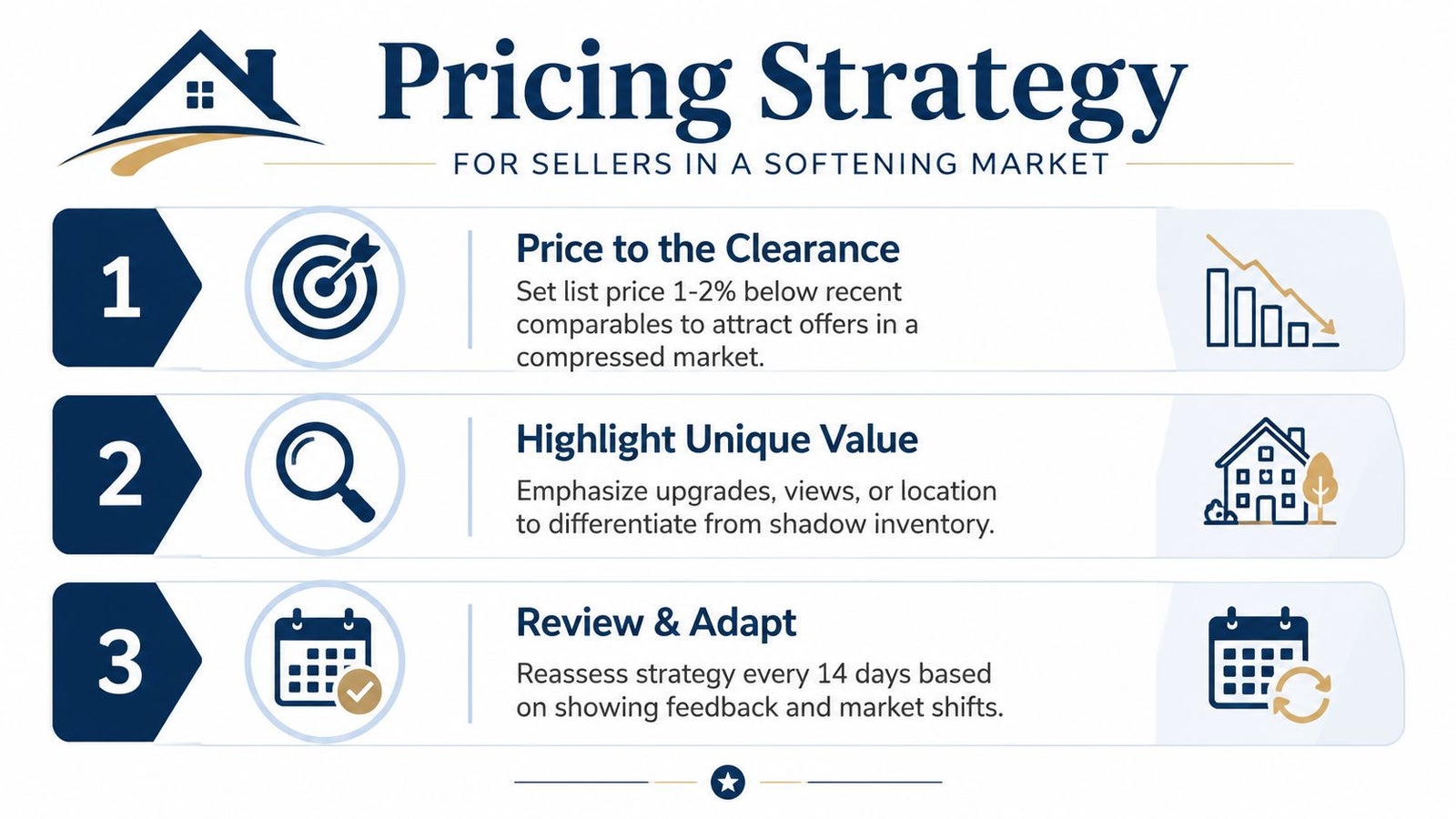
- Price for the active buyer pool. The supplied pricing framework recommends setting the list price 1% to 2% below recent comparables to attract offers in a compressed market. Use that range as a test against local sales, current alternatives, and the unit's condition, rather than applying it automatically.
- Make the unit easy to compare. Professional photography, video tours, a 3D walkthrough, organized strata documents, and practical showing access help buyers assess the resale unit against shadow inventory and competing listings.
- Set a review date before listing. If showings occur but buyers repeatedly question price, condition, or building costs, respond to that evidence. A reduction makes sense when comparable sales, feedback, and competing listings point in the same direction.
- Protect the net result. A slightly lower price with clean terms may be preferable to a higher conditional offer that leaves financing, completion timing, inclusions, or repairs uncertain. Review those terms with your REALTOR® rather than focusing only on the headline amount.
"Seller discipline: The first price should attract the right comparison set. A later reduction cannot always recover attention lost through an obviously mispriced launch."
What the Data Means for Condo Buyers and Investors
Buyers face two separate questions: does a specific condo justify its current transaction price, and would waiting improve the entry point? Those decisions should be assessed independently rather than reduced to a single market-timing call.
The market remains vulnerable, although the monthly pace of decline has moderated. TD Economics projects a roughly 15% peak-to-trough decline from the 2023 high by mid-2027, so further downside remains possible even if monthly changes become less severe, as outlined in its Vancouver condo market outlook.
A buyer's decision filter
Start with liquidity. A neighbourhood may look stable because a few well-positioned units sell while weaker listings accumulate. Examine completed transactions in the same building and nearby comparable buildings. The relevant question is whether the unit type is clearing at current prices or merely attracting views and inquiries.
Compare the replacement options. Unsold new and nearly new condos create shadow inventory that can reset the resale floor. Compare the full package, including parking, storage, strata obligations, warranty position, layout, completion status, and any developer incentive. A resale unit priced below its original expectation may still offer poor value if the buyer assumes significant future building costs or gives up features available in newer supply.
The comparison should focus on actual clearing prices, not only benchmark movements or asking prices. A benchmark can remain above the price at which marginal units transact, especially when sellers resist reductions and buyers have more substitutes.
Stress-test the financing. The purchase must fit the buyer's income, reserves, and expected holding period. A possible future recovery does not offset a payment structure that leaves no room for repairs, strata increases, vacancy, or employment changes.
The investor's separate calculation
Investors should test rent against the purchase price, operating costs, taxes, financing, strata fees, insurance, and realistic vacancy assumptions. Completion waves may add rental homes, giving tenants more choice and forcing landlords to compete on condition and price. Projected income is therefore sensitive to the building's location, layout, amenities, and incoming competition.
For a property-by-property framework, buyers can consult this 2026 guide to Vancouver condos for sale. The sound approach is to negotiate from verified transaction evidence, then determine whether the condo's long-term use or investment case still works if prices take longer to recover.
Get a Data-Informed Condo Valuation for Your Property
Aggregate statistics establish direction, but they can't tell you what a specific condo will sell for. Two units in the same market can produce different outcomes because of floor level, orientation, renovation quality, floor plan, parking, storage, strata finances, building reputation, and the strength of competing listings.
A useful comparative market analysis should therefore do more than attach a citywide benchmark to a unit. It should examine recent sales in the same building and immediate area, compare original list prices with final sale prices, review days on market, and account for unsold new-construction competition. That process is particularly important when benchmark prices and actual transactions are moving at different speeds.
For sellers, the result should be a realistic pricing range and a launch plan that explains what evidence would justify holding firm or adjusting quickly. For buyers, the same work can identify whether a listing reflects genuine value or a stale price that hasn't caught up with current clearing conditions.
Jacky Levi - Sotheby's Realty Advisor & Realtor provides residential brokerage services across Greater Vancouver, including condo valuation, buyer representation, listing preparation, marketing coordination, negotiation, and transaction management. The practice also covers Vancouver, Burnaby, Richmond, Coquitlam, North Vancouver, and surrounding communities, where building-level inventory can differ sharply from the regional headline.
A no-obligation market analysis can give you a property-specific view of the Vancouver condo price trend before you choose a list price, submit an offer, or decide to wait.
Jacky Levi - Sotheby's Realty Advisor & Realtor offers MLS-grounded comparative market analysis, listing preparation, professional marketing, and negotiation support for Vancouver condo sellers, buyers, and investors. Visit the site to request a no-obligation valuation suited to your building, unit, and goals, and make your next pricing decision with transaction-level evidence rather than a citywide headline.