Searching for Vancouver townhouses for sale can feel messy fast. You've got listings open in multiple tabs, prices shifting from one site to the next, and no clear sense of what's worth a tour. The smartest way through that noise is to start with a dedicated REALTOR® who knows the neighbourhood-level market, then use the right self-service tools to pressure-test every listing before you write an offer. In Metro Vancouver, that matters more than ever because the townhouse segment is active, but still operating below long-run demand, with 1,648 total residential sales in February 2026, 13,545 active listings, and a townhouse benchmark price of $1,046,100 according to Greater Vancouver REALTORS® (GVR March 2026 stats package).
When you're serious about Vancouver townhouses for sale, a seasoned Realtor is the first tool that saves time. Jacky Levi brings 20+ years of Greater Vancouver residential experience, a licensed REALTOR® and Associate Broker background, and a service model built around pricing, negotiation, and transaction management for condos, townhomes, and detached homes in neighbourhoods across Vancouver West, East Vancouver, North and West Vancouver. His value is simple: he helps buyers and sellers interpret the market instead of just browsing it.

Jacky's biggest strength is local judgement paired with structured execution. That's a real advantage if you're comparing older low-strata homes against newer developments with more operating costs, or if you're buying remotely and need someone to coordinate vendors, inspections, and access.
The trade-off is straightforward. There isn't a published fee schedule, so you'll need a consultation to get a customized quote. If you want a more hands-on process and a broker who can keep the search grounded in market reality, that's a feature, not a drawback.
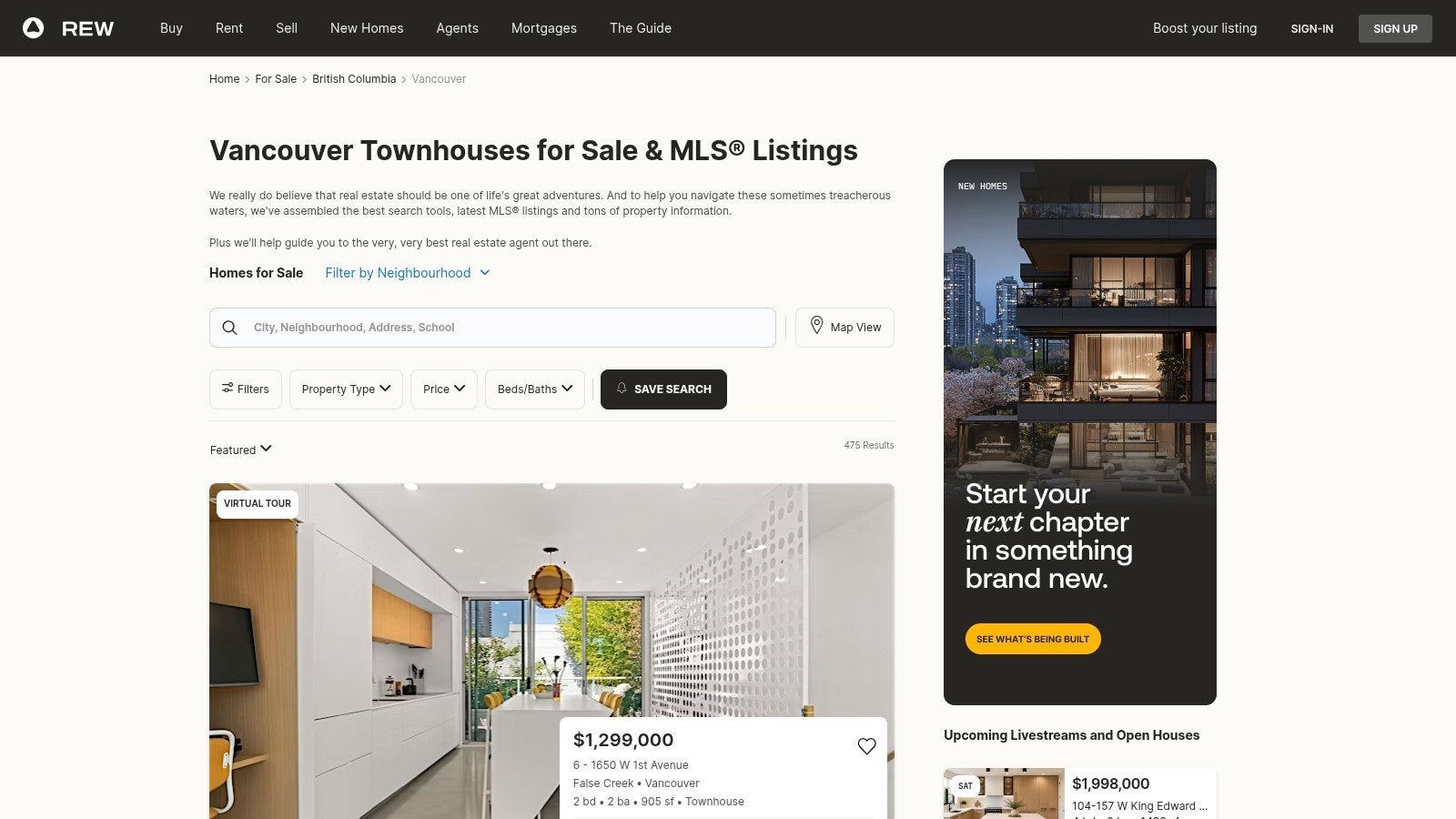
REW is one of the first sites I'd open after speaking with a REALTOR®. It's built for Greater Vancouver inventory, and its townhouse search is strong enough that you can quickly see what's on the market across the city, not just in one brokerage feed. For a buyer comparing Vancouver townhouses for sale, that full market view matters because it prevents you from making decisions based on a narrow slice of supply.
Having the right tools is the first step, but buying a townhouse in Vancouver takes more than a clean search page. You still need to read strata documents carefully, compare neighbourhood-level pricing, understand monthly carrying costs, and decide how aggressive your offer should be in the context of current inventory. With 13,545 active listings in the wider market and townhouse pricing hovering around the $1.046 million range in early 2026, strategy matters just as much as access to listings (GVR February 2026 stats package).
The portals in this guide are strongest when they work together. REW helps you cast a wide net. REALTOR.ca verifies the listing. Zealty shows freshness. Zoocasa and Royal LePage make comparison easier. LoyalHomes keeps the search simple. Jacky Levi ties all of that together with MLS analysis, local judgment, negotiation support, and a process that keeps buyers from overpaying or missing red flags.
That matters because the Vancouver townhouse market isn't one-size-fits-all. A buyer in Vancouver West, where pricing can sit far above the regional average, needs a different strategy than someone targeting East Vancouver or North Vancouver. The right advisor helps you calibrate the search to the neighbourhood, the building age, the fee structure, and the resale path.
Contact Jacky Levi today for a complimentary consultation to review your shortlisted properties and build a purchase plan that fits your budget, your timing, and your long-term goals.
If you're ready to move from browsing to buying, Jacky Levi, Sotheby's Realty Advisor & Realtor, can help you compare Vancouver townhouses for sale with local market intelligence, MLS-based pricing strategy, and full transaction support.
1. Jacky Levi, Vancouver Realtor, Sotheby's International Realty Canada
Why this matters before you start clicking around
Townhouses in this market need MLS-backed comparative market analysis, not guesswork. That is especially important in a segment where regional price bands can vary sharply by area, and where the broad Metro Vancouver benchmark can hide big neighbourhood differences. Jacky's site also supports the practical side of buying and selling, with professional photography, video, 3D walkthroughs, staging consultation, open houses, private showings, offer strategy, and contract administration.
"Practical rule: If a townhouse looks attractive online, ask for a comparative market analysis before you fall in love with the listing photos."
For buyers, that approach helps narrow options by true value, not just finishing quality. For sellers, it means you can position a listing against recent comparables instead of hoping the market absorbs an optimistic asking price. A useful starting point is his 2026 buyer's guide to Vancouver homes, which fits neatly into a townhouse search workflow because it pushes you toward strategy, not just browsing.
What works and what doesn't
Jacky's biggest strength is local judgement paired with structured execution. That's a real advantage if you're comparing older low-strata homes against newer developments with more operating costs, or if you're buying remotely and need someone to coordinate vendors, inspections, and access.
"He's a strong fit when you want one point of contact for strategy, showings, and closing details."
The trade-off is straightforward. There isn't a published fee schedule, so you'll need a consultation to get a customized quote. If you want a more hands-on process and a broker who can keep the search grounded in market reality, that's a feature, not a drawback.
2. REW for the broadest Vancouver inventory
REW is one of the first sites I'd open after speaking with a REALTOR®. It's built for Greater Vancouver inventory, and its townhouse search is strong enough that you can quickly see what's on the market across the city, not just in one brokerage feed. For a buyer comparing Vancouver townhouses for sale, that full market view matters because it prevents you from making decisions based on a narrow slice of supply.
The best use case is micro-targeting. If you're focused on the Cambie Corridor, for example, REW's map search helps you draw a custom boundary so you're not wasting time on listings that are outside the walkable Canada Line zone. That's exactly how I'd use it in practice: first cast a wide net, then tighten the search around commute, school, and lifestyle needs.
REW also handles saved searches and alerts well, which helps when inventory shifts quickly. You can track new arrivals, review open houses, and use the listing-agent contact details to move from browsing to viewing without delay. For a buyer who wants the search to stay organized, that's a real advantage.
The downside is that syndication can create duplicates, so you still need to verify details before you rely on a listing count. REW is excellent for discovery, but it is not a deep analytics platform. Use it to build the shortlist, then move to a second source and your agent for validation.
If you want to see how a curated listing feed can support that process, the featured properties page is a good complement because it keeps the search anchored to real, current inventory.
REW also handles saved searches and alerts well, which helps when inventory shifts quickly. You can track new arrivals, review open houses, and use the listing-agent contact details to move from browsing to viewing without delay. For a buyer who wants the search to stay organized, that's a real advantage.
"What works best here: broad coverage, strong map search, and fast narrowing by neighbourhood."
The downside is that syndication can create duplicates, so you still need to verify details before you rely on a listing count. REW is excellent for discovery, but it is not a deep analytics platform. Use it to build the shortlist, then move to a second source and your agent for validation.
If you want to see how a curated listing feed can support that process, the featured properties page is a good complement because it keeps the search anchored to real, current inventory.
3. REALTOR.ca for verification and trust
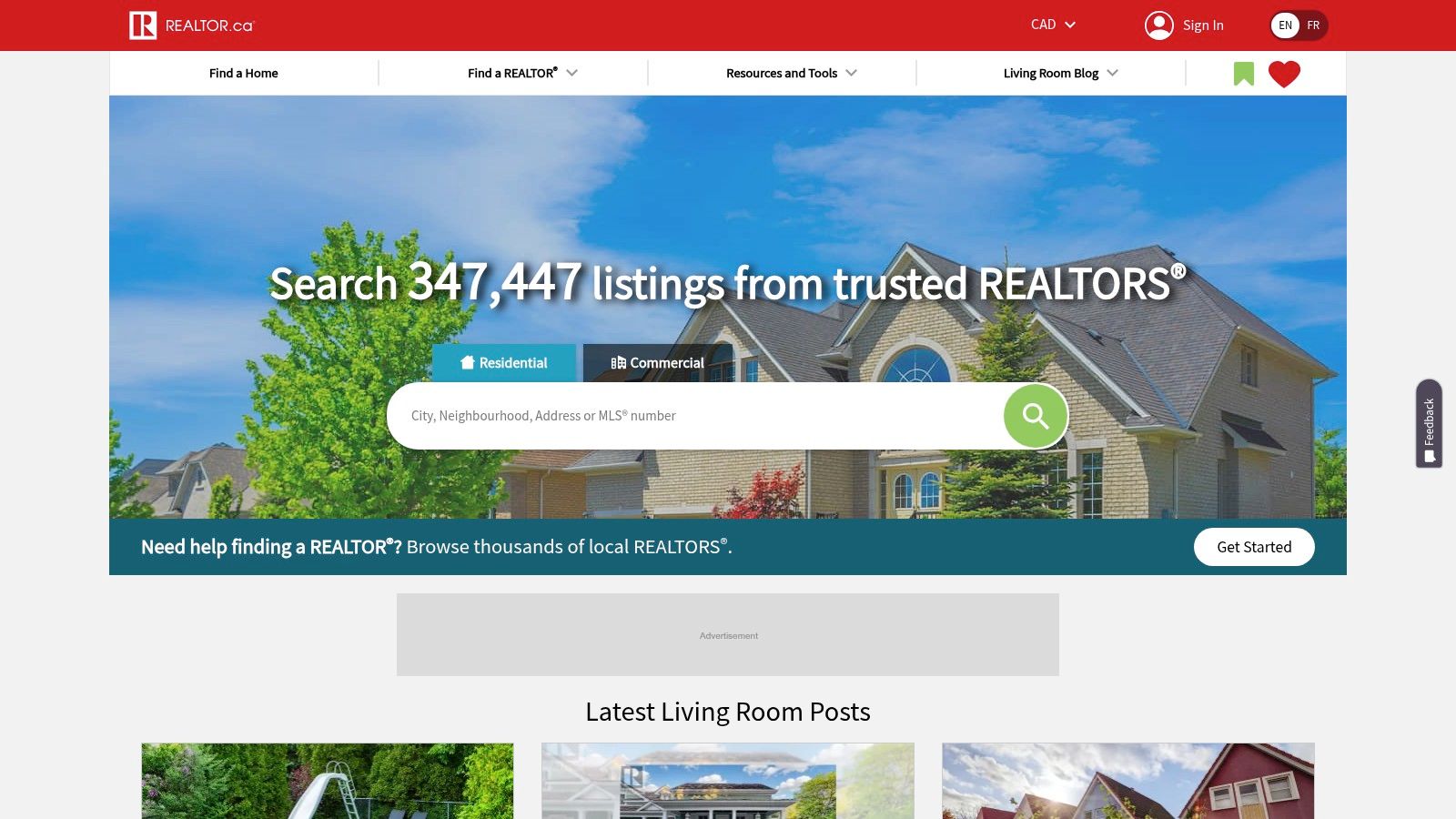
REALTOR.ca is the platform I use when I want the cleanest MLS-backed cross-check. It's Canada's national listing portal, and in a Vancouver townhouse search that makes it useful for one very specific job, confirming that the property you found elsewhere is listed the way you think it is. If another site shows a home you like, searching the MLS number on REALTOR.ca gives you the board-sourced version of the listing.
That matters because a polished portal can be helpful without being complete. REALTOR.ca gives you a standard listing format, consistent metadata, and the official brokerage attribution, which makes it easier to compare homes without getting distracted by design differences between portals. When buyers ask me how to reduce mistakes in the early search stage, I usually say to trust the listing data, not the marketing presentation.
After you find a townhouse on REW, Zealty, or Zoocasa, check the same property on REALTOR.ca. Then compare the photos, MLS number, brokerage name, and core details before you book a showing or ask for documents. That step sounds basic, but it prevents a lot of confusion when multiple sites are republishing the same home.
The site is less specialized for Vancouver than some BC-focused portals, and the interface is more generic. Still, that's exactly why it belongs in the workflow. It's not where you fall in love with a townhouse; it's where you verify that the townhouse is real, current, and correctly represented.
A useful side benefit is that REALTOR.ca keeps your search grounded when you start comparing different neighbourhoods or property types. That's especially helpful when the wider Metro Vancouver market is showing more choice than usual, because a higher listing count can create a false sense of ease if you don't verify each option carefully.
For a market snapshot mindset, this pairs well with Jacky Levi's January 2026 Vancouver real estate update, which helps frame the broader conditions around your search.
A simple way to use it well
After you find a townhouse on REW, Zealty, or Zoocasa, check the same property on REALTOR.ca. Then compare the photos, MLS number, brokerage name, and core details before you book a showing or ask for documents. That step sounds basic, but it prevents a lot of confusion when multiple sites are republishing the same home.
The site is less specialized for Vancouver than some BC-focused portals, and the interface is more generic. Still, that's exactly why it belongs in the workflow. It's not where you fall in love with a townhouse; it's where you verify that the townhouse is real, current, and correctly represented.
A useful side benefit is that REALTOR.ca keeps your search grounded when you start comparing different neighbourhoods or property types. That's especially helpful when the wider Metro Vancouver market is showing more choice than usual, because a higher listing count can create a false sense of ease if you don't verify each option carefully.
For a market snapshot mindset, this pairs well with Jacky Levi's January 2026 Vancouver real estate update, which helps frame the broader conditions around your search.
4. Zealty for listing freshness and momentum
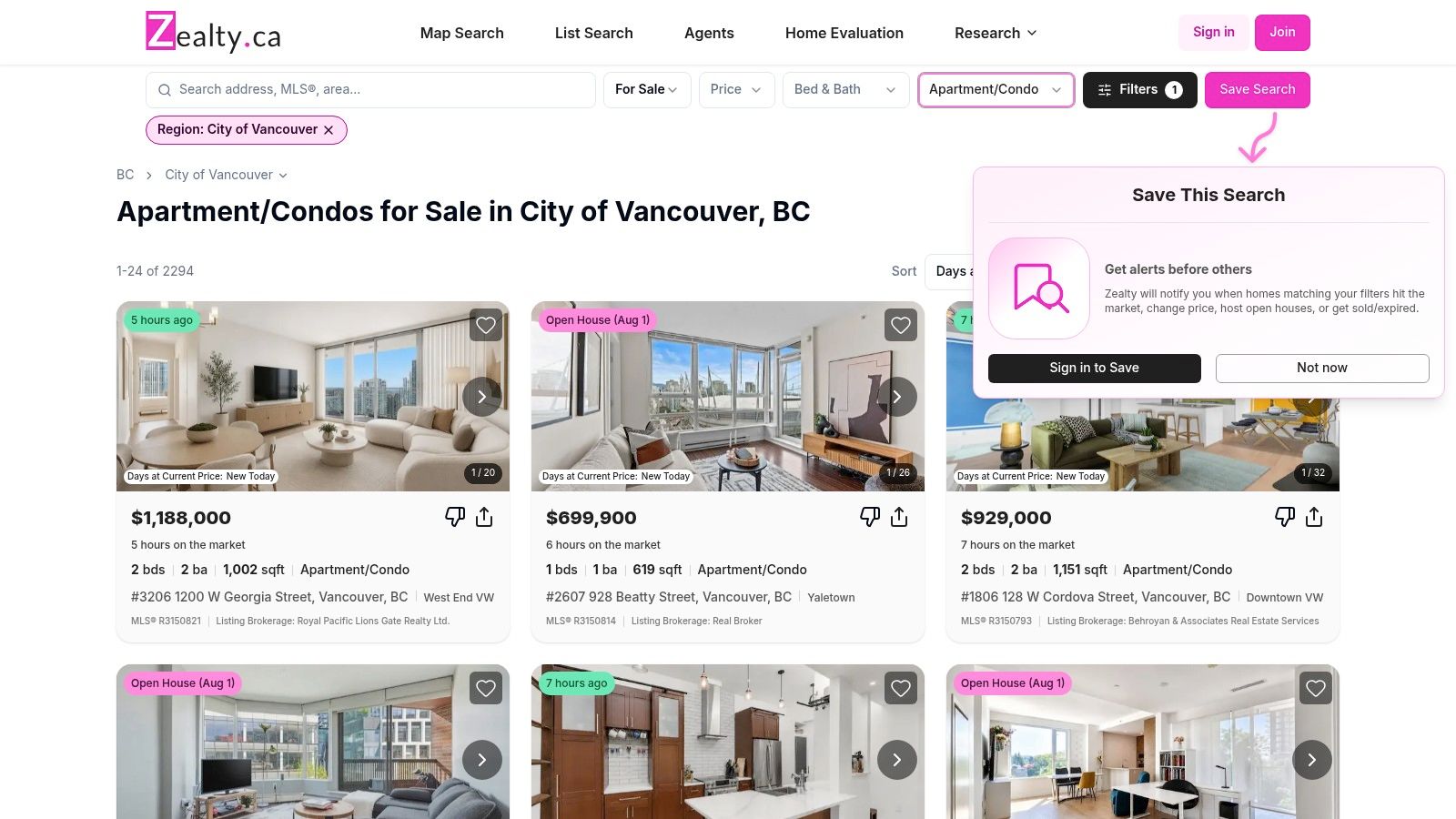
Zealty is one of the sharpest tools for reading the feel of the Vancouver townhouse market. It's fast, data-forward, and useful when you want to know which homes are fresh, which ones are lingering, and which ones may be getting more negotiable. If you're scanning Vancouver townhouses for sale across multiple sub-markets, that kind of quick signal can save a lot of time.
The interface makes it easy to check open houses, “new today” flags, and price-drop behaviour without digging through clutter. That matters when you're trying to decide whether a listing deserves a same-day showing or a slower, more deliberate review. In practice, I'd use Zealty when I want to answer one question quickly, is this townhouse getting attention or sitting long enough to invite negotiation
It's especially good for neighbourhood-by-neighbourhood scanning. If you want to check Yaletown, East Vancouver, or West Vancouver in one sitting, Zealty keeps the experience straightforward and responsive. That makes it handy for buyers who compare several pockets at once rather than focusing on only one area.
The limitation is that Zealty is lighter on deep analytics than a specialized market research platform. It tells you a lot about freshness and presentation, but not everything about long-term value, strata risk, or maintenance history. That's where your agent and strata document review still matter.
If you're trying to filter a crowded field, Zealty is a strong middle step between raw inventory and serious due diligence. It's the site I'd open when the goal is speed, and the listings are moving faster than you can tour them all.
Where Zealty helps most
It's especially good for neighbourhood-by-neighbourhood scanning. If you want to check Yaletown, East Vancouver, or West Vancouver in one sitting, Zealty keeps the experience straightforward and responsive. That makes it handy for buyers who compare several pockets at once rather than focusing on only one area.
"Useful habit: Check the “new today” and price-drop flags before deciding whether a listing needs immediate action."
The limitation is that Zealty is lighter on deep analytics than a specialized market research platform. It tells you a lot about freshness and presentation, but not everything about long-term value, strata risk, or maintenance history. That's where your agent and strata document review still matter.
If you're trying to filter a crowded field, Zealty is a strong middle step between raw inventory and serious due diligence. It's the site I'd open when the goal is speed, and the listings are moving faster than you can tour them all.
5. Zoocasa for side-by-side comparison
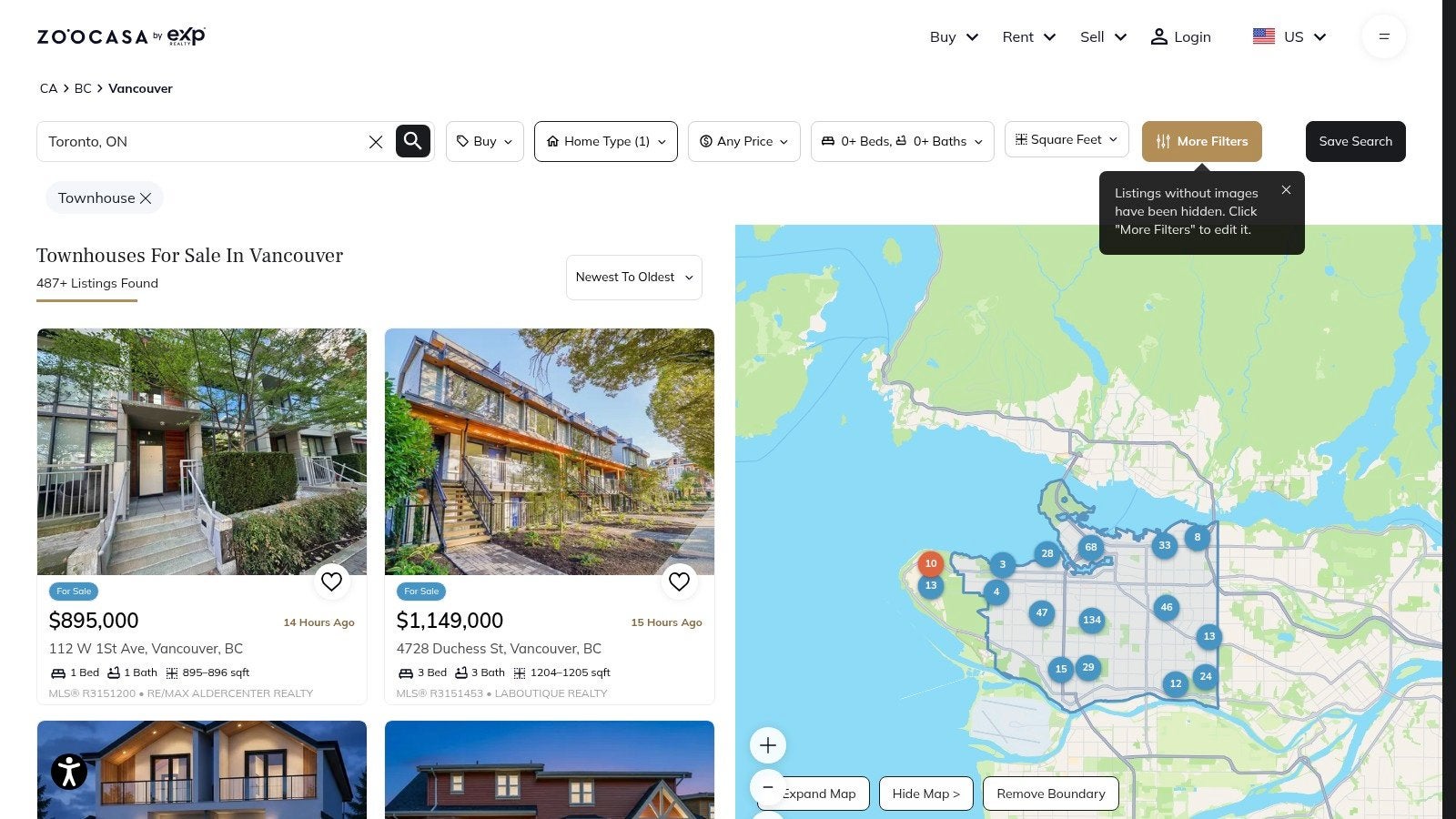
Zoocasa works well for buyers who want a cleaner, more guided search experience. The site gives you dedicated Vancouver townhouse filtering, and the platform feels especially useful when you've already narrowed your list to a handful of homes that are close enough to compare directly. For many first-time buyers, that's the point where the search gets emotional, and Zoocasa helps bring it back to structure.
The best feature is the comparison workflow. If you're choosing between two or three townhouses, the side-by-side view makes it easier to compare price, size, and features without hopping between tabs. That's useful when one unit has a slightly better layout, another has a better location, and a third has a lower fee structure.
Zoocasa also connects naturally to brokerage support, which can be a plus if you want to move from browsing into touring with less friction. The UI is polished on mobile, so it's convenient if you're researching on the go between work, school pickup, or showings.
The trade-off is that brokerage-led platforms often prioritise lead generation over deep analysis. That doesn't make Zoocasa weak, it just means you should use it as a comparison layer, not your only source of truth. I'd pair it with REALTOR.ca and your agent's CMA before making an offer.
If you want a broader buying framework that keeps the same disciplined mindset, this 2026 guide to finding an apartment in Vancouver is useful because the search process, verification, and comparison habits translate well across property types.
The best feature is the comparison workflow. If you're choosing between two or three townhouses, the side-by-side view makes it easier to compare price, size, and features without hopping between tabs. That's useful when one unit has a slightly better layout, another has a better location, and a third has a lower fee structure.
Best fit for shoppers who want a guided experience
Zoocasa also connects naturally to brokerage support, which can be a plus if you want to move from browsing into touring with less friction. The UI is polished on mobile, so it's convenient if you're researching on the go between work, school pickup, or showings.
The trade-off is that brokerage-led platforms often prioritise lead generation over deep analysis. That doesn't make Zoocasa weak, it just means you should use it as a comparison layer, not your only source of truth. I'd pair it with REALTOR.ca and your agent's CMA before making an offer.
"Practical rule: Use Zoocasa after you've narrowed the search, not before. It's better at choosing between finalists than finding the whole field."
If you want a broader buying framework that keeps the same disciplined mindset, this 2026 guide to finding an apartment in Vancouver is useful because the search process, verification, and comparison habits translate well across property types.
Vancouver Townhouses for Sale, 5-Source Comparison
Each of these seven options plays a different role in a smart townhouse search. Jacky Levi is the most hands-on choice, best for buyers who want local pricing guidance, negotiation support, and help managing the full transaction from shortlist to closing. REW is the broad inventory tool, useful for mapping neighbourhoods and tracking new listings across Greater Vancouver. REALTOR.ca is the trust layer, ideal for verifying MLS details and cross-checking what you found elsewhere. Zealty is strong for reading listing momentum, especially when you want to spot fresh listings, price drops, or homes that may be sitting long enough to invite negotiation. Zoocasa is best once you have a shortlist and want a cleaner side-by-side comparison experience. Royal LePage adds a simple brand-backed cross-check, with practical mortgage estimate tools that help you test affordability quickly. LoyalHomes is the easiest low-friction option, especially for first-time buyers who want a simple BC-focused search without too much clutter. Used together, these tools give you a balanced workflow that covers discovery, verification, comparison, and decision-making.
From Browsing to Buying Your Next Step
Having the right tools is the first step, but buying a townhouse in Vancouver takes more than a clean search page. You still need to read strata documents carefully, compare neighbourhood-level pricing, understand monthly carrying costs, and decide how aggressive your offer should be in the context of current inventory. With 13,545 active listings in the wider market and townhouse pricing hovering around the $1.046 million range in early 2026, strategy matters just as much as access to listings (GVR February 2026 stats package).
The portals in this guide are strongest when they work together. REW helps you cast a wide net. REALTOR.ca verifies the listing. Zealty shows freshness. Zoocasa and Royal LePage make comparison easier. LoyalHomes keeps the search simple. Jacky Levi ties all of that together with MLS analysis, local judgment, negotiation support, and a process that keeps buyers from overpaying or missing red flags.
That matters because the Vancouver townhouse market isn't one-size-fits-all. A buyer in Vancouver West, where pricing can sit far above the regional average, needs a different strategy than someone targeting East Vancouver or North Vancouver. The right advisor helps you calibrate the search to the neighbourhood, the building age, the fee structure, and the resale path.
Contact Jacky Levi today for a complimentary consultation to review your shortlisted properties and build a purchase plan that fits your budget, your timing, and your long-term goals.
If you're ready to move from browsing to buying, Jacky Levi, Sotheby's Realty Advisor & Realtor, can help you compare Vancouver townhouses for sale with local market intelligence, MLS-based pricing strategy, and full transaction support.