
A townhouse is a good investment in Metro Vancouver only when cash flow covers its costs and the strata reserves stay healthy over a seven- to ten-year hold, not when the case relies on short-term price gains.
That verdict runs against the habit of treating attached homes as a smaller version of a detached-house bet. A larger floor plan and family appeal don't automatically produce a better return. You may be buying more expensive space, paying only modestly higher rent, and still carrying the full weight of financing, fees, and a repair the strata hasn't funded yet. The useful test is whether the unit pays its way while you own it, and whether the documents show the next roof, drainage job, or road repair is already paid for.
Prices are falling while rents carry the case. That single fact shapes every return calculation a townhouse buyer runs in Metro Vancouver today.
The Greater Vancouver REALTORS June 2025 statistics package puts the benchmark townhouse price at $1,113,100 in March 2025, down 0.8% from March 2024, and at $1,103,900 in June 2025, a 3.0% year-over-year decrease. That same package shows the June 2025 townhouse price index 38.2% higher than five years earlier and 111.6% higher than ten years earlier. The October 2025 statistics package then records the benchmark at $1,066,700, down 3.8% year over year.
Read those figures together and the pattern matters more than any single month. The long-run index rewards patience across a decade, yet the market has been falling through 2025. A representative townhouse valued at $800,000 ten years ago would correspond to about $1.69 million at that historical index rate, though the result still turns on municipality, neighbourhood, age, size, strata quality, and renovation condition. That compounding sits in the past. A purchase made today starts at a declining benchmark, which means the monthly carry has to work on its own.
The slide hasn't reversed. The Greater Vancouver REALTORS March 2026 statistics package shows the townhouse benchmark at $1,047,100 in March 2026, still down 5.7% year over year.
Say you bought at the June 2025 benchmark of $1,103,900. You don't break even on a monthly basis until rent, or a realistic slice of appreciation, covers the mortgage, strata fees, tax, insurance, and upkeep. The price you pay matters as much as the market's direction. Transaction costs, property taxes, insurance, maintenance, and strata fees can wipe out a paper gain, and the strata's own balance sheet belongs in that calculation: an unfunded major repair enters your return the day you buy, whatever the market does. Entry tax is part of the bill as well, and the property transfer tax in BC guide shows how it lands on the price on the contract.
Price change isn't the same thing as money left after costs. A clear method for evaluating total ROI on rentals keeps the monthly result and the resale result in the same calculation.
Demand is real, and so is the rent gap against the purchase price. CMHC's Vancouver rental market reporting shows the average rent for a two-bedroom unit in the 2025 survey was $2,900, while the purpose-built rental vacancy rate was 3.7%. Earlier CMHC figures show Vancouver average occupied apartment rents rising from $995 in 2014 to $2,373 in 2022, an increase of about 138% over eight years. The 2022 vacant-unit average was $1,658.
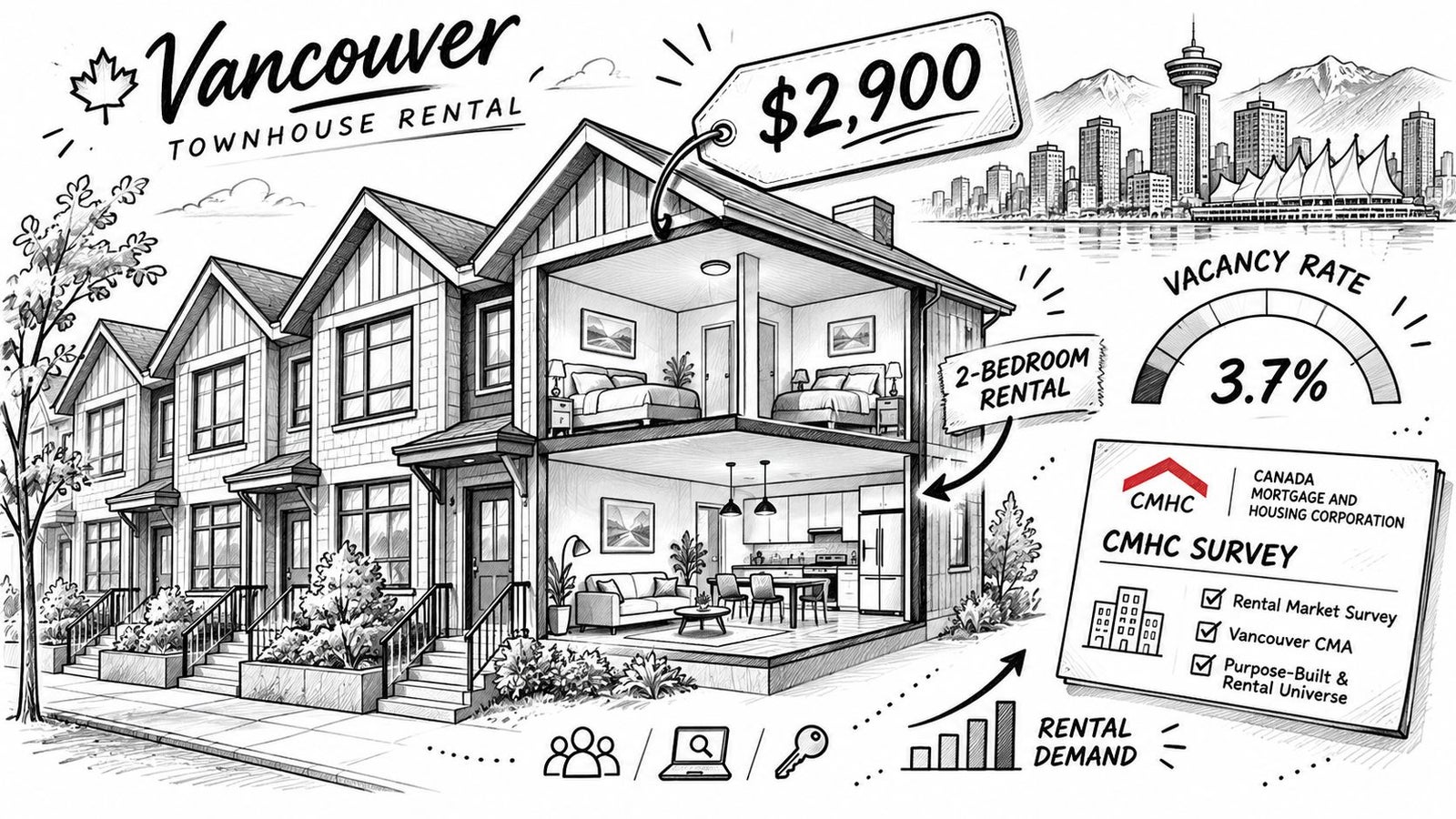
Those series are regional, not a forecast for one townhouse. Use them as a demand benchmark, then price the unit you are buying. At $2,900 a month, annual gross rent is $34,800.
At $2,900 in monthly rent, annual gross rent is $34,800. The simple gross yield varies by purchase benchmark:
One vacant month costs $2,900. That's one-twelfth of $34,800. Three empty months remove a quarter of gross income before a single bill is paid. A 3.7% vacancy rate is not a crisis, but it is not zero either, and a townhouse that takes longer to lease than a purpose-built apartment can sit past that average.
A townhouse can still be a good rental when owner-occupier demand is strong, the neighbourhood has durable employment and transit, and your appreciation expectations stay modest. Gross yield is only the starting line. At the October 2025 benchmark, 3.3% arrives before mortgage interest, strata fees, property tax, insurance, repairs, vacancy, management, and closing costs. Run those lines on the specific unit. A cheaper listing with a weak reserve can lose to a dearer one whose fees already fund the work.
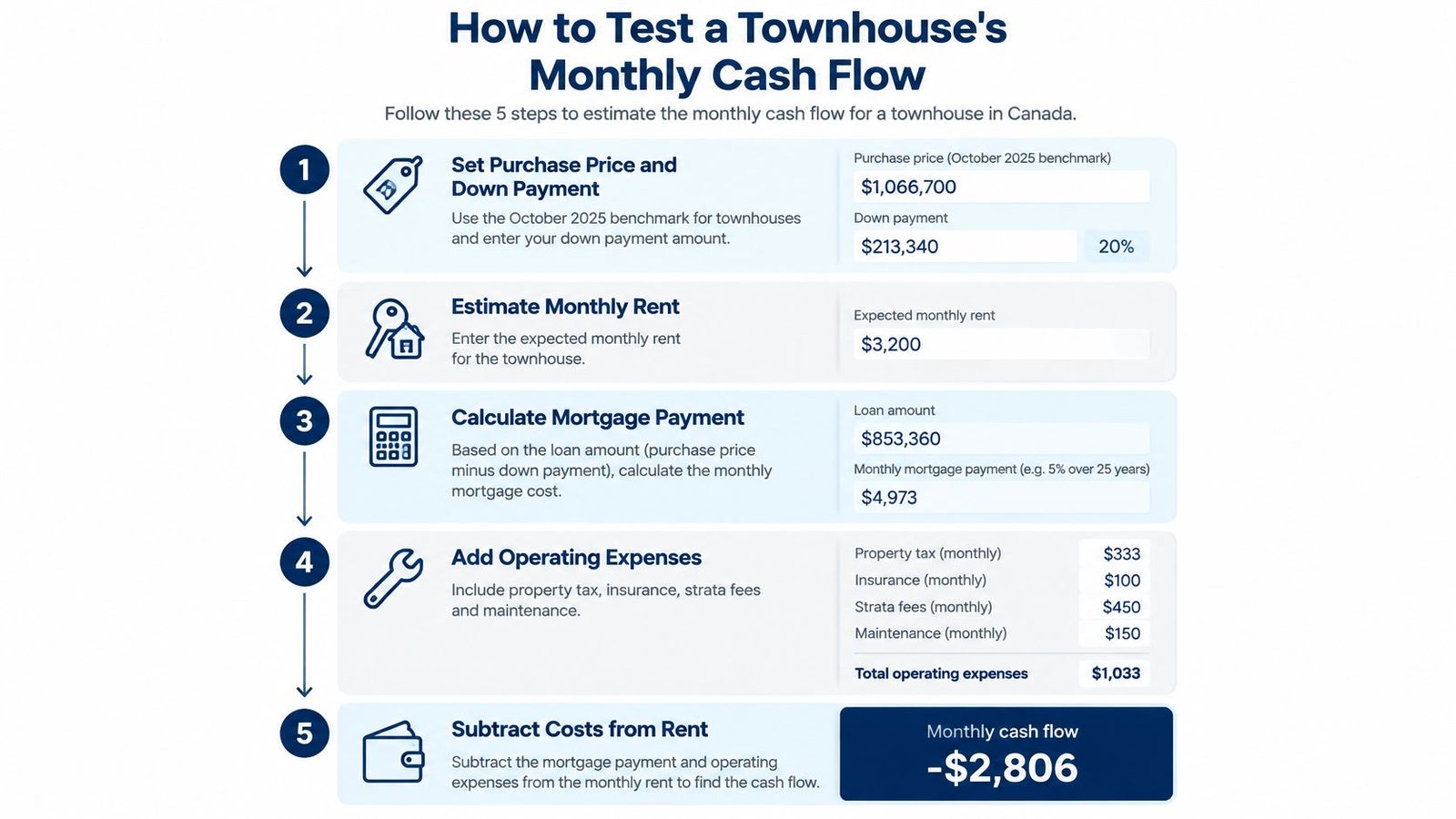
Gross yield misleads because $34,800 of rent is only about 3.3% of an October 2025 benchmark price, and none of the bills have been paid yet. The test below uses $1,066,700 as a sample purchase price so you can see the shape of the math, then you swap in the listing.
A 4% decline on a $700,000 property is $28,000 of paper value gone before selling costs. With 20% equity, that is about 20% of the original equity, ignoring principal repayment. The same arithmetic scales straight onto a benchmark purchase.
BC Assessment's 2026 Lower Mainland figures show median assessed values for strata homes, including condos and townhouses, falling from $798,000 to $772,000 in the City of Vancouver, from $732,000 to $706,000 in Burnaby, and from $727,000 to $699,000 in Coquitlam, declines of roughly 3% to 4%. These are assessment benchmarks, not sale prices. They are still a reason to stop assuming next year's price will be higher.
On a $1,066,700 townhouse, 20% down is $213,340. The table shows how much of that cheque a price drop consumes, before commission.
4% decline (assessment-style move): Consumes 20% of the original 20% down payment.
5% decline: Consumes 25% of the down payment.
10% decline: Consumes 50% of the down payment.
Model at least a 5% to 10% price decline, a renewal at a higher rate, a strata levy, and vacancy-tax exposure before you decide the purchase works. British Columbia's speculation and vacancy tax applies annually to qualifying residential properties in designated taxable areas, and the rate charged depends on the owner's residency and how their income is taxed. Foreign owners and owners whose income goes largely untaxed in Canada pay a meaningfully higher rate than Canadian residents who declare their income here. Eligibility and exemptions turn on occupancy and personal circumstances, so confirm your status before you buy. An empty unit that fails an exemption doesn't just lose rent. It can owe a tax calculated on the property's value, which stacks on top of the carrying costs the vacancy already created.
Treat refinancing as its own line in the model. If the payment jumps at renewal and the stressed rent case is already negative, you need cash reserves of your own, separate from the strata's contingency fund. Those are two different piles of money, and only one of them is yours. The contingency fund pays for the building's roof. Your reserve pays your mortgage when the rent doesn't.
Run the worst case. A buyer who cannot fund the renewal payment, the levy, and a vacant month at the same time has no margin for error, whatever the long-term price trend says.
The same townhouse is a different investment depending on who holds it and for how long. Match the row, then read the risk as a filter, not a slogan.
Owner-occupier who may rent later: Offers a place to live and a hedge against housing costs, but future rent may not cover ownership costs.
Pure rental investor: Fits only if the stressed cash-flow case is positive. Otherwise, a monthly loss turns the purchase into a bet on price growth.
Long-horizon holder (ten years or more): Better aligned with the long appreciation pattern, though market cycles can still interrupt it.
Short-term buyer (two or three years): A weak fit because transaction costs and softer prices may be hard to recover.
Owner-occupier. You gain a place to live and a hedge against rent you would otherwise pay a landlord. Don't justify the purchase with rental income alone, because a later lease may not cover the mortgage and fees. If you compare this path with a strata apartment, the guide to buying a condo for investment in Vancouver is the side-by-side on a different ownership structure.
The cost most price comparisons skip is the special levy. Say Owner A saves $150 a month in strata fees against a neighbouring complex, $1,800 a year. A $12,000 levy erases about 6.7 years of that saving in a single cheque.
That $12,000 isn't a guess pulled from thin air. Under the Strata Property Act, as set out in the province's guide to special levies, a levy allocated by the usual statutory methods generally needs a 3/4 vote at an annual or special general meeting. If the levy is divided another way, it needs unanimous approval. The resolution must identify the project, the total levy, the allocation method, and each strata lot's amount. If a complex approves a $600,000 roof replacement and your unit-entitlement share is 2%, the indicative levy is $12,000, subject to the exact allocation. Put that figure in the cash-flow model as an investment expense. It isn't inside the monthly fee.
For a British Columbia strata with five or more lots, the depreciation report requirements make the report a core investment document. It projects major common-property maintenance, repair, and replacement over 30 years. Since July 1, 2024, these strata corporations generally must obtain a report on a five-year cycle and can no longer avoid it through an annual 3/4 vote. The report must include a physical inventory, expected costs, assumptions such as inflation and interest rates, and at least three funding models.
Read which model the complex is using. A future roof, siding, balcony, drainage, or road project might be funded from the contingency reserve, from higher fees, from borrowing, or from a levy. A weak reserve plus large upcoming work cuts the net return even when the asking price looks fair. On a bare-land or townhouse strata, shared roads and utilities are easy to miss because they aren't inside the unit.
Water is one of the repairs that shows up late. If minutes mention a claim, a practical homeowner guide to assessing flood damage helps you tell a dried-out stain from a repair the reserve hasn't funded.
Pre-offer checks
Request the depreciation report and set it beside the current budget, the financial statements, and the contingency reserve balance. Note which funding model the strata is following, not just the one that looks cheapest.
Read the last year of meeting minutes, the Form B, and correspondence on proposed projects. The Form B information certificate is where approved levies and arrears are supposed to surface.
Check insurance claims and deductibles. A high deductible can turn a "covered" loss into an owner assessment.
Ask whether any levy is approved or pending. Confirm in the purchase contract whether it has been paid, assigned, or negotiated before you remove subjects.
Rerun the worksheet with your projected share of major work. If the stressed case flips from positive to negative, the price isn't attractive anymore.
A lower monthly fee isn't cheaper ownership when the strata has deferred the work. Clients we sit down with include first-time homebuyers, seasoned investors, and homeowners looking to sell, and the document pile is the same for a townhouse as for the condos, townhouses, single detached homes, and pre-sales we help people buy or sell. The first step is a discovery meeting, where you share the plan and test whether timing and market conditions match the goal.
Bring the worksheet, the depreciation report, the Form B, and your lender quote to that meeting with Jacky Levi, a licensed REALTOR and Associate Broker with Sotheby's International Realty Canada, at jackylevi.com. We'll review the numbers and the strata documents against your budget before an offer goes in.
Jacky Levi - Vancouver Realtor advises buyers and investors on Greater Vancouver townhouses with MLS-based pricing, offer strategy, and a clear read of carrying costs before you commit. If you're weighing a townhouse against your hold period and your monthly budget, start with the worksheet and the strata documents rather than a headline price. Visit Jacky Levi - Vancouver Realtor to book a discovery meeting and test the purchase against your numbers.
That verdict runs against the habit of treating attached homes as a smaller version of a detached-house bet. A larger floor plan and family appeal don't automatically produce a better return. You may be buying more expensive space, paying only modestly higher rent, and still carrying the full weight of financing, fees, and a repair the strata hasn't funded yet. The useful test is whether the unit pays its way while you own it, and whether the documents show the next roof, drainage job, or road repair is already paid for.
The Short Answer on Townhouse Returns in Metro Vancouver
Prices are falling while rents carry the case. That single fact shapes every return calculation a townhouse buyer runs in Metro Vancouver today.
- March 2025 benchmark: $1,113,100, down 0.8% from March 2024.
- June 2025 benchmark: $1,103,900, down 3.0% year over year.
- October 2025 benchmark: $1,066,700, down 3.8% year over year.
- Five-year change to June 2025: +38.2% compared with five years earlier.
- Ten-year change to June 2025: +111.6% compared with ten years earlier.
The Greater Vancouver REALTORS June 2025 statistics package puts the benchmark townhouse price at $1,113,100 in March 2025, down 0.8% from March 2024, and at $1,103,900 in June 2025, a 3.0% year-over-year decrease. That same package shows the June 2025 townhouse price index 38.2% higher than five years earlier and 111.6% higher than ten years earlier. The October 2025 statistics package then records the benchmark at $1,066,700, down 3.8% year over year.
Read those figures together and the pattern matters more than any single month. The long-run index rewards patience across a decade, yet the market has been falling through 2025. A representative townhouse valued at $800,000 ten years ago would correspond to about $1.69 million at that historical index rate, though the result still turns on municipality, neighbourhood, age, size, strata quality, and renovation condition. That compounding sits in the past. A purchase made today starts at a declining benchmark, which means the monthly carry has to work on its own.
The slide hasn't reversed. The Greater Vancouver REALTORS March 2026 statistics package shows the townhouse benchmark at $1,047,100 in March 2026, still down 5.7% year over year.
Say you bought at the June 2025 benchmark of $1,103,900. You don't break even on a monthly basis until rent, or a realistic slice of appreciation, covers the mortgage, strata fees, tax, insurance, and upkeep. The price you pay matters as much as the market's direction. Transaction costs, property taxes, insurance, maintenance, and strata fees can wipe out a paper gain, and the strata's own balance sheet belongs in that calculation: an unfunded major repair enters your return the day you buy, whatever the market does. Entry tax is part of the bill as well, and the property transfer tax in BC guide shows how it lands on the price on the contract.
Practical rule: Hold for seven to ten years, confirm that rent plus realistic appreciation beats total carrying costs, and check that the strata reserve can fund the next major repair. If any answer is no, you're buying a price-growth story.
Price change isn't the same thing as money left after costs. A clear method for evaluating total ROI on rentals keeps the monthly result and the resale result in the same calculation.
Rental Demand and Gross Yield in Vancouver
Demand is real, and so is the rent gap against the purchase price. CMHC's Vancouver rental market reporting shows the average rent for a two-bedroom unit in the 2025 survey was $2,900, while the purpose-built rental vacancy rate was 3.7%. Earlier CMHC figures show Vancouver average occupied apartment rents rising from $995 in 2014 to $2,373 in 2022, an increase of about 138% over eight years. The 2022 vacant-unit average was $1,658.
Those series are regional, not a forecast for one townhouse. Use them as a demand benchmark, then price the unit you are buying. At $2,900 a month, annual gross rent is $34,800.
At $2,900 in monthly rent, annual gross rent is $34,800. The simple gross yield varies by purchase benchmark:
- March 2025 ($1,113,100): 3.1% gross yield.
- June 2025 ($1,103,900): 3.2% gross yield.
- October 2025 ($1,066,700): 3.3% gross yield.
What one empty month does
One vacant month costs $2,900. That's one-twelfth of $34,800. Three empty months remove a quarter of gross income before a single bill is paid. A 3.7% vacancy rate is not a crisis, but it is not zero either, and a townhouse that takes longer to lease than a purpose-built apartment can sit past that average.
A townhouse can still be a good rental when owner-occupier demand is strong, the neighbourhood has durable employment and transit, and your appreciation expectations stay modest. Gross yield is only the starting line. At the October 2025 benchmark, 3.3% arrives before mortgage interest, strata fees, property tax, insurance, repairs, vacancy, management, and closing costs. Run those lines on the specific unit. A cheaper listing with a weak reserve can lose to a dearer one whose fees already fund the work.
How to Test a Townhouse's Monthly Cash Flow
Gross yield misleads because $34,800 of rent is only about 3.3% of an October 2025 benchmark price, and none of the bills have been paid yet. The test below uses $1,066,700 as a sample purchase price so you can see the shape of the math, then you swap in the listing.
- Set the purchase price and the down payment. You need a real contract price, not a wish. Use the October 2025 benchmark of $1,066,700 only as the sample, then replace it with the MLS price and the comparables. The down payment sets the loan, and the loan sets almost everything else.
- Estimate monthly mortgage interest from a lender quote. A headline rate hides the term, the amortization, and the stress test your lender will use. Ask for the payment on your down payment and your amortization, and write down the interest portion separately from principal.
- Add strata fees, property tax, insurance, and a maintenance allowance. These are ownership costs whether the unit is rented or not. Pull strata fees from the current budget, tax from the municipal notice, and insurance from the strata summary plus your own quote. Our property tax guide for Vancouver homeowners is the place to read the notice before you annualize it.
- Apply a vacancy allowance, then deduct it from gross rent. A 3.7% purpose-built vacancy rate is a reasonable first haircut on $2,900 a month. If the unit is older or harder to show, use a larger allowance. Adjusted rent is what you can spend, not the asking rent on a listing site.
- Subtract every cost from adjusted rent and compare the result with zero. A positive number means the unit carries itself this month. A negative number means you are writing a cheque each month and hoping resale makes it back.
- Rerun the test with rent 10% lower and mortgage interest one percentage point higher. This is the stressed case. If it is still negative, the property needs appreciation to justify the purchase, and you have to decide whether that risk is acceptable before you write an offer.
Purchase price: Use the current MLS listing and comparable sales. Example: $1,066,700 (October 2025 benchmark).
Mortgage interest: Get a written lender quote for your down payment, term, and amortization.
Monthly rent: Check comparable rentals and CMHC rental data. Example: $2,900 (two-bedroom average).
Vacancy allowance: Use the local rental vacancy rate. Example: 3.7% (purpose-built rental).
Strata fees: Check the current budget and financial statements for this strata lot's monthly fee.
Property tax: Divide the unit's latest municipal tax bill by 12.
Insurance: Check the strata insurance summary and get a personal quote for the deductible and your contents coverage.
Maintenance and reserves: Use the depreciation report and reserve balance to estimate your share of the next funded repair.
Selling costs: Get agent and legal estimates for commission and legal fees at resale.
If the stressed case is negative, stop calling the townhouse a cash-flow investment. It is an appreciation bet, and you should only take it if you can fund the monthly shortfall for years.
Stress-Testing a Price Drop and Vacancy Tax
A 4% decline on a $700,000 property is $28,000 of paper value gone before selling costs. With 20% equity, that is about 20% of the original equity, ignoring principal repayment. The same arithmetic scales straight onto a benchmark purchase.
BC Assessment's 2026 Lower Mainland figures show median assessed values for strata homes, including condos and townhouses, falling from $798,000 to $772,000 in the City of Vancouver, from $732,000 to $706,000 in Burnaby, and from $727,000 to $699,000 in Coquitlam, declines of roughly 3% to 4%. These are assessment benchmarks, not sale prices. They are still a reason to stop assuming next year's price will be higher.
On a $1,066,700 townhouse, 20% down is $213,340. The table shows how much of that cheque a price drop consumes, before commission.
4% decline (assessment-style move): Consumes 20% of the original 20% down payment.
5% decline: Consumes 25% of the down payment.
10% decline: Consumes 50% of the down payment.
What else belongs in the model
Model at least a 5% to 10% price decline, a renewal at a higher rate, a strata levy, and vacancy-tax exposure before you decide the purchase works. British Columbia's speculation and vacancy tax applies annually to qualifying residential properties in designated taxable areas, and the rate charged depends on the owner's residency and how their income is taxed. Foreign owners and owners whose income goes largely untaxed in Canada pay a meaningfully higher rate than Canadian residents who declare their income here. Eligibility and exemptions turn on occupancy and personal circumstances, so confirm your status before you buy. An empty unit that fails an exemption doesn't just lose rent. It can owe a tax calculated on the property's value, which stacks on top of the carrying costs the vacancy already created.
A 10% drop consumes half the down payment on paper. Principal you have repaid doesn't erase that if you have to sell into the lower price.
Treat refinancing as its own line in the model. If the payment jumps at renewal and the stressed rent case is already negative, you need cash reserves of your own, separate from the strata's contingency fund. Those are two different piles of money, and only one of them is yours. The contingency fund pays for the building's roof. Your reserve pays your mortgage when the rent doesn't.
Run the worst case. A buyer who cannot fund the renewal payment, the levy, and a vacant month at the same time has no margin for error, whatever the long-term price trend says.
Which Townhouse Investor Profile Fits Best
The same townhouse is a different investment depending on who holds it and for how long. Match the row, then read the risk as a filter, not a slogan.
Owner-occupier who may rent later: Offers a place to live and a hedge against housing costs, but future rent may not cover ownership costs.
Pure rental investor: Fits only if the stressed cash-flow case is positive. Otherwise, a monthly loss turns the purchase into a bet on price growth.
Long-horizon holder (ten years or more): Better aligned with the long appreciation pattern, though market cycles can still interrupt it.
Short-term buyer (two or three years): A weak fit because transaction costs and softer prices may be hard to recover.
Owner-occupier. You gain a place to live and a hedge against rent you would otherwise pay a landlord. Don't justify the purchase with rental income alone, because a later lease may not cover the mortgage and fees. If you compare this path with a strata apartment, the guide to buying a condo for investment in Vancouver is the side-by-side on a different ownership structure.
Strata Reserves, Levies and Pre-Offer Checks
The cost most price comparisons skip is the special levy. Say Owner A saves $150 a month in strata fees against a neighbouring complex, $1,800 a year. A $12,000 levy erases about 6.7 years of that saving in a single cheque.
That $12,000 isn't a guess pulled from thin air. Under the Strata Property Act, as set out in the province's guide to special levies, a levy allocated by the usual statutory methods generally needs a 3/4 vote at an annual or special general meeting. If the levy is divided another way, it needs unanimous approval. The resolution must identify the project, the total levy, the allocation method, and each strata lot's amount. If a complex approves a $600,000 roof replacement and your unit-entitlement share is 2%, the indicative levy is $12,000, subject to the exact allocation. Put that figure in the cash-flow model as an investment expense. It isn't inside the monthly fee.
What the depreciation report forces into the math
For a British Columbia strata with five or more lots, the depreciation report requirements make the report a core investment document. It projects major common-property maintenance, repair, and replacement over 30 years. Since July 1, 2024, these strata corporations generally must obtain a report on a five-year cycle and can no longer avoid it through an annual 3/4 vote. The report must include a physical inventory, expected costs, assumptions such as inflation and interest rates, and at least three funding models.
Read which model the complex is using. A future roof, siding, balcony, drainage, or road project might be funded from the contingency reserve, from higher fees, from borrowing, or from a levy. A weak reserve plus large upcoming work cuts the net return even when the asking price looks fair. On a bare-land or townhouse strata, shared roads and utilities are easy to miss because they aren't inside the unit.
Water is one of the repairs that shows up late. If minutes mention a claim, a practical homeowner guide to assessing flood damage helps you tell a dried-out stain from a repair the reserve hasn't funded.
Pre-offer checks
Request the depreciation report and set it beside the current budget, the financial statements, and the contingency reserve balance. Note which funding model the strata is following, not just the one that looks cheapest.
Read the last year of meeting minutes, the Form B, and correspondence on proposed projects. The Form B information certificate is where approved levies and arrears are supposed to surface.
Check insurance claims and deductibles. A high deductible can turn a "covered" loss into an owner assessment.
Ask whether any levy is approved or pending. Confirm in the purchase contract whether it has been paid, assigned, or negotiated before you remove subjects.
Rerun the worksheet with your projected share of major work. If the stressed case flips from positive to negative, the price isn't attractive anymore.
A lower monthly fee isn't cheaper ownership when the strata has deferred the work. Clients we sit down with include first-time homebuyers, seasoned investors, and homeowners looking to sell, and the document pile is the same for a townhouse as for the condos, townhouses, single detached homes, and pre-sales we help people buy or sell. The first step is a discovery meeting, where you share the plan and test whether timing and market conditions match the goal.
Bring the worksheet, the depreciation report, the Form B, and your lender quote to that meeting with Jacky Levi, a licensed REALTOR and Associate Broker with Sotheby's International Realty Canada, at jackylevi.com. We'll review the numbers and the strata documents against your budget before an offer goes in.
Jacky Levi - Vancouver Realtor advises buyers and investors on Greater Vancouver townhouses with MLS-based pricing, offer strategy, and a clear read of carrying costs before you commit. If you're weighing a townhouse against your hold period and your monthly budget, start with the worksheet and the strata documents rather than a headline price. Visit Jacky Levi - Vancouver Realtor to book a discovery meeting and test the purchase against your numbers.