
The listing photos are booked, the storage locker is half empty, and then the strata manager sends the annual general meeting package. Somewhere in the minutes is a motion approving a special levy for balcony and building envelope work, and the number attached to your unit is larger than any renovation you've ever paid for.
Selling a condo with a special assessment in Vancouver isn't a separate problem you solve after you set the price. The levy is part of the property the buyer is buying, and the contract has to carry it. Two things decide almost everything: what the resolution says, and the date the transfer completes. Move a completion date by three weeks and a five-figure bill can shift from the seller's column to the buyer's.
The order that works is documents first, then the completion-date split, then pricing, then offer terms. Skipping straight to pricing is how sellers end up renegotiating in the final week of a 60-day completion.
Say you own a two-bedroom in Mount Pleasant and, six months before you decide to sell, your strata approves a $14,000 special levy for balcony and building envelope repairs. You've been paying it monthly; the scaffolding came down in the fall, and the balconies look new. The assumption most sellers make at that point is that the bill closed with the project. It didn't. A buyer's agent will ask for the levy resolution and the instalment schedule within a day of showing interest, and the conversation moves from finishes to who owes what on completion day.
In British Columbia, a special assessment is generally treated as a strata corporation special levy for an extraordinary expense such as a roof replacement, elevator upgrade or major repair, as the Province of British Columbia's guidance on special levies sets out. The resolution behind it must identify the project purpose, the total amount, the calculation method, each strata lot's share and the payment deadline, with instalment dates stated where applicable. None of that is informal. It's a structured obligation attached to your strata lot and recorded in the strata's own documents.
That's why a buyer's lender, the buyer's lawyer and the buyer's agent all fold it into the purchase-price conversation. Under section 109 of the BC Strata Property Act, when a levy was approved before conveyance, the seller owes the portion payable before the conveyance date and the buyer owes the portion payable on or after it. Your completion date and the levy's payment schedule can change the split even though the levy existed months before anyone wrote an offer. The same provincial guidance notes that buyers and sellers can negotiate their own arrangement, which makes the statute a starting point rather than a verdict.
Three questions to answer before your first showing:
Two surprises catch sellers repeatedly. The first is a levy approved at a council or general meeting after the listing goes live, which changes the price and the disclosure mid-campaign. The second is a proposed levy that council has discussed but never passed by resolution, which sellers describe to buyers as though it were already approved. Both create the same damage: a buyer who feels misled.
Your first move this week is to request the full strata file and confirm, in writing, whether the levy is proposed, approved or partly paid before you speak to a single buyer.
A buyer may question a levy figure when the Form B, resolution and strata ledger do not agree. Gather the file before listing, then update it as the sale progresses. A new resolution, revised balance or engineering report can affect the buyer's assessment of the property and the terms they are prepared to offer.
A strata sale may require the Form B Information Certificate, bylaws and rules, meeting minutes, financial statements, the annual budget, depreciation report, insurance information, strata plan and information on special levies. Prepare the paperwork alongside the home, not after the photographs. The same preparation applies to getting your home ready for sale.
Form B Information Certificate: Shows amounts currently owed and future payments for approved special levies. Get it from the strata manager. Check that the figures and payment dates match the current ledger and levy records.
Levy resolution: Shows the purpose, total amount, allocation method, each lot's share and payment dates. Get it from the strata manager or meeting records. Check that your share and instalment dates match the resolution.
Meeting minutes: Show discussion and decisions about the levy. Get them from the strata manager or council. Check whether the levy was approved or is still proposed.
Depreciation report: Shows reserve fund information and anticipated projects. Get it from the strata council. Note projects that could affect future costs.
Annual budget and financial statements: Show operating and reserve fund information. Get them from the strata council. Check the figures alongside planned work.
Insurance information: Shows building and common property coverage. Get it from the strata manager. Confirm the information is current.
Notices of litigation: Show information about open claims involving the strata corporation. Get them from the strata manager. Identify any claims that may affect the property.
Strata plan and bylaws: Show unit boundaries and rules on matters such as rentals, pets and use of the unit. Get them from the strata manager or Land Title Office. Check for rules relevant to a buyer's intended use.
Request Form B in writing from the strata manager and record the request date. The Province of BC's Form B guidance explains what the certificate covers, including future amounts payable for an approved special levy and their payment dates.
Request the levy resolution, meeting notice and minutes, then compare your lot's share and payment schedule with the strata ledger.
Put any mismatch in writing to the strata manager and request clarification. A verbal explanation will not resolve conflicting figures in the sale file.
Review the depreciation report and budget for planned projects and reserve fund information that could prompt buyer questions.
Check the insurance information, litigation notices and bylaws so you can provide the relevant records and address questions about the property's use.
Read the second row carefully, because it's where most sellers misjudge their exposure. With a completion date of 15 March, an instalment due 1 March is the seller's, and an instalment due 1 April belongs to the buyer, even though both instalments sit inside the same resolution.
The third row is the one that needs a lawyer. When a levy is approved after the purchase contract but before completion, BCFSA model wording contemplates crediting the buyer for the portion the buyer is legally obligated to pay, since the buyer had no vote on that approval.
The resolution itself tells you a lot about whether the number is fixed. A BC special-levy resolution must state the levy's purpose, the amount, the calculation method, each lot's amount and the payment dates, per section 108 of the Strata Property Act, which is how you know whether the money funds elevators, roofing, balconies or plumbing, and whether it's payable in one hit or over time. Before marketing, request the meeting notice, resolution, minutes, budget, invoices or engineering reports and the payment schedule. That bundle is what lets a buyer evaluate your price with facts.
Total levy share for the unit: $12,000, split by instalment timing.
Portion paid before completion: Seller, $4,000.
Balance due after completion: Buyer, $8,000.
Projected strata-fee increase over three years: Buyer, if the reserve fund is short.
Unresolved project risk: Buyer, if a second levy is approved.
The headline number is $12,000. The number the buyer weighs is the $8,000 balance plus financing, plus whatever the fees do, plus the chance of another levy. Price against the second figure.
Lower the list price by the buyer's exposure. The simplest route, and the one that shows up immediately in a buyer's mortgage pre-approval. It also gives away more than you may need to, because buyers discount risk more heavily than they discount a known instalment.
Offer a fixed credit at completion. You keep the headline price and hand over an agreed amount on the closing statement. It works well when your comparable sales support the list price and the levy is the only objection.
Pay the levy off before closing. Cleanest for the buyer and for their lender, and worth the arithmetic whenever the remaining balance is small relative to the price. It removes the objection entirely instead of negotiating over it.
If you want the pricing conversation walked through end to end, this covers the same ground:
The decision rule I'd apply: pick the option that keeps the buyer's total cost in line with comparable sales nearby, not the option that protects your headline number. Then write the chosen figure into the listing file so how you price the home rests on a documented number rather than a hunch. A competitive list price still comes from current market conditions and comparable listings in your area; the levy moves where inside that range you land.
A buyer reading a levy resolution asks one question before anything else: does this price already reflect the bill? Answer it before they ask. Provide the Form B, the resolution and the minutes before anyone writes an offer, and state in writing whether each levy is approved or only proposed. A verbal figure from a strata manager is not disclosure, and a buyer who discovers an approved levy later has grounds to reopen the price or walk.
When an offer arrives, the levy lives in specific clauses rather than in the general goodwill of the deal. The terms to review are the purchase price, deposit, completion date, possession date, adjustment date, buyer conditions, included and excluded items, additional terms, and the offer expiry.
Two of those deserve attention. The completion date sets the split. The adjustment date decides how strata fees and any levy instalments are prorated between you and the buyer.
Conditions matter just as much. If a buyer conditions the offer on financing, inspection or a review of strata documents, the transaction enters the subject or condition period, during which the buyer works to satisfy or waive those conditions by the specified deadlines. Once all conditions are removed or satisfied under the contract, the transaction can become a firm sale, after which it moves to conveyancing, completion and possession. The home selling process runs in that order, and a levy clause that isn't settled before conditions are removed becomes a completion-week argument.
A worked example. Your unit is listed at $1,050,000. An offer comes in at $1,020,000 with a clause asking you to cover the full $14,000 levy. Accepting costs you $44,000 against your list price and rewards the buyer for negotiating last. Refusing outright loses a buyer who is otherwise ready to proceed.
A counter at $1,035,000 with a $7,000 credit at completion and a 30-day strata review window usually closes the gap. You've shared the cost, the buyer has a written number their lender can see, and the levy stops being an open-ended risk.
Keep three habits. Never accept a levy figure that only exists in conversation, set the offer expiry long enough for a proper strata review, and bring in a lawyer the moment a levy clause is drafted, because the wording decides whether you've promised a credit, a price reduction or both.
Book the levy review before the listing goes live, not after the first offer lands. A strata manager needs days, not hours, to answer a question about an instalment reset, and a lawyer needs the resolution in front of them before they can draft a clause you'll live with.
Three actions this week:
Pull the full strata file and mark every document you're still missing. Write the levy split into a draft contract clause, even before you have a buyer, so the wording is tested while there's time to change it. Set the list price using the total exposure figure, not the outstanding balance.
Some practical habits make the rest of the process calmer. Book the review well before listing so a slow strata response doesn't cost you a week. Ask for any missing approval record in writing, since a gap in the minutes is a disclosure problem, not an administrative one. Keep one labelled file, update it after acceptance and again before completion, and treat every new strata email as something to file rather than something to remember.
Jacky Levi personally oversees each sale, communicating with prospective buyers and their Realtors and negotiating on the seller's behalf, so the levy conversation stays consistent from the first showing to the closing statement. Sellers also get a plain explanation of the documents involved, what they're being asked to sign, and when advice from a lawyer, notary or accountant is the right call rather than an optional extra.
Sellers who treat the assessment as a separate administrative matter spend the negotiation defending a number they never priced. Sellers who treat it as part of the property's contract walk into the offer conversation with the resolution, the schedule and the split already on paper.
Jacky Levi - Vancouver Realtor works with condo and townhome sellers across Greater Vancouver on exactly this sequence, from reading the strata file to writing the levy split into the contract before an offer is accepted. Sellers receive a detailed breakdown of expected selling costs so nothing lands as a surprise at closing, along with a walk-through of each stratum document and signature. Visit Jacky Levi - Vancouver Realtor to book a strata file and levy review before your listing goes live.
Selling a condo with a special assessment in Vancouver isn't a separate problem you solve after you set the price. The levy is part of the property the buyer is buying, and the contract has to carry it. Two things decide almost everything: what the resolution says, and the date the transfer completes. Move a completion date by three weeks and a five-figure bill can shift from the seller's column to the buyer's.
The order that works is documents first, then the completion-date split, then pricing, then offer terms. Skipping straight to pricing is how sellers end up renegotiating in the final week of a 60-day completion.
What a Special Levy Means When You Sell
Say you own a two-bedroom in Mount Pleasant and, six months before you decide to sell, your strata approves a $14,000 special levy for balcony and building envelope repairs. You've been paying it monthly; the scaffolding came down in the fall, and the balconies look new. The assumption most sellers make at that point is that the bill closed with the project. It didn't. A buyer's agent will ask for the levy resolution and the instalment schedule within a day of showing interest, and the conversation moves from finishes to who owes what on completion day.
In British Columbia, a special assessment is generally treated as a strata corporation special levy for an extraordinary expense such as a roof replacement, elevator upgrade or major repair, as the Province of British Columbia's guidance on special levies sets out. The resolution behind it must identify the project purpose, the total amount, the calculation method, each strata lot's share and the payment deadline, with instalment dates stated where applicable. None of that is informal. It's a structured obligation attached to your strata lot and recorded in the strata's own documents.
The levy follows the unit, not the owner
That's why a buyer's lender, the buyer's lawyer and the buyer's agent all fold it into the purchase-price conversation. Under section 109 of the BC Strata Property Act, when a levy was approved before conveyance, the seller owes the portion payable before the conveyance date and the buyer owes the portion payable on or after it. Your completion date and the levy's payment schedule can change the split even though the levy existed months before anyone wrote an offer. The same provincial guidance notes that buyers and sellers can negotiate their own arrangement, which makes the statute a starting point rather than a verdict.
Three questions to answer before your first showing:
- How much is still owed on your unit's share, in dollars, as of today.
- When each instalment falls due, including any final payment at the end of the schedule.
- Who pays which instalment, given the completion date you're aiming for.
Practical rule: if you can't answer all three in writing, you aren't ready to price the unit, and you certainly aren't ready to accept an offer.
Two surprises catch sellers repeatedly. The first is a levy approved at a council or general meeting after the listing goes live, which changes the price and the disclosure mid-campaign. The second is a proposed levy that council has discussed but never passed by resolution, which sellers describe to buyers as though it were already approved. Both create the same damage: a buyer who feels misled.
Your first move this week is to request the full strata file and confirm, in writing, whether the levy is proposed, approved or partly paid before you speak to a single buyer.
Gather the Strata Documents Before You List
A buyer may question a levy figure when the Form B, resolution and strata ledger do not agree. Gather the file before listing, then update it as the sale progresses. A new resolution, revised balance or engineering report can affect the buyer's assessment of the property and the terms they are prepared to offer.
A strata sale may require the Form B Information Certificate, bylaws and rules, meeting minutes, financial statements, the annual budget, depreciation report, insurance information, strata plan and information on special levies. Prepare the paperwork alongside the home, not after the photographs. The same preparation applies to getting your home ready for sale.
The documents and what each one shows
Form B Information Certificate: Shows amounts currently owed and future payments for approved special levies. Get it from the strata manager. Check that the figures and payment dates match the current ledger and levy records.
Levy resolution: Shows the purpose, total amount, allocation method, each lot's share and payment dates. Get it from the strata manager or meeting records. Check that your share and instalment dates match the resolution.
Meeting minutes: Show discussion and decisions about the levy. Get them from the strata manager or council. Check whether the levy was approved or is still proposed.
Depreciation report: Shows reserve fund information and anticipated projects. Get it from the strata council. Note projects that could affect future costs.
Annual budget and financial statements: Show operating and reserve fund information. Get them from the strata council. Check the figures alongside planned work.
Insurance information: Shows building and common property coverage. Get it from the strata manager. Confirm the information is current.
Notices of litigation: Show information about open claims involving the strata corporation. Get them from the strata manager. Identify any claims that may affect the property.
Strata plan and bylaws: Show unit boundaries and rules on matters such as rentals, pets and use of the unit. Get them from the strata manager or Land Title Office. Check for rules relevant to a buyer's intended use.
The order to pull them
Request Form B in writing from the strata manager and record the request date. The Province of BC's Form B guidance explains what the certificate covers, including future amounts payable for an approved special levy and their payment dates.
Request the levy resolution, meeting notice and minutes, then compare your lot's share and payment schedule with the strata ledger.
Put any mismatch in writing to the strata manager and request clarification. A verbal explanation will not resolve conflicting figures in the sale file.
Review the depreciation report and budget for planned projects and reserve fund information that could prompt buyer questions.
Check the insurance information, litigation notices and bylaws so you can provide the relevant records and address questions about the property's use.
A stale Form B can become a common reason for a deal to stall. For example, a certificate showing $3,200 remaining may no longer match the ledger if an instalment changes and the balance rises to $4,100. That $900 discrepancy can lead the buyer to question the rest of the paperwork.
Under section 108 of the Strata Property Act, the resolution sets out the levy's purpose, total amount, allocation method, each strata lot's share and payment dates. The required voting threshold depends on the allocation method. Check the resolution and meeting records to confirm the levy was approved and that your lot's amount and instalment schedule match the ledger.
Keep the documents together in a labelled digital or paper file before listing photos are taken. That gives you a clear record to draw on when buyers review the levy and ask how it affects the property's price and contract terms.
Buyer agents ask this before they ask about parking. Allocation follows timing, not who negotiated harder or who agreed to what at the showing. Under the statutory default, a levy approved before conveyance is split at the conveyance date: the seller carries the portion due before that date, the buyer carries the portion due on or after it, and the parties can contract for a different economic arrangement, as the Province of BC's special levy page confirms.
The cleanest way to explain the split to a seller is as a bill cut in two at the completion date.
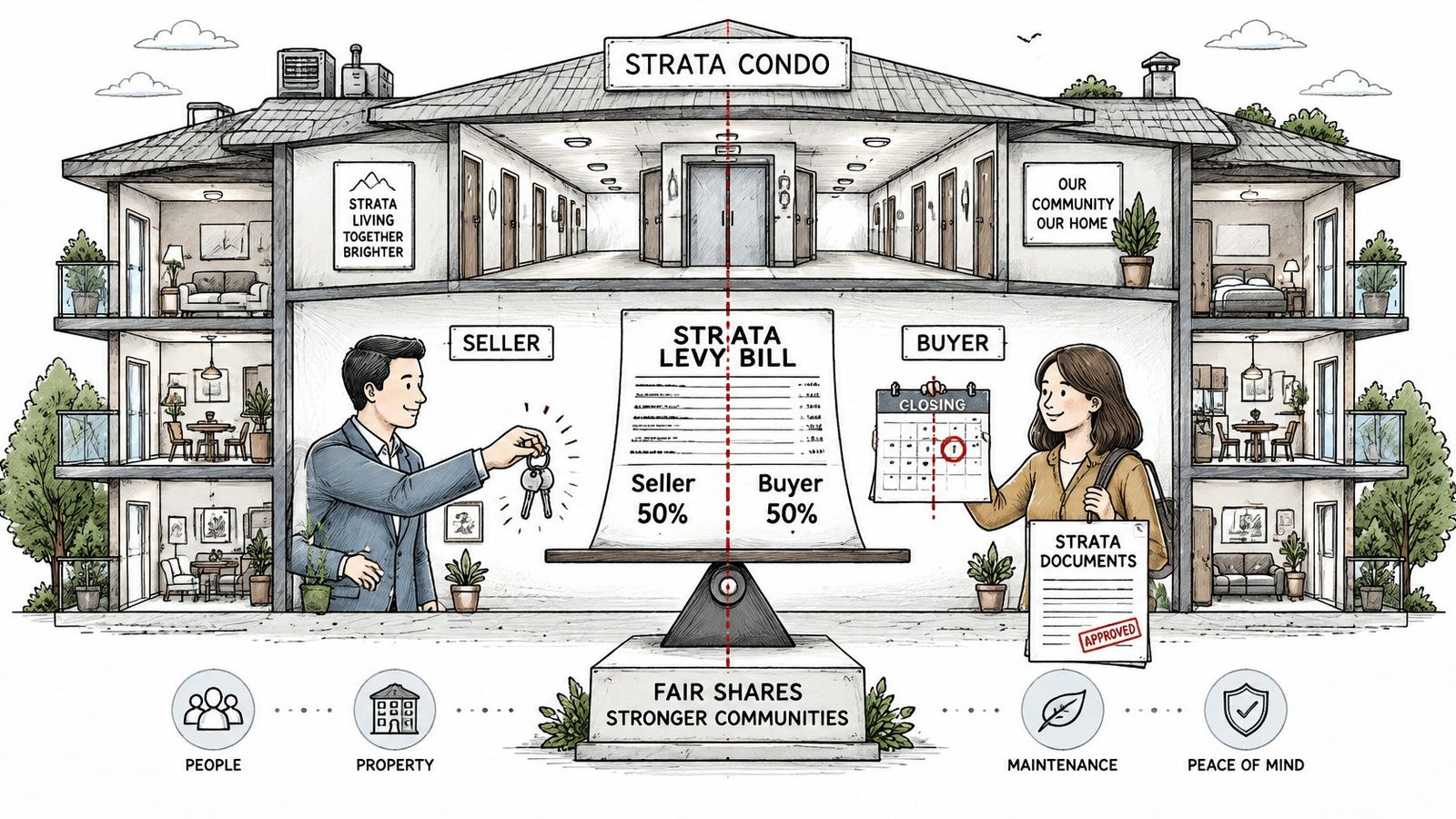
Approved before conveyance, instalment due before completion: The seller pays instalments due before the conveyance date; the buyer pays those due on or after it. State the split by date and each party's amount in the contract.
Approved before the purchase contract, instalments spanning completion: The seller pays the portion payable before conveyance; the buyer pays the portion payable on or after it. State the approval date and instalment schedule in the contract.
Approved after the contract, before completion: The seller pays amounts already due before conveyance. The buyer is credited for the amount they must later pay. State the credit or price adjustment and its amount in the contract.
Proposed but not yet approved: Neither party owes an approved levy amount yet. Disclose that the levy is proposed without claiming an approval date.
Refund issued after completion: The buyer receives the refund as the current owner when it is issued; the seller receives nothing. Include an express clause allocating the refund.
What the resolution must contain
Under section 108 of the Strata Property Act, the resolution sets out the levy's purpose, total amount, allocation method, each strata lot's share and payment dates. The required voting threshold depends on the allocation method. Check the resolution and meeting records to confirm the levy was approved and that your lot's amount and instalment schedule match the ledger.
Keep the documents together in a labelled digital or paper file before listing photos are taken. That gives you a clear record to draw on when buyers review the levy and ask how it affects the property's price and contract terms.
Who Pays the Levy at Completion
Buyer agents ask this before they ask about parking. Allocation follows timing, not who negotiated harder or who agreed to what at the showing. Under the statutory default, a levy approved before conveyance is split at the conveyance date: the seller carries the portion due before that date, the buyer carries the portion due on or after it, and the parties can contract for a different economic arrangement, as the Province of BC's special levy page confirms.
The cleanest way to explain the split to a seller is as a bill cut in two at the completion date.
Approved before conveyance, instalment due before completion: The seller pays instalments due before the conveyance date; the buyer pays those due on or after it. State the split by date and each party's amount in the contract.
Approved before the purchase contract, instalments spanning completion: The seller pays the portion payable before conveyance; the buyer pays the portion payable on or after it. State the approval date and instalment schedule in the contract.
Approved after the contract, before completion: The seller pays amounts already due before conveyance. The buyer is credited for the amount they must later pay. State the credit or price adjustment and its amount in the contract.
Proposed but not yet approved: Neither party owes an approved levy amount yet. Disclose that the levy is proposed without claiming an approval date.
Refund issued after completion: The buyer receives the refund as the current owner when it is issued; the seller receives nothing. Include an express clause allocating the refund.
Read the second row carefully, because it's where most sellers misjudge their exposure. With a completion date of 15 March, an instalment due 1 March is the seller's, and an instalment due 1 April belongs to the buyer, even though both instalments sit inside the same resolution.
The third row is the one that needs a lawyer. When a levy is approved after the purchase contract but before completion, BCFSA model wording contemplates crediting the buyer for the portion the buyer is legally obligated to pay, since the buyer had no vote on that approval.
What a clean sale package states
- The resolution date and whether the levy is approved, proposed or partly paid.
- The unit share in dollars, taken from the resolution, not from a memory of the meeting.
- The instalment schedule, with every due date that falls near completion.
- Payment responsibility by date, plus any credit or price adjustment and its amount.
- Refund treatment, since a refund generally goes to the current owner when issued.
- Any conveyancing holdback the lawyer recommends.
Four failures sink these deals: an undisclosed approved levy, a proposed levy treated as approved, future instalments left out of the contract, and a refund nobody allocated. Sellers who want to see where a credit lands on the closing statement should review Realtor commission and selling costs before they promise one.
Before completion, clear what you owe so the strata can issue Form F, which is generally required to register the transfer. Unpaid amounts often must be paid or otherwise arranged before Form F is issued, so have your lawyer confirm the Form F position with the strata manager in writing before the completion date is fixed.
Every seller asks the same question first: does the levy cut the list price, or can a credit solve it? Neither answer is honest until you've built the buyer's total exposure figure from the paperwork.
Before completion, clear what you owe so the strata can issue Form F, which is generally required to register the transfer. Unpaid amounts often must be paid or otherwise arranged before Form F is issued, so have your lawyer confirm the Form F position with the strata manager in writing before the completion date is fixed.
Price the Condo Around the Levy
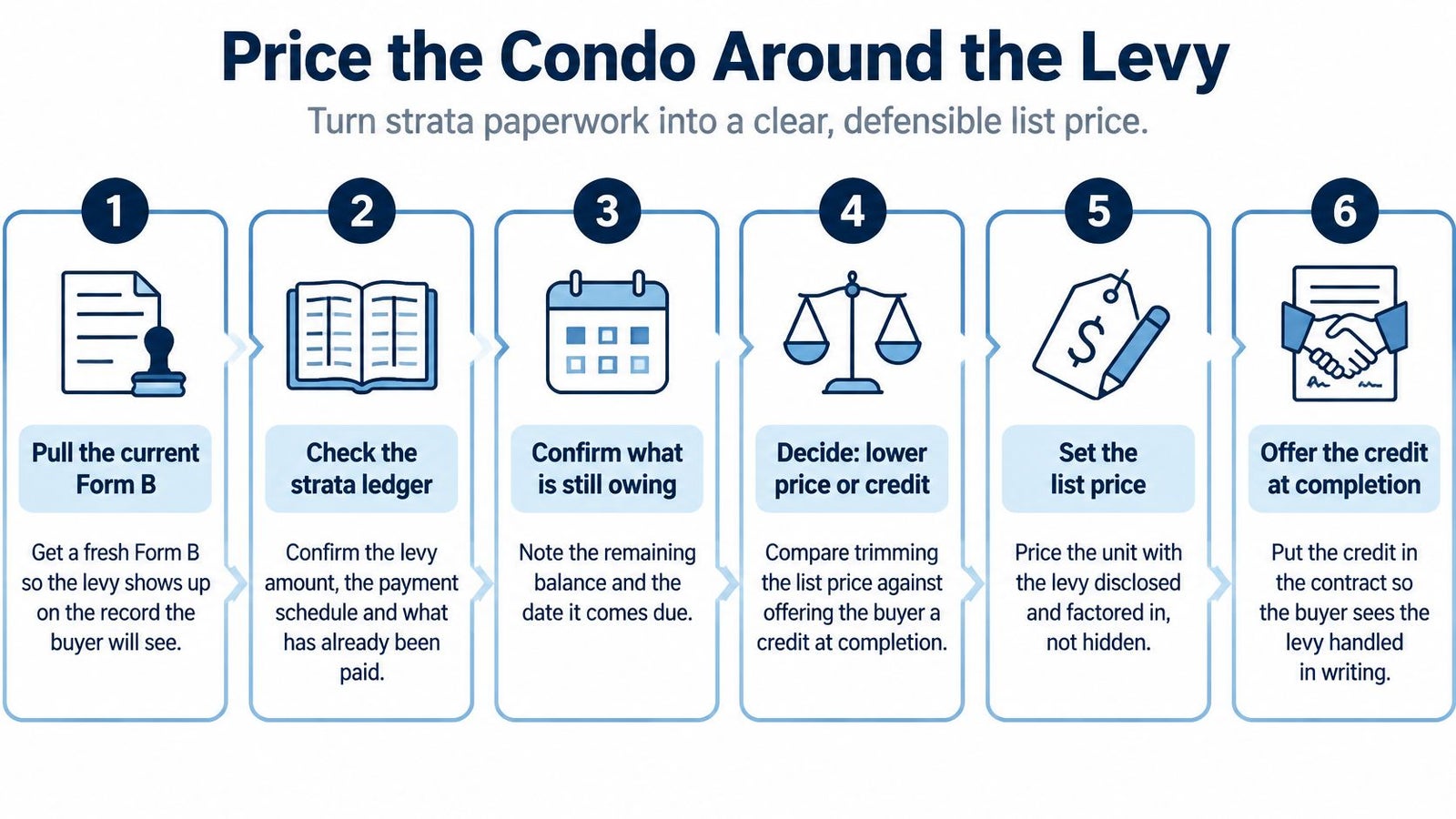
Every seller asks the same question first: does the levy cut the list price, or can a credit solve it? Neither answer is honest until you've built the buyer's total exposure figure from the paperwork.
The six steps
- Pull the current balance from the Form B and the strata ledger, and write down the instalment dates and your unit share.
- Separate the two halves. Your portion, paid before completion, is a cost you carry. The balance after completion is a cost the buyer carries.
- Add the buyer's financing cost on the remaining balance across the instalment period, since that money has a carrying cost even at low rates.
- Ask the strata manager about a projected strata-fee increase tied to a reserve shortfall, and record it as unknown if no answer comes back.
- Note unresolved project risk, such as pending litigation or a second levy already being discussed in minutes.
- Compare the total with recent Vancouver sales of comparable units, both with and without a levy attached.
The resolution itself tells you a lot about whether the number is fixed. A BC special-levy resolution must state the levy's purpose, the amount, the calculation method, each lot's amount and the payment dates, per section 108 of the Strata Property Act, which is how you know whether the money funds elevators, roofing, balconies or plumbing, and whether it's payable in one hit or over time. Before marketing, request the meeting notice, resolution, minutes, budget, invoices or engineering reports and the payment schedule. That bundle is what lets a buyer evaluate your price with facts.
The arithmetic on a $12,000 share
Total levy share for the unit: $12,000, split by instalment timing.
Portion paid before completion: Seller, $4,000.
Balance due after completion: Buyer, $8,000.
Projected strata-fee increase over three years: Buyer, if the reserve fund is short.
Unresolved project risk: Buyer, if a second levy is approved.
The headline number is $12,000. The number the buyer weighs is the $8,000 balance plus financing, plus whatever the fees do, plus the chance of another levy. Price against the second figure.
Three ways to handle it at the price
Lower the list price by the buyer's exposure. The simplest route, and the one that shows up immediately in a buyer's mortgage pre-approval. It also gives away more than you may need to, because buyers discount risk more heavily than they discount a known instalment.
Offer a fixed credit at completion. You keep the headline price and hand over an agreed amount on the closing statement. It works well when your comparable sales support the list price and the levy is the only objection.
Pay the levy off before closing. Cleanest for the buyer and for their lender, and worth the arithmetic whenever the remaining balance is small relative to the price. It removes the objection entirely instead of negotiating over it.
If you want the pricing conversation walked through end to end, this covers the same ground:
The decision rule I'd apply: pick the option that keeps the buyer's total cost in line with comparable sales nearby, not the option that protects your headline number. Then write the chosen figure into the listing file so how you price the home rests on a documented number rather than a hunch. A competitive list price still comes from current market conditions and comparable listings in your area; the levy moves where inside that range you land.
Disclose the Levy and Negotiate Offers
A buyer reading a levy resolution asks one question before anything else: does this price already reflect the bill? Answer it before they ask. Provide the Form B, the resolution and the minutes before anyone writes an offer, and state in writing whether each levy is approved or only proposed. A verbal figure from a strata manager is not disclosure, and a buyer who discovers an approved levy later has grounds to reopen the price or walk.
The offer terms that carry the levy
When an offer arrives, the levy lives in specific clauses rather than in the general goodwill of the deal. The terms to review are the purchase price, deposit, completion date, possession date, adjustment date, buyer conditions, included and excluded items, additional terms, and the offer expiry.
Two of those deserve attention. The completion date sets the split. The adjustment date decides how strata fees and any levy instalments are prorated between you and the buyer.
Conditions matter just as much. If a buyer conditions the offer on financing, inspection or a review of strata documents, the transaction enters the subject or condition period, during which the buyer works to satisfy or waive those conditions by the specified deadlines. Once all conditions are removed or satisfied under the contract, the transaction can become a firm sale, after which it moves to conveyancing, completion and possession. The home selling process runs in that order, and a levy clause that isn't settled before conditions are removed becomes a completion-week argument.
A worked example. Your unit is listed at $1,050,000. An offer comes in at $1,020,000 with a clause asking you to cover the full $14,000 levy. Accepting costs you $44,000 against your list price and rewards the buyer for negotiating last. Refusing outright loses a buyer who is otherwise ready to proceed.
A counter at $1,035,000 with a $7,000 credit at completion and a 30-day strata review window usually closes the gap. You've shared the cost, the buyer has a written number their lender can see, and the levy stops being an open-ended risk.
Negotiation rule: never counter on the levy until the buyer's agent has the resolution in hand. Offers written without it are guesses, and guesses get withdrawn.
Keep three habits. Never accept a levy figure that only exists in conversation, set the offer expiry long enough for a proper strata review, and bring in a lawyer the moment a levy clause is drafted, because the wording decides whether you've promised a credit, a price reduction or both.
Book a Levy Review Before You List
Book the levy review before the listing goes live, not after the first offer lands. A strata manager needs days, not hours, to answer a question about an instalment reset, and a lawyer needs the resolution in front of them before they can draft a clause you'll live with.
Three actions this week:
Pull the full strata file and mark every document you're still missing. Write the levy split into a draft contract clause, even before you have a buyer, so the wording is tested while there's time to change it. Set the list price using the total exposure figure, not the outstanding balance.
Some practical habits make the rest of the process calmer. Book the review well before listing so a slow strata response doesn't cost you a week. Ask for any missing approval record in writing, since a gap in the minutes is a disclosure problem, not an administrative one. Keep one labelled file, update it after acceptance and again before completion, and treat every new strata email as something to file rather than something to remember.
Jacky Levi personally oversees each sale, communicating with prospective buyers and their Realtors and negotiating on the seller's behalf, so the levy conversation stays consistent from the first showing to the closing statement. Sellers also get a plain explanation of the documents involved, what they're being asked to sign, and when advice from a lawyer, notary or accountant is the right call rather than an optional extra.
The levy is part of the sale, not a bill beside it. Price it, contract it, and disclose it that way.
Sellers who treat the assessment as a separate administrative matter spend the negotiation defending a number they never priced. Sellers who treat it as part of the property's contract walk into the offer conversation with the resolution, the schedule and the split already on paper.
Jacky Levi - Vancouver Realtor works with condo and townhome sellers across Greater Vancouver on exactly this sequence, from reading the strata file to writing the levy split into the contract before an offer is accepted. Sellers receive a detailed breakdown of expected selling costs so nothing lands as a surprise at closing, along with a walk-through of each stratum document and signature. Visit Jacky Levi - Vancouver Realtor to book a strata file and levy review before your listing goes live.