A two-bedroom condo in Vancouver can cost about $3,590 a month to carry at the end of 2025, while the median two-bedroom rent was $2,300, according to the Canada Mortgage and Housing Corporation housing market outlook. That gap is why buying a condo in Vancouver is a five-year ownership budget, not a price on a listing. Property transfer tax, strata reserves and offer conditions belong on one checklist before you remove subjects.
On closing day, you need cash that never shows up in the down payment. For most Vancouver condos, property transfer tax is the largest single completion cost. You pay it when the transfer is registered, even if the purchase is financed.
British Columbia uses marginal rates. The Province's calculation examples set the tax at 1% on the first $200,000 and 2% on the portion above $200,000 up to $2 million. On a $475,000 purchase, that is $2,000 on the first $200,000 plus $5,500 on the remaining $275,000, for $7,500 before any first-time buyer exemption. When every eligibility condition is met, the exemption removes that $7,500.
Standard tax below uses those same marginal rates. The exemption column shows what a qualifying first-time buyer still has to plan for.
Read the rows in order. At $500,000 the standard tax is $8,000, and a fully eligible first-time buyer can clear it. At $750,000 the standard tax is $13,000, and the exemption caps at $8,000, so $5,000 is still due. At $835,000 the standard tax is $14,700 ($2,000 plus 2% of $635,000), and the same $8,000 cap leaves $6,700. The $850,000 row sits in the reduced band. Don't guess that figure. Your conveyancing lawyer calculates the proportional exemption.
The tax is separate from everything else you still fund on completion:
Then build the monthly side of the same five-year budget. A mortgage payment that looks fine can fail once you add strata fees, property tax, insurance deductibles, utilities and a possible special levy. Stress-test that full number against the CMHC carrying-cost gap above, and only then decide what you can offer.
Eligibility comes before any tax figure. British Columbia's First-Time Home Buyers' Program can eliminate property transfer tax on a qualifying principal residence priced at $500,000 or less. Above that, and up to $835,000, the maximum exemption is $8,000. Between more than $835,000 and less than $860,000, the exemption is reduced proportionally. Use the table in the previous section to see what remains. The bands don't change because a condo feels like a starter home.
You generally must be a Canadian citizen or permanent resident. You must have lived in British Columbia for at least one year immediately before registration, or filed at least two B.C. income-tax returns in the previous six taxation years. You must not have owned a principal residence anywhere in the world. A home you held overseas still counts.
The condo must become your principal residence. For the full eligibility range, fair market value is $835,000 or less, and the land is no larger than 0.5 hectares. A qualifying buyer of a $500,000 Vancouver condo may avoid the full tax. An $850,000 purchase receives only a partial exemption. Confirm both facts with your lawyer and file the exemption before completion. Our property transfer tax in B.C. page walks through how that filing sits beside the purchase contract.
The exemption follows the eligible share of the transfer, not the household story. The Province's current-amount guidance bases the amount on the percentage of the transfer that qualifies. If one buyer qualifies and the other doesn't, the exemption shrinks to that share. It doesn't wipe out the whole bill.
Say a couple buys a Vancouver condo and one partner previously owned a home abroad. Expect the exemption on the eligible share only. Fair market value, lot size, any non-residential improvements and the registration date also feed the calculation. Settle ownership percentages and each person's prior-ownership history before the transfer-tax declaration goes in. Changing title later can change the tax.
Answer these three questions today:
A pre-sale is a strata condo you buy on the open market well before the building is finished, usually at a price fixed in the contract. It is a condo path. Don't assume the same tax treatment you read for a townhouse or a detached house.
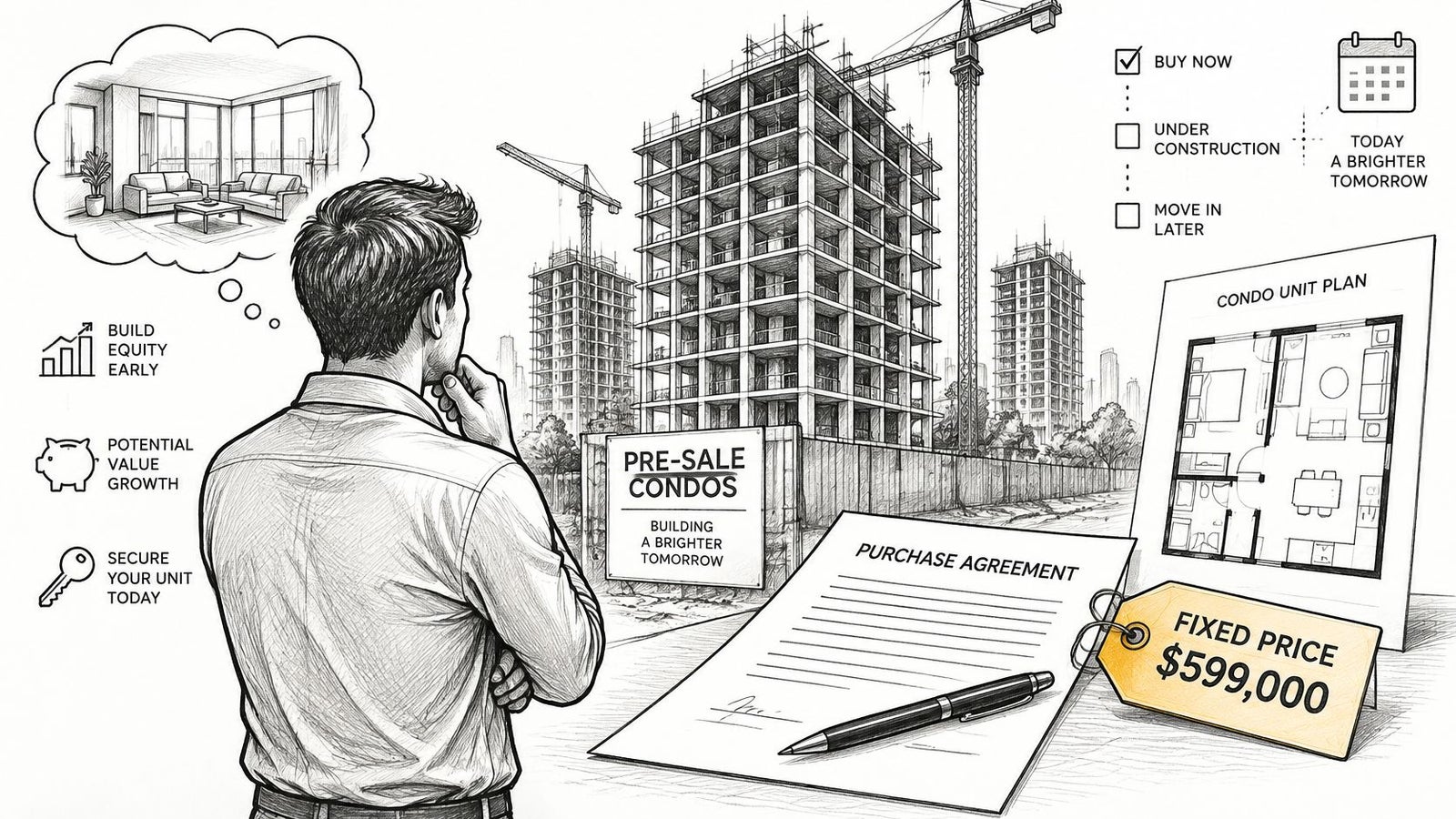
Buyers often think the tax is based on the deposit they wrote at the sales centre. It isn't. For a pre-sold strata condo, the Province's pre-sold strata guidance generally uses the total amount paid to acquire the property. The fair market value used for a first-time buyer exemption is that same total, not an early deposit and not the first contract estimate.
Say you sign a presale at $780,000 and pay deposits over several years. The figure for the tax analysis is the full $780,000 acquisition price. Eligibility and value are judged at registration, so estimate the completion price and the tax before you pay the next deposit.
Have the conveyancing lawyer read these four items before registration:
Pull the Form B, the report and the minutes together, then price your offer against the gap you find. You can browse listings by building so the document request is tied to a specific corporation, not a neighbourhood average. Don't remove subject conditions until those two core documents agree.
A fair offer starts with a benchmark, then leaves it behind. Greater Vancouver REALTORS® reported the Metro Vancouver apartment benchmark at $743,700 in July 2025, down 3.2% from July 2024, in its July market update. In August 2025, the same benchmark was $734,400, with 956 apartment-home sales, in the August update. By December 2025, it was $710,000, down 5.3% from December 2024, in the year-end release.

A benchmark describes a typical apartment in Metro Vancouver. It is not your unit, your floor plan or your building's reserve. The latest figure in this set is December 2025, so pull a current benchmark before you set a price. A softer benchmark doesn't mean every building got cheaper.
Listings on our site can be browsed across four areas: Vancouver (Westside), East Vancouver, North Vancouver and West Vancouver. Compare them on transit, how the floor plan works, building age and resale demand. A Westside one-bedroom beside a station and an Eastside two-bedroom in an older concrete building can carry very different five-year costs even when the benchmarks look close.
CMHC's 2025 rental market reporting for major centres shows a 1.5% vacancy rate for condominium apartments and an average two-bedroom condo rent of $2,900 a month. That is a tight regional market, and a reference point only. It is not income you can underwrite for one suite. Rents move with neighbourhood, size, age, furnishing, parking and strata rental limits. Read the bylaws before you treat rent as part of the offer math.
Before you bid, check four neighbourhood tests:
Pre-approval is the start, not the finish. Four decisions still shape the offer and the completion budget.
Down payment first. Decide the amount and where the money sits. A larger down payment shrinks the mortgage and can change what you must still hold back for tax, legal fees and a levy reserve. If the funds are coming from more than one account, confirm they will be in the lawyer's trust account before completion.
Then the qualifying rate. Lenders test affordability at a stress-test rate above your contract rate. A payment that feels comfortable on a rate sheet can still fail that test. Get the pre-approval in writing so the ceiling is a lender's number, not a calculator's.
Then the terms behind the rate. Compare prepayment privileges, term length and whether the rate is fixed or variable. A slightly higher rate with room to pay down principal can cost less over five years than a teaser rate you can't break.
Then the lender's own charges. Appraisal, legal and broker items belong in the completion estimate from the first section, not as a surprise on the statement.
Say you are targeting a $700,000 condo. You set the down payment, you hold a pre-approval, and you check that the stress-test payment still fits a month that includes strata fees and property tax. If it doesn't, lower the offer ceiling before you fall for a floor plan.
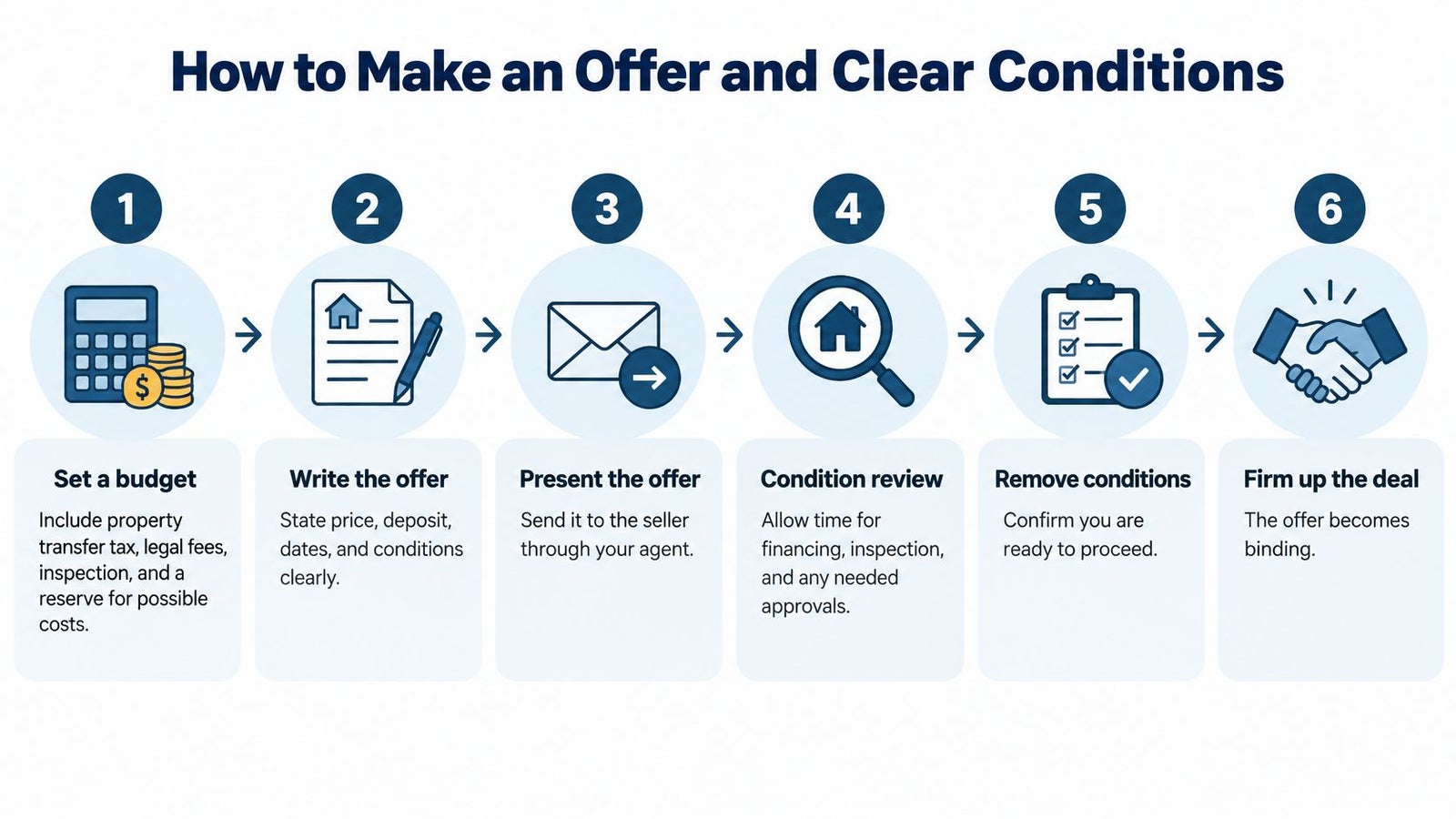
If you have conditions for financing, inspection or strata documents, the deal enters the subject or condition period. You satisfy or waive each condition by its deadline. Miss one, and you are either stuck or back at the start.
Set the full budget. Include property transfer tax, legal fees, the inspection and a reserve for a possible levy. Buyers who budget only the down payment arrive at completion short.
Lock the mortgage terms. Pre-approval should name the amount, the rate type and the date the commitment expires. Fintrack's guide to mortgage commitments is a clear read on what that letter promises, so you don't treat a rate quote as a commitment.
Submit and negotiate. Price, deposit, completion, possession and the conditions travel together. Don't trade away the document condition to win a small price cut.
A clean removal file is short and specific. Each condition is either satisfied or waived in writing, the financing matches the commitment, the inspection and strata review are done, and the lawyer has confirmed the tax and the funds. That is the moment the offer firms up. Not when you liked the view.

Book the consultation before the offer, not after you have waived subjects. The first step is a discovery meeting, where you share budget, target neighbourhoods and timing, and we test whether the market still fits those goals.
Before you book, confirm the realtor's licence and brokerage on the British Columbia Financial Services Authority register and on the website. Realtors in British Columbia are licensed and regulated by the BCFSA. Jacky Levi is a Vancouver Realtor and Associate Broker with more than 20 years in this market. Choosing a Vancouver realtor is worth reading so you know what to ask in that first hour.
Bring three things:
What a Vancouver Condo Costs Beyond the Price
On closing day, you need cash that never shows up in the down payment. For most Vancouver condos, property transfer tax is the largest single completion cost. You pay it when the transfer is registered, even if the purchase is financed.
British Columbia uses marginal rates. The Province's calculation examples set the tax at 1% on the first $200,000 and 2% on the portion above $200,000 up to $2 million. On a $475,000 purchase, that is $2,000 on the first $200,000 plus $5,500 on the remaining $275,000, for $7,500 before any first-time buyer exemption. When every eligibility condition is met, the exemption removes that $7,500.
Property transfer tax by purchase price
Standard tax below uses those same marginal rates. The exemption column shows what a qualifying first-time buyer still has to plan for.
- $475,000 purchase: Standard tax is $7,500. A qualifying first-time buyer receives a full exemption.
- $500,000 purchase: Standard tax is $8,000. A qualifying first-time buyer receives a full exemption.
- $750,000 purchase: Standard tax is $13,000. The maximum $8,000 exemption leaves $5,000 due.
- $835,000 purchase: Standard tax is $14,700. The maximum $8,000 exemption leaves $6,700 due.
- $850,000 purchase: Standard tax is $15,000. The exemption is reduced between $835,000 and $860,000; ask your lawyer to confirm the amount.
Read the rows in order. At $500,000 the standard tax is $8,000, and a fully eligible first-time buyer can clear it. At $750,000 the standard tax is $13,000, and the exemption caps at $8,000, so $5,000 is still due. At $835,000 the standard tax is $14,700 ($2,000 plus 2% of $635,000), and the same $8,000 cap leaves $6,700. The $850,000 row sits in the reduced band. Don't guess that figure. Your conveyancing lawyer calculates the proportional exemption.
The tax is separate from everything else you still fund on completion:
- Legal fees: the lawyer or notary who registers title and files the tax return.
- Inspection: a unit and building review while subjects are still open.
- Lender charges: appraisal, broker or lender fees that land on the completion statement.
- Strata adjustments: the seller's prepaid fees, which are prorated to your possession date.
- Insurance: your contents policy, plus any deductible exposure the strata summary reveals.
Practical rule: Ask the conveyancing lawyer for a written completion-cost estimate before you write an offer, so closing day isn't a scramble for funds.
Then build the monthly side of the same five-year budget. A mortgage payment that looks fine can fail once you add strata fees, property tax, insurance deductibles, utilities and a possible special levy. Stress-test that full number against the CMHC carrying-cost gap above, and only then decide what you can offer.
Who Qualifies for the First-Time Buyer Tax Exemption
Eligibility comes before any tax figure. British Columbia's First-Time Home Buyers' Program can eliminate property transfer tax on a qualifying principal residence priced at $500,000 or less. Above that, and up to $835,000, the maximum exemption is $8,000. Between more than $835,000 and less than $860,000, the exemption is reduced proportionally. Use the table in the previous section to see what remains. The bands don't change because a condo feels like a starter home.
Personal rules and property rules
You generally must be a Canadian citizen or permanent resident. You must have lived in British Columbia for at least one year immediately before registration, or filed at least two B.C. income-tax returns in the previous six taxation years. You must not have owned a principal residence anywhere in the world. A home you held overseas still counts.
The condo must become your principal residence. For the full eligibility range, fair market value is $835,000 or less, and the land is no larger than 0.5 hectares. A qualifying buyer of a $500,000 Vancouver condo may avoid the full tax. An $850,000 purchase receives only a partial exemption. Confirm both facts with your lawyer and file the exemption before completion. Our property transfer tax in B.C. page walks through how that filing sits beside the purchase contract.
When only one buyer qualifies
The exemption follows the eligible share of the transfer, not the household story. The Province's current-amount guidance bases the amount on the percentage of the transfer that qualifies. If one buyer qualifies and the other doesn't, the exemption shrinks to that share. It doesn't wipe out the whole bill.
Say a couple buys a Vancouver condo and one partner previously owned a home abroad. Expect the exemption on the eligible share only. Fair market value, lot size, any non-residential improvements and the registration date also feed the calculation. Settle ownership percentages and each person's prior-ownership history before the transfer-tax declaration goes in. Changing title later can change the tax.
Answer these three questions today:
- Have I ever owned a home anywhere in the world?
- Have I lived in B.C. for a year, or filed two B.C. returns in six years?
- Will this condo be my principal residence?
Pre-Sale Condos and the Total Purchase Price
A pre-sale is a strata condo you buy on the open market well before the building is finished, usually at a price fixed in the contract. It is a condo path. Don't assume the same tax treatment you read for a townhouse or a detached house.
Buyers often think the tax is based on the deposit they wrote at the sales centre. It isn't. For a pre-sold strata condo, the Province's pre-sold strata guidance generally uses the total amount paid to acquire the property. The fair market value used for a first-time buyer exemption is that same total, not an early deposit and not the first contract estimate.
Say you sign a presale at $780,000 and pay deposits over several years. The figure for the tax analysis is the full $780,000 acquisition price. Eligibility and value are judged at registration, so estimate the completion price and the tax before you pay the next deposit.
Have the conveyancing lawyer read these four items before registration:
- Deposit schedule: dates and amounts still owing.
- Assignment history: whether the contract changed hands, and at what price.
- Completion statement: the amount due to acquire the unit.
- Purchase contract: inclusions, GST treatment and completion timing.
Before the next deposit, ask the developer or your lawyer three things. What is the total price at completion? What are the deposit refund terms? Does the exemption apply to my ownership share?
We help clients buy or sell condos, townhouses, single detached homes and pre-sales, and the pre-sale file is where that document check earns its keep. A fixed contract price is not a fixed closing bill until the lawyer has reconciled it.
The fastest test of future fees is the paper, not the lobby. In Metro Vancouver, a strata corporation with five or more lots had to obtain a depreciation report by July 1, 2026 if it had not obtained one since December 31, 2020, under the Province's depreciation report requirements. That deadline has passed. Ask whether the strata has a current report, and whether it was obtained on time.
The report must be renewed at least every five years. It must cover common-property components, estimated service lives over a 30-year horizon, recurring and major repairs, and projected funding. Compare recommended spending with the contingency reserve fund, current strata fees, prior special levies and the funding plan. A large gap means fee increases or special assessments are more likely, even when the asking price looks sharp. The latest report must be attached to the Form B Information Certificate. Reconcile both before you remove subjects.
The Province's note on choosing a report provider is clear that a six-unit building and a high-rise with an underground parkade are different jobs. On a tower, read the report by system: roofing, elevators, domestic water, windows and doors, mechanical equipment, parkade structure, fire-safety systems and the building envelope. A failure in any shared system is an owner-wide bill. Planning for major property repairs is a useful plain-language companion when you are judging whether the reserve can fund that list.
We help clients buy or sell condos, townhouses, single detached homes and pre-sales, and the pre-sale file is where that document check earns its keep. A fixed contract price is not a fixed closing bill until the lawyer has reconciled it.
Strata Documents That Predict Future Fees
The fastest test of future fees is the paper, not the lobby. In Metro Vancouver, a strata corporation with five or more lots had to obtain a depreciation report by July 1, 2026 if it had not obtained one since December 31, 2020, under the Province's depreciation report requirements. That deadline has passed. Ask whether the strata has a current report, and whether it was obtained on time.
The report must be renewed at least every five years. It must cover common-property components, estimated service lives over a 30-year horizon, recurring and major repairs, and projected funding. Compare recommended spending with the contingency reserve fund, current strata fees, prior special levies and the funding plan. A large gap means fee increases or special assessments are more likely, even when the asking price looks sharp. The latest report must be attached to the Form B Information Certificate. Reconcile both before you remove subjects.
The Province's note on choosing a report provider is clear that a six-unit building and a high-rise with an underground parkade are different jobs. On a tower, read the report by system: roofing, elevators, domestic water, windows and doors, mechanical equipment, parkade structure, fire-safety systems and the building envelope. A failure in any shared system is an owner-wide bill. Planning for major property repairs is a useful plain-language companion when you are judging whether the reserve can fund that list.
Strata documents, what they reveal and red flags
- Depreciation report: Shows component service lives and 30-year funding needs. Watch for a large gap between recommended spending and the reserve fund.
- Form B Information Certificate: Shows fees, reserves, levies and rules. Watch for a planned special levy that isn't reflected in current fees.
- Strata minutes from the last two years: Reveal leaks, repairs and disputes. Watch for repeated envelope, elevator or parkade repairs.
- Contingency reserve fund statement: Shows cash available for repairs. Watch for a balance that's low relative to the report's funding needs.
- Insurance summary: Shows coverage, deductibles and claims. Watch for a high deductible or recent large claims.
- Engineering or envelope studies: Show the condition of building components. Watch for unfunded remediation work.
A lower price in an older building can be safer than a newer tower with thin fees, if the reserve, the maintenance record and the insurance position are stronger.
Pull the Form B, the report and the minutes together, then price your offer against the gap you find. You can browse listings by building so the document request is tied to a specific corporation, not a neighbourhood average. Don't remove subject conditions until those two core documents agree.
Neighbourhoods and Market Shifts Shaping Your Offer
A fair offer starts with a benchmark, then leaves it behind. Greater Vancouver REALTORS® reported the Metro Vancouver apartment benchmark at $743,700 in July 2025, down 3.2% from July 2024, in its July market update. In August 2025, the same benchmark was $734,400, with 956 apartment-home sales, in the August update. By December 2025, it was $710,000, down 5.3% from December 2024, in the year-end release.
- July 2025: Apartment benchmark of $743,700, down 3.2% from July 2024.
- August 2025: Apartment benchmark of $734,400, with 956 apartment-home sales.
- December 2025: Apartment benchmark of $710,000, down 5.3% from December 2024.
A benchmark describes a typical apartment in Metro Vancouver. It is not your unit, your floor plan or your building's reserve. The latest figure in this set is December 2025, so pull a current benchmark before you set a price. A softer benchmark doesn't mean every building got cheaper.
Where the building sits
Listings on our site can be browsed across four areas: Vancouver (Westside), East Vancouver, North Vancouver and West Vancouver. Compare them on transit, how the floor plan works, building age and resale demand. A Westside one-bedroom beside a station and an Eastside two-bedroom in an older concrete building can carry very different five-year costs even when the benchmarks look close.
CMHC's 2025 rental market reporting for major centres shows a 1.5% vacancy rate for condominium apartments and an average two-bedroom condo rent of $2,900 a month. That is a tight regional market, and a reference point only. It is not income you can underwrite for one suite. Rents move with neighbourhood, size, age, furnishing, parking and strata rental limits. Read the bylaws before you treat rent as part of the offer math.
Before you bid, check four neighbourhood tests:
- Transit: the walk you will make, not the map pin.
- Rental bylaws: caps, bans and waiting lists, even if you plan to live there.
- Building age: what the depreciation report says is due inside five years.
- Parking and storage: whether they are included, leased or extra.
Financing Your Condo Purchase
Pre-approval is the start, not the finish. Four decisions still shape the offer and the completion budget.
Down payment first. Decide the amount and where the money sits. A larger down payment shrinks the mortgage and can change what you must still hold back for tax, legal fees and a levy reserve. If the funds are coming from more than one account, confirm they will be in the lawyer's trust account before completion.
Then the qualifying rate. Lenders test affordability at a stress-test rate above your contract rate. A payment that feels comfortable on a rate sheet can still fail that test. Get the pre-approval in writing so the ceiling is a lender's number, not a calculator's.
Then the terms behind the rate. Compare prepayment privileges, term length and whether the rate is fixed or variable. A slightly higher rate with room to pay down principal can cost less over five years than a teaser rate you can't break.
Then the lender's own charges. Appraisal, legal and broker items belong in the completion estimate from the first section, not as a surprise on the statement.
Say you are targeting a $700,000 condo. You set the down payment, you hold a pre-approval, and you check that the stress-test payment still fits a month that includes strata fees and property tax. If it doesn't, lower the offer ceiling before you fall for a floor plan.
Financing subjects in the offer have to match the pre-approval and the completion date. Set that deadline before the offer is written, not after the seller has countered.
How to Make an Offer and Clear Conditions
If you have conditions for financing, inspection or strata documents, the deal enters the subject or condition period. You satisfy or waive each condition by its deadline. Miss one, and you are either stuck or back at the start.
Set the full budget. Include property transfer tax, legal fees, the inspection and a reserve for a possible levy. Buyers who budget only the down payment arrive at completion short.
Lock the mortgage terms. Pre-approval should name the amount, the rate type and the date the commitment expires. Fintrack's guide to mortgage commitments is a clear read on what that letter promises, so you don't treat a rate quote as a commitment.
Read the strata file before you write. Depreciation report and Form B first, then two years of minutes. The common slip is booking that reading after the subject deadline has already started to run.
Write each condition with a date. Financing, inspection and document review each need their own deadline. A vague "subject to strata documents" doesn't tell anyone when you must decide. Our home inspection guide for buyers shows what to ask the inspector to cover inside a condo, including moisture and common-area clues.
Submit and negotiate. Price, deposit, completion, possession and the conditions travel together. Don't trade away the document condition to win a small price cut.
Work the subject period. Satisfy or waive each item in writing by its deadline. Silence is not a waiver, and a late waiver can collapse the deal.
Confirm tax and funds. The lawyer states the transfer tax and any exemption, and you arrange the completion funds. Don't wait for the completion statement to learn the exemption was partial.
Complete and take keys. Registration happens on the completion date. Keys follow possession, which is often the same day and sometimes is not. Check both dates on the contract.
A clean removal file is short and specific. Each condition is either satisfied or waived in writing, the financing matches the commitment, the inspection and strata review are done, and the lawyer has confirmed the tax and the funds. That is the moment the offer firms up. Not when you liked the view.
Book the consultation before the offer, not after you have waived subjects. The first step is a discovery meeting, where you share budget, target neighbourhoods and timing, and we test whether the market still fits those goals.
Before you book, confirm the realtor's licence and brokerage on the British Columbia Financial Services Authority register and on the website. Realtors in British Columbia are licensed and regulated by the BCFSA. Jacky Levi is a Vancouver Realtor and Associate Broker with more than 20 years in this market. Choosing a Vancouver realtor is worth reading so you know what to ask in that first hour.
Bring three things:
- The pre-approval letter, with the amount and the expiry.
- A shortlist of three to five buildings, not fifteen pretty listings.
- Your request list for the Form B and the depreciation report on each one.
Say your budget is $700,000. You shortlist three buildings and ask for those documents before the first offer. Strata risk and tax are checked while you can still walk away.
List three buildings, request their Form B and depreciation report, and book the discovery meeting. That order keeps your money out of a contract until the five-year budget is real.
Jacky Levi - Vancouver Realtor helps buyers across Vancouver and Greater Vancouver weigh condo prices against transfer tax, strata reserves and offer conditions before subjects come off. If you want that checklist applied to a real shortlist, visit Jacky Levi - Vancouver Realtor and book a buyer consultation before you write the offer.
List three buildings, request their Form B and depreciation report, and book the discovery meeting. That order keeps your money out of a contract until the five-year budget is real.
Jacky Levi - Vancouver Realtor helps buyers across Vancouver and Greater Vancouver weigh condo prices against transfer tax, strata reserves and offer conditions before subjects come off. If you want that checklist applied to a real shortlist, visit Jacky Levi - Vancouver Realtor and book a buyer consultation before you write the offer.