
You're comparing a Vancouver condo with a townhome, then a detached home appears. It has a quiet street, a private yard, parking, and room for a growing household you've been looking for. The price feels intimidating, though, and you're wondering whether you're buying a comfortable home, a valuable piece of land, or both. A seller may face the reverse question: how should a property be priced when buyers are really assessing the lot, the neighbourhood, and what could eventually be built there?

A detached home is a freestanding house on its own lot, but that simple definition misses why the property type attracts so much attention in Greater Vancouver. You aren't only choosing bedrooms and bathrooms. You're also choosing separation from neighbours, control over outdoor space, parking options, and a land position in a region where developable land is limited.
The appeal becomes clear in everyday situations. A family can let children play in the yard without sharing a common hallway. Someone working from home can use a separate room without hearing neighbours through a shared wall. A seller, meanwhile, may be marketing not just an older building, but a lot with renovation, expansion, or redevelopment potential.
Detached homes remain important even as the region becomes denser. In Metro Vancouver, single-detached homes represented 27.7% of housing stock in 2021, down from 50% in 1991, according to the Metro Vancouver Housing Data Book. The decline doesn't mean detached homes have disappeared. It means other housing forms have grown faster, making detached supply more limited relative to the region's total housing.
That distinction helps explain the market. A detached home can carry strong pricing power because buyers are competing for a narrower type of opportunity. Yet affordability, maintenance, zoning, and neighbourhood conditions still matter. Scarcity doesn't make every detached property a good purchase, and a large house doesn't automatically justify an ambitious asking price.
This guide builds the idea step by step. You'll learn what separates detached homes from condos, duplexes, semi-detached houses, and townhomes, how their benefits affect daily life, which costs deserve attention, and why one Vancouver neighbourhood can behave differently from another. For a broader comparison of ownership types, see this practical guide to buying a condo versus a house in Vancouver.
Think of a townhome as one section of a connected row and a detached home as an island. The island has its own structure, its own boundaries, and a greater degree of control around the property. That doesn't mean every decision is unrestricted, because zoning, permits, building codes, and neighbourhood rules still apply. It does mean you aren't sharing walls, a roofline, or a small piece of the building with an adjoining household in the same way.
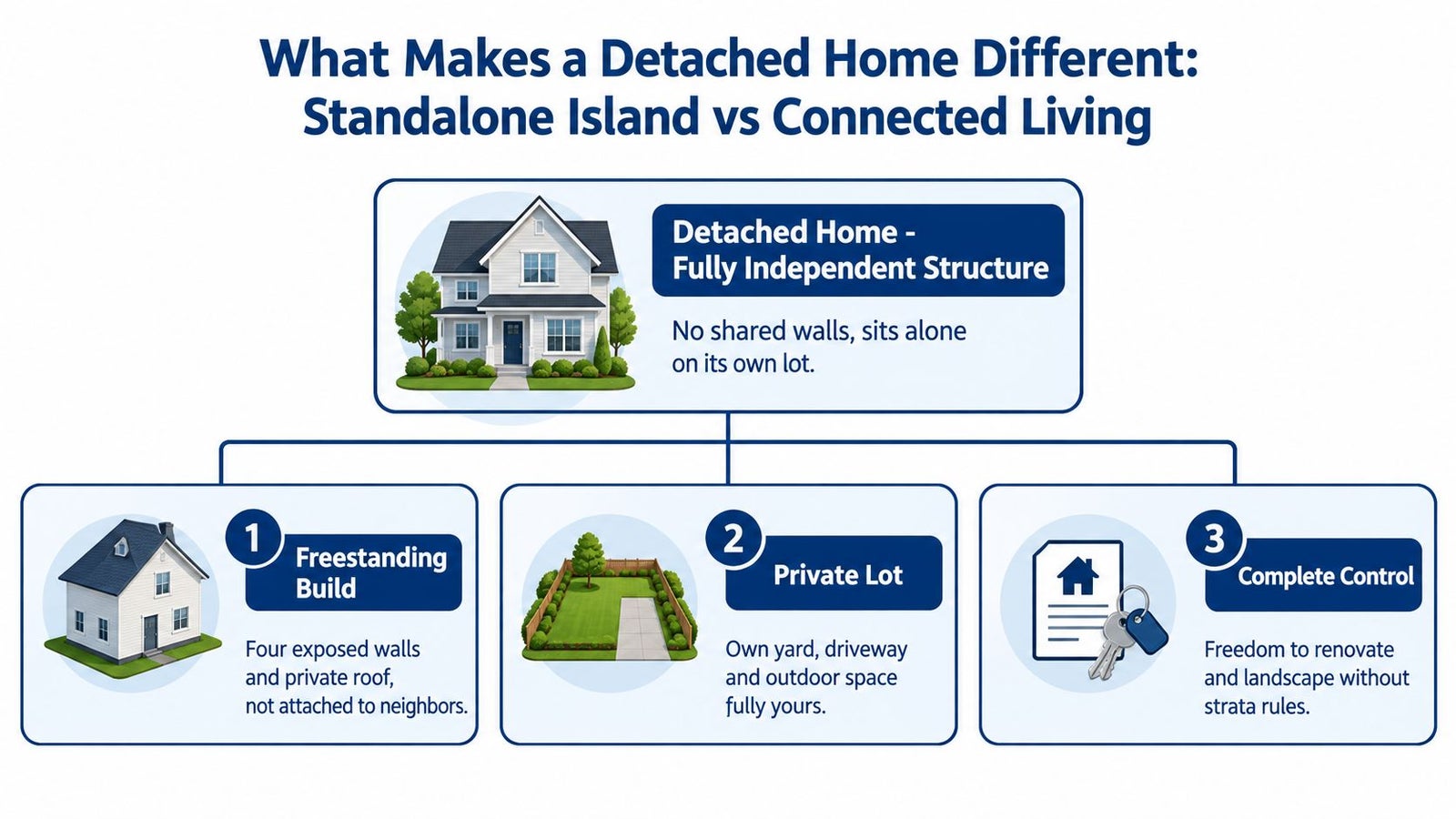
A detached home has a freestanding building. Its walls aren't physically attached to a neighbouring residence, which generally creates more privacy and can reduce the noise concerns common in attached living. The home usually has setbacks from the lot lines, producing space around at least part of the structure.
A semi-detached home shares one wall with another residence. A duplex may contain two homes in one building, either side by side or one above the other. A townhome typically forms part of a connected row and may share walls with homes on one or both sides. The legal ownership structure can vary, so appearance alone isn't enough. Buyers should confirm title, zoning, and any strata arrangements.
With a detached purchase, the lot is central to the value. The house provides shelter and usability, but the land determines location, frontage, access, privacy, and what future planning rules may permit. That's why an older house on a strategically located lot can attract more attention than a newer house in a less flexible setting.
In Metro Vancouver, the shrinking share of detached housing makes this land component especially important. A detached home is best understood as a location-specific land market with a house attached, not a larger version of a condo.
A buyer should ask whether the lot supports the intended use, whether additions are feasible, and whether municipal rules affect redevelopment potential. A seller should understand which features are lifestyle benefits and which reflect land value. The same square footage can produce very different outcomes when lot shape, street position, zoning capacity, and surrounding development differ.
Detached-home benefits become easier to judge when you connect each feature to a real routine. A private yard isn't valuable only because it appears in a listing. It matters because you can plant a garden, let a dog outside, host a barbecue, or give children somewhere to play without booking shared space.
No shared walls can change the feel of daily life. You may have fewer concerns about a neighbour's television, footsteps, or renovation schedule, although detached homes aren't silent and street noise still depends on the location.
The yard also gives you control over how outdoor space works. One owner might prioritize a low-maintenance patio, another might need room for raised garden beds, and a third might want a play area or workshop. Check drainage, sunlight, fencing, and access rather than treating the yard as a decorative extra.
A driveway or garage can simplify life in a car-dependent household. It may also provide storage for bicycles, tools, seasonal equipment, or sports gear. In a Vancouver setting, that practical space can be as important as an additional interior room.
Detached layouts often support multiple uses. A spare bedroom can become an office, a lower level can accommodate guests, or an approved accessory space may help a multigenerational household. Expansion possibilities depend on the lot and municipal requirements, so don't assume a large yard automatically permits an addition or laneway home.
You can usually make more decisions about landscaping, exterior maintenance, and renovations than you could in a strata property. That freedom is useful when your plans are specific, such as improving accessibility, changing the garden, or reworking an inefficient floor plan.
The image above is not repeated in practice, but the important trade-off is straightforward:
You don't have a strata corporation coordinating every exterior repair, and there may be no shared reserve fund absorbing common costs. You choose the contractor, schedule the work, and pay the bill.
In 2021, 38% of owner households in Metro Vancouver lived in single-detached housing, according to the Metro Vancouver Housing Data Book 2025. Detached homes therefore remain a major ownership choice, even while apartments and attached dwellings have expanded across the region.
Before deciding, list your actual priorities. If privacy, a garden, parking, and renovation control rank highest, a detached home may solve problems that a lower-maintenance property can't. If your priority is a short commute with predictable upkeep, an attached home may be the better fit.
A buyer may see a detached home as a place to live. A seller may see the same property as a building sitting on a scarce piece of land. Both views matter in Greater Vancouver, where the lot can influence value as much as the rooms above it.
Start with a budget that reflects daily comfort, not only mortgage approval. Include taxes, insurance, utilities, repairs, and money set aside for future work. British Columbia reported a 63% mortgage payment-to-income ratio for detached homes in 2026 Q1. Vancouver was the most expensive CMA for purchasing a detached home, with the ratio about 16 percentage points higher than Abbotsford-Mission, according to the B.C. housing affordability update.
Then examine the home and the land as separate parts of one decision. Check the roof, foundation, drainage, electrical and plumbing systems, permits, and signs of moisture. A clean interior does not erase concerns below the floor or beyond the walls.
Review zoning and possible future uses before assuming a lot can support an addition, secondary space, or redevelopment. Rules, setbacks, lot shape, access, and neighbourhood context can limit what appears possible. In a land-first market, the right question is not whether you like the house. Ask what the property can support, and whether that potential matters to your plans.
A seller should avoid pricing by interior size alone. Compare nearby detached homes, then adjust for lot dimensions, street appeal, condition, parking, renovation quality, and possible future use. A smaller house on a well-positioned lot may appeal to a different buyer than a larger property requiring substantial work.
Presentation should explain both the building and the land. Clear the yard, address visible deferred maintenance, organize permits and renovation records, and use photography that shows outdoor space, access, parking, and the home's relationship to the lot. Buyers need a clear picture of current function without losing sight of underlying land value.
Greater Vancouver detached-home sales reached 747 in June 2026, compared with 657 in June 2025, a 13.7% increase, as reported in the Greater Vancouver Realtors June 2026 statistics package. Regional activity provides context, not a price for every property. Buyers should compare the specific lot, condition, and nearby alternatives. Sellers should base their strategy on local comparable analysis rather than the regional figure alone.
A detached home budget starts before the first repair bill. Alongside the mortgage, owners pay property taxes, insurance, utilities, landscaping, routine repairs, and larger capital projects. Because there is no building-wide strata structure managing shared elements, the owner handles more of the property directly.
Begin with the regular monthly costs: mortgage payments, property taxes, home insurance, heating, electricity, water, waste services, and yard care. Set aside a separate maintenance reserve for expenses that arrive irregularly, including roof repairs, exterior painting, drainage work, fencing, appliance replacement, and foundation-related repairs.
The lot works like a second system to maintain. A larger yard may provide outdoor value, privacy, or future options, while also increasing landscaping and exterior upkeep. An older house may offer character and renovation potential, but its roof, drainage, wiring, plumbing, and foundation should be assessed rather than presumed sound.
A pre-purchase inspection reveals visible concerns and can identify areas for further review. Targeted specialists may still be appropriate. A roofing contractor can assess remaining service life, a drainage professional can examine grading and water movement, and an electrician or plumber can review older systems. Ask for permits and invoices when renovations have been disclosed.
Abbotsford-Mission About 16 percentage points lower than Vancouver Nearby buyers may face less payment stress, subject to their own finances
The figures come from the B.C. housing affordability update. They cannot determine an individual buyer's limit, but they show why a Vancouver budget should be stress-tested beyond lender approval. Include possible repair costs, changing utility bills, and the property's tax burden.
Property tax deserves its own line in the budget. Review the annual bill, possible reassessment implications, and how taxes fit beside insurance and utilities. This guide to Vancouver property tax can help homeowners organise that review.
Keep a property file with inspection reports, permits, warranties, invoices, appliance details, and seasonal maintenance notes. Records do not prevent repairs, but they make decisions faster and give the next owner a clearer history of the home.
How Detached Home Trends Vary Across Vancouver Neighbourhoods
A regional average can conceal the decision that matters most, which is whether a particular neighbourhood and lot fit your purpose. Detached homes respond to land scarcity, zoning, transit, schools, street character, redevelopment interest, and buyer depth. Those factors don't move together across Vancouver, Burnaby, Richmond, North Vancouver, Coquitlam, and surrounding municipalities.
The long-term supply shift is clear across British Columbia. Statistics Canada's 2021 Census shows single-detached houses made up 42.4% of occupied private dwellings in B.C., down from 44.1% in 2016 and 62.5% in 1986. The Statistics Canada Census profile illustrates a structural move toward denser forms, not the disappearance of detached living.
Scarcity is shaped by the pipeline
Detached homes remain a smaller part of new construction. BC Housing recorded 9,037 single-detached registrations out of 51,407 total new-home registrations in 2022, meaning detached homes represented 17.6%, down from 22.5% in 2021. The BC Residential Building Stats Report provides that registration context.
Later registry figures show the same broad pattern. BC Housing reported 5,860 single-detached registrations in 2024, while the first four months of 2025 produced 2,163. The first five months of 2026 produced 2,077 single-detached registrations compared with 17,533 multi-unit registrations, according to the BC Housing new-home registry report. Since new detached supply is limited, resale homes remain the main route into this segment.
Sales activity doesn't always tell you what values are doing. In 2026, Metro Vancouver detached sales and benchmark prices diverged across several months. February sales were down 10.5%, with a benchmark of $1,835,900. April sales rose 14%, while the benchmark was $1,840,700. June sales rose 13.7%, with a benchmark of $1,842,900, and August sales were 3.1% lower while the benchmark slipped to $1,799,400, according to the Greater Vancouver Realtors February 2026 statistics package.
Those figures show why “hot” and “cold” are incomplete descriptions. A neighbourhood can record more transactions while sellers accept softer pricing, perhaps because buyers have become more willing to act but remain selective. Independent regional analysis in 2026 found Port Moody and Belcarra were the only communities to record detached price growth in the first half of the year, while many markets saw sales rise without prices increasing.
For a buyer, compare recent sales, active competition, lot characteristics, and time on market within the target area. For a seller, build the pricing story around the specific land position rather than a broad regional headline. This local guide to Vancouver neighbourhoods can help frame those location differences before you shortlist properties.
A detached home should pass two tests. It needs to work as a place to live, and its lot should make sense for the way you want to hold, improve, or eventually sell the property. That doesn't mean every buyer needs redevelopment potential. It means you should know whether you're paying primarily for a finished house, a location, land flexibility, or a combination.
Buyers can make the next step practical:
Define the household need: Write down requirements for privacy, outdoor space, parking, commute, schools, work-from-home space, and future household changes.
Sellers should take a similarly focused approach. Identify the property's strongest land and lifestyle attributes, complete essential preparation, assemble records, and set a price that reflects condition and local evidence. Strong marketing should show the house, the yard, the street context, and the practical ways the property can serve its next owner.
Review these detached-home search options in Vancouver for inventory, then turn promising listings into a shortlist based on lot quality and total ownership cost. The right detached home isn't necessarily the newest or largest one. It's the property whose location, land, condition, and carrying costs align with your plan.
Jacky Levi - Vancouver Realtor can provide comparative market analysis, pricing strategy, listing preparation, buyer representation, negotiation, and transaction coordination across Greater Vancouver. The practical next move is to prepare your financing or property information, identify your target neighbourhoods, and request a focused conversation before you make an offer or set a list price.
Jacky Levi - Vancouver Realtor offers data-informed guidance for detached-home buyers and sellers, including local comparable analysis, pricing strategy, marketing preparation, negotiation, and transaction management across Greater Vancouver. Visit Jacky Levi - Vancouver Realtor to discuss your lot, neighbourhood, budget, or selling plan and decide on a clear next step.
Introduction to Detached Home Living in Vancouver
A detached home is a freestanding house on its own lot, but that simple definition misses why the property type attracts so much attention in Greater Vancouver. You aren't only choosing bedrooms and bathrooms. You're also choosing separation from neighbours, control over outdoor space, parking options, and a land position in a region where developable land is limited.
The appeal becomes clear in everyday situations. A family can let children play in the yard without sharing a common hallway. Someone working from home can use a separate room without hearing neighbours through a shared wall. A seller, meanwhile, may be marketing not just an older building, but a lot with renovation, expansion, or redevelopment potential.
Detached homes remain important even as the region becomes denser. In Metro Vancouver, single-detached homes represented 27.7% of housing stock in 2021, down from 50% in 1991, according to the Metro Vancouver Housing Data Book. The decline doesn't mean detached homes have disappeared. It means other housing forms have grown faster, making detached supply more limited relative to the region's total housing.
That distinction helps explain the market. A detached home can carry strong pricing power because buyers are competing for a narrower type of opportunity. Yet affordability, maintenance, zoning, and neighbourhood conditions still matter. Scarcity doesn't make every detached property a good purchase, and a large house doesn't automatically justify an ambitious asking price.
This guide builds the idea step by step. You'll learn what separates detached homes from condos, duplexes, semi-detached houses, and townhomes, how their benefits affect daily life, which costs deserve attention, and why one Vancouver neighbourhood can behave differently from another. For a broader comparison of ownership types, see this practical guide to buying a condo versus a house in Vancouver.
What Makes a Detached Home Different
Think of a townhome as one section of a connected row and a detached home as an island. The island has its own structure, its own boundaries, and a greater degree of control around the property. That doesn't mean every decision is unrestricted, because zoning, permits, building codes, and neighbourhood rules still apply. It does mean you aren't sharing walls, a roofline, or a small piece of the building with an adjoining household in the same way.
Start with the structure
A detached home has a freestanding building. Its walls aren't physically attached to a neighbouring residence, which generally creates more privacy and can reduce the noise concerns common in attached living. The home usually has setbacks from the lot lines, producing space around at least part of the structure.
A semi-detached home shares one wall with another residence. A duplex may contain two homes in one building, either side by side or one above the other. A townhome typically forms part of a connected row and may share walls with homes on one or both sides. The legal ownership structure can vary, so appearance alone isn't enough. Buyers should confirm title, zoning, and any strata arrangements.
Then separate the building from the land
With a detached purchase, the lot is central to the value. The house provides shelter and usability, but the land determines location, frontage, access, privacy, and what future planning rules may permit. That's why an older house on a strategically located lot can attract more attention than a newer house in a less flexible setting.
In Metro Vancouver, the shrinking share of detached housing makes this land component especially important. A detached home is best understood as a location-specific land market with a house attached, not a larger version of a condo.
Practical rule: Evaluate the structure for present-day living, but evaluate the lot for long-term flexibility.
A buyer should ask whether the lot supports the intended use, whether additions are feasible, and whether municipal rules affect redevelopment potential. A seller should understand which features are lifestyle benefits and which reflect land value. The same square footage can produce very different outcomes when lot shape, street position, zoning capacity, and surrounding development differ.
Key Features and Everyday Benefits You Can Expect
Detached-home benefits become easier to judge when you connect each feature to a real routine. A private yard isn't valuable only because it appears in a listing. It matters because you can plant a garden, let a dog outside, host a barbecue, or give children somewhere to play without booking shared space.
Privacy and outdoor space
No shared walls can change the feel of daily life. You may have fewer concerns about a neighbour's television, footsteps, or renovation schedule, although detached homes aren't silent and street noise still depends on the location.
The yard also gives you control over how outdoor space works. One owner might prioritize a low-maintenance patio, another might need room for raised garden beds, and a third might want a play area or workshop. Check drainage, sunlight, fencing, and access rather than treating the yard as a decorative extra.
Parking, storage, and flexible rooms
A driveway or garage can simplify life in a car-dependent household. It may also provide storage for bicycles, tools, seasonal equipment, or sports gear. In a Vancouver setting, that practical space can be as important as an additional interior room.
Detached layouts often support multiple uses. A spare bedroom can become an office, a lower level can accommodate guests, or an approved accessory space may help a multigenerational household. Expansion possibilities depend on the lot and municipal requirements, so don't assume a large yard automatically permits an addition or laneway home.
Control comes with responsibility
You can usually make more decisions about landscaping, exterior maintenance, and renovations than you could in a strata property. That freedom is useful when your plans are specific, such as improving accessibility, changing the garden, or reworking an inefficient floor plan.
The image above is not repeated in practice, but the important trade-off is straightforward:
More control means more direct responsibility.
You don't have a strata corporation coordinating every exterior repair, and there may be no shared reserve fund absorbing common costs. You choose the contractor, schedule the work, and pay the bill.
In 2021, 38% of owner households in Metro Vancouver lived in single-detached housing, according to the Metro Vancouver Housing Data Book 2025. Detached homes therefore remain a major ownership choice, even while apartments and attached dwellings have expanded across the region.
Before deciding, list your actual priorities. If privacy, a garden, parking, and renovation control rank highest, a detached home may solve problems that a lower-maintenance property can't. If your priority is a short commute with predictable upkeep, an attached home may be the better fit.
What Buyers and Sellers Should Consider Before Deciding
A buyer may see a detached home as a place to live. A seller may see the same property as a building sitting on a scarce piece of land. Both views matter in Greater Vancouver, where the lot can influence value as much as the rooms above it.
The buyer's side
Start with a budget that reflects daily comfort, not only mortgage approval. Include taxes, insurance, utilities, repairs, and money set aside for future work. British Columbia reported a 63% mortgage payment-to-income ratio for detached homes in 2026 Q1. Vancouver was the most expensive CMA for purchasing a detached home, with the ratio about 16 percentage points higher than Abbotsford-Mission, according to the B.C. housing affordability update.
Then examine the home and the land as separate parts of one decision. Check the roof, foundation, drainage, electrical and plumbing systems, permits, and signs of moisture. A clean interior does not erase concerns below the floor or beyond the walls.
Review zoning and possible future uses before assuming a lot can support an addition, secondary space, or redevelopment. Rules, setbacks, lot shape, access, and neighbourhood context can limit what appears possible. In a land-first market, the right question is not whether you like the house. Ask what the property can support, and whether that potential matters to your plans.
The seller's side
A seller should avoid pricing by interior size alone. Compare nearby detached homes, then adjust for lot dimensions, street appeal, condition, parking, renovation quality, and possible future use. A smaller house on a well-positioned lot may appeal to a different buyer than a larger property requiring substantial work.
Presentation should explain both the building and the land. Clear the yard, address visible deferred maintenance, organize permits and renovation records, and use photography that shows outdoor space, access, parking, and the home's relationship to the lot. Buyers need a clear picture of current function without losing sight of underlying land value.
Greater Vancouver detached-home sales reached 747 in June 2026, compared with 657 in June 2025, a 13.7% increase, as reported in the Greater Vancouver Realtors June 2026 statistics package. Regional activity provides context, not a price for every property. Buyers should compare the specific lot, condition, and nearby alternatives. Sellers should base their strategy on local comparable analysis rather than the regional figure alone.
Ownership Costs and Maintenance Realities
A detached home budget starts before the first repair bill. Alongside the mortgage, owners pay property taxes, insurance, utilities, landscaping, routine repairs, and larger capital projects. Because there is no building-wide strata structure managing shared elements, the owner handles more of the property directly.
Begin with the regular monthly costs: mortgage payments, property taxes, home insurance, heating, electricity, water, waste services, and yard care. Set aside a separate maintenance reserve for expenses that arrive irregularly, including roof repairs, exterior painting, drainage work, fencing, appliance replacement, and foundation-related repairs.
The lot works like a second system to maintain. A larger yard may provide outdoor value, privacy, or future options, while also increasing landscaping and exterior upkeep. An older house may offer character and renovation potential, but its roof, drainage, wiring, plumbing, and foundation should be assessed rather than presumed sound.
A pre-purchase inspection reveals visible concerns and can identify areas for further review. Targeted specialists may still be appropriate. A roofing contractor can assess remaining service life, a drainage professional can examine grading and water movement, and an electrician or plumber can review older systems. Ask for permits and invoices when renovations have been disclosed.
Abbotsford-Mission About 16 percentage points lower than Vancouver Nearby buyers may face less payment stress, subject to their own finances
The figures come from the B.C. housing affordability update. They cannot determine an individual buyer's limit, but they show why a Vancouver budget should be stress-tested beyond lender approval. Include possible repair costs, changing utility bills, and the property's tax burden.
Property tax deserves its own line in the budget. Review the annual bill, possible reassessment implications, and how taxes fit beside insurance and utilities. This guide to Vancouver property tax can help homeowners organise that review.
Keep a property file with inspection reports, permits, warranties, invoices, appliance details, and seasonal maintenance notes. Records do not prevent repairs, but they make decisions faster and give the next owner a clearer history of the home.
How Detached Home Trends Vary Across Vancouver Neighbourhoods
A regional average can conceal the decision that matters most, which is whether a particular neighbourhood and lot fit your purpose. Detached homes respond to land scarcity, zoning, transit, schools, street character, redevelopment interest, and buyer depth. Those factors don't move together across Vancouver, Burnaby, Richmond, North Vancouver, Coquitlam, and surrounding municipalities.
The long-term supply shift is clear across British Columbia. Statistics Canada's 2021 Census shows single-detached houses made up 42.4% of occupied private dwellings in B.C., down from 44.1% in 2016 and 62.5% in 1986. The Statistics Canada Census profile illustrates a structural move toward denser forms, not the disappearance of detached living.
Scarcity is shaped by the pipeline
Detached homes remain a smaller part of new construction. BC Housing recorded 9,037 single-detached registrations out of 51,407 total new-home registrations in 2022, meaning detached homes represented 17.6%, down from 22.5% in 2021. The BC Residential Building Stats Report provides that registration context.
Later registry figures show the same broad pattern. BC Housing reported 5,860 single-detached registrations in 2024, while the first four months of 2025 produced 2,163. The first five months of 2026 produced 2,077 single-detached registrations compared with 17,533 multi-unit registrations, according to the BC Housing new-home registry report. Since new detached supply is limited, resale homes remain the main route into this segment.
Volume and price can disagree
Sales activity doesn't always tell you what values are doing. In 2026, Metro Vancouver detached sales and benchmark prices diverged across several months. February sales were down 10.5%, with a benchmark of $1,835,900. April sales rose 14%, while the benchmark was $1,840,700. June sales rose 13.7%, with a benchmark of $1,842,900, and August sales were 3.1% lower while the benchmark slipped to $1,799,400, according to the Greater Vancouver Realtors February 2026 statistics package.
Those figures show why “hot” and “cold” are incomplete descriptions. A neighbourhood can record more transactions while sellers accept softer pricing, perhaps because buyers have become more willing to act but remain selective. Independent regional analysis in 2026 found Port Moody and Belcarra were the only communities to record detached price growth in the first half of the year, while many markets saw sales rise without prices increasing.
For a buyer, compare recent sales, active competition, lot characteristics, and time on market within the target area. For a seller, build the pricing story around the specific land position rather than a broad regional headline. This local guide to Vancouver neighbourhoods can help frame those location differences before you shortlist properties.
Making Your Next Move With Confidence
A detached home should pass two tests. It needs to work as a place to live, and its lot should make sense for the way you want to hold, improve, or eventually sell the property. That doesn't mean every buyer needs redevelopment potential. It means you should know whether you're paying primarily for a finished house, a location, land flexibility, or a combination.
Buyers can make the next step practical:
Define the household need: Write down requirements for privacy, outdoor space, parking, commute, schools, work-from-home space, and future household changes.
- Stress-test the budget: Include the mortgage, taxes, insurance, utilities, maintenance, and likely immediate repairs.
- Review the lot: Check access, frontage, slope, drainage, zoning, permits, and any restrictions before treating future potential as value.
- Compare locally: Use sales and active listings from the same neighbourhood and a similar property type, not only a broad Metro Vancouver benchmark.
- Protect the transaction: Use appropriate inspection, financing, document-review, and legal conditions.
Sellers should take a similarly focused approach. Identify the property's strongest land and lifestyle attributes, complete essential preparation, assemble records, and set a price that reflects condition and local evidence. Strong marketing should show the house, the yard, the street context, and the practical ways the property can serve its next owner.
Review these detached-home search options in Vancouver for inventory, then turn promising listings into a shortlist based on lot quality and total ownership cost. The right detached home isn't necessarily the newest or largest one. It's the property whose location, land, condition, and carrying costs align with your plan.
Jacky Levi - Vancouver Realtor can provide comparative market analysis, pricing strategy, listing preparation, buyer representation, negotiation, and transaction coordination across Greater Vancouver. The practical next move is to prepare your financing or property information, identify your target neighbourhoods, and request a focused conversation before you make an offer or set a list price.
Jacky Levi - Vancouver Realtor offers data-informed guidance for detached-home buyers and sellers, including local comparable analysis, pricing strategy, marketing preparation, negotiation, and transaction management across Greater Vancouver. Visit Jacky Levi - Vancouver Realtor to discuss your lot, neighbourhood, budget, or selling plan and decide on a clear next step.