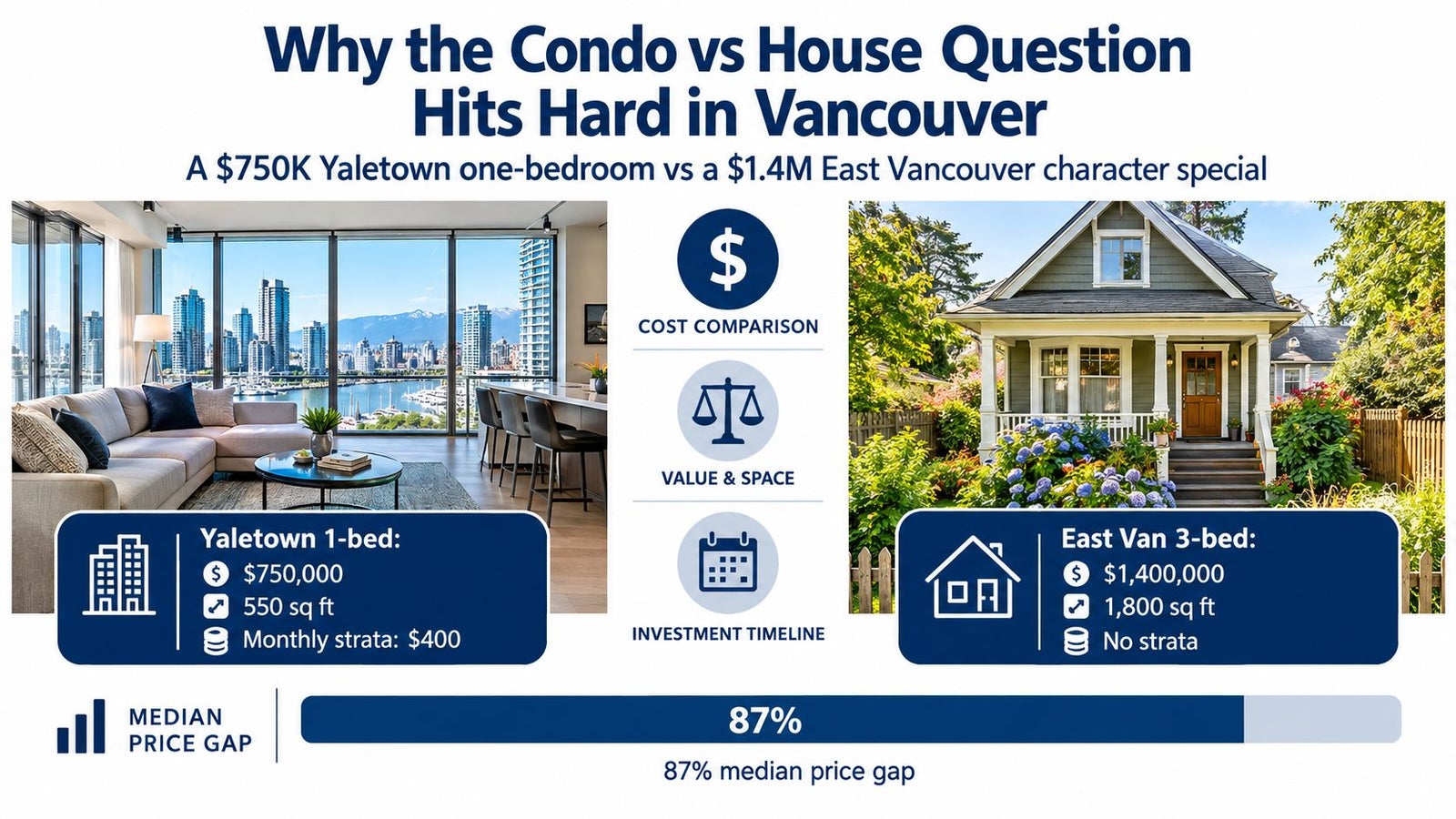
You're looking at a Yaletown one-bedroom listed around $750,000, while an East Vancouver character house is asking closer to $1.4 million. Both could work on paper. One offers a walkable downtown lifestyle and predictable building responsibilities. The other gives you more rooms, outdoor space, and control, but demands substantially more cash and attention.
That's the buying condo vs. house decision in Greater Vancouver. It isn't about which property costs less. You're comparing land ownership with shared building ownership, monthly strata obligations with private maintenance, and urban convenience with space and autonomy. The right answer depends on your savings, qualification, expected hold period, household plans, and tolerance for responsibility.
A Yaletown professional couple may be able to make the condo payment comfortably, but the East Vancouver house could change everything from their down payment to their commute. Metro Vancouver's market has historically maintained a wide gap between apartments and detached homes. A July 2026 market summary reported an average condo price of about $695,200, while detached homes had a benchmark around $1.8479 million in May 2026, according to this Metro Vancouver market update.
That spread means a detached property can cost roughly 2.5 to 2.7 times as much as a condo before you account for property transfer tax, mortgage size, insurance, utilities, and repairs. In a region where developable land is constrained, and demand remains concentrated around established communities and transit corridors, many buyers choose condos because houses are financially out of reach, not because a smaller home was their first choice.
Condo living trades control for convenience. In a Yaletown high-rise, you may walk to work, use a fitness room, receive packages through concierge services, and leave town without arranging exterior maintenance. In a Metrotown tower, the same convenience may come with quick access to transit, shopping, and shared amenities.
The trade-off is that your home is part of a managed community. Strata bylaws can affect renovations, flooring, pets, rentals, move-ins, and short-term stays. You may need approval to remove a wall, replace flooring, install certain fixtures, or make changes visible from outside the unit. Shared walls, corridors, elevators, and amenity areas also create a different sound and privacy experience than a detached home.
Sticker price sets the first boundary, not the final decision. A $750,000 condo and a $1.4 million detached home create different upfront requirements, transfer-tax exposure, mortgage payments, insurance arrangements, and maintenance risks. In Greater Vancouver, the purchase-price gap is only the beginning of the ownership comparison.
British Columbia's general property transfer tax is 1% on the first $200,000, 2% on the portion from $200,001 to $2 million, 3% above $2 million, plus an additional 2% on the portion above $3 million for residential property, as summarized in this British Columbia property transfer tax guide. An eligible first-time buyer may reduce or eliminate some of that cost. Eligibility depends on principal-residence status, citizenship or permanent-resident status, prior B.C. residency or tax filing history, and whether the buyer has previously owned a principal residence.
For a $750,000 condo, the federal down-payment structure requires 5% on the first $500,000 and 10% on the portion from $500,000 to $1.499 million. The minimum down payment is therefore $50,000, before closing costs. Buyers should confirm the full structure with a mortgage professional. For comparison, a $700,000 condo requires at least $35,000 down, based on the rules outlined in this Canadian down-payment calculator.
The detached purchase requires substantially more capital. At $1.4 million, the buyer remains below the $1.5 million threshold, so the same tiered calculation applies. At $1.6 million, the minimum down payment becomes $250,000, because 20% is required on any amount at $1.5 million or more. A larger mortgage also raises interest exposure and qualifying pressure.
Mortgage qualification can remove an option before lifestyle preferences enter the discussion. Canadian borrowers generally qualify under the mortgage stress test at the contract rate plus 2%, or 5.25%, whichever is higher. Lenders also assess property taxes, heating costs, existing debt, and, for condos, the relevant portion of strata fees.
A buyer may qualify for a Yaletown condo mortgage and still feel squeezed once the monthly strata payment is included. The lower purchase price helps, but strata fees use part of the household's carrying-cost budget. A detached buyer avoids that monthly charge, then takes on a larger mortgage and direct responsibility for maintenance, insurance, utilities, and repairs.
The down-payment thresholds
The Canadian minimum structure is:
Under $500,000: A minimum of 5% applies to the purchase price.
From $500,000 to $1.499 million: The buyer puts 5% on the first $500,000 and 10% on the remaining amount.
At $1.5 million or more: A minimum of 20% applies.
These rules are set out in the Canadian down-payment guidance. The difference is substantial. A $700,000 condo requires at least $35,000 down, while a $1.6 million house requires at least $250,000 down, before closing costs. Neither figure covers an emergency fund, moving expenses, legal fees, inspection costs, or immediate repairs.
If you have under $150,000 saved, start with condos in areas such as Mount Pleasant, Coquitlam Centre, Metrotown, or Brentwood Park. The lower entry price can preserve cash for closing costs and an emergency reserve. Don't choose a condo solely because you can make the minimum down payment. Read the strata documents, test the monthly budget, and confirm whether the layout can serve you beyond the immediate move.
A family expecting more space should be cautious about buying a compact condo as a supposedly temporary solution. A 600-square-foot layout can become restrictive quickly once children, work-from-home needs, storage, and visitors enter the picture. If the budget allows, compare East Vancouver, North Vancouver, and Burnaby houses or townhomes, even if that means accepting an older property or a longer commute.
Downsizers often benefit from concrete towers in Coal Harbour or Kerrisdale. A secure building with elevators, amenities, parking, and professional management can remove yard work and exterior maintenance from daily life. The important review is the building's condition and fee structure, not just the view.
Investors need to read the bylaws before they analyze the rent. Rental restrictions, pet clauses, tenant rules, and the 25/75 strata rental rule can affect the usable investment strategy. A detached property with a legal suite may offer different control, but it brings more maintenance and a larger capital requirement.
A relocating professional may value Yaletown, False Creek, or a Canada Line corridor more than extra rooms. The condo can shorten the commute and reduce hands-on work while the buyer learns the region. Compare that convenience against resale depth, building quality, parking, and whether the unit still works if employment or household plans change.
For a neighbourhood-by-neighbourhood search, property-type comparison, and review of strata rules, use this Vancouver condos for sale buyer's guide.
That's the buying condo vs. house decision in Greater Vancouver. It isn't about which property costs less. You're comparing land ownership with shared building ownership, monthly strata obligations with private maintenance, and urban convenience with space and autonomy. The right answer depends on your savings, qualification, expected hold period, household plans, and tolerance for responsibility.
Why the Condo vs House Question Hits Hard in Vancouver
A Yaletown professional couple may be able to make the condo payment comfortably, but the East Vancouver house could change everything from their down payment to their commute. Metro Vancouver's market has historically maintained a wide gap between apartments and detached homes. A July 2026 market summary reported an average condo price of about $695,200, while detached homes had a benchmark around $1.8479 million in May 2026, according to this Metro Vancouver market update.
That spread means a detached property can cost roughly 2.5 to 2.7 times as much as a condo before you account for property transfer tax, mortgage size, insurance, utilities, and repairs. In a region where developable land is constrained, and demand remains concentrated around established communities and transit corridors, many buyers choose condos because houses are financially out of reach, not because a smaller home was their first choice.
The financial difference also appears at closing. In British Columbia, an eligible first-time buyer can receive a full property transfer tax exemption on a principal residence valued at $500,000 or less, and a maximum $8,000 exemption on a home valued above $500,000 and up to $835,000, with the benefit phasing out above that level until $860,000. The Greater Vancouver REALTORS® property transfer tax fact sheet explains the exemption's principal-residence and lot-size requirements.
That's why a condo near the exemption threshold can require materially less cash than a detached house, even before the mortgage begins. The sensible comparison is not “condo or house in theory.” It's what each option costs to buy, carry, live in, and eventually sell for your specific stage of life.
That's why a condo near the exemption threshold can require materially less cash than a detached house, even before the mortgage begins. The sensible comparison is not “condo or house in theory.” It's what each option costs to buy, carry, live in, and eventually sell for your specific stage of life.
What Living in a Condo vs a House Actually Feels Like
Condo living trades control for convenience. In a Yaletown high-rise, you may walk to work, use a fitness room, receive packages through concierge services, and leave town without arranging exterior maintenance. In a Metrotown tower, the same convenience may come with quick access to transit, shopping, and shared amenities.
The trade-off is that your home is part of a managed community. Strata bylaws can affect renovations, flooring, pets, rentals, move-ins, and short-term stays. You may need approval to remove a wall, replace flooring, install certain fixtures, or make changes visible from outside the unit. Shared walls, corridors, elevators, and amenity areas also create a different sound and privacy experience than a detached home.
A Kerrisdale character home gives a family a yard, storage, and renovation potential that a downtown condo can't replicate. It also brings leaf clearing, garden work, snow removal, drainage concerns, and the occasional urgent repair. A Main Street duplex or East Vancouver house may offer more flexibility than a tower, but it still requires you to manage every part of the building that a strata would otherwise coordinate.
Practical rule: Choose the property that matches your ordinary Tuesday, not the lifestyle you picture only during an open house.
Comparing the True Cost of Owning Each
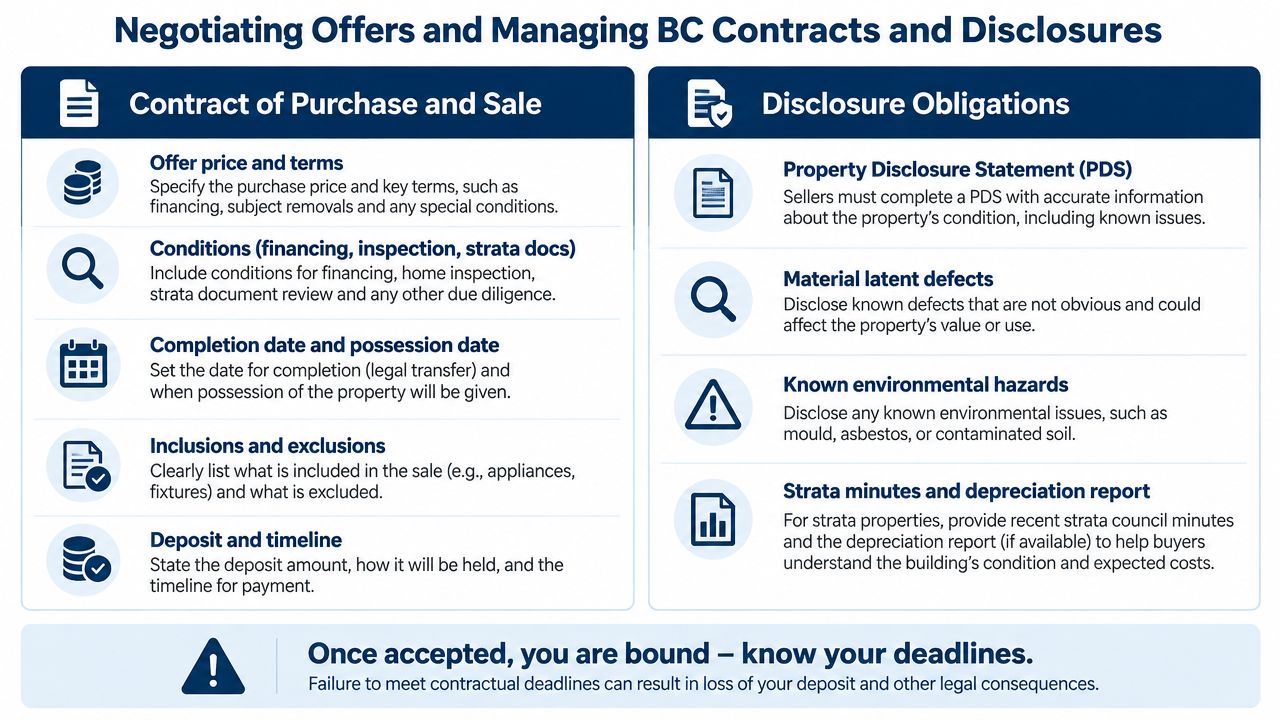
Sticker price sets the first boundary, not the final decision. A $750,000 condo and a $1.4 million detached home create different upfront requirements, transfer-tax exposure, mortgage payments, insurance arrangements, and maintenance risks. In Greater Vancouver, the purchase-price gap is only the beginning of the ownership comparison.
British Columbia's general property transfer tax is 1% on the first $200,000, 2% on the portion from $200,001 to $2 million, 3% above $2 million, plus an additional 2% on the portion above $3 million for residential property, as summarized in this British Columbia property transfer tax guide. An eligible first-time buyer may reduce or eliminate some of that cost. Eligibility depends on principal-residence status, citizenship or permanent-resident status, prior B.C. residency or tax filing history, and whether the buyer has previously owned a principal residence.
For a $750,000 condo, the federal down-payment structure requires 5% on the first $500,000 and 10% on the portion from $500,000 to $1.499 million. The minimum down payment is therefore $50,000, before closing costs. Buyers should confirm the full structure with a mortgage professional. For comparison, a $700,000 condo requires at least $35,000 down, based on the rules outlined in this Canadian down-payment calculator.
The detached purchase requires substantially more capital. At $1.4 million, the buyer remains below the $1.5 million threshold, so the same tiered calculation applies. At $1.6 million, the minimum down payment becomes $250,000, because 20% is required on any amount at $1.5 million or more. A larger mortgage also raises interest exposure and qualifying pressure.
How Financing Changes Between a Condo and a House
Mortgage qualification can remove an option before lifestyle preferences enter the discussion. Canadian borrowers generally qualify under the mortgage stress test at the contract rate plus 2%, or 5.25%, whichever is higher. Lenders also assess property taxes, heating costs, existing debt, and, for condos, the relevant portion of strata fees.
A buyer may qualify for a Yaletown condo mortgage and still feel squeezed once the monthly strata payment is included. The lower purchase price helps, but strata fees use part of the household's carrying-cost budget. A detached buyer avoids that monthly charge, then takes on a larger mortgage and direct responsibility for maintenance, insurance, utilities, and repairs.
The down-payment thresholds
The Canadian minimum structure is:
Under $500,000: A minimum of 5% applies to the purchase price.
From $500,000 to $1.499 million: The buyer puts 5% on the first $500,000 and 10% on the remaining amount.
At $1.5 million or more: A minimum of 20% applies.
These rules are set out in the Canadian down-payment guidance. The difference is substantial. A $700,000 condo requires at least $35,000 down, while a $1.6 million house requires at least $250,000 down, before closing costs. Neither figure covers an emergency fund, moving expenses, legal fees, inspection costs, or immediate repairs.
At $749,000, the condo's minimum down payment is $25,000 on the first $500,000 plus 10% of the remaining $249,000, or $24,900, for a total of $49,900. At $1.65 million, the detached home requires 20%, or $330,000. Ask a lender to confirm the mortgage structure and any default-insurance implications before relying on these figures.
Condo financing also depends on the building, not only the buyer. Lenders and insurers may review the strata's financial health, insurance, maintenance records, and legal issues. Review the Form B information certificate for Vancouver condo buyers to identify obligations that may not appear in the listing description.
The best choice changes with the buyer, not just the neighbourhood. A first-time buyer, a family with young children, a downsizer, an investor, and a relocating professional may all have different definitions of affordability and flexibility.
Condo financing also depends on the building, not only the buyer. Lenders and insurers may review the strata's financial health, insurance, maintenance records, and legal issues. Review the Form B information certificate for Vancouver condo buyers to identify obligations that may not appear in the listing description.
Matching Buyer Profiles to the Right Property Type
The best choice changes with the buyer, not just the neighbourhood. A first-time buyer, a family with young children, a downsizer, an investor, and a relocating professional may all have different definitions of affordability and flexibility.
First-time buyers with limited savings
If you have under $150,000 saved, start with condos in areas such as Mount Pleasant, Coquitlam Centre, Metrotown, or Brentwood Park. The lower entry price can preserve cash for closing costs and an emergency reserve. Don't choose a condo solely because you can make the minimum down payment. Read the strata documents, test the monthly budget, and confirm whether the layout can serve you beyond the immediate move.
Growing families
A family expecting more space should be cautious about buying a compact condo as a supposedly temporary solution. A 600-square-foot layout can become restrictive quickly once children, work-from-home needs, storage, and visitors enter the picture. If the budget allows, compare East Vancouver, North Vancouver, and Burnaby houses or townhomes, even if that means accepting an older property or a longer commute.
Downsizers
Downsizers often benefit from concrete towers in Coal Harbour or Kerrisdale. A secure building with elevators, amenities, parking, and professional management can remove yard work and exterior maintenance from daily life. The important review is the building's condition and fee structure, not just the view.
Investors
Investors need to read the bylaws before they analyze the rent. Rental restrictions, pet clauses, tenant rules, and the 25/75 strata rental rule can affect the usable investment strategy. A detached property with a legal suite may offer different control, but it brings more maintenance and a larger capital requirement.
Relocating professionals
A relocating professional may value Yaletown, False Creek, or a Canada Line corridor more than extra rooms. The condo can shorten the commute and reduce hands-on work while the buyer learns the region. Compare that convenience against resale depth, building quality, parking, and whether the unit still works if employment or household plans change.
For a neighbourhood-by-neighbourhood search, property-type comparison, and review of strata rules, use this Vancouver condos for sale buyer's guide.
The most common mistake is buying the property that fits today's approval but not tomorrow's life. A condo is sensible for a first purchase or a deliberate urban lifestyle. A house is sensible when outdoor space, storage, privacy, and long-term control are central requirements, not occasional preferences.
In Greater Vancouver, resale comes down to two questions: how many buyers can afford the property, and how well it fits their long-term plans. Detached homes have historically benefited from scarce land and often delivered stronger long-term appreciation than apartments and attached homes, particularly in land-constrained Vancouver West, North Vancouver, and Richmond. That advantage only helps if you can hold through market cycles and carry the property without financial strain.
Condos usually offer a wider buyer pool because the purchase price is lower. That supports easier financing and can improve liquidity when affordability tightens. Metro Vancouver condos were reported around a $699,000 median with 53 to 62 days on market in mid-2026, while detached homes remained around a $1.80 million benchmark in August 2026, according to the Vancouver housing market data. The same source reported detached sales falling 3.1% year over year, showing how the higher-priced segment can respond more sharply to affordability pressure and weaker buyer confidence.
Before setting your expected hold period, review how long it takes to sell a condo in Vancouver. A property that attracts many qualified buyers gives you more flexibility when work, family, or finances change.
A condo's resale value depends on the entire building, not only the suite's finishes. Buyers review insurance, the depreciation report, meeting minutes, contingency reserves, maintenance history, rental rules, and potential special assessments. A renovated kitchen will not offset unresolved envelope work or weak financial planning.
Detached homes carry a different resale risk. Scarce land can support long-term value, yet the higher purchase price narrows the buyer pool. A house may take longer to sell in a sideways market even when buyers still value the lot.
If you expect to move in under five years, I usually favour a well-chosen condo over stretching into a detached home. Selling costs and market timing already create risk. A house adds greater capital exposure and more complicated decisions around presentation, repairs, and pricing. Buyers planning to stay for many years can justify a detached purchase when the monthly budget, maintenance reserve, and household needs support it.
The property still has to be sound. A poorly chosen condo can be less liquid than a good house, while a badly located or compromised house can sit despite its land component. Buy the building or property that future buyers can understand, afford, and finance.
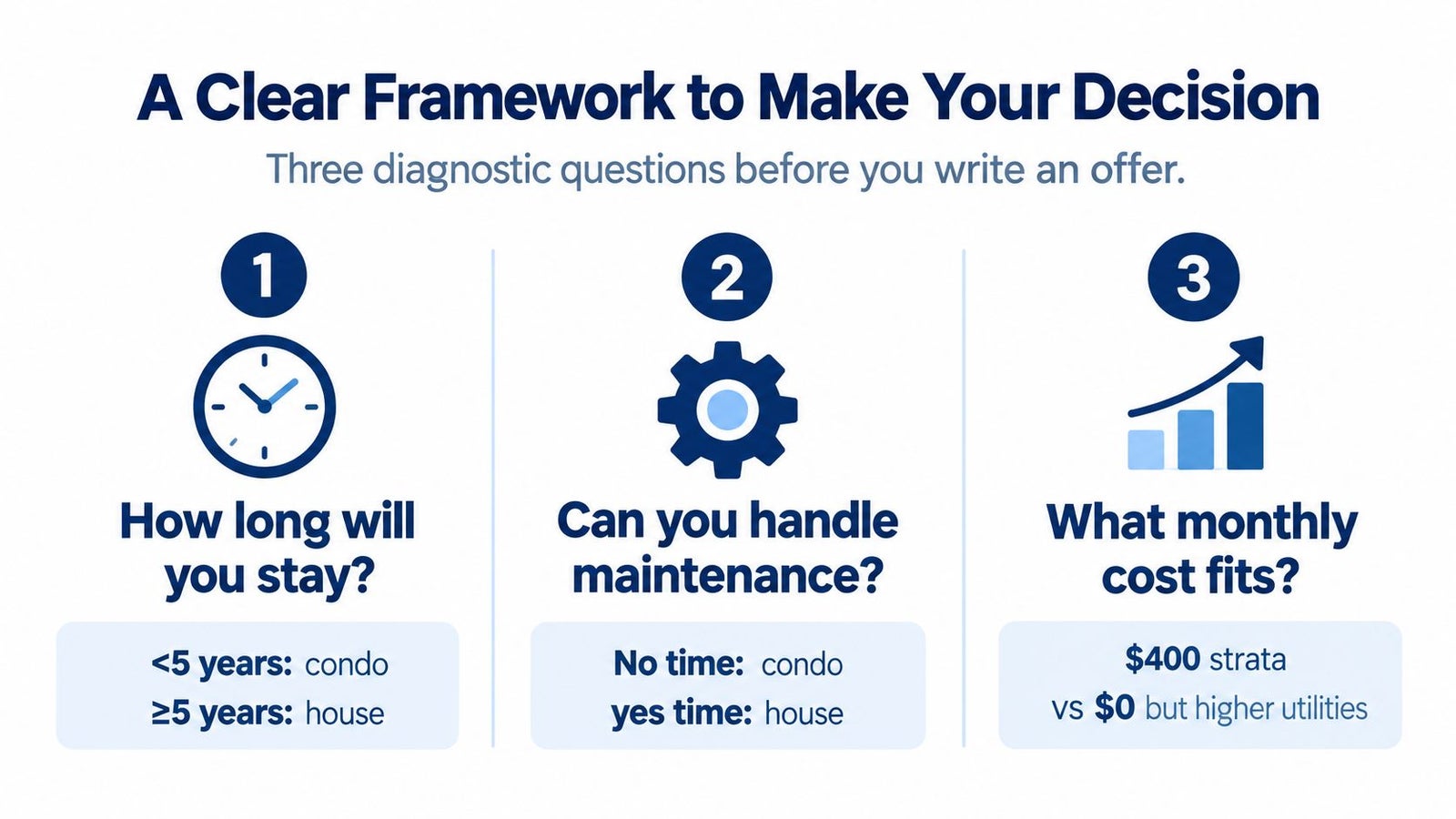
Answer three questions before you write an offer. If your answers are unclear, you're not ready to choose between a condo and a house.
If your realistic horizon is under five years, favour a condo with broad buyer appeal, strong transit access, sensible strata finances, and a layout that rents or resells easily. A longer hold makes the detached option more reasonable because you have more time to absorb market fluctuations and benefit from land ownership.
The five-year line isn't a guarantee. It's a discipline that forces you to account for selling costs, moving plans, household changes, and the risk of buying a property that doesn't suit your next move.
Build the budget from the full payment, not the mortgage quote. Include mortgage principal and interest, property tax, insurance, utilities, strata fees where applicable, and a separate maintenance reserve for a house. If the payment only works when nothing breaks and strata fees never rise, the property isn't affordable.
A condo's monthly fee may feel uncomfortable, but it can replace some unpredictable exterior expenses. A house may show no strata charge, but the owner must fund the roof, drainage, heating, yard, and other systems directly.
A first-time buyer usually needs access, liquidity, and cash preservation. A growing family needs bedrooms, storage, outdoor space, and a plan for future room. A downsizer may prioritise security and lock-and-leave convenience. An investor needs lawful rental flexibility and reliable building records.
Use a simple test:
Buy the condo if location, convenience, lower entry cost, and limited maintenance are your priorities.
Buy the house if privacy, land, storage, renovation control, and long-term space matter enough to justify the larger commitment.
Keep searching if either option would leave no emergency reserve after closing.
Resale, Liquidity, and Long-Term Value
In Greater Vancouver, resale comes down to two questions: how many buyers can afford the property, and how well it fits their long-term plans. Detached homes have historically benefited from scarce land and often delivered stronger long-term appreciation than apartments and attached homes, particularly in land-constrained Vancouver West, North Vancouver, and Richmond. That advantage only helps if you can hold through market cycles and carry the property without financial strain.
Condos usually offer a wider buyer pool because the purchase price is lower. That supports easier financing and can improve liquidity when affordability tightens. Metro Vancouver condos were reported around a $699,000 median with 53 to 62 days on market in mid-2026, while detached homes remained around a $1.80 million benchmark in August 2026, according to the Vancouver housing market data. The same source reported detached sales falling 3.1% year over year, showing how the higher-priced segment can respond more sharply to affordability pressure and weaker buyer confidence.
Before setting your expected hold period, review how long it takes to sell a condo in Vancouver. A property that attracts many qualified buyers gives you more flexibility when work, family, or finances change.
What can hurt a condo resale
A condo's resale value depends on the entire building, not only the suite's finishes. Buyers review insurance, the depreciation report, meeting minutes, contingency reserves, maintenance history, rental rules, and potential special assessments. A renovated kitchen will not offset unresolved envelope work or weak financial planning.
Detached homes carry a different resale risk. Scarce land can support long-term value, yet the higher purchase price narrows the buyer pool. A house may take longer to sell in a sideways market even when buyers still value the lot.
Short timelines favour liquidity. Long timelines reward patience and control.
If you expect to move in under five years, I usually favour a well-chosen condo over stretching into a detached home. Selling costs and market timing already create risk. A house adds greater capital exposure and more complicated decisions around presentation, repairs, and pricing. Buyers planning to stay for many years can justify a detached purchase when the monthly budget, maintenance reserve, and household needs support it.
The property still has to be sound. A poorly chosen condo can be less liquid than a good house, while a badly located or compromised house can sit despite its land component. Buy the building or property that future buyers can understand, afford, and finance.
A Clear Framework to Make Your Decision
Answer three questions before you write an offer. If your answers are unclear, you're not ready to choose between a condo and a house.
How long will you stay
If your realistic horizon is under five years, favour a condo with broad buyer appeal, strong transit access, sensible strata finances, and a layout that rents or resells easily. A longer hold makes the detached option more reasonable because you have more time to absorb market fluctuations and benefit from land ownership.
The five-year line isn't a guarantee. It's a discipline that forces you to account for selling costs, moving plans, household changes, and the risk of buying a property that doesn't suit your next move.
What monthly cost can you carry
Build the budget from the full payment, not the mortgage quote. Include mortgage principal and interest, property tax, insurance, utilities, strata fees where applicable, and a separate maintenance reserve for a house. If the payment only works when nothing breaks and strata fees never rise, the property isn't affordable.
A condo's monthly fee may feel uncomfortable, but it can replace some unpredictable exterior expenses. A house may show no strata charge, but the owner must fund the roof, drainage, heating, yard, and other systems directly.
Which life stage are you in
A first-time buyer usually needs access, liquidity, and cash preservation. A growing family needs bedrooms, storage, outdoor space, and a plan for future room. A downsizer may prioritise security and lock-and-leave convenience. An investor needs lawful rental flexibility and reliable building records.
Use a simple test:
Buy the condo if location, convenience, lower entry cost, and limited maintenance are your priorities.
Buy the house if privacy, land, storage, renovation control, and long-term space matter enough to justify the larger commitment.
Keep searching if either option would leave no emergency reserve after closing.
Pull together 12 months of spending, ask a mortgage professional to test both scenarios at current Metro Vancouver rates, and compare actual listings in your target neighbourhoods. Then book a 30-minute call with a local REALTOR® who tracks both condo and detached inventory, reviews strata documents, and can show you where your budget creates the least compromise.
Jacky Levi - Vancouver Realtor offers buyer representation, neighbourhood-level market analysis, offer strategy, and transaction coordination across Greater Vancouver for condos, townhomes, and detached homes. Visit Jacky Levi - Vancouver Realtor to compare suitable properties and discuss the total cost of ownership before you make an offer.
Jacky Levi - Vancouver Realtor offers buyer representation, neighbourhood-level market analysis, offer strategy, and transaction coordination across Greater Vancouver for condos, townhomes, and detached homes. Visit Jacky Levi - Vancouver Realtor to compare suitable properties and discuss the total cost of ownership before you make an offer.