
You're standing in a Saturday open house in East Vancouver, greeting card in hand, while the agent at the door asks whether you're already working with a REALTOR®. You like the home, but one question matters before you discuss price, defects, financing, or an offer: whose interests does this person represent?
In British Columbia, that answer isn't meant to remain vague. The province's disclosure framework requires real estate professionals to explain whether they can represent you as a client, what duties apply, and how complaints are handled, as set out in the BCFSA consumer guide to real estate disclosures. Most buyers still walk past the paperwork without reading it.
That's a mistake. Buyer agency real estate in Vancouver is a regulated relationship, not just someone opening doors. It affects what advice you receive, what information stays confidential, how an offer is built, and what happens if the seller's agent is the person standing beside you at the kitchen island.
Ask the agent one direct question before you start discussing the property:
If the home is listed, the agent hosting the open house will usually be working for the seller's brokerage or representing the seller directly. That agent can explain the property, provide documents, and answer factual questions. The agent generally can't give you confidential advice about your maximum price, your urgency, or the terms that would best protect you if those duties belong to the seller.
The other option is separate buyer representation. In that arrangement, your REALTOR® works for you under a written agency relationship. Your agent helps identify suitable properties, assesses risks, prepares an offer, negotiates terms, and keeps your personal information private within the limits of the law and the agreement.
BC's rules require disclosure of the nature of representation before trading services are provided, and, when a buyer's offer is being prepared, no later than immediately before the buyer makes that offer under the British Columbia Real Estate Services Rules. The disclosure process is designed to make the relationship clear at the point it matters.
Follow three steps:
In British Columbia, that answer isn't meant to remain vague. The province's disclosure framework requires real estate professionals to explain whether they can represent you as a client, what duties apply, and how complaints are handled, as set out in the BCFSA consumer guide to real estate disclosures. Most buyers still walk past the paperwork without reading it.
That's a mistake. Buyer agency real estate in Vancouver is a regulated relationship, not just someone opening doors. It affects what advice you receive, what information stays confidential, how an offer is built, and what happens if the seller's agent is the person standing beside you at the kitchen island.
The Open House Question That Changes Everything
Ask the agent one direct question before you start discussing the property:
Are you representing the seller, me, or neither of us?
If the home is listed, the agent hosting the open house will usually be working for the seller's brokerage or representing the seller directly. That agent can explain the property, provide documents, and answer factual questions. The agent generally can't give you confidential advice about your maximum price, your urgency, or the terms that would best protect you if those duties belong to the seller.
The other option is separate buyer representation. In that arrangement, your REALTOR® works for you under a written agency relationship. Your agent helps identify suitable properties, assesses risks, prepares an offer, negotiates terms, and keeps your personal information private within the limits of the law and the agreement.
BC's rules require disclosure of the nature of representation before trading services are provided, and, when a buyer's offer is being prepared, no later than immediately before the buyer makes that offer under the British Columbia Real Estate Services Rules. The disclosure process is designed to make the relationship clear at the point it matters.
What to do at the door
Follow three steps:
- Read the sign-in or disclosure material. Don't treat it as routine paperwork.
- Ask who the agent represents. A friendly manner doesn't answer that question.
- Avoid revealing your strategy. Don't volunteer your budget ceiling, motivation, timeline, or willingness to waive conditions to the seller's representative.
A represented buyer enters the property with an advocate. An unrepresented buyer enters with access to information, but not necessarily advice designed around the buyer's interests. Those are different things.
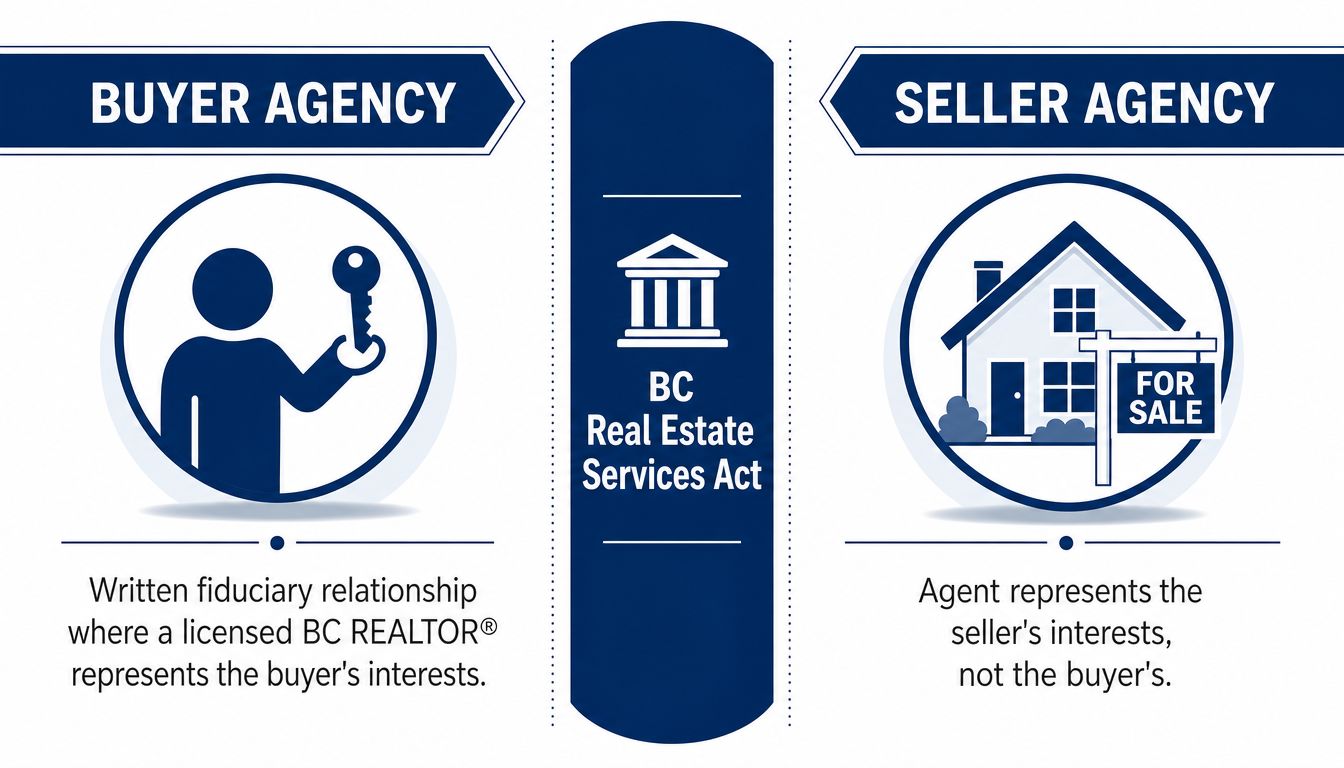
Buyer agency is a written fiduciary relationship between you and a licensed BC real estate professional. The REALTOR® represents your interests in the transaction and owes duties that include loyalty, confidentiality, disclosure, reasonable care and skill, and obedience to your lawful instructions. The relationship is documented rather than left to an informal understanding.
BCFSA explains that a buyer agency agreement is a legally binding contract with the brokerage. When signed, it creates exclusive representation for a specified period and region, which means a buyer should understand exactly what they're agreeing to before working with that brokerage on a property search. The BCREA explanation of buyer agency is useful reading before your first appointment.
The practical arrangements can differ:
Before choosing an agent, review this practical guide to choosing a Vancouver REALTOR®. Compare communication style, neighbourhood knowledge, contract discipline, and willingness to explain compensation plainly.
A buyer's agent doesn't earn your trust by saying they're on your side. The relationship has substance because BC agency law attaches duties to it. Those duties matter from the first serious consultation through subject removal and possession.
Undivided loyalty means your agent must put your interests ahead of competing personal or financial incentives. If inventory is tight in Kitsilano or Burnaby, your REALTOR® shouldn't steer you toward a property because it produces a more convenient transaction or better remuneration.
Your agent can recommend a home, but the recommendation should connect to your stated needs, financial limits, and risk tolerance. If the property isn't right, the agent should say so.
Your maximum price, reasons for moving, financing pressure, preferred possession date, and willingness to compromise should remain private. Telling the seller's representative that you “love the place” or “can go higher” can weaken your position before negotiations begin.
Confidentiality is especially valuable in a multiple-offer situation, where one careless disclosure can alter how the seller evaluates your offer.
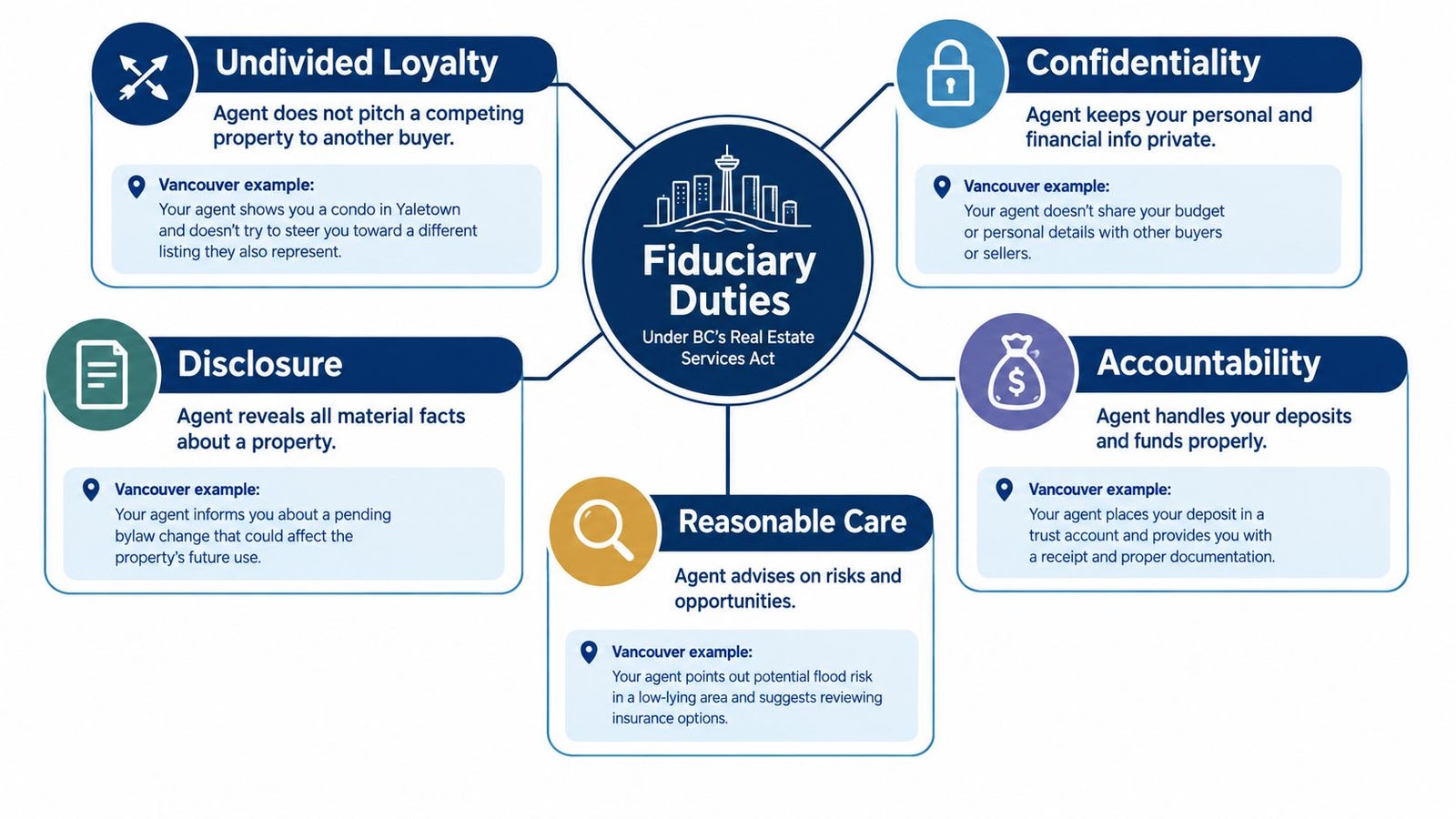
Full disclosure requires your agent to bring material facts and relevant transaction information to your attention. That can include issues revealed through available property information, strata documents, seller disclosures, or conversations with the listing representative.
A latent defect, an unusual strata restriction, or a condition that creates financing concern shouldn't be buried because it might complicate the deal. Your agent isn't a building engineer or lawyer, but they should identify when you need those professionals.
Advice should reflect Vancouver realities, including strata document review, financing conditions, inspection decisions, subject removal, deposit timing, and BC contract practice. A REALTOR® who knows only broad market headlines may miss the practical implications of a specific building, neighbourhood, or offer term.
Reasonable care doesn't mean guaranteeing an outcome. It means organizing the process competently, identifying risks, asking appropriate questions, and recommending specialist advice when the issue falls outside the agent's role.
Obedience to lawful instructions means your agent follows your decisions, not their preferred outcome. You decide whether to offer, how much to offer, which subjects to include, and whether to walk away.
The agent can advise firmly. They can explain that a condition may make an offer less competitive or that a price exceeds sensible market support. They can't substitute their judgment for yours.
BCFSA provides consumer information about protecting the public and the prohibition on ordinary dual agency through its real estate consumer protection guidance. A breach isn't merely a disappointing handshake complaint. Regulatory processes and contractual remedies may apply, depending on the facts.
Don't sign a buyer agency agreement because you're excited about a listing. Sign only after you understand the relationship, the restrictions, and the money.
BCFSA's disclosure framework requires the nature of representation to be explained before real estate services are provided. The agreement itself should make the relationship, scope, and compensation clear. Ask the REALTOR® to explain every clause in plain English, then take the document away before committing.
Term length tells you how long the agreement lasts. A longer term may suit a buyer who wants an ongoing search, but it also increases the importance of early termination rights and holdover wording.
Geographic scope defines where the agreement applies. “Greater Vancouver” can cover a much broader search than a specific Vancouver neighbourhood. If you're considering Vancouver, North Shore, Burnaby, Richmond, or Coquitlam, make sure the document reflects your actual plan.
Exclusivity determines whether you're committing to one brokerage for the covered term and region. BCREA describes the signed agreement as creating exclusive representation for a specified period and region, so don't assume you can casually work with several REALTORS® on the same search.
Compensation deserves the clearest conversation. Ask what the REALTOR® is paid, when payment is due, what happens if the seller's side offers no cooperation commission, and whether you could owe a shortfall. Commission structures are negotiable, and a written agreement should tell you how the economics work rather than relying on the old assumption that the seller automatically pays both sides.
If you deal directly with the seller's agent, don't expect confidential advice on your price or terms. The agent may need to disclose information about you to the seller where the rules require it, and the agent can't act as your private negotiating adviser.
BCFSA says an unrepresented party must be warned about the risks of dealing with a professional who already represents the other side. The required disclosure process should make that risk visible before you make a serious commitment.
If you're unrepresented, get independent legal and inspection advice before signing or submitting anything. If you want advocacy, arrange separate representation early, before you reveal your negotiating position.
Mei is a first-time buyer looking for a two-bedroom home in East Vancouver. She has a financing plan, a preferred monthly payment, and a short list of neighbourhood requirements, but she doesn't yet know which trade-offs are safe.
Her REALTOR® begins with an organized MLS review rather than sending every available listing. A Mount Pleasant condo looks attractive, but the strata material raises questions about maintenance history and future costs. Mei gets those documents before the showing, so she can decide whether the issue deserves further investigation instead of falling in love with the floor plan first.
For more neighbourhood-specific research, buyers can also review a guide to finding an apartment for sale in Vancouver.
At the property, the agent points out street noise, exposure, layout limitations, and the difference between the unit's presentation and its long-term practicality. The conversation includes comparable properties, recent local activity, strata obligations, and whether the home fits Mei's budget without forcing her to stretch beyond a responsible pre-approval.
That advice should be candid. If competing offers are likely, the agent can explain the strategic consequences of different prices and conditions. Mei still decides whether to compete, and no professional should pressure her to risk funds she can't afford to lose.
When Mei proceeds, her REALTOR® helps organize financing, inspection, and strata-document review conditions. The agent discusses deposit timing, possession terms, escalation language, and seller conditions, then presents the offer and manages the response.
Much of the work stays behind the scenes. The REALTOR® may call the listing agent for context, review Form A disclosures, clarify conflicting information, and push back when a seller's condition shifts excessive risk to the buyer. That work is difficult to appreciate if you judge representation only by the number of showings.
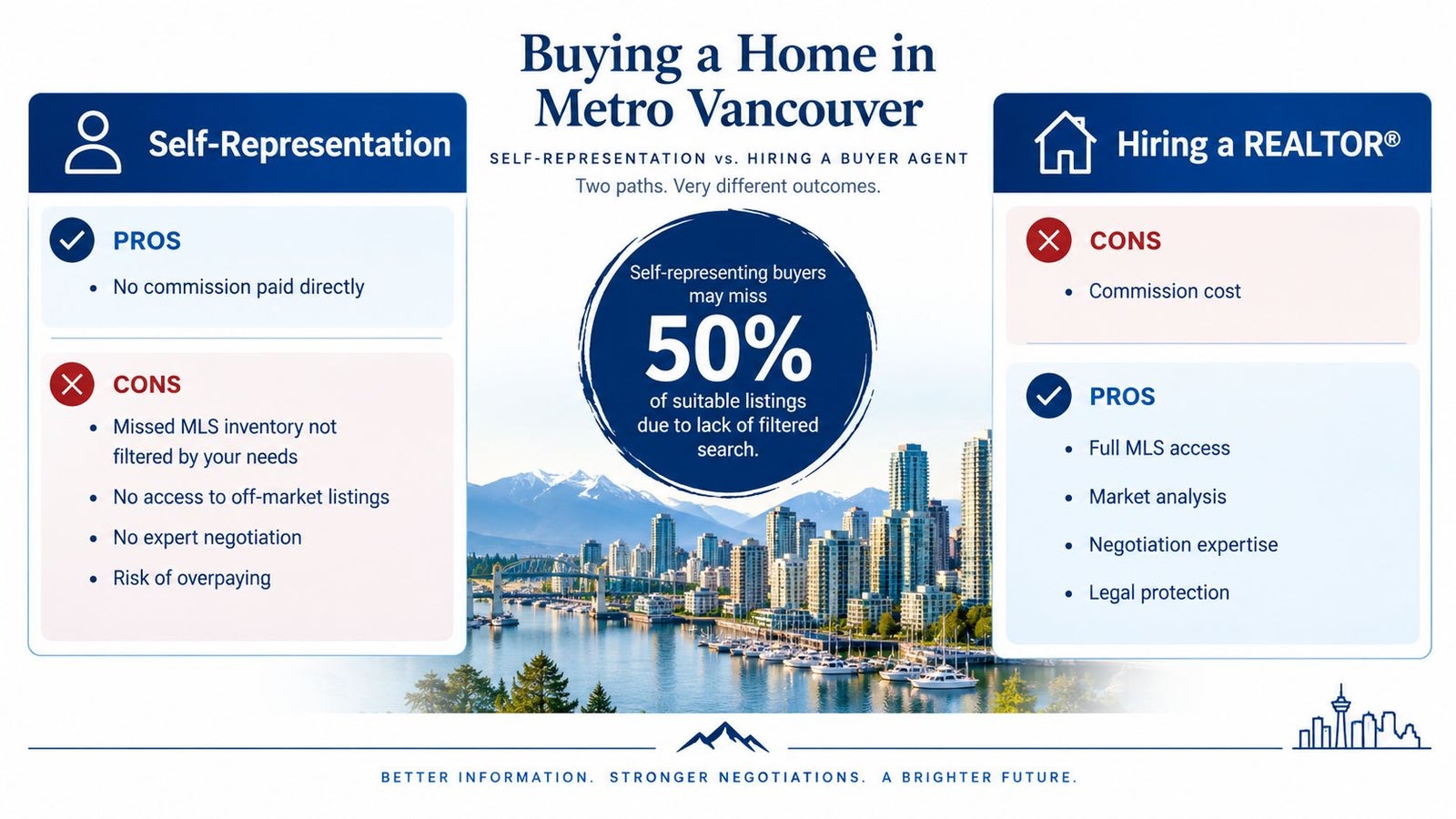
Self-representation can reduce a direct expense, but it doesn't eliminate the work or the risk. A buyer still needs to identify suitable properties, interpret market evidence, assess strata documents, draft protective conditions, negotiate price and timing, and manage the transaction through completion.
In Vancouver, the largest risk often isn't the visible commission discussion. It's the cost of making a poor decision without a professional whose job is to challenge assumptions. You might miss a suitable listing because your search is too broad or too narrow, submit an offer with weak wording, overlook a material latent defect, or accept a seller condition that should have been negotiated.
The exact economics depend on the agreement and transaction. BC commission structures are negotiable and are commonly split from seller proceeds rather than paid directly by buyers, but a buyer representation agreement should explain what happens if the seller offers no cooperation commission. That is why compensation belongs in the first serious conversation, not after several showings.
Suppose two buyers evaluate similar Kitsilano condos. The self-represented buyer negotiates directly with the listing agent and focuses on the purchase price. The buyer may save a separately payable fee if the agreement and cooperation terms allow it, but must independently handle the offer structure, document review, condition wording, and negotiation.
The represented buyer pays the agreed cost of service according to the written agreement. In return, the REALTOR® reviews the available information, identifies questions, tests the seller's position, and helps build an offer that protects financing, inspection, and document review. If the agent uncovers a risk that changes the buyer's view of value, that advice can matter more than the headline fee.
There's no universal answer. A highly experienced buyer in a calm segment may reasonably choose limited service or no representation, provided they understand the risks and obtain professional advice where needed. For a first-time buyer facing time pressure, competing offers, strata complexity, or an unfamiliar neighbourhood, I'd usually choose representation and negotiate the service terms rather than go completely alone.
Use a written plan for the negotiation, including price, subjects, dates, and walk-away limits. This offer strategy guide for Greater Vancouver buyers can help structure that conversation.
Treat the first meeting as an interview, not a commitment. You're assessing judgment, communication, local knowledge, and contract discipline.
Before you meet:
Set a regular cadence for MLS updates and any permitted off-market information. Agree on showing protocols, response times, decision deadlines, and exactly how offers and counter-offers will be communicated.
My rule is simple: never sign a buyer agency agreement in the same sitting as your first listing tour. Take it home, read every clause, and return with questions. A careful pause at the beginning is easier than trying to unwind an agreement after you've toured properties and entered negotiations.
Jacky Levi - Vancouver Realtor provides buyer representation across Greater Vancouver, including neighbourhood guidance, private-showing coordination, pricing context, offer strategy, negotiation, and transaction support. If you want a clear explanation of buyer agency in real estate before signing anything, visit Jacky Levi - Vancouver Realtor and arrange a direct conversation about your search.
What Buyer Agency Actually Means in BC
Buyer agency is a written fiduciary relationship between you and a licensed BC real estate professional. The REALTOR® represents your interests in the transaction and owes duties that include loyalty, confidentiality, disclosure, reasonable care and skill, and obedience to your lawful instructions. The relationship is documented rather than left to an informal understanding.
BCFSA explains that a buyer agency agreement is a legally binding contract with the brokerage. When signed, it creates exclusive representation for a specified period and region, which means a buyer should understand exactly what they're agreeing to before working with that brokerage on a property search. The BCREA explanation of buyer agency is useful reading before your first appointment.
The practical arrangements can differ:
- Single agency: One brokerage or designated professional represents you, with full duties owed to you under the agreement.
- Limited service: You and the REALTOR® divide responsibilities. You might handle some property research or communication while the agent provides defined services.
- Customer service or no representation: The professional may provide limited assistance but doesn't owe you the same fiduciary duties as a buyer's agent.
My recommendation: Treat buyer representation as the professional baseline for a serious search, not as a luxury add-on. If you want advice about value, conditions, negotiation, and risk, hire someone whose legal duties point toward you.
Before choosing an agent, review this practical guide to choosing a Vancouver REALTOR®. Compare communication style, neighbourhood knowledge, contract discipline, and willingness to explain compensation plainly.
The Five Fiduciary Duties You Should Expect
A buyer's agent doesn't earn your trust by saying they're on your side. The relationship has substance because BC agency law attaches duties to it. Those duties matter from the first serious consultation through subject removal and possession.
Loyalty comes before the commission
Undivided loyalty means your agent must put your interests ahead of competing personal or financial incentives. If inventory is tight in Kitsilano or Burnaby, your REALTOR® shouldn't steer you toward a property because it produces a more convenient transaction or better remuneration.
Your agent can recommend a home, but the recommendation should connect to your stated needs, financial limits, and risk tolerance. If the property isn't right, the agent should say so.
Confidentiality protects your negotiating position
Your maximum price, reasons for moving, financing pressure, preferred possession date, and willingness to compromise should remain private. Telling the seller's representative that you “love the place” or “can go higher” can weaken your position before negotiations begin.
Confidentiality is especially valuable in a multiple-offer situation, where one careless disclosure can alter how the seller evaluates your offer.
Disclosure means surfacing material risk
Full disclosure requires your agent to bring material facts and relevant transaction information to your attention. That can include issues revealed through available property information, strata documents, seller disclosures, or conversations with the listing representative.
A latent defect, an unusual strata restriction, or a condition that creates financing concern shouldn't be buried because it might complicate the deal. Your agent isn't a building engineer or lawyer, but they should identify when you need those professionals.
Reasonable care and skill must be local
Advice should reflect Vancouver realities, including strata document review, financing conditions, inspection decisions, subject removal, deposit timing, and BC contract practice. A REALTOR® who knows only broad market headlines may miss the practical implications of a specific building, neighbourhood, or offer term.
Reasonable care doesn't mean guaranteeing an outcome. It means organizing the process competently, identifying risks, asking appropriate questions, and recommending specialist advice when the issue falls outside the agent's role.
Lawful instructions keep the decision yours
Obedience to lawful instructions means your agent follows your decisions, not their preferred outcome. You decide whether to offer, how much to offer, which subjects to include, and whether to walk away.
The agent can advise firmly. They can explain that a condition may make an offer less competitive or that a price exceeds sensible market support. They can't substitute their judgment for yours.
BCFSA provides consumer information about protecting the public and the prohibition on ordinary dual agency through its real estate consumer protection guidance. A breach isn't merely a disappointing handshake complaint. Regulatory processes and contractual remedies may apply, depending on the facts.
Reading a Buyer Agency Agreement Before You Sign
Don't sign a buyer agency agreement because you're excited about a listing. Sign only after you understand the relationship, the restrictions, and the money.
BCFSA's disclosure framework requires the nature of representation to be explained before real estate services are provided. The agreement itself should make the relationship, scope, and compensation clear. Ask the REALTOR® to explain every clause in plain English, then take the document away before committing.
Start with the four clauses that control your relationship
Term length tells you how long the agreement lasts. A longer term may suit a buyer who wants an ongoing search, but it also increases the importance of early termination rights and holdover wording.
Geographic scope defines where the agreement applies. “Greater Vancouver” can cover a much broader search than a specific Vancouver neighbourhood. If you're considering Vancouver, North Shore, Burnaby, Richmond, or Coquitlam, make sure the document reflects your actual plan.
Exclusivity determines whether you're committing to one brokerage for the covered term and region. BCREA describes the signed agreement as creating exclusive representation for a specified period and region, so don't assume you can casually work with several REALTORS® on the same search.
Compensation deserves the clearest conversation. Ask what the REALTOR® is paid, when payment is due, what happens if the seller's side offers no cooperation commission, and whether you could owe a shortfall. Commission structures are negotiable, and a written agreement should tell you how the economics work rather than relying on the old assumption that the seller automatically pays both sides.
Also examine the precise definition of when the agency relationship begins. Ask whether a private showing, market analysis, offer consultation, or property tour triggers obligations. You'll find useful questions in this guide on interviewing a REALTOR® in Vancouver.
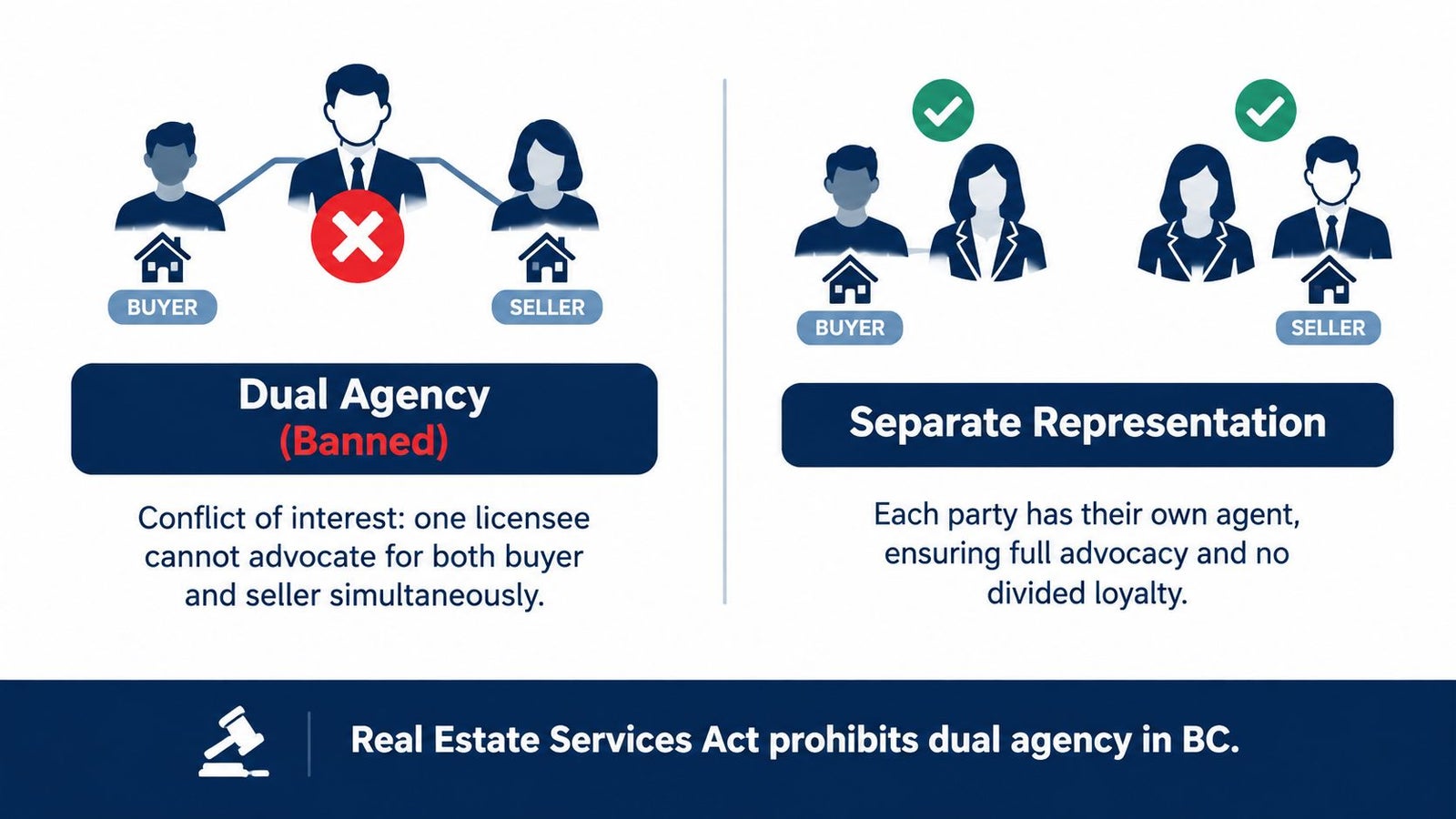
BC prohibits ordinary dual agency because one licensee can't faithfully advocate for the buyer's best price and the seller's best price in the same transaction. The ban took effect in 2018, with only rare exceptions in remote areas, according to BCFSA's consumer guidance.
That rule matters at the Vancouver kitchen table. A listing agent hired by the seller can't generally become the buyer's advocate for that same property. The agent can communicate facts and manage the seller's transaction, but the agent's loyalty remains with the seller.
Under separate representation, the buyer has one professional and the seller has another. Each side receives advice from someone whose duties point toward that client. This structure doesn't guarantee that either party gets the outcome they want, but it creates a clear professional boundary.
The phrase “same brokerage” still requires attention. If separate licensees from one brokerage represent each side, the brokerage must manage the conflict through the applicable disclosure and consent process. BC's framework distinguishes that arrangement from one licensee personally representing both parties. Ask how the brokerage handles the file and request the relevant written disclosure.
Why Dual Agency Is Off the Table in BC
BC prohibits ordinary dual agency because one licensee can't faithfully advocate for the buyer's best price and the seller's best price in the same transaction. The ban took effect in 2018, with only rare exceptions in remote areas, according to BCFSA's consumer guidance.
That rule matters at the Vancouver kitchen table. A listing agent hired by the seller can't generally become the buyer's advocate for that same property. The agent can communicate facts and manage the seller's transaction, but the agent's loyalty remains with the seller.
Separate representation removes the divided loyalty
Under separate representation, the buyer has one professional and the seller has another. Each side receives advice from someone whose duties point toward that client. This structure doesn't guarantee that either party gets the outcome they want, but it creates a clear professional boundary.
The phrase “same brokerage” still requires attention. If separate licensees from one brokerage represent each side, the brokerage must manage the conflict through the applicable disclosure and consent process. BC's framework distinguishes that arrangement from one licensee personally representing both parties. Ask how the brokerage handles the file and request the relevant written disclosure.
The unrepresented buyer's position
If you deal directly with the seller's agent, don't expect confidential advice on your price or terms. The agent may need to disclose information about you to the seller where the rules require it, and the agent can't act as your private negotiating adviser.
BCFSA says an unrepresented party must be warned about the risks of dealing with a professional who already represents the other side. The required disclosure process should make that risk visible before you make a serious commitment.
At an open house, “the agent answered my questions” doesn't mean “the agent represented me.”
If you're unrepresented, get independent legal and inspection advice before signing or submitting anything. If you want advocacy, arrange separate representation early, before you reveal your negotiating position.
What Representation Feels Like in a Vancouver Search
Mei is a first-time buyer looking for a two-bedroom home in East Vancouver. She has a financing plan, a preferred monthly payment, and a short list of neighbourhood requirements, but she doesn't yet know which trade-offs are safe.
Her REALTOR® begins with an organized MLS review rather than sending every available listing. A Mount Pleasant condo looks attractive, but the strata material raises questions about maintenance history and future costs. Mei gets those documents before the showing, so she can decide whether the issue deserves further investigation instead of falling in love with the floor plan first.
For more neighbourhood-specific research, buyers can also review a guide to finding an apartment for sale in Vancouver.
The showing is more than a door opening
At the property, the agent points out street noise, exposure, layout limitations, and the difference between the unit's presentation and its long-term practicality. The conversation includes comparable properties, recent local activity, strata obligations, and whether the home fits Mei's budget without forcing her to stretch beyond a responsible pre-approval.
That advice should be candid. If competing offers are likely, the agent can explain the strategic consequences of different prices and conditions. Mei still decides whether to compete, and no professional should pressure her to risk funds she can't afford to lose.
Offer preparation reveals the real value
When Mei proceeds, her REALTOR® helps organize financing, inspection, and strata-document review conditions. The agent discusses deposit timing, possession terms, escalation language, and seller conditions, then presents the offer and manages the response.
Much of the work stays behind the scenes. The REALTOR® may call the listing agent for context, review Form A disclosures, clarify conflicting information, and push back when a seller's condition shifts excessive risk to the buyer. That work is difficult to appreciate if you judge representation only by the number of showings.
When Skipping an Agent Actually Costs More
Self-representation can reduce a direct expense, but it doesn't eliminate the work or the risk. A buyer still needs to identify suitable properties, interpret market evidence, assess strata documents, draft protective conditions, negotiate price and timing, and manage the transaction through completion.
In Vancouver, the largest risk often isn't the visible commission discussion. It's the cost of making a poor decision without a professional whose job is to challenge assumptions. You might miss a suitable listing because your search is too broad or too narrow, submit an offer with weak wording, overlook a material latent defect, or accept a seller condition that should have been negotiated.
The exact economics depend on the agreement and transaction. BC commission structures are negotiable and are commonly split from seller proceeds rather than paid directly by buyers, but a buyer representation agreement should explain what happens if the seller offers no cooperation commission. That is why compensation belongs in the first serious conversation, not after several showings.
A Kitsilano comparison
Suppose two buyers evaluate similar Kitsilano condos. The self-represented buyer negotiates directly with the listing agent and focuses on the purchase price. The buyer may save a separately payable fee if the agreement and cooperation terms allow it, but must independently handle the offer structure, document review, condition wording, and negotiation.
The represented buyer pays the agreed cost of service according to the written agreement. In return, the REALTOR® reviews the available information, identifies questions, tests the seller's position, and helps build an offer that protects financing, inspection, and document review. If the agent uncovers a risk that changes the buyer's view of value, that advice can matter more than the headline fee.
There's no universal answer. A highly experienced buyer in a calm segment may reasonably choose limited service or no representation, provided they understand the risks and obtain professional advice where needed. For a first-time buyer facing time pressure, competing offers, strata complexity, or an unfamiliar neighbourhood, I'd usually choose representation and negotiate the service terms rather than go completely alone.
Use a written plan for the negotiation, including price, subjects, dates, and walk-away limits. This offer strategy guide for Greater Vancouver buyers can help structure that conversation.
Your Next Steps With a Vancouver REALTOR®
Treat the first meeting as an interview, not a commitment. You're assessing judgment, communication, local knowledge, and contract discipline.
Before you meet:
- Prepare financing: Bring your mortgage pre-approval or speak with a qualified mortgage professional.
- Define the search: List your preferred neighbourhoods, property type, budget boundaries, must-haves, and acceptable compromises.
- Write questions: Ask about experience in your target pocket, strata review practices, offer strategy, availability, and communication.
During the meeting
- Confirm licensing: Ask the REALTOR® to explain their licence status and brokerage relationship.
- Read the agreement: Request a plain-language explanation of term, geography, exclusivity, compensation, termination, and holdover clauses.
- Clarify cooperation: Ask whether payment from the listing side is expected, documented, or unavailable, and what you would owe in each situation.
- Test candour: Ask for examples of deals where the agent advised a client not to buy or not to overbid.
- Request references: Speak with recent Vancouver buyers who can describe the actual working relationship.
After signing
Set a regular cadence for MLS updates and any permitted off-market information. Agree on showing protocols, response times, decision deadlines, and exactly how offers and counter-offers will be communicated.
My rule is simple: never sign a buyer agency agreement in the same sitting as your first listing tour. Take it home, read every clause, and return with questions. A careful pause at the beginning is easier than trying to unwind an agreement after you've toured properties and entered negotiations.
Jacky Levi - Vancouver Realtor provides buyer representation across Greater Vancouver, including neighbourhood guidance, private-showing coordination, pricing context, offer strategy, negotiation, and transaction support. If you want a clear explanation of buyer agency in real estate before signing anything, visit Jacky Levi - Vancouver Realtor and arrange a direct conversation about your search.