
You're touring a Vancouver building that looks exactly like the last apartment you saw. Same lobby, similar floor plans, comparable amenities. Then the listing agent says it's a condo, while the rental ad down the street calls a nearly identical home an apartment. The confusion is understandable, because the condo and apartment difference in Vancouver usually isn't architectural. It's legal and financial.
A condo is generally an individually owned strata lot. An apartment is generally a rental unit in a building owned by one landlord or ownership entity. That distinction affects who holds title, who sets the rules, who pays for major building costs, how renting works, and what happens when something goes wrong.
The right choice depends on what you're trying to do. A first-time buyer, a renter relocating to Vancouver, a seller preparing a listing, and an investor comparing cash flow should ask different questions.
Walk into an apartment-style tower in Vancouver, and you might see a concierge desk, shared corridors, elevators, underground parking and a fitness room. Those features don't tell you whether the homes inside are condos or rental apartments. The same physical style can operate under either ownership model.
A buyer may own one unit in the building, while another resident rents a different unit from its owner. To the person living there, both homes may feel like apartments. Legally, one is a strata lot owned by an individual, and the other is a rental unit controlled by a landlord or property company.
That distinction becomes practical the moment you need permission for a renovation, receive a building notice, face a water leak or decide to move. A condo owner answers to the strata corporation and must follow its bylaws. A tenant usually deals with a landlord or property manager under a tenancy agreement.
Condo ownership is a major part of housing in British Columbia. Statistics Canada found that condominium apartments represented close to 20% of properties in BC, compared with about 10% in Ontario, while properties with multiple residential units accounted for 10.1% in BC versus 3.3% in Ontario according to its Canadian Housing Statistics Program data. In Vancouver, 32.5% of households called a condo home in 2021, and BC had the largest provincial share of condo dwellers at 23.6%, based on the same Statistics Canada source.
That's why “condo” in Vancouver signals more than a style of building. It signals an ownership system that shapes urban housing, investment decisions and rental supply across the city and the Lower Mainland.
By the end of this guide, you'll be able to identify the legal difference, compare the true financial exposure, understand rental restrictions, and decide whether buying a condo or renting an apartment fits your circumstances.
In British Columbia, a condo is typically a strata lot. The owner holds title to an individual unit and an undivided share of the building's common property, such as hallways, elevators, exterior walls and shared facilities. The strata corporation manages those common areas and collects contributions from owners for operating costs and long-term building needs.
An apartment is usually a rental unit owned by one landlord, corporation or other entity. The resident pays rent under a tenancy agreement rather than holding title to the home. The landlord remains responsible for the building as a whole, subject to applicable legal duties and the terms of the tenancy.
The visual distinction is unreliable. BC strata housing can include apartment-style buildings, townhomes, duplexes and some detached-home subdivisions. The province makes this point in its guidance on living in a strata, which explains that strata housing isn't the same as renting an apartment and isn't limited to one building form.
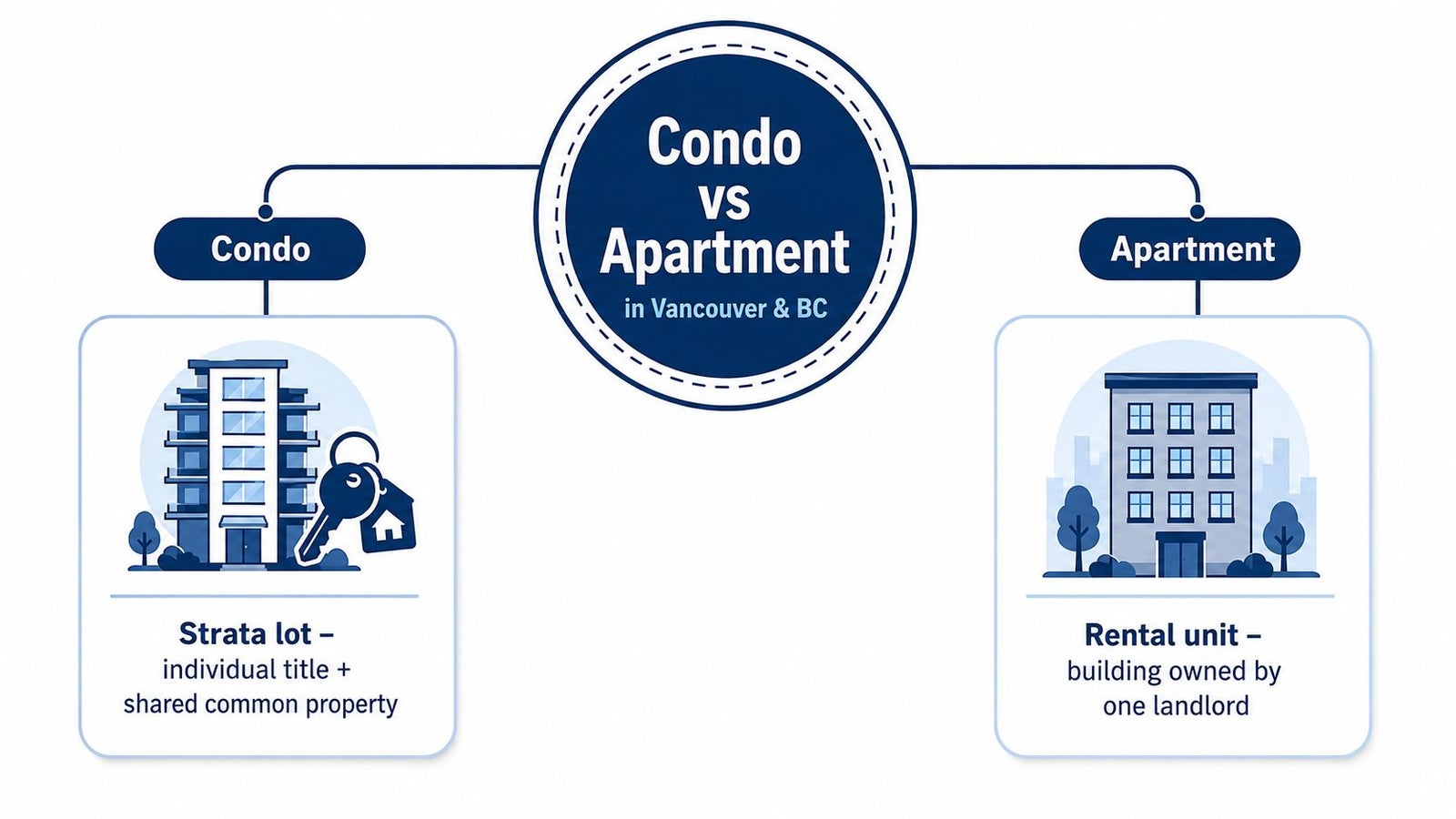
Consider two homes in similar towers near a SkyTrain station. In the first, an individual owner bought the unit and pays strata fees, property taxes and mortgage costs. In the second, a rental company owns the unit or the entire building, and the resident pays rent to that landlord.
Both homes may have a balcony, appliance package and access to a shared gym. The owner of the condo may be able to sell the strata lot, subject to the market and transaction requirements. The apartment tenant can leave according to the tenancy agreement but doesn't own an asset to sell.
A townhome can also be a condo if it's part of a strata corporation. A detached home can be part of a strata subdivision. Conversely, a building that looks like a condo tower may be operated entirely as rental housing.
The ownership model determines your obligations. Condo ownership brings shared governance, fees, unit entitlement and exposure to building decisions. Apartment renting brings a landlord relationship and a tenancy agreement, with no direct ownership interest in the building.
That's the core of the condo and apartment difference. Don't let granite counters, a modern lobby or a rooftop terrace decide the category. Confirm the title structure and the governing documents.
The legal framework explains why condo ownership feels different from apartment renting even when the homes look alike. A condo owner owns a defined strata lot and shares responsibility for common property. An apartment renter occupies a unit owned by someone else and normally has no vote in the building's ownership decisions.
BC's strata framework began with the first strata legislation in 1966, was updated through the Strata Titles Act of 1974, and was later superseded by the Strata Property Act of 1998, which remains in force. This legal evolution gave BC a formal way to divide a building into individually owned units while keeping common property under shared administration. The historical development is outlined in this BC strata legal and ownership overview.
The market reflects that structure. Statistics Canada reported that 36.3% of BC condos were investor-owned in 2020, compared with 16.5% of houses, making condos more than twice as likely as houses to be investor-owned. CMHC also found that 10.4% of condominium apartments in BC had at least one non-resident owner, compared with 6.1% in Ontario, while the Vancouver CMA recorded 11.2%. Those figures are available through the linked background source above and show why condos function as a distinct ownership and investment class.
A condo owner who rents out a unit has two sets of documents to understand. The owner must follow strata bylaws and the Strata Property Act, while the tenancy itself is also governed by the Residential Tenancy Act. A tenant in a conventional apartment generally deals with the landlord or manager rather than a strata council.
Before buying, review the minutes, bylaws, financial statements and Form B information. A practical guide to Form B information certificates for Vancouver condo buyers can help you understand which building details deserve attention before you waive conditions.
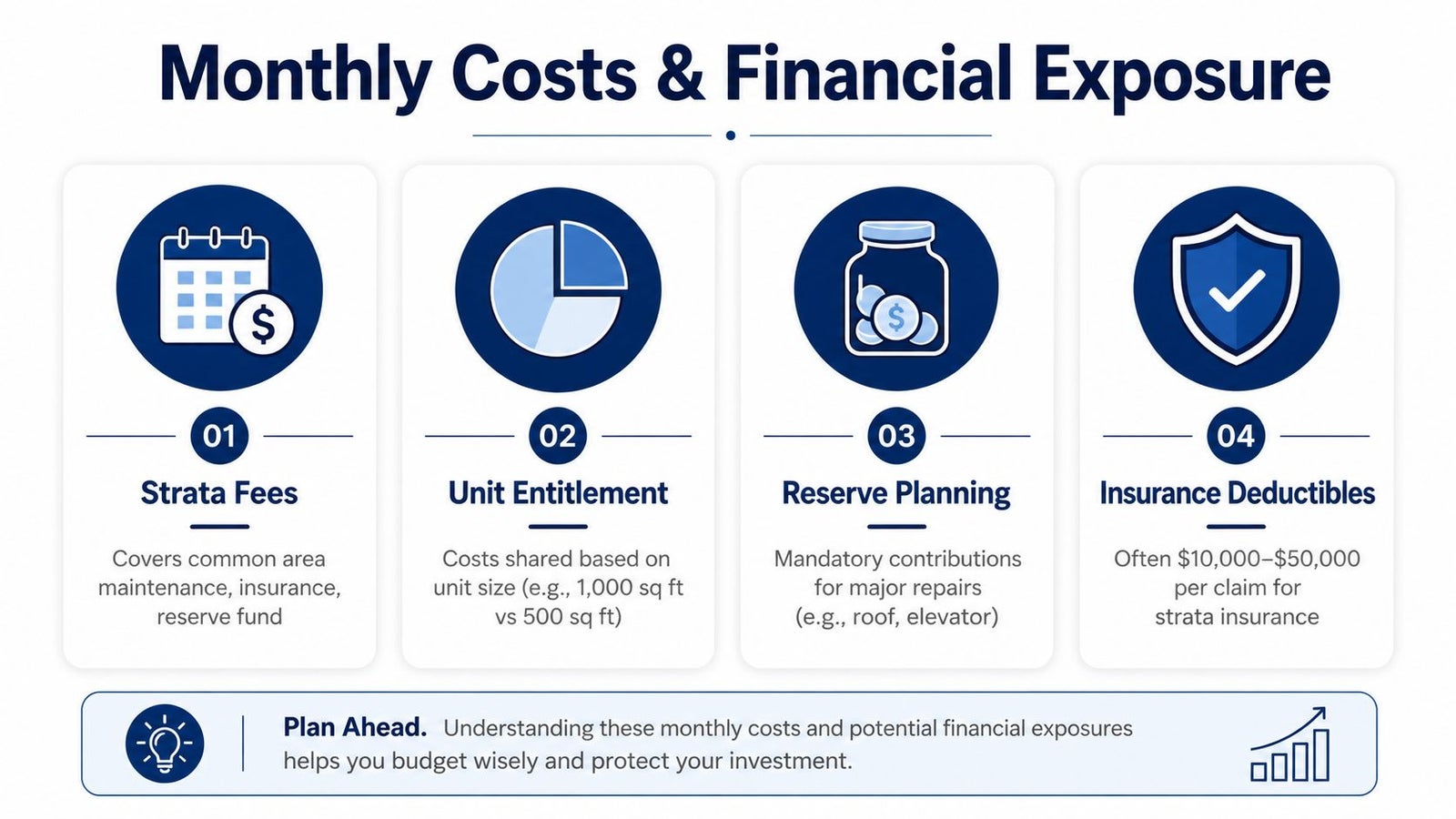
The biggest budgeting mistake is treating a condo payment as if it were only a mortgage. Ownership carries shared operating expenses, reserve planning and insurance exposure. Apartment renting is usually more predictable because the tenant pays rent under the tenancy agreement and doesn't directly fund the building's capital obligations.
Strata fees cover shared expenses and are allocated partly through unit entitlement, which determines an owner's proportionate share of common property and costs. A larger home may carry a different allocation from a smaller one, and the fee level depends on the building's services, maintenance needs, insurance and reserve planning.
The fee itself isn't the only issue. An underfunded reserve plan can create pressure for major work, while a building with extensive amenities may have higher ongoing operating costs. Owners also need to understand whether insurance deductibles or special levies could affect them.
BC law requires a strata corporation to insure common property and buildings shown on the strata plan at full replacement value and to carry at least $2 million in liability insurance, as explained in this BC condo insurance and deductible guide. The same source explains that an insurance deductible can be treated as a common expense and charged through strata fees in certain circumstances.
The rental market shows why “condo versus apartment” can become a cash-flow question. CMHC's 2025 Rental Market Report recorded 3.7% purpose-built rental vacancy in Metro Vancouver, compared with 1.5% vacancy for condominium apartments, and reported an average two-bedroom condo apartment rent of about $2,900. The report is available through CMHC's Rental Market Reports for major centres.
Separate Metro Vancouver housing data found rental condominiums averaged $2,541 in 2024, compared with $1,929 for purpose-built rentals, a 32% premium. That premium may help an owner's gross revenue, but it doesn't automatically produce positive cash flow after financing, strata fees, property taxes, insurance and repairs.
Watch for these practical exposures:
A Vancouver buyer should request the current insurance certificate, deductible amount, recent financial statements, depreciation report where applicable, meeting minutes and history of special levies. You can also review Vancouver condo sales trends, prices and 2026 insights before comparing a purchase against local rental alternatives.
The old assumption that a condo strata can ban rentals is no longer reliable. BC prohibits rental-restriction bylaws in strata corporations, so long-term renting is generally allowed. That doesn't mean every rental strategy is permitted, and it doesn't remove the owner's responsibility to comply with the building's other bylaws and the Residential Tenancy Act.
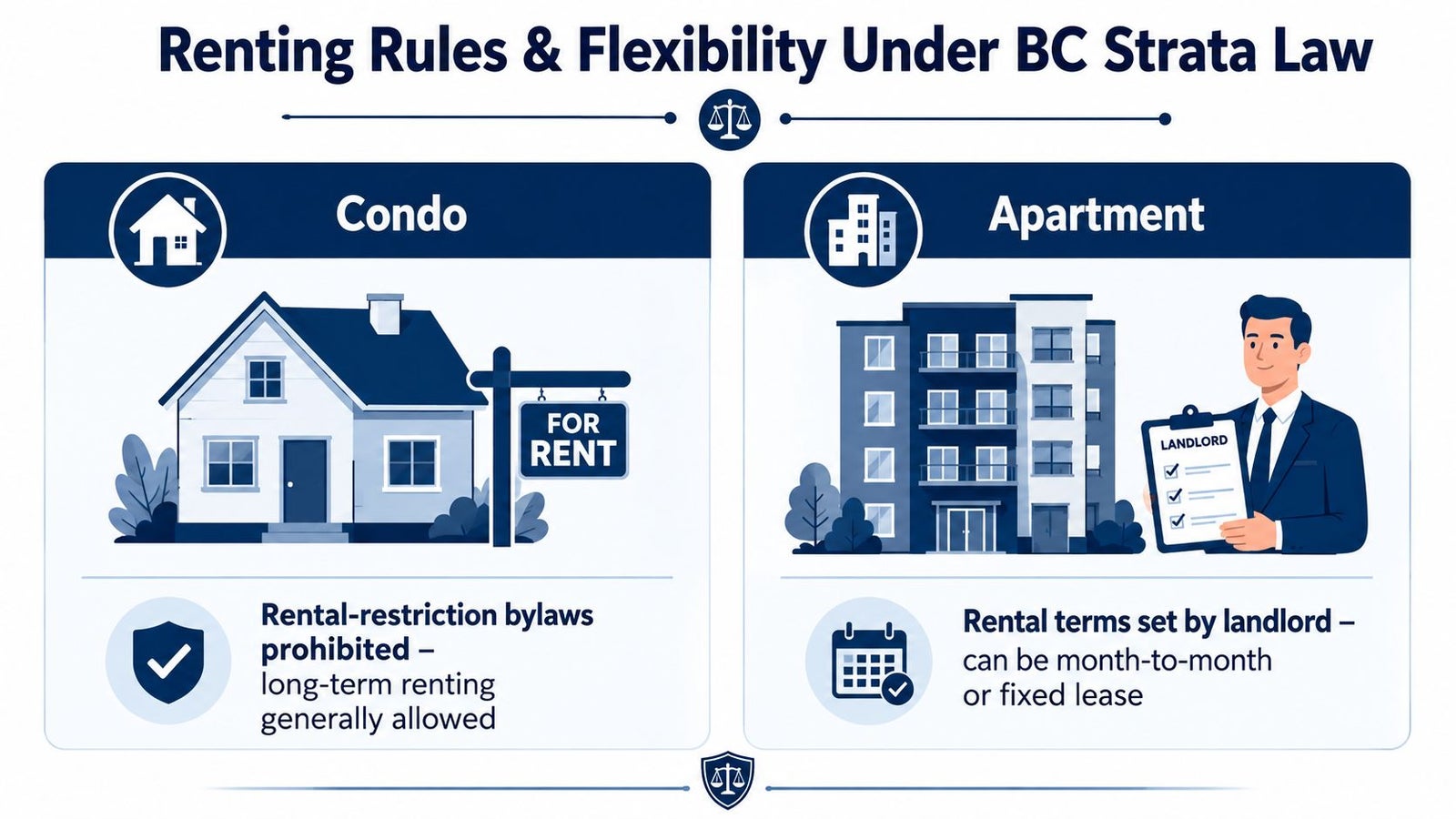
A condo investor can generally rent a unit to a long-term tenant, but the tenancy still has to comply with provincial landlord-tenant requirements. The tenant receives the protections and obligations that apply under the Residential Tenancy Act, while the owner remains accountable to the strata corporation.
Short-term rentals are a separate issue. They remain tightly restricted, and municipalities such as Vancouver generally limit them to principal residences only. A buyer planning to use a condo as a short-term rental shouldn't rely on a listing description or casual advice. The applicable municipal requirements and strata documents need to be checked directly through the province's short-term rental bylaws guidance.
An investor may buy a condo intending to create a stable long-term rental. That plan can work only if the projected rent covers the full ownership burden and the unit complies with strata rules, municipal requirements and tenancy law.
A relocating professional might rent a condo for a year. The resident deals with an individual owner and may encounter unit-specific rules about move-ins, pets, alterations or access. The home may feel more personal than a standard rental, but the tenant still has legal tenancy rights.
A first-time buyer may want the option to rent the unit later. That flexibility can be valuable, but it shouldn't be confused with permission for nightly stays or hotel-style use.
A condo landlord operates under two overlapping legal regimes, unlike a typical apartment renter who mainly deals with the landlord or property manager. The provincial explanation of renting in strata makes that dual responsibility clear.
The best choice depends less on whether you like towers or low-rise buildings and more on whether you want ownership responsibility. Vancouver's housing stock includes a substantial condo presence, so buyers and renters have plenty of overlap in location and building style. The decision turns on control, flexibility and financial exposure.
Buy a condo when you want to establish ownership, can manage the mortgage and carrying costs, and are prepared to participate in a shared building. The purchase gives you a title interest in the strata lot, but it also makes you responsible for decisions that affect the building.
Don't buy solely because the monthly mortgage appears close to rent. Add strata fees, property taxes, insurance, utilities, maintenance inside the unit and the possibility of special levies. Read the strata documents before treating the unit as affordable.
Position the property as a specific strata opportunity, not as a generic apartment. Buyers will want to know about fees, amenities, parking, storage, pet rules, rental permissions, recent work and insurance exposure. A clean document package can reduce uncertainty and help buyers understand the home's real value.
A seller should also separate the unit's features from the building's condition. New flooring may improve presentation, but it won't resolve concerns about deferred maintenance or weak reserve planning.
Choose an apartment when you want a straightforward tenancy relationship and less responsibility for building capital costs. Choose a rented condo when the specific home, location or owner relationship is more attractive, but read the tenancy agreement and building rules carefully.
Ask who handles repairs, how access is arranged, what utilities you'll pay, whether pets are allowed and what move-in restrictions apply. The word “condo” doesn't automatically mean better service, and “apartment” doesn't automatically mean lower quality.
A condo may offer rental flexibility and an ownership asset, but the financial analysis must include governance risk. Review strata minutes, fee history, insurance deductibles, reserve planning, rental use and the cost of complying with municipal rules.
Purpose-built rental and individually owned rental condos can produce different vacancy and rent outcomes. Compare net cash flow, not advertised rent. For a broader purchasing framework, review this Vancouver condos for sale 2026 buyers guide.
Use documents to make the decision. A viewing tells you whether the home feels right, but it won't reveal the building's financial health, rental rules or insurance exposure.
Before submitting or finalizing an offer, check:
A buyer should also separate a good unit from a risky building. A renovated suite doesn't compensate for unclear insurance, recurring water issues or a budget that ignores predictable capital work.
Ask for the tenancy agreement before committing. Confirm rent, deposit terms, utilities, renewal expectations, repair procedures, access rules and any strata requirements that affect your daily life.
If you're considering an apartment purchase or a rental-oriented property, use these Vancouver apartment search considerations to organise the search around location, ownership structure and intended use rather than appearance alone.
The practical recommendation is simple. Buy a condo when you want ownership and can absorb shared building obligations. Rent an apartment when flexibility and predictable responsibility matter more than building equity. If you're unsure, have the documents reviewed before you commit, not after a problem appears.
Jacky Levi - Vancouver Realtor offers buyer and seller representation, strata document review coordination, neighbourhood-level market analysis and full transaction management across Greater Vancouver. Visit Jacky Levi - Vancouver Realtor to discuss whether a condo purchase, condo sale or apartment rental strategy fits your goals and the building's real financial and legal conditions.
A condo is generally an individually owned strata lot. An apartment is generally a rental unit in a building owned by one landlord or ownership entity. That distinction affects who holds title, who sets the rules, who pays for major building costs, how renting works, and what happens when something goes wrong.
- Ownership: A condo owner holds title to a strata lot. An apartment building is typically owned by one landlord or ownership entity.
- Shared areas: Condo owners share common property through the strata corporation. In an apartment, the landlord manages common areas.
- Monthly payment: Condo costs may include a mortgage or rent, property taxes if owned, and strata fees. Apartment living usually means rent, plus any utilities or charges listed in the tenancy agreement.
- Governance: Condos are governed by strata bylaws, rules, and the Strata Property Act. Apartments are governed by lease terms and landlord-tenant law.
- Major building costs: Condo owners may face special levies or deductible assessments. In an apartment building, those costs are usually the landlord's responsibility.
- Rental flexibility: Long-term renting in a condo is generally allowed, subject to applicable rules. In an apartment, flexibility depends on the lease and landlord policies.
- Resale: A condo owner can sell the strata lot. A tenant in an apartment has no property to resell.
The right choice depends on what you're trying to do. A first-time buyer, a renter relocating to Vancouver, a seller preparing a listing, and an investor comparing cash flow should ask different questions.
Introduction: Why the Same Building Can Be Both
The building style doesn't answer the question
Walk into an apartment-style tower in Vancouver, and you might see a concierge desk, shared corridors, elevators, underground parking and a fitness room. Those features don't tell you whether the homes inside are condos or rental apartments. The same physical style can operate under either ownership model.
A buyer may own one unit in the building, while another resident rents a different unit from its owner. To the person living there, both homes may feel like apartments. Legally, one is a strata lot owned by an individual, and the other is a rental unit controlled by a landlord or property company.
That distinction becomes practical the moment you need permission for a renovation, receive a building notice, face a water leak or decide to move. A condo owner answers to the strata corporation and must follow its bylaws. A tenant usually deals with a landlord or property manager under a tenancy agreement.
The useful question: Don't ask whether the home looks like an apartment. Ask who owns the unit and who controls the shared building.
Why Vancouver makes the distinction especially important
Condo ownership is a major part of housing in British Columbia. Statistics Canada found that condominium apartments represented close to 20% of properties in BC, compared with about 10% in Ontario, while properties with multiple residential units accounted for 10.1% in BC versus 3.3% in Ontario according to its Canadian Housing Statistics Program data. In Vancouver, 32.5% of households called a condo home in 2021, and BC had the largest provincial share of condo dwellers at 23.6%, based on the same Statistics Canada source.
That's why “condo” in Vancouver signals more than a style of building. It signals an ownership system that shapes urban housing, investment decisions and rental supply across the city and the Lower Mainland.
By the end of this guide, you'll be able to identify the legal difference, compare the true financial exposure, understand rental restrictions, and decide whether buying a condo or renting an apartment fits your circumstances.
What Condo and Apartment Mean in Vancouver and BC
Start with ownership, not appearance
In British Columbia, a condo is typically a strata lot. The owner holds title to an individual unit and an undivided share of the building's common property, such as hallways, elevators, exterior walls and shared facilities. The strata corporation manages those common areas and collects contributions from owners for operating costs and long-term building needs.
An apartment is usually a rental unit owned by one landlord, corporation or other entity. The resident pays rent under a tenancy agreement rather than holding title to the home. The landlord remains responsible for the building as a whole, subject to applicable legal duties and the terms of the tenancy.
The visual distinction is unreliable. BC strata housing can include apartment-style buildings, townhomes, duplexes and some detached-home subdivisions. The province makes this point in its guidance on living in a strata, which explains that strata housing isn't the same as renting an apartment and isn't limited to one building form.
Apply the definition to real Vancouver examples
Consider two homes in similar towers near a SkyTrain station. In the first, an individual owner bought the unit and pays strata fees, property taxes and mortgage costs. In the second, a rental company owns the unit or the entire building, and the resident pays rent to that landlord.
Both homes may have a balcony, appliance package and access to a shared gym. The owner of the condo may be able to sell the strata lot, subject to the market and transaction requirements. The apartment tenant can leave according to the tenancy agreement but doesn't own an asset to sell.
A townhome can also be a condo if it's part of a strata corporation. A detached home can be part of a strata subdivision. Conversely, a building that looks like a condo tower may be operated entirely as rental housing.
Why the term matters to Vancouver buyers
The ownership model determines your obligations. Condo ownership brings shared governance, fees, unit entitlement and exposure to building decisions. Apartment renting brings a landlord relationship and a tenancy agreement, with no direct ownership interest in the building.
That's the core of the condo and apartment difference. Don't let granite counters, a modern lobby or a rooftop terrace decide the category. Confirm the title structure and the governing documents.
Ownership and Legal Structure Compared Side by Side
The legal framework explains why condo ownership feels different from apartment renting even when the homes look alike. A condo owner owns a defined strata lot and shares responsibility for common property. An apartment renter occupies a unit owned by someone else and normally has no vote in the building's ownership decisions.
Core differentiator: A condo is an ownership interest inside a shared legal structure. An apartment is usually a tenancy inside a building controlled by one owner.
BC's strata system created a distinct ownership class
BC's strata framework began with the first strata legislation in 1966, was updated through the Strata Titles Act of 1974, and was later superseded by the Strata Property Act of 1998, which remains in force. This legal evolution gave BC a formal way to divide a building into individually owned units while keeping common property under shared administration. The historical development is outlined in this BC strata legal and ownership overview.
The market reflects that structure. Statistics Canada reported that 36.3% of BC condos were investor-owned in 2020, compared with 16.5% of houses, making condos more than twice as likely as houses to be investor-owned. CMHC also found that 10.4% of condominium apartments in BC had at least one non-resident owner, compared with 6.1% in Ontario, while the Vancouver CMA recorded 11.2%. Those figures are available through the linked background source above and show why condos function as a distinct ownership and investment class.
The compliance difference for landlords
A condo owner who rents out a unit has two sets of documents to understand. The owner must follow strata bylaws and the Strata Property Act, while the tenancy itself is also governed by the Residential Tenancy Act. A tenant in a conventional apartment generally deals with the landlord or manager rather than a strata council.
Before buying, review the minutes, bylaws, financial statements and Form B information. A practical guide to Form B information certificates for Vancouver condo buyers can help you understand which building details deserve attention before you waive conditions.
Monthly Costs, Fees and Financial Exposure in Practice
The biggest budgeting mistake is treating a condo payment as if it were only a mortgage. Ownership carries shared operating expenses, reserve planning and insurance exposure. Apartment renting is usually more predictable because the tenant pays rent under the tenancy agreement and doesn't directly fund the building's capital obligations.
Condo costs extend beyond the monthly fee
Strata fees cover shared expenses and are allocated partly through unit entitlement, which determines an owner's proportionate share of common property and costs. A larger home may carry a different allocation from a smaller one, and the fee level depends on the building's services, maintenance needs, insurance and reserve planning.
The fee itself isn't the only issue. An underfunded reserve plan can create pressure for major work, while a building with extensive amenities may have higher ongoing operating costs. Owners also need to understand whether insurance deductibles or special levies could affect them.
BC law requires a strata corporation to insure common property and buildings shown on the strata plan at full replacement value and to carry at least $2 million in liability insurance, as explained in this BC condo insurance and deductible guide. The same source explains that an insurance deductible can be treated as a common expense and charged through strata fees in certain circumstances.
Vancouver rental economics aren't interchangeable
The rental market shows why “condo versus apartment” can become a cash-flow question. CMHC's 2025 Rental Market Report recorded 3.7% purpose-built rental vacancy in Metro Vancouver, compared with 1.5% vacancy for condominium apartments, and reported an average two-bedroom condo apartment rent of about $2,900. The report is available through CMHC's Rental Market Reports for major centres.
Separate Metro Vancouver housing data found rental condominiums averaged $2,541 in 2024, compared with $1,929 for purpose-built rentals, a 32% premium. That premium may help an owner's gross revenue, but it doesn't automatically produce positive cash flow after financing, strata fees, property taxes, insurance and repairs.
Watch for these practical exposures:
- Deductible assessments: A water leak that triggers a strata insurance claim can lead to owners sharing the deductible through fees or a special levy.
- Reserve pressure: Elevators, roofs and building systems require long-term planning, and owners share the financial consequences of delayed maintenance.
- Operating increases: A low current fee isn't necessarily a bargain if the budget doesn't reflect the building's actual needs.
- Tenant predictability: Apartment renters usually face rent and agreed utilities rather than direct exposure to strata assessments.
A Vancouver buyer should request the current insurance certificate, deductible amount, recent financial statements, depreciation report where applicable, meeting minutes and history of special levies. You can also review Vancouver condo sales trends, prices and 2026 insights before comparing a purchase against local rental alternatives.
Renting Rules and Flexibility Under BC Strata Law
The old assumption that a condo strata can ban rentals is no longer reliable. BC prohibits rental-restriction bylaws in strata corporations, so long-term renting is generally allowed. That doesn't mean every rental strategy is permitted, and it doesn't remove the owner's responsibility to comply with the building's other bylaws and the Residential Tenancy Act.
Long-term renting is different from short-term use
A condo investor can generally rent a unit to a long-term tenant, but the tenancy still has to comply with provincial landlord-tenant requirements. The tenant receives the protections and obligations that apply under the Residential Tenancy Act, while the owner remains accountable to the strata corporation.
Short-term rentals are a separate issue. They remain tightly restricted, and municipalities such as Vancouver generally limit them to principal residences only. A buyer planning to use a condo as a short-term rental shouldn't rely on a listing description or casual advice. The applicable municipal requirements and strata documents need to be checked directly through the province's short-term rental bylaws guidance.
Three scenarios that expose the difference
An investor may buy a condo intending to create a stable long-term rental. That plan can work only if the projected rent covers the full ownership burden and the unit complies with strata rules, municipal requirements and tenancy law.
A relocating professional might rent a condo for a year. The resident deals with an individual owner and may encounter unit-specific rules about move-ins, pets, alterations or access. The home may feel more personal than a standard rental, but the tenant still has legal tenancy rights.
A first-time buyer may want the option to rent the unit later. That flexibility can be valuable, but it shouldn't be confused with permission for nightly stays or hotel-style use.
A condo landlord operates under two overlapping legal regimes, unlike a typical apartment renter who mainly deals with the landlord or property manager. The provincial explanation of renting in strata makes that dual responsibility clear.
Practical rule: Before listing a condo, confirm the permitted rental use, municipal licensing requirements, move-in procedures, tenant insurance expectations and every relevant strata bylaw.
Which Option Fits Your Situation in Vancouver
The best choice depends less on whether you like towers or low-rise buildings and more on whether you want ownership responsibility. Vancouver's housing stock includes a substantial condo presence, so buyers and renters have plenty of overlap in location and building style. The decision turns on control, flexibility and financial exposure.
If you're a first-time buyer
Buy a condo when you want to establish ownership, can manage the mortgage and carrying costs, and are prepared to participate in a shared building. The purchase gives you a title interest in the strata lot, but it also makes you responsible for decisions that affect the building.
Don't buy solely because the monthly mortgage appears close to rent. Add strata fees, property taxes, insurance, utilities, maintenance inside the unit and the possibility of special levies. Read the strata documents before treating the unit as affordable.
If you're selling a condo
Position the property as a specific strata opportunity, not as a generic apartment. Buyers will want to know about fees, amenities, parking, storage, pet rules, rental permissions, recent work and insurance exposure. A clean document package can reduce uncertainty and help buyers understand the home's real value.
A seller should also separate the unit's features from the building's condition. New flooring may improve presentation, but it won't resolve concerns about deferred maintenance or weak reserve planning.
If you're renting
Choose an apartment when you want a straightforward tenancy relationship and less responsibility for building capital costs. Choose a rented condo when the specific home, location or owner relationship is more attractive, but read the tenancy agreement and building rules carefully.
Ask who handles repairs, how access is arranged, what utilities you'll pay, whether pets are allowed and what move-in restrictions apply. The word “condo” doesn't automatically mean better service, and “apartment” doesn't automatically mean lower quality.
If you're investing
A condo may offer rental flexibility and an ownership asset, but the financial analysis must include governance risk. Review strata minutes, fee history, insurance deductibles, reserve planning, rental use and the cost of complying with municipal rules.
Purpose-built rental and individually owned rental condos can produce different vacancy and rent outcomes. Compare net cash flow, not advertised rent. For a broader purchasing framework, review this Vancouver condos for sale 2026 buyers guide.
How to Choose and What to Check Before You Act
Use documents to make the decision. A viewing tells you whether the home feels right, but it won't reveal the building's financial health, rental rules or insurance exposure.
Buyer checklist
Before submitting or finalizing an offer, check:
- Strata documents: Read bylaws, rules, minutes, budgets, financial statements and the Form B information certificate.
- Insurance details: Confirm the corporation's coverage, the current deductible and whether recent claims or assessments appear in the records.
- Fee history: Compare the current strata fee with past budgets and understand what services it covers.
- Reserve planning: Look for evidence that the corporation is preparing for major repairs rather than postponing them.
- Rental permissions: Confirm long-term rental use, short-term restrictions, move-in requirements and municipal obligations.
- Unit condition: Inspect plumbing, appliances, windows, flooring and any alterations that may require approval.
A buyer should also separate a good unit from a risky building. A renovated suite doesn't compensate for unclear insurance, recurring water issues or a budget that ignores predictable capital work.
Renter checklist
Ask for the tenancy agreement before committing. Confirm rent, deposit terms, utilities, renewal expectations, repair procedures, access rules and any strata requirements that affect your daily life.
If you're considering an apartment purchase or a rental-oriented property, use these Vancouver apartment search considerations to organise the search around location, ownership structure and intended use rather than appearance alone.
The practical recommendation is simple. Buy a condo when you want ownership and can absorb shared building obligations. Rent an apartment when flexibility and predictable responsibility matter more than building equity. If you're unsure, have the documents reviewed before you commit, not after a problem appears.
Jacky Levi - Vancouver Realtor offers buyer and seller representation, strata document review coordination, neighbourhood-level market analysis and full transaction management across Greater Vancouver. Visit Jacky Levi - Vancouver Realtor to discuss whether a condo purchase, condo sale or apartment rental strategy fits your goals and the building's real financial and legal conditions.