
In 2026, Greater Vancouver condos typically spend roughly 39 to 54 days on the market, depending on the month, with a realistic full listing-to-closing journey of about 8 to 14 weeks once you add offer negotiation, subject removal, and strata paperwork. That's the practical answer to how long it takes to sell a condo in Vancouver.
You're probably asking because you're standing in your kitchen, looking at the boxes you haven't packed and wondering whether listing now means moving in a month or still showing the unit when the season changes. The MLS figure is useful, but it isn't the same as the time between deciding to sell and handing over the keys.
A serious Vancouver condo sale includes preparation, photography, buyer review, negotiation, financing, strata documents, legal work, and completion. If you plan only for the listing period, you'll underestimate the calendar and create unnecessary pressure.
You decide to list on a Sunday evening. The condo is clean, but the kitchen counter is crowded, a wall needs touch-up paint, and the strata paperwork is somewhere in an email thread. The sale clock has already started, even though the MLS clock hasn't.
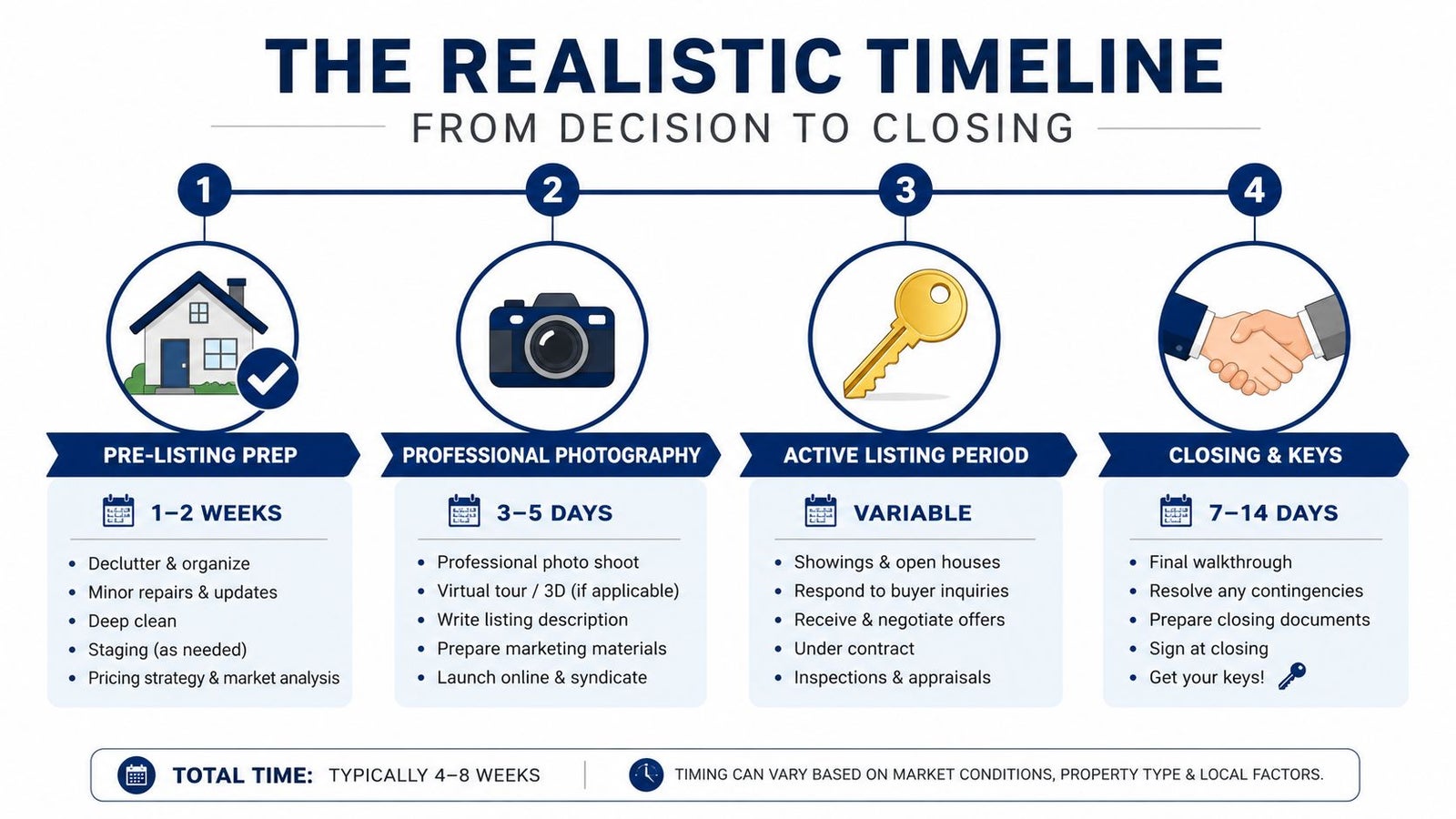
Allow roughly one to two weeks for preparation. During this window, you'll declutter, complete minor repairs, arrange staging, confirm showing access, review comparable sales, and order the strata documents buyers will want to see. Professional photography and floor-plan preparation may take several days within that period.
This work matters because buyers make fast comparisons online. A unit with clear photographs, accurate room dimensions, and an organized disclosure package gives agents fewer reasons to delay a showing or add cautious conditions.
The seven-step Vancouver condo sale process can help sellers organize these decisions before launch.
On Day 1, the property goes live. In recent Greater Vancouver data, condos have ranged from 35 days on market in December 2023 to 39 days in June 2026, with readings of 42 days in April 2026, 43 days in March, 45 days in May, and 54 days in July. That range is documented in Greater Vancouver condo market timing data.
In practical terms, budget 39 to 54 days for the active selling period, depending on pricing, inventory, and buyer demand. Add one to three days for offer negotiation, including reviewing financing strength, deposit terms, dates, included items, and subjects.
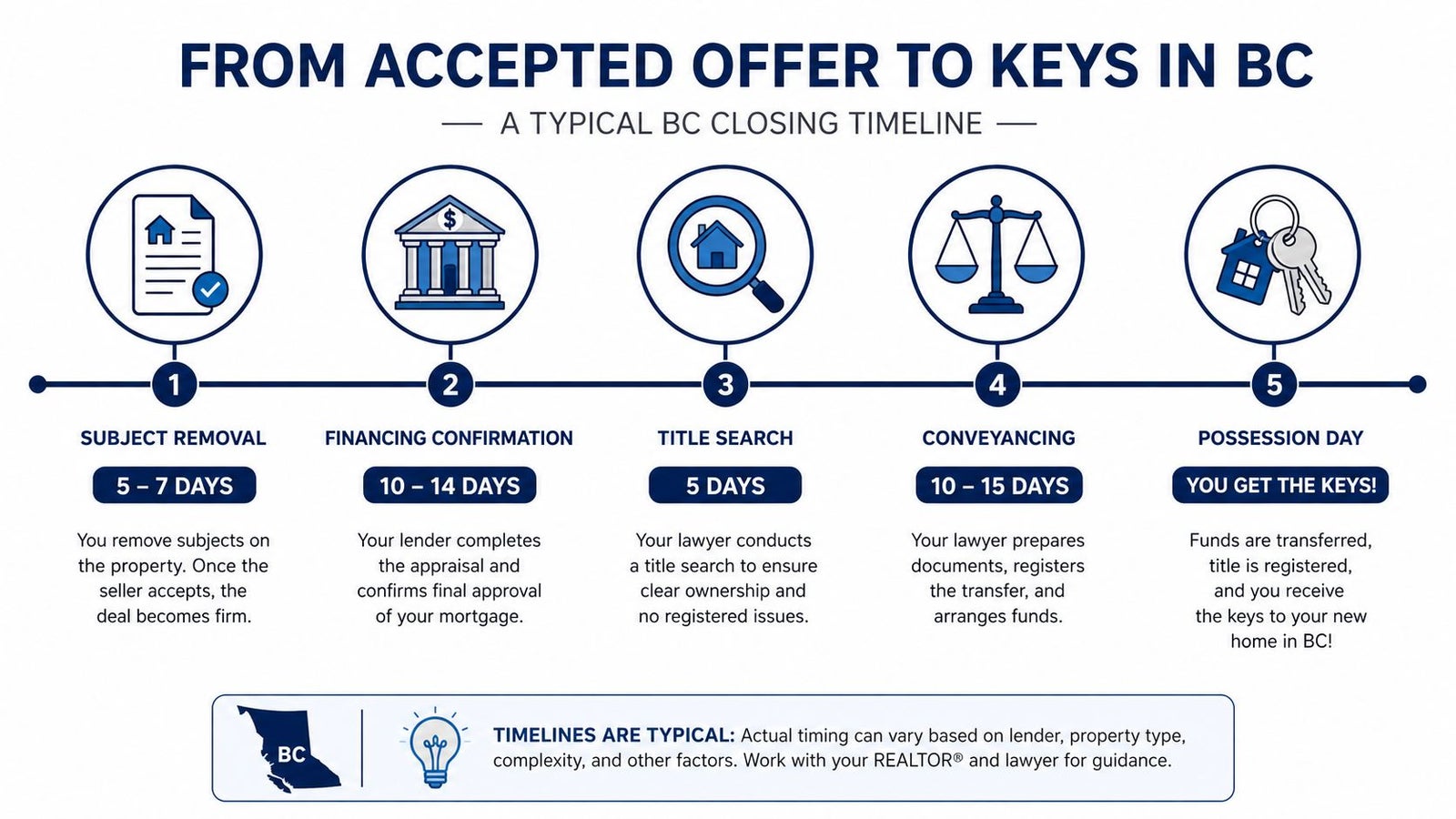
A buyer may need seven to fourteen days for subject removal, financing confirmation, inspection, and strata review. After that, allow another two to four weeks for financing, strata administration, legal completion, and possession arrangements.
The arithmetic is straightforward. One to two weeks of preparation, roughly five to eight weeks on the market, one to two weeks for subjects, and two to four weeks to close creates a realistic eight-to-fourteen-week journey from decision to keys.
Days on market is an MLS measurement, not a complete sale timeline. It generally records the period from when a listing goes live until it's sold, expired, or removed. It doesn't include the days you spend preparing the home, arranging photography, ordering documents, or waiting for the buyer to complete the transaction.
A Greater Vancouver condo may therefore show 39 to 49 days on market in 2026, while the seller has spent much longer managing the full transaction. The regional range is described in BC days-on-market guidance for condos.
The standard number can also look better than the actual marketing history. If a seller withdraws an overpriced listing and later relaunches it, the new listing may appear to have a fresh MLS clock. A broader property-days-on-market measure can reconnect those periods and show how long the property has effectively been exposed.
January 2026 coverage reported Greater Vancouver condominiums at 49 days on market, while another measure that accounts for relisted homes showed about 100 days. The same update put townhomes at 47 days and detached homes at 61 days, which illustrates why sellers need to ask what the statistic includes. See the February 2026 Greater Vancouver market update for that distinction.
A regional average blends very different buildings and buyer pools. Downtown Vancouver, Kitsilano, Burnaby South, and other micro-areas can move at different speeds because unit sizes, transit access, maintenance fees, building age, rental restrictions, and competing inventory vary.
The February 2026 Vancouver real estate statistics are more useful when treated as context rather than a promise for a specific building. Your building's recent accepted sales and active competition are the better benchmark.
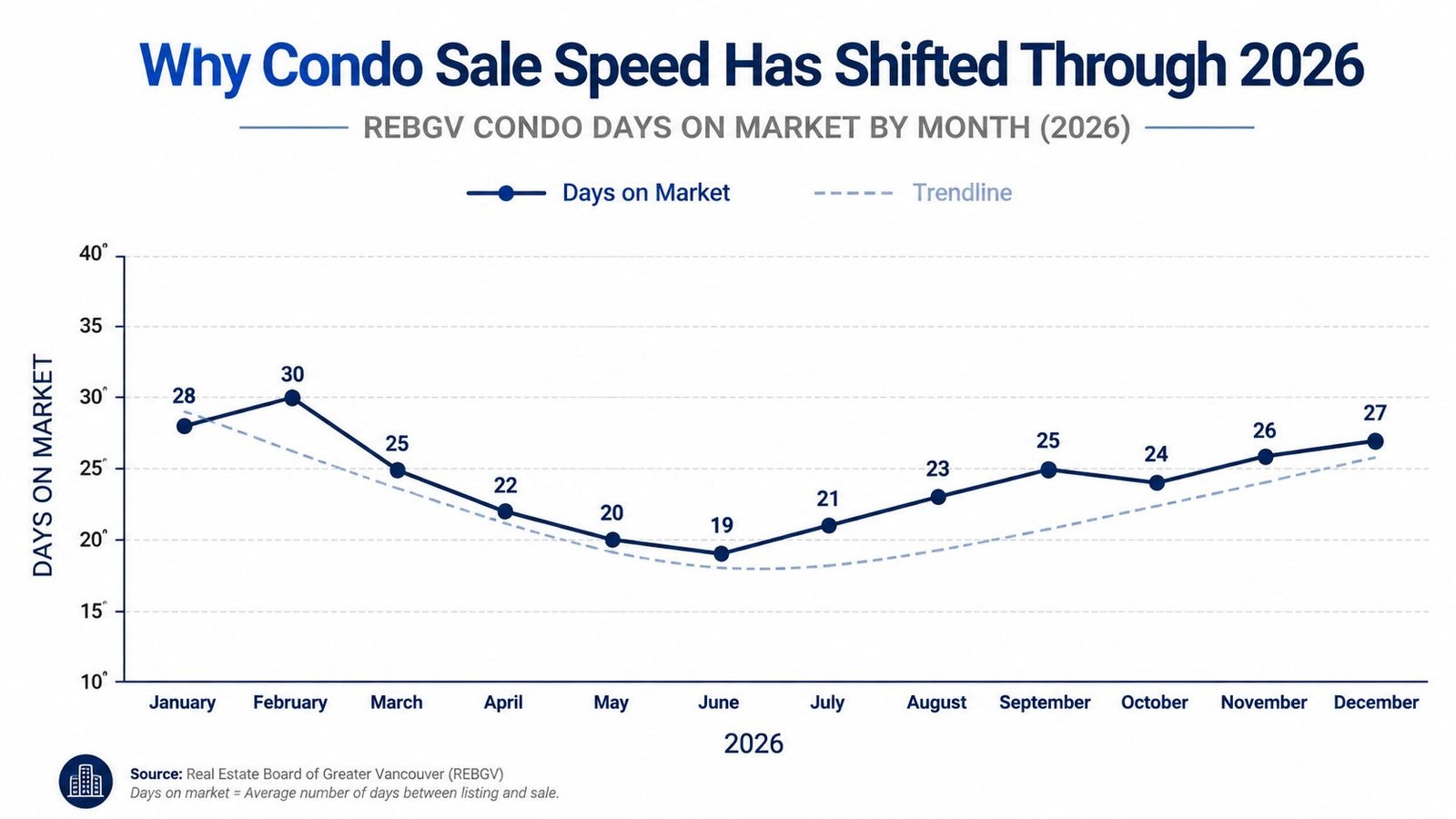
Condo sale speed doesn't stay fixed across a calendar year. In Greater Vancouver, one 2026 market series recorded 42 days in April, 45 in May, 53 in June, and 54 in July, while median condo prices remained broadly steady around $699,000 to $718,800. The data appears in April 2026 BC housing market coverage.
That combination matters. A slower sale period alongside relatively flat prices tells sellers that waiting longer isn't automatically producing a higher result. Buyers may still be willing to purchase, but they're taking longer to compare listings and negotiate.
Greater Vancouver condo absorption is strongly affected by active supply. When active condo listings rise into the 6,000 to 7,000-plus range, listings generally take longer to sell. Benchmark apartment prices around $688,000 to $695,200, together with sales of about 1,100 units per month, point to a more balanced pace than a peak seller's market. Those figures are reported in May 2026 Vancouver market analysis.
For a seller, the implication is direct. You're competing against every similar unit a buyer can see today, not just against last year's sale.
Spring can bring more buyer attention, but it can also bring more competing listings. Summer may create a longer absorption window, while early autumn can bring renewed activity before the year-end slowdown. These patterns are useful for planning, but pricing and presentation still matter more than choosing a theoretically perfect week.
Interest rates also shape the buyer pool. The effect of interest-rate cuts on Vancouver real estate can influence affordability and confidence, but you can't build a selling plan around a policy announcement that may or may not arrive on your preferred schedule.
An accepted offer isn't the finish line. It's the point where the buyer begins proving they can complete the purchase and the seller must keep the property and documents available for the transaction.
The deposit is usually paid on or within 24 hours of subject removal, depending on the contract and brokerage instructions. If subjects are removed on Thursday, the deposit may be due by Friday. Sellers should understand the timing and confirm that the buyer and their representatives have the banking and trust arrangements ready. See this BC deposit timing explanation.
After subject removal, the lawyers or notaries handle title work, adjustments, lender requirements, and transfer documents. The buyer's lender may still need final approval, and the strata may need to provide documents such as the Form F Certificate of Payment. Building management schedules and statutory holidays can add friction.
Use the BC real estate transaction process to map responsibilities between the seller, buyer, agents, lender, strata manager, and legal professionals.
I won't invent a precise “days lost per percentage point” formula because no reliable figure is provided here. The practical conclusion is still clear: there's no defensible universal DOM penalty for each percentage point above the comparable range. The penalty depends on the building, competing supply, unit condition, and buyer pool.
A condo priced correctly in a slower Burnaby submarket can attract attention faster than a poorly positioned unit in a popular pocket. Buyers compare price per square foot, layout, exposure, maintenance fees, parking, storage, building history, and renovation quality. They don't reward an owner's preferred number just because the owner needs it.
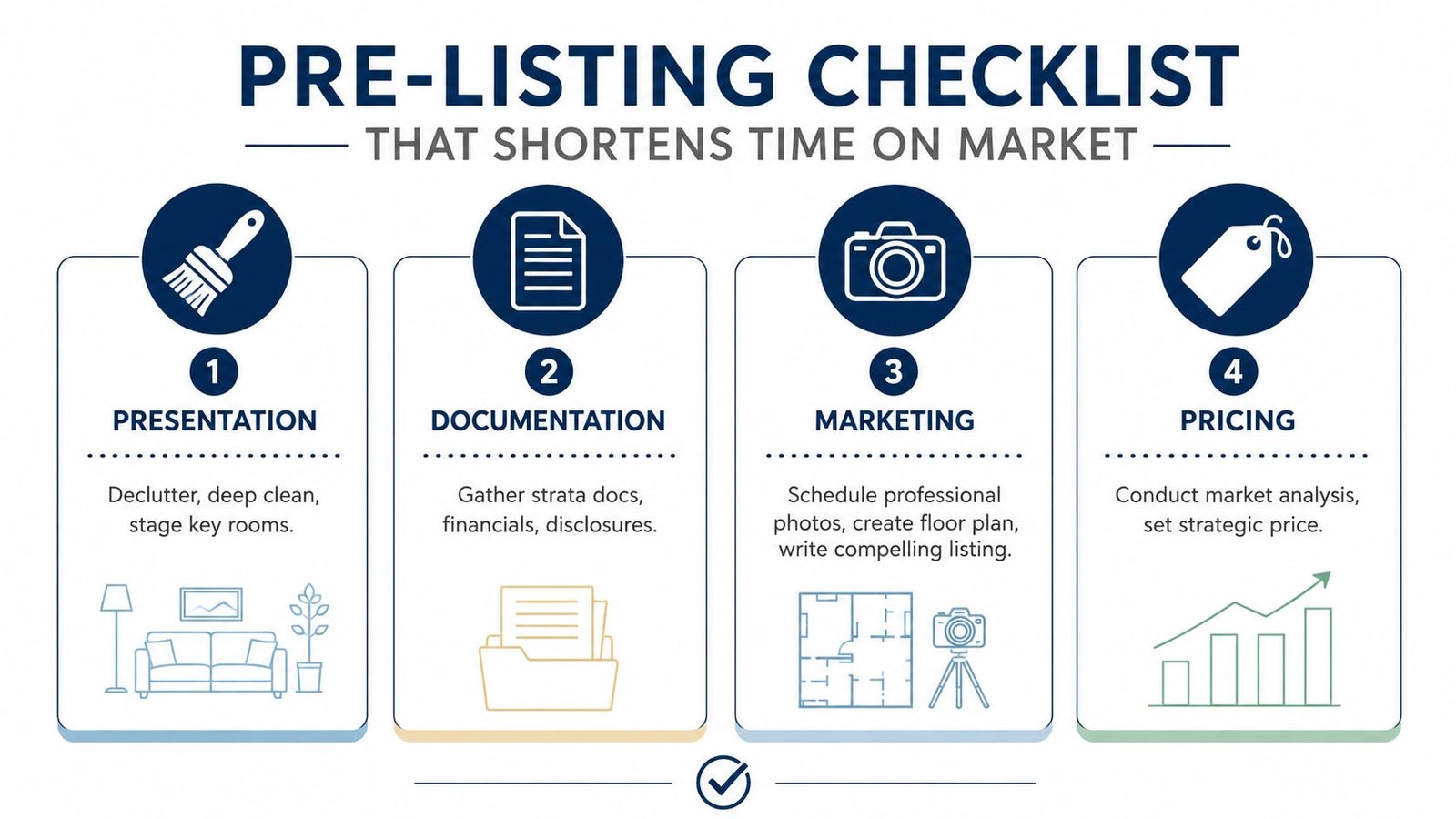
The best time to remove delays is before the listing goes live. Give yourself two to four weeks to organize the unit, documents, access, and launch materials.
Start with recently sold units in the same building or the closest comparable buildings. Review the current competition, not just the sale you remember from a stronger market. Request a mortgage payout statement and check whether any special levy, tenancy issue, or ownership detail needs to be disclosed.
The common mistake is choosing a list price from an old appraisal without testing it against active alternatives. A price that looks reasonable in isolation can be uncompetitive on launch day.
Declutter surfaces, remove bulky furniture, complete visible repairs, and deep-clean the kitchen and bathrooms. Schedule professional photography, a floor plan, and a virtual tour before the listing date, rather than treating them as optional extras.
The photography should show the actual selling strengths of the condo, including light, views, storage, parking, and the relationship between rooms. A floor plan helps buyers understand awkward layouts before they book a showing.
If the unit is tenanted, agree on notice and showing procedures early. Confirm who holds keys, whether a lockbox is permitted, which hours the building allows showings, and whether concierge or strata rules affect access.
A seller who offers only narrow appointment windows may lose buyers who are comparing several properties in one trip. Access doesn't guarantee an offer, but inaccessible listings can't compete properly.
Order the Form B Information Certificate immediately. Gather the property disclosure, recent strata minutes, depreciation report if available, bylaws, financial information, insurance documents, and records of capital expenditures. BC requires a disclosure statement before marketing certain new strata developments with five or more condominium units, as outlined in the CMHC British Columbia condominium fact sheet.
Anchor your planning to three numbers:
1. Roughly 39 to 54 days on market, depending on the month and market conditions
2. About eight to fourteen weeks from the decision to list through closing and key handover.
3. A pricing discussion centred on the most recent neighbourhood benchmark, with a practical review of whether the proposed list price sits within 1% to 3% of that benchmark.
The first two figures are supported by the 2026 Greater Vancouver timing data discussed above. The 1% to 3% pricing band is a planning recommendation, not a verified market statistic. It should never replace a building-specific comparative market analysis.
Use the first 30 minutes to answer three questions:
You should leave that conversation with a draft go-to-market calendar. It should show when documents are ordered, when preparation starts, when photography happens, when the listing launches, and which week you could realistically hand over the keys.
An advisor's role isn't to promise a perfect sale date. It's to connect pricing strategy with logistics, prepare the property properly, manage buyer access, negotiate terms, and keep the transaction moving after the offer is accepted. Jacky Levi - Sotheby's Realty Advisor & Realtor can provide comparative market analysis, listing preparation, professional media coordination, offer strategy, and transaction management across Greater Vancouver.
Book the conversation before you're committed to a move. A short review of your building, your timing, and your financial requirements will tell you whether you're ready to list now or need more preparation first.
Jacky Levi - Sotheby's Realty Advisor & Realtor offers building-specific pricing analysis, organised listing preparation, professional marketing, and transaction coordination from launch through closing. Visit Jacky Levi - Sotheby's Realty Advisor & Realtor to start a focused pricing conversation and build a realistic Vancouver condo sale calendar.
You're probably asking because you're standing in your kitchen, looking at the boxes you haven't packed and wondering whether listing now means moving in a month or still showing the unit when the season changes. The MLS figure is useful, but it isn't the same as the time between deciding to sell and handing over the keys.
A serious Vancouver condo sale includes preparation, photography, buyer review, negotiation, financing, strata documents, legal work, and completion. If you plan only for the listing period, you'll underestimate the calendar and create unnecessary pressure.
The Realistic Timeline From Decision to Closing
You decide to list on a Sunday evening. The condo is clean, but the kitchen counter is crowded, a wall needs touch-up paint, and the strata paperwork is somewhere in an email thread. The sale clock has already started, even though the MLS clock hasn't.
Before the listing goes live
Allow roughly one to two weeks for preparation. During this window, you'll declutter, complete minor repairs, arrange staging, confirm showing access, review comparable sales, and order the strata documents buyers will want to see. Professional photography and floor-plan preparation may take several days within that period.
This work matters because buyers make fast comparisons online. A unit with clear photographs, accurate room dimensions, and an organized disclosure package gives agents fewer reasons to delay a showing or add cautious conditions.
The seven-step Vancouver condo sale process can help sellers organize these decisions before launch.
From MLS launch to accepted offer
On Day 1, the property goes live. In recent Greater Vancouver data, condos have ranged from 35 days on market in December 2023 to 39 days in June 2026, with readings of 42 days in April 2026, 43 days in March, 45 days in May, and 54 days in July. That range is documented in Greater Vancouver condo market timing data.
In practical terms, budget 39 to 54 days for the active selling period, depending on pricing, inventory, and buyer demand. Add one to three days for offer negotiation, including reviewing financing strength, deposit terms, dates, included items, and subjects.
From accepted offer to keys
A buyer may need seven to fourteen days for subject removal, financing confirmation, inspection, and strata review. After that, allow another two to four weeks for financing, strata administration, legal completion, and possession arrangements.
The arithmetic is straightforward. One to two weeks of preparation, roughly five to eight weeks on the market, one to two weeks for subjects, and two to four weeks to close creates a realistic eight-to-fourteen-week journey from decision to keys.
"Practical rule: If you have a firm moving deadline, start the sale conversation before you think you need to."
What Days on Market Actually Measures in Greater Vancouver
Days on market is an MLS measurement, not a complete sale timeline. It generally records the period from when a listing goes live until it's sold, expired, or removed. It doesn't include the days you spend preparing the home, arranging photography, ordering documents, or waiting for the buyer to complete the transaction.
A Greater Vancouver condo may therefore show 39 to 49 days on market in 2026, while the seller has spent much longer managing the full transaction. The regional range is described in BC days-on-market guidance for condos.
Standard days on market versus cumulative exposure
The standard number can also look better than the actual marketing history. If a seller withdraws an overpriced listing and later relaunches it, the new listing may appear to have a fresh MLS clock. A broader property-days-on-market measure can reconnect those periods and show how long the property has effectively been exposed.
January 2026 coverage reported Greater Vancouver condominiums at 49 days on market, while another measure that accounts for relisted homes showed about 100 days. The same update put townhomes at 47 days and detached homes at 61 days, which illustrates why sellers need to ask what the statistic includes. See the February 2026 Greater Vancouver market update for that distinction.
Why neighbourhood averages can mislead
A regional average blends very different buildings and buyer pools. Downtown Vancouver, Kitsilano, Burnaby South, and other micro-areas can move at different speeds because unit sizes, transit access, maintenance fees, building age, rental restrictions, and competing inventory vary.
The February 2026 Vancouver real estate statistics are more useful when treated as context rather than a promise for a specific building. Your building's recent accepted sales and active competition are the better benchmark.
Why Condo Sale Speed Has Shifted Through 2026
Condo sale speed doesn't stay fixed across a calendar year. In Greater Vancouver, one 2026 market series recorded 42 days in April, 45 in May, 53 in June, and 54 in July, while median condo prices remained broadly steady around $699,000 to $718,800. The data appears in April 2026 BC housing market coverage.
That combination matters. A slower sale period alongside relatively flat prices tells sellers that waiting longer isn't automatically producing a higher result. Buyers may still be willing to purchase, but they're taking longer to compare listings and negotiate.
Inventory changes the waiting game
Greater Vancouver condo absorption is strongly affected by active supply. When active condo listings rise into the 6,000 to 7,000-plus range, listings generally take longer to sell. Benchmark apartment prices around $688,000 to $695,200, together with sales of about 1,100 units per month, point to a more balanced pace than a peak seller's market. Those figures are reported in May 2026 Vancouver market analysis.
For a seller, the implication is direct. You're competing against every similar unit a buyer can see today, not just against last year's sale.
Use seasonal timing carefully
Spring can bring more buyer attention, but it can also bring more competing listings. Summer may create a longer absorption window, while early autumn can bring renewed activity before the year-end slowdown. These patterns are useful for planning, but pricing and presentation still matter more than choosing a theoretically perfect week.
Interest rates also shape the buyer pool. The effect of interest-rate cuts on Vancouver real estate can influence affordability and confidence, but you can't build a selling plan around a policy announcement that may or may not arrive on your preferred schedule.
From Accepted Offer to Keys in BC
An accepted offer isn't the finish line. It's the point where the buyer begins proving they can complete the purchase and the seller must keep the property and documents available for the transaction.
The subject-removal period
In BC, the standard subject-removal period is commonly five business days or seven calendar days, and the exact period is negotiable. A buyer may use that time for financing, inspection, appraisal, and review of the strata documents. The BC offer-acceptance timeline explains why sellers should focus on the contract dates rather than assume every deal follows the same pattern.
For a condo seller, the Form B Information Certificate is particularly important. BC requires the current prescribed Form B to disclose information about the strata lot and strata corporation, and buyers often need it before removing conditions. The BC government's Form B guidance sets out its role.
In BC, the standard subject-removal period is commonly five business days or seven calendar days, and the exact period is negotiable. A buyer may use that time for financing, inspection, appraisal, and review of the strata documents. The BC offer-acceptance timeline explains why sellers should focus on the contract dates rather than assume every deal follows the same pattern.
For a condo seller, the Form B Information Certificate is particularly important. BC requires the current prescribed Form B to disclose information about the strata lot and strata corporation, and buyers often need it before removing conditions. The BC government's Form B guidance sets out its role.
Deposit and completion
The deposit is usually paid on or within 24 hours of subject removal, depending on the contract and brokerage instructions. If subjects are removed on Thursday, the deposit may be due by Friday. Sellers should understand the timing and confirm that the buyer and their representatives have the banking and trust arrangements ready. See this BC deposit timing explanation.
After subject removal, the lawyers or notaries handle title work, adjustments, lender requirements, and transfer documents. The buyer's lender may still need final approval, and the strata may need to provide documents such as the Form F Certificate of Payment. Building management schedules and statutory holidays can add friction.
"A clean subject removal is a major milestone, but possession only happens when the legal and financial steps are complete."
Use the BC real estate transaction process to map responsibilities between the seller, buyer, agents, lender, strata manager, and legal professionals.
Price is the decisive lever
I won't invent a precise “days lost per percentage point” formula because no reliable figure is provided here. The practical conclusion is still clear: there's no defensible universal DOM penalty for each percentage point above the comparable range. The penalty depends on the building, competing supply, unit condition, and buyer pool.
A condo priced correctly in a slower Burnaby submarket can attract attention faster than a poorly positioned unit in a popular pocket. Buyers compare price per square foot, layout, exposure, maintenance fees, parking, storage, building history, and renovation quality. They don't reward an owner's preferred number just because the owner needs it.
Pre-Listing Checklist That Shortens Time on Market
The best time to remove delays is before the listing goes live. Give yourself two to four weeks to organize the unit, documents, access, and launch materials.
Pricing preparation
Start with recently sold units in the same building or the closest comparable buildings. Review the current competition, not just the sale you remember from a stronger market. Request a mortgage payout statement and check whether any special levy, tenancy issue, or ownership detail needs to be disclosed.
The common mistake is choosing a list price from an old appraisal without testing it against active alternatives. A price that looks reasonable in isolation can be uncompetitive on launch day.
Presentation preparation
Declutter surfaces, remove bulky furniture, complete visible repairs, and deep-clean the kitchen and bathrooms. Schedule professional photography, a floor plan, and a virtual tour before the listing date, rather than treating them as optional extras.
The photography should show the actual selling strengths of the condo, including light, views, storage, parking, and the relationship between rooms. A floor plan helps buyers understand awkward layouts before they book a showing.
Access preparation
If the unit is tenanted, agree on notice and showing procedures early. Confirm who holds keys, whether a lockbox is permitted, which hours the building allows showings, and whether concierge or strata rules affect access.
A seller who offers only narrow appointment windows may lose buyers who are comparing several properties in one trip. Access doesn't guarantee an offer, but inaccessible listings can't compete properly.
Legal and strata preparation
Order the Form B Information Certificate immediately. Gather the property disclosure, recent strata minutes, depreciation report if available, bylaws, financial information, insurance documents, and records of capital expenditures. BC requires a disclosure statement before marketing certain new strata developments with five or more condominium units, as outlined in the CMHC British Columbia condominium fact sheet.
Ordering strata documents too late is one of the most avoidable Vancouver condo delays. If a serious buyer can't review the package, the offer may arrive later or carry more conditions.
Consider two representative seller situations. The point isn't to promise that either result will repeat. It's to show how decisions made before and during the listing can change the calendar.
The first is a 580-square-foot one-bedroom in a 1990s Yaletown tower, listed in late February 2026 by an owner who was downsizing. The seller removed excess furniture, arranged staging, prepared the documents, and priced the unit 2% below the last comparable sale. The buyer accepted a clean offer in 18 days, and the transaction closed in 42 days.
The second is a 920-square-foot two-bedroom in a Metrotown high-rise, listed in early May by an estate executor. The executor priced at the last appraised value, declined staging, restricted showing windows, and relied on less effective presentation. The condo stayed on the market for 71 days, the price was reduced twice, and the sale closed after 128 days.
Two Vancouver Condos Two Different Outcomes
Consider two representative seller situations. The point isn't to promise that either result will repeat. It's to show how decisions made before and during the listing can change the calendar.
The first is a 580-square-foot one-bedroom in a 1990s Yaletown tower, listed in late February 2026 by an owner who was downsizing. The seller removed excess furniture, arranged staging, prepared the documents, and priced the unit 2% below the last comparable sale. The buyer accepted a clean offer in 18 days, and the transaction closed in 42 days.
The second is a 920-square-foot two-bedroom in a Metrotown high-rise, listed in early May by an estate executor. The executor priced at the last appraised value, declined staging, restricted showing windows, and relied on less effective presentation. The condo stayed on the market for 71 days, the price was reduced twice, and the sale closed after 128 days.
The first seller made the unit easy to understand and easy to visit. The second seller made buyers wait while the listing competed against more convenient alternatives.
Photography and floor-plan quality also shape how buyers interpret value. A strong image set can communicate light and layout immediately, while weak images leave buyers uncertain and less likely to prioritize a showing.
Feedback should be treated as evidence, not as an insult. If several agents identify the same pricing or presentation problem, adjust before weeks of exposure turn into a stale listing.
Photography and floor-plan quality also shape how buyers interpret value. A strong image set can communicate light and layout immediately, while weak images leave buyers uncertain and less likely to prioritize a showing.
"The market decides how many buyers are available. Your launch decisions decide whether those buyers stop scrolling."
Feedback should be treated as evidence, not as an insult. If several agents identify the same pricing or presentation problem, adjust before weeks of exposure turn into a stale listing.
Your Next Step and How to Get Started
Anchor your planning to three numbers:
1. Roughly 39 to 54 days on market, depending on the month and market conditions
2. About eight to fourteen weeks from the decision to list through closing and key handover.
3. A pricing discussion centred on the most recent neighbourhood benchmark, with a practical review of whether the proposed list price sits within 1% to 3% of that benchmark.
The first two figures are supported by the 2026 Greater Vancouver timing data discussed above. The 1% to 3% pricing band is a planning recommendation, not a verified market statistic. It should never replace a building-specific comparative market analysis.
Make the first conversation concrete
- Which recent sales in your building are comparable?
- How much active competition is available for your unit type?
- What launch, offer, subject-removal, completion, and possession dates fit your plans?
You should leave that conversation with a draft go-to-market calendar. It should show when documents are ordered, when preparation starts, when photography happens, when the listing launches, and which week you could realistically hand over the keys.
An advisor's role isn't to promise a perfect sale date. It's to connect pricing strategy with logistics, prepare the property properly, manage buyer access, negotiate terms, and keep the transaction moving after the offer is accepted. Jacky Levi - Sotheby's Realty Advisor & Realtor can provide comparative market analysis, listing preparation, professional media coordination, offer strategy, and transaction management across Greater Vancouver.
Book the conversation before you're committed to a move. A short review of your building, your timing, and your financial requirements will tell you whether you're ready to list now or need more preparation first.
Jacky Levi - Sotheby's Realty Advisor & Realtor offers building-specific pricing analysis, organised listing preparation, professional marketing, and transaction coordination from launch through closing. Visit Jacky Levi - Sotheby's Realty Advisor & Realtor to start a focused pricing conversation and build a realistic Vancouver condo sale calendar.