
You're probably staring at a handful of tabs right now, maybe REALTOR.ca, a brokerage page, and a few aggregator sites that all seem to show the same Vancouver property listings. They don't. The difference between a searchable listing and an actionable one is where the data comes from, how current it is, and whether you understand what the market is telling you.
In Metro Vancouver, properties listed on the MLS® reached 65,335 in 2025 according to Greater Vancouver REALTORS®, 13.1% above the region's 10-year annual average of 57,782 and 8.2% higher than 2024 Greater Vancouver REALTORS® December 2025 stats package. At the same time, residential sales fell to 23,800 in 2025, 24.7% below the 10-year annual sales average of 31,625 in the Greater Vancouver REALTORS® December 2025 stats package. That gap matters because when supply rises and demand softens, pricing discipline, exposure strategy, and comparable-sales analysis stop being optional and start being the whole game.
A buyer can waste hours on listings that look current but are already stale, incomplete, or delayed. Vancouver property data starts with the MLS®, then moves through board systems, brokerage feeds, and public websites that display the same property in different ways. If you know where a listing sits in that chain, you can tell whether you are seeing the market in real time or just a delayed version of it.
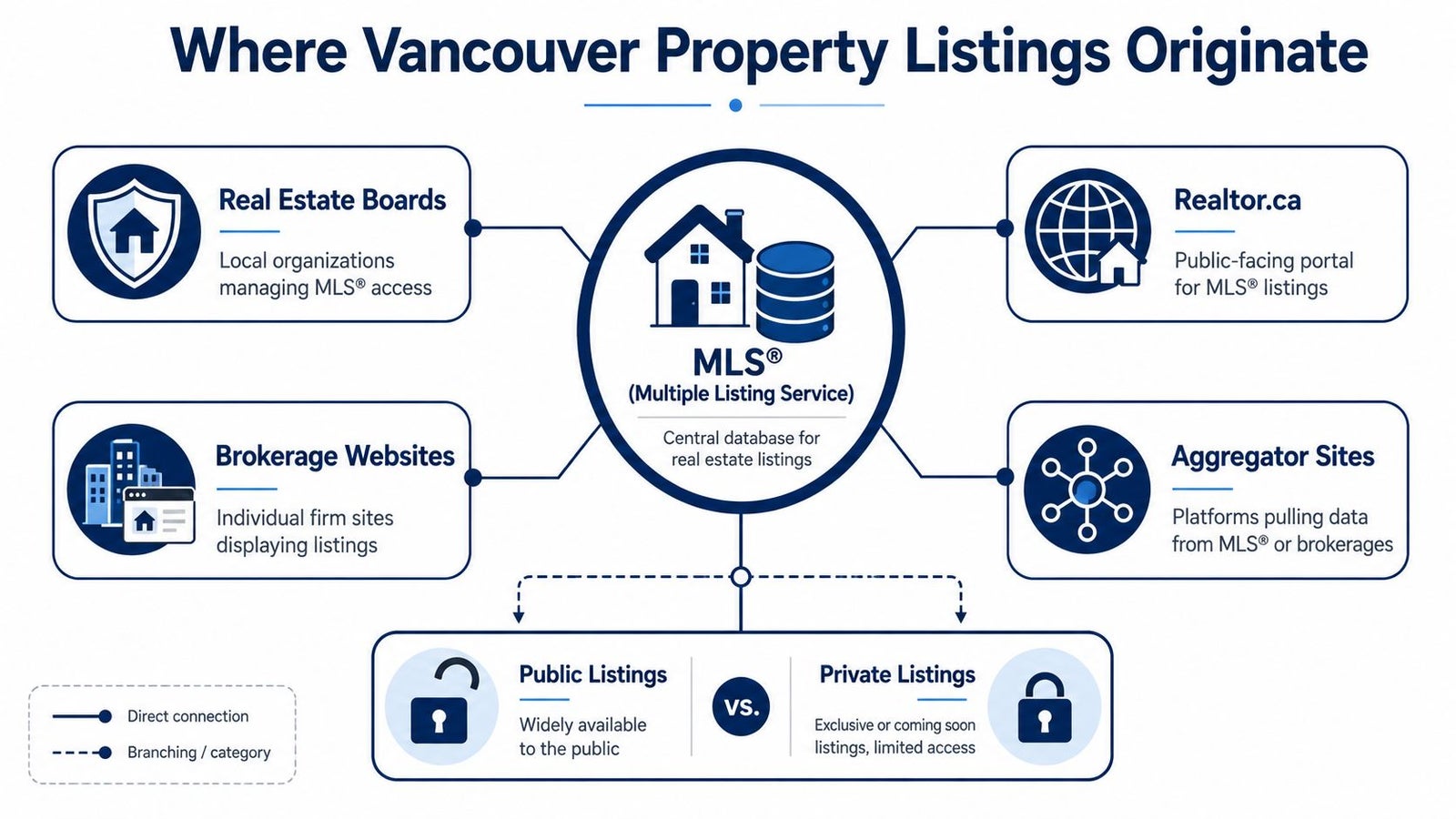
The MLS® is the core database for most Vancouver residential listings. REALTOR.ca and brokerage websites pull from it, but they do not always present the same details in the same order or with the same speed. A direct brokerage feed usually gives you cleaner timing on status changes, new comparable listings, and back-on-market moves than a generic aggregator.
Use that difference. If you are buying, earlier alerts help you respond before the best options draw attention. If you are selling, you want your listing shown where serious buyers search, not buried in a slow or cluttered interface.
That matters in a market with more inventory and slower absorption. More listings on the board do not help you if the platform you rely on is slow to reflect price changes, status updates, or fresh comparables. In that kind of market, the advantage comes from cleaner data and faster visibility, not from scrolling through more noise.
If you want a quicker way to scan building-specific inventory, use this Vancouver building search instead of starting from scratch every time.
A public listing shows the address, photos, and remarks. It does not show the full story behind how that property reached the market, which buyer pool it is attracting, or whether the seller has positioned it for speed, caution, or maximum exposure. Some listings are broadly marketed. Others are shaped by property type, tenancy, or missing documents, and that changes how you should read them.
Source matters because the listing is the output of a system. That system controls speed, visibility, and credibility, and those three factors tell you more about the opportunity than the photos ever will.
Most buyers search too broadly. They start with price, bedrooms, and maybe a neighbourhood, then wonder why the results feel random. You need to search like someone trying to discover advantageous positions, not just inventory.
Start with the obvious filters, then push deeper. Use days on market to identify stale listings, search terms like rental suite, renovated, or parking, and narrow the map to the exact blocks you'd live on. If you're hunting in a competitive pocket, a small adjustment in the search radius is often more useful than widening the budget.
Some Vancouver homes are harder to sell because buyers attach risk or inconvenience to them. Micro-condos, homes without rental suites, and condos without parking can sit longer because they don't fit the broadest demand profile Vancouver buyer-friction commentary. That doesn't make them bad. It means you should price them differently in your mind.
The best buyers look for the gap between a listing and an asset. If a property has weaker resale appeal because of layout, parking, or tenancy structure, that can create room to negotiate. If a property avoids those friction points, it may command a tighter market response.
Use exclusions too. If your search tool allows it, remove what you know you won't buy. Exclude homes without parking if that's essential. Exclude fixed tenancies if you need flexibility. Exclude unfinished or poorly presented properties if your priority is move-in readiness. Precision saves time and keeps you focused.
Here's the simplest way to think about it, and it works:
A flat-looking search page can hide real market differences. The key is to stop asking, “What's available?” and start asking, “Why is this still available?” That question separates casual browsers from informed buyers.
A listing photo can make a place look polished. The full story sits in the details buyers skim past. If you want to judge Vancouver property listings properly, read the remarks, inspect the financial fields, and treat the document package as part of the product.
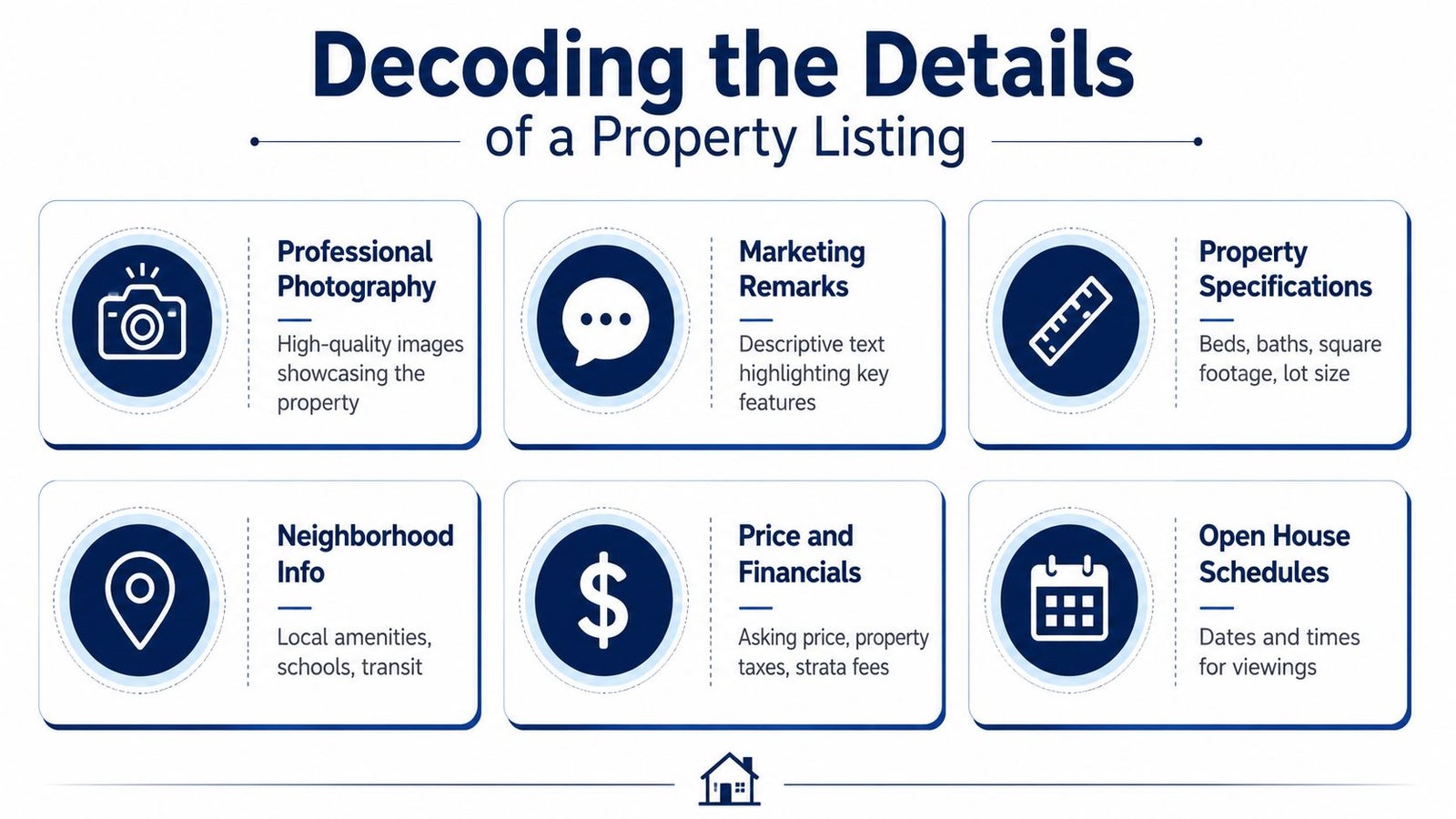
Good photography helps, but it also exposes maintenance issues if you know what to look for. Check for inconsistent flooring, tired trim, dated appliances, or rooms photographed to avoid awkward angles. Those are not cosmetic details only. They often show how recently a home has been cared for.
Marketing remarks matter just as much. When a listing leans on words like “potential,” “value add,” or “excellent opportunity,” I pay attention. That wording can mean the property needs work, the layout is awkward, or the seller knows the price is ambitious.
The financial fields deserve close inspection too. Property taxes, strata fees, assessed value, and the wording around inclusions all shape affordability and resale strategy. A buyer who skips these details is usually comparing asking prices without comparing carrying costs.
British Columbia's regulator says the listing package should be ready before a property goes live, including identity verification for everyone on title and a title document dated within 30 days of listing. For strata properties, the necessary documents need to be compiled before launch. If that package is incomplete, the listing can stall.
That preparation matters more than presentation. A condo seller who has the strata documents ready lets buyers review bylaws, maintenance, and financial information early. That shortens decision time and reduces avoidable surprises.
A proper listing review should answer four questions fast.
There is no single Vancouver market. There are dozens of micro-markets, and each one behaves differently by property type, location, and buyer profile. A detached home, a townhome, and a condo can all sit in the same city and still move at different speeds.
In July 2026, Metro Vancouver townhomes sold faster with 35 days on market than detached homes and condos, both at 39 days July 2026 Metro Vancouver market update. That is the kind of detail that changes how you price, offer, and negotiate. If you rely on a single citywide headline, you'll miss the actual competition.
Benchmark against your direct competition
A detached house should not be judged against a condo, and a westside townhouse should not be judged against a suburban one just because they're both in Metro Vancouver. The relevant comparison is the immediate pool of alternatives that a buyer would consider. That's how you know whether a listing is expensive, fair, or priced to move.
Neighbourhood knowledge is what turns data into judgement. A property on the Vancouver Westside is competing with very different expectations, financing realities, and lifestyle priorities than one in a more transit-driven pocket. If you're buying, you need to know what similar homes have to overcome. If you're selling, you need to know what buyers are comparing against your place.
The practical mistake is overreacting to the city average. The smarter move is to compare one home with the homes that share its architecture, lot type, strata profile, and location profile. That's the only way to build a credible offer or list price.
Listings become strategic instead of cosmetic. A neighbourhood search page only matters if it helps you see what's sellable, what's stale, and what's mispriced. That's why I'd rather review a focused area page like this Vancouver West Side search than waste time on broad, undifferentiated inventory.
When you know the local rhythm, you stop guessing. You can tell whether a property deserves a fast offer, a cautious wait, or a hard pass.
A good buyer doesn't wait for the right listing to appear by accident. They build a system that brings relevant listings to them, then they move quickly when the numbers and the property line up.


In Metro Vancouver, properties listed on the MLS® reached 65,335 in 2025 according to Greater Vancouver REALTORS®, 13.1% above the region's 10-year annual average of 57,782 and 8.2% higher than 2024 Greater Vancouver REALTORS® December 2025 stats package. At the same time, residential sales fell to 23,800 in 2025, 24.7% below the 10-year annual sales average of 31,625 in the Greater Vancouver REALTORS® December 2025 stats package. That gap matters because when supply rises and demand softens, pricing discipline, exposure strategy, and comparable-sales analysis stop being optional and start being the whole game.
Where Vancouver Property Listings Originate
A buyer can waste hours on listings that look current but are already stale, incomplete, or delayed. Vancouver property data starts with the MLS®, then moves through board systems, brokerage feeds, and public websites that display the same property in different ways. If you know where a listing sits in that chain, you can tell whether you are seeing the market in real time or just a delayed version of it.
MLS® is the source of truth
The MLS® is the core database for most Vancouver residential listings. REALTOR.ca and brokerage websites pull from it, but they do not always present the same details in the same order or with the same speed. A direct brokerage feed usually gives you cleaner timing on status changes, new comparable listings, and back-on-market moves than a generic aggregator.
Use that difference. If you are buying, earlier alerts help you respond before the best options draw attention. If you are selling, you want your listing shown where serious buyers search, not buried in a slow or cluttered interface.
"Practical rule: do not treat every website as equal. The closer a platform sits to the MLS® feed, the faster you are likely to see a listing update."
That matters in a market with more inventory and slower absorption. More listings on the board do not help you if the platform you rely on is slow to reflect price changes, status updates, or fresh comparables. In that kind of market, the advantage comes from cleaner data and faster visibility, not from scrolling through more noise.
If you want a quicker way to scan building-specific inventory, use this Vancouver building search instead of starting from scratch every time.
Public listings and private reality
A public listing shows the address, photos, and remarks. It does not show the full story behind how that property reached the market, which buyer pool it is attracting, or whether the seller has positioned it for speed, caution, or maximum exposure. Some listings are broadly marketed. Others are shaped by property type, tenancy, or missing documents, and that changes how you should read them.
Source matters because the listing is the output of a system. That system controls speed, visibility, and credibility, and those three factors tell you more about the opportunity than the photos ever will.
How to Search and Filter Listings Like a Pro
Most buyers search too broadly. They start with price, bedrooms, and maybe a neighbourhood, then wonder why the results feel random. You need to search like someone trying to discover advantageous positions, not just inventory.
Start with the obvious filters, then push deeper. Use days on market to identify stale listings, search terms like rental suite, renovated, or parking, and narrow the map to the exact blocks you'd live on. If you're hunting in a competitive pocket, a small adjustment in the search radius is often more useful than widening the budget.
Filter for friction, not just features
Some Vancouver homes are harder to sell because buyers attach risk or inconvenience to them. Micro-condos, homes without rental suites, and condos without parking can sit longer because they don't fit the broadest demand profile Vancouver buyer-friction commentary. That doesn't make them bad. It means you should price them differently in your mind.
The best buyers look for the gap between a listing and an asset. If a property has weaker resale appeal because of layout, parking, or tenancy structure, that can create room to negotiate. If a property avoids those friction points, it may command a tighter market response.
Use exclusions too. If your search tool allows it, remove what you know you won't buy. Exclude homes without parking if that's essential. Exclude fixed tenancies if you need flexibility. Exclude unfinished or poorly presented properties if your priority is move-in readiness. Precision saves time and keeps you focused.
Here's the simplest way to think about it, and it works:
- Search for buyer friction: Look for listings that others may skip because of parking, suite income, or tenancy limits.
- Search for hidden value: Use terms like renovated, updated kitchen, or rental suite when those features matter to your strategy.
- Search by map, not just area name: One side of a neighbourhood can behave very differently from another.
- Search by timing: Older listings deserve a second look because the seller may be more negotiable.
Read listings as signals
A flat-looking search page can hide real market differences. The key is to stop asking, “What's available?” and start asking, “Why is this still available?” That question separates casual browsers from informed buyers.
Decoding the Details of a Property Listing
A listing photo can make a place look polished. The full story sits in the details buyers skim past. If you want to judge Vancouver property listings properly, read the remarks, inspect the financial fields, and treat the document package as part of the product.
Photos tell you more than style
Good photography helps, but it also exposes maintenance issues if you know what to look for. Check for inconsistent flooring, tired trim, dated appliances, or rooms photographed to avoid awkward angles. Those are not cosmetic details only. They often show how recently a home has been cared for.
Marketing remarks matter just as much. When a listing leans on words like “potential,” “value add,” or “excellent opportunity,” I pay attention. That wording can mean the property needs work, the layout is awkward, or the seller knows the price is ambitious.
"Read between the lines. A polished listing can still be a difficult property if the layout, financing profile, or strata situation creates friction for the next buyer."
The financial fields deserve close inspection too. Property taxes, strata fees, assessed value, and the wording around inclusions all shape affordability and resale strategy. A buyer who skips these details is usually comparing asking prices without comparing carrying costs.
Documents come first, not later
British Columbia's regulator says the listing package should be ready before a property goes live, including identity verification for everyone on title and a title document dated within 30 days of listing. For strata properties, the necessary documents need to be compiled before launch. If that package is incomplete, the listing can stall.
That preparation matters more than presentation. A condo seller who has the strata documents ready lets buyers review bylaws, maintenance, and financial information early. That shortens decision time and reduces avoidable surprises.
A proper listing review should answer four questions fast.
- Is the title clean and current?
- Are the strata documents complete?
- Do the photos match the story in the remarks?
- Do the financials fit the buyer's budget and long-term plan?
Analyzing Neighbourhoods and Property-Specific Data
There is no single Vancouver market. There are dozens of micro-markets, and each one behaves differently by property type, location, and buyer profile. A detached home, a townhome, and a condo can all sit in the same city and still move at different speeds.
In July 2026, Metro Vancouver townhomes sold faster with 35 days on market than detached homes and condos, both at 39 days July 2026 Metro Vancouver market update. That is the kind of detail that changes how you price, offer, and negotiate. If you rely on a single citywide headline, you'll miss the actual competition.
Benchmark against your direct competition
A detached house should not be judged against a condo, and a westside townhouse should not be judged against a suburban one just because they're both in Metro Vancouver. The relevant comparison is the immediate pool of alternatives that a buyer would consider. That's how you know whether a listing is expensive, fair, or priced to move.
Neighbourhood knowledge is what turns data into judgement. A property on the Vancouver Westside is competing with very different expectations, financing realities, and lifestyle priorities than one in a more transit-driven pocket. If you're buying, you need to know what similar homes have to overcome. If you're selling, you need to know what buyers are comparing against your place.
The practical mistake is overreacting to the city average. The smarter move is to compare one home with the homes that share its architecture, lot type, strata profile, and location profile. That's the only way to build a credible offer or list price.
"Useful habit: ask for the most recent comparable sales in the same property type, not just the same neighbourhood. A condo in one building can behave differently from a condo two blocks away."
Use local context before you decide
Listings become strategic instead of cosmetic. A neighbourhood search page only matters if it helps you see what's sellable, what's stale, and what's mispriced. That's why I'd rather review a focused area page like this Vancouver West Side search than waste time on broad, undifferentiated inventory.
When you know the local rhythm, you stop guessing. You can tell whether a property deserves a fast offer, a cautious wait, or a hard pass.
Your Action Plan for Buying a Vancouver Property
A good buyer doesn't wait for the right listing to appear by accident. They build a system that brings relevant listings to them, then they move quickly when the numbers and the property line up.
Set up custom alerts first. If your search is too loose, your inbox will fill with clutter. If it's tight, you'll see the right new listings early enough to respond with intent.
Here's the standard I'd hold.
Build your buying sequence
- Set Up Property Alerts. Use saved searches that match your real target, not a fantasy wish list.
- Secure Pre-Approval. Know your budget before you start falling in love with listings.
- Work with a Realtor. You need someone who understands comparable sales, showing logistics, and offer timing.
- Attend Open Houses and Showings. Photos won't show traffic noise, layout flow, or building condition.
- Make a Competitive Offer. The first serious offer should be based on current data, not emotion.
- Do Due Diligence. Review inspection findings, strata documents, and legal items before you commit.
- Close the Deal. Keep financing, paperwork, and deadlines organised until completion.
Here's the standard I'd hold.
- Pre-approval should be done before touring seriously. It saves time and prevents false confidence.
- Open houses should be used to test the home's reality. Pay attention to storage, light, noise, and layout flow.
- Offer strategy should reflect the building or block, not just the asking price. Comparable sales matter more than optimism.
- Due diligence should start before subjects become a crisis. Strata documents and inspections aren't optional in a high-stakes purchase
If you're buying in Vancouver, the agent you choose should be able to manage alerts, showings, comparables, and negotiation without making the process feel chaotic. That is the significant value of an experienced local advisor.
A buyer decides fast in Vancouver. If the home looks rushed before launch, the listing starts at a disadvantage before anyone books a showing. The strongest results come from a property that is priced, prepared, documented, and photographed before it ever hits the market.
Preparing Your Property for a Standout Listing
A buyer decides fast in Vancouver. If the home looks rushed before launch, the listing starts at a disadvantage before anyone books a showing. The strongest results come from a property that is priced, prepared, documented, and photographed before it ever hits the market.
British Columbia's listing requirements make the same point clearly. Legal and strata paperwork should be assembled before marketing begins, and a condo seller should have the full strata package ready so buyers can review it without delay BCFSA listing information checklist. That is part of the product. When the paperwork is incomplete, the listing feels unfinished before a buyer even walks through the door.
Set the price from the market outward, not from the seller's hope inward. The asking price should reflect recent comparable sales, the home's condition, and the buyer pool that is most likely to respond. Get the number right first, and every other part of preparation works harder.
Staging matters because buyers make decisions quickly. They need to read scale, light, and function without distraction. Clean lines, neutral furniture, and uncluttered rooms make it easier for them to picture the space being used well. That is sales positioning, not decoration.
Professional photography, video tours, and clear floor-plan style marketing all matter. They only work when the home is ready. If the property still needs repairs, cleaning, decluttering, or document gathering, media day just produces polished images of unfinished work.
The vendor team should also be lined up before launch. Cleaners, stagers, photographers, and legal support need coordination, not improvisation. That is why many clients want one point of contact managing the sequence from prep to offer review.
For a practical Vancouver house-selling timeline, this seller preparation guide gives a useful front-end checklist. It shows the kind of organization that keeps a launch clean, orderly, and professional.
A standout listing comes from preparation, accuracy, and disciplined execution. It does not happen by chance.
Start with pricing, then presentation
Set the price from the market outward, not from the seller's hope inward. The asking price should reflect recent comparable sales, the home's condition, and the buyer pool that is most likely to respond. Get the number right first, and every other part of preparation works harder.
Staging matters because buyers make decisions quickly. They need to read scale, light, and function without distraction. Clean lines, neutral furniture, and uncluttered rooms make it easier for them to picture the space being used well. That is sales positioning, not decoration.
Build the listing package before the camera arrives
Professional photography, video tours, and clear floor-plan style marketing all matter. They only work when the home is ready. If the property still needs repairs, cleaning, decluttering, or document gathering, media day just produces polished images of unfinished work.
"Seller rule: every delay before launch costs momentum. Get the documents, pricing, staging, and media ordered early so the first week of market exposure counts."
The vendor team should also be lined up before launch. Cleaners, stagers, photographers, and legal support need coordination, not improvisation. That is why many clients want one point of contact managing the sequence from prep to offer review.
For a practical Vancouver house-selling timeline, this seller preparation guide gives a useful front-end checklist. It shows the kind of organization that keeps a launch clean, orderly, and professional.
A standout listing comes from preparation, accuracy, and disciplined execution. It does not happen by chance.