
Your 2025 city portion is about $3.12 per $1,000 of assessed value, so a $1.5 million home is looking at about $4,677 in city levy before grants and other charges, based on the published rate of $3.11827 per $1,000 (City of Vancouver residential tax rates). If that tax notice just landed on your kitchen table, the number can feel abrupt, but it makes more sense once you see the bill as a stack of parts, not one single charge.
A lot of Vancouver owners assume the bill only changed because the city “raised taxes”. In practice, the total can move because of assessment changes, municipal rate changes, grants, timing, and separate housing-related charges that sit beside the base tax.
A Vancouver owner opens the annual notice and sees a number that seems to have appeared out of nowhere. The surprise usually comes from treating the bill as one thing, when it's really two moving parts, the value of the home and the rate applied to that value.
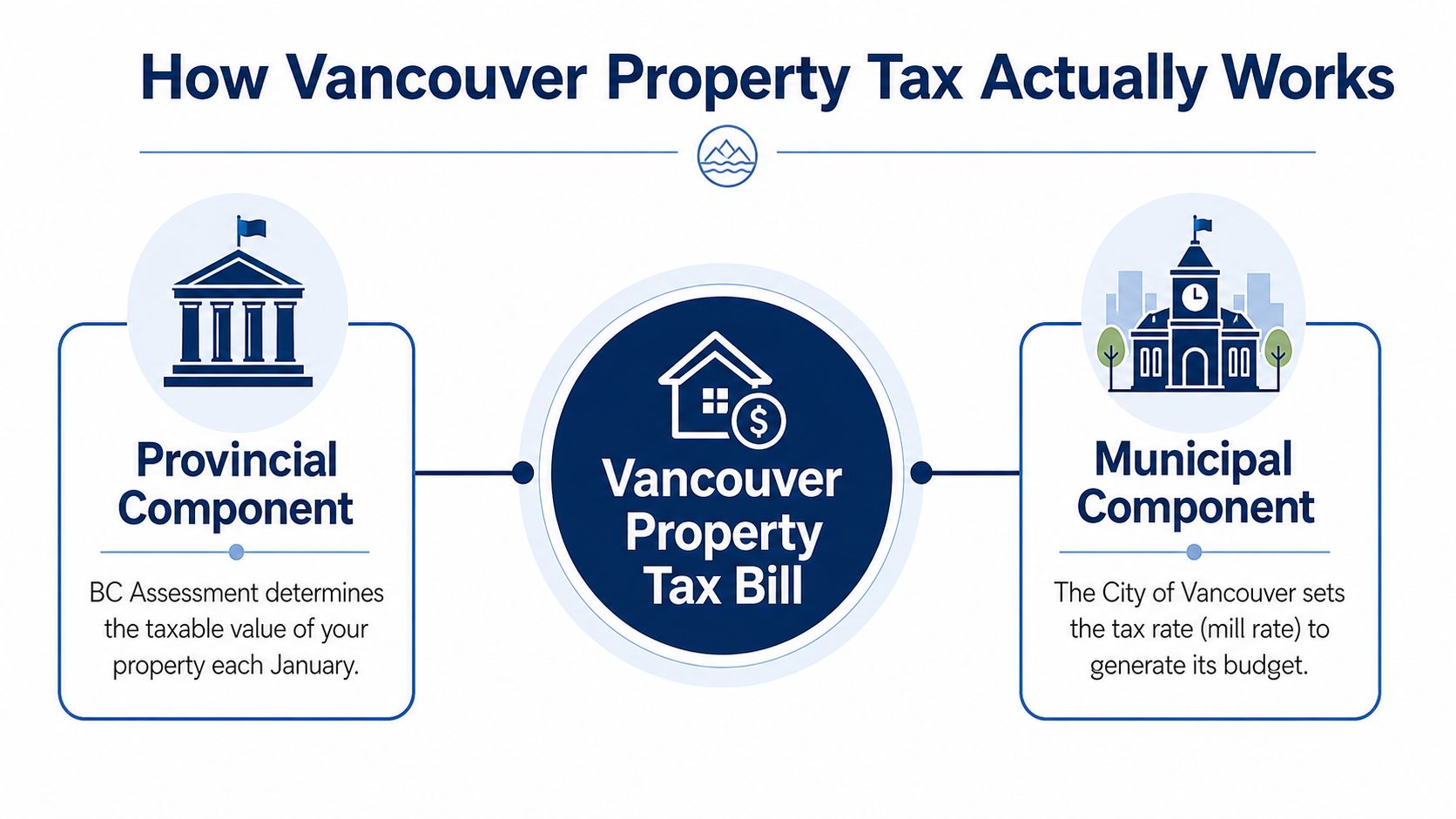
BC Assessment determines the taxable assessed value, and that value becomes the starting point for the tax bill (BC Assessment's property tax equation). This value serves as a price tag the province places on the property for tax purposes, not necessarily the exact price a buyer just paid, or a seller hopes to get.
That matters because the City of Vancouver didn't necessarily do anything different in your neighbourhood. If your assessed value rose, your bill can rise even if the city budget barely moved.
The City then applies a mill rate, which is just dollars per $1,000 of taxable assessed value. The formula is simple, taxable assessed value divided by 1,000, multiplied by the applicable rate (BC Assessment's property tax equation).
A homeowner often experiences this as a single annual bill, but it behaves more like a layered invoice. The base municipal rate is only one layer, and later sections show how the homeowner grant, school tax, Empty Homes Tax, and timing penalties can change the actual amount paid.
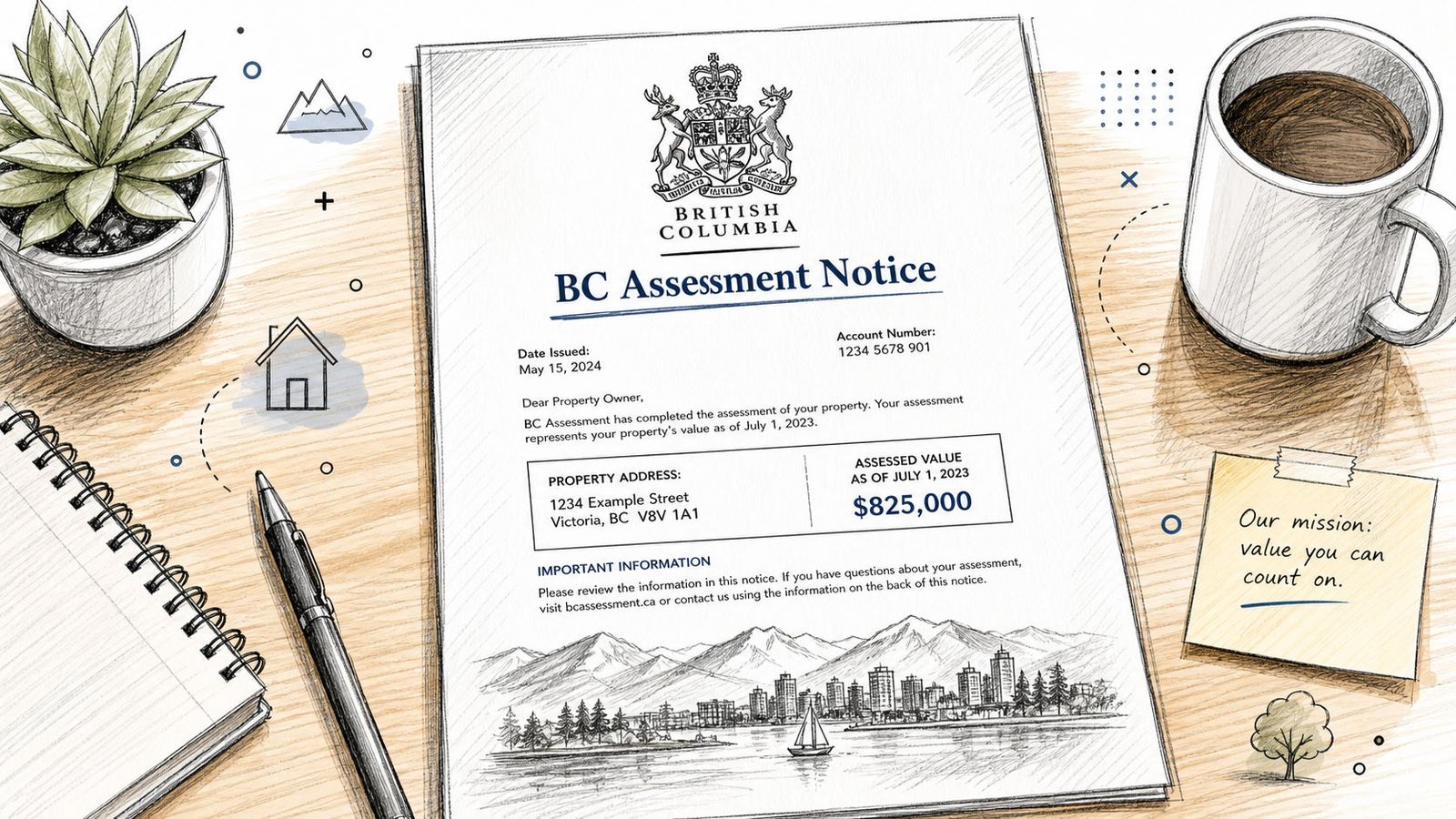
BC Assessment sets the starting point for the property tax conversation. It sends out a separate assessment notice, and that assessed value is based on a market snapshot, not the exact day you bought the home or listed it for sale.
A homeowner often blames themselves when the bill rises. Usually, the bigger story is municipal budgeting and rate setting, not personal behaviour.
The same rate lands differently depending on price point. A condo owner, a townhome owner, and a detached homeowner all pay the same city rate structure, but the cash-flow impact is not remotely the same.
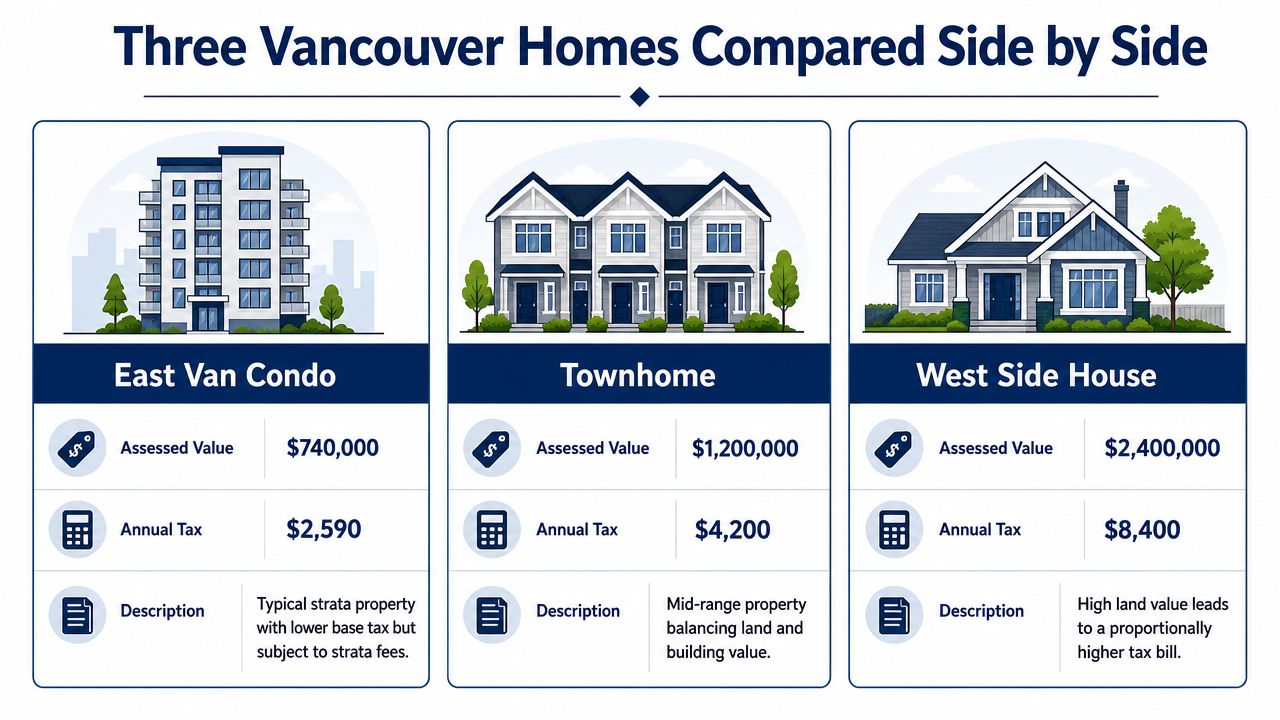
Using the 2025 residential rate of $3.11827 per $1,000 (City of Vancouver residential tax rates):
$740,000 East Vancouver condo. About $2,308 in city-related levy.
$1,200,000 townhome. About $3,742 in city-related levy.
$2,400,000 West Side detached home. About $7,484 in city-related levy.
The provided benchmark for a $740,000 Vancouver condo also helps show that taxes can move meaningfully even on a smaller property, because a modest annual change can still show up in the monthly budget (Policy Alternatives on Vancouver property taxes).
A detached owner usually doesn't just face a larger tax number, they feel a larger swing when the rate changes. The condo owner may care more about strata fees plus tax together, while the townhome owner is often trying to balance mortgage, maintenance, and tax in one line of monthly planning.
Take a $2,100,000 home. It sits above the full-grant threshold, so the owner does not get the maximum grant amount. The difference is not huge in percentage terms, but it's enough to change the cash the owner needs at payment time.
That's exactly why the grant should be part of the annual planning conversation. One homeowner can be just inside the full benefit range, while another with a nearby assessed value misses part of it and has to make up the difference in cash.
The main payment deadline across most of BC is the first business day of July, which was July 2 in 2026 (BC homeowner grant timing and thresholds). Missing that deadline triggers an immediate 10% penalty on the unpaid balance under provincial rules (BC homeowner grant timing and thresholds).
That penalty is why timing matters as much as value. If someone is selling, buying, or moving mid-year, the transfer date and grant eligibility can affect who carries the cash burden.
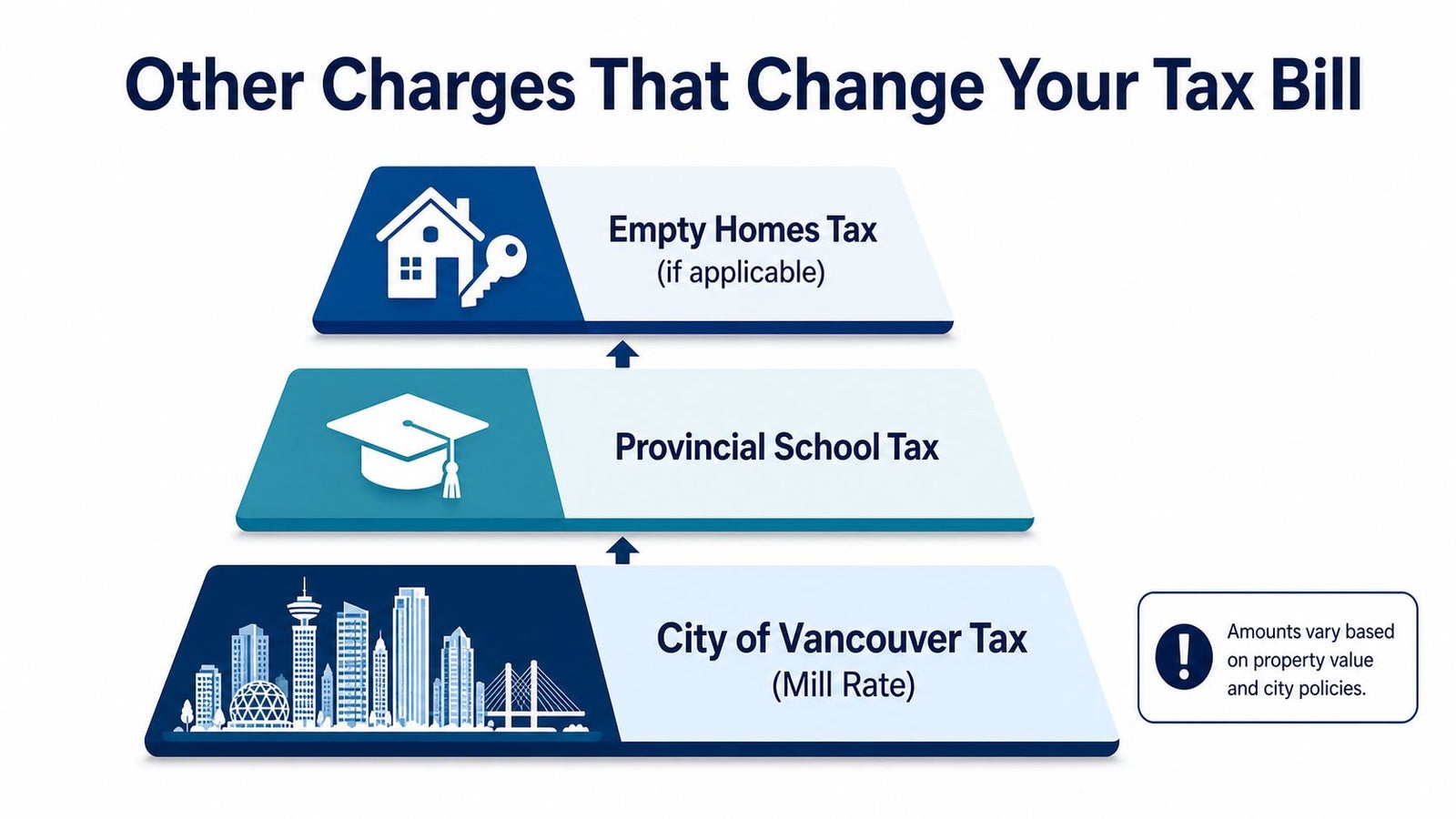
A Vancouver property tax bill can change even when the City's base rate stays the same. That is the part many explainers leave out, and it is where owners get surprised, because the final amount on the notice is a stack of separate charges, not one single number.
The Empty Homes Tax sits on top of regular property taxes, according to the City of Vancouver's own explanation (City of Vancouver Empty Homes Tax). For a vacant condo, that means one property can carry the usual municipal tax and a separate charge in the same year, which changes the holding decision in a very direct way.
The city describes that tax as a policy tool, separate from the standard mill rate. In practical terms, if a home is left empty and the declaration supports that status, the owner is dealing with a separate line item rather than a higher version of the normal property tax.
The city's explanation also points to research showing the Empty Homes Tax reduced vacant units without a significant effect on average rent or new supply. For a homeowner or investor, that does not settle the policy argument, but it does explain why the charge is treated as a holding-cost measure, not just a source of municipal revenue.
Other lines can also appear on a property tax bill, including the school tax and local-area improvements. Those items do not always get the same attention as the base municipal rate, yet they still raise the amount due.
If you want the bill in the broader ownership context, the detached home maintenance guide is a useful companion piece, because property tax is only one part of the carrying cost of owning in Vancouver.
If the assessed value looks too high, there is a process. The first move is to read the assessment notice carefully, then file a Notice of Complaint by the end of January, and prepare evidence for the Property Assessment Review Panel.
The strongest evidence is usually straightforward, comparable sales, condition reports, or income data where relevant. A recent purchase below assessment can also be useful, especially if the purchase was arm's length and the property details line up.
A class appeal is different from a value appeal. One disputes what the property is worth for assessment purposes, the other disputes the category it was placed in.
Filing an appeal does not stop the tax payment clock. Owners still need to pay the bill while the review is in motion.
A lot of Vancouver owners assume the bill only changed because the city “raised taxes”. In practice, the total can move because of assessment changes, municipal rate changes, grants, timing, and separate housing-related charges that sit beside the base tax.
How Vancouver Property Tax Actually Works
A Vancouver owner opens the annual notice and sees a number that seems to have appeared out of nowhere. The surprise usually comes from treating the bill as one thing, when it's really two moving parts, the value of the home and the rate applied to that value.
The first part is the assessed value
BC Assessment determines the taxable assessed value, and that value becomes the starting point for the tax bill (BC Assessment's property tax equation). This value serves as a price tag the province places on the property for tax purposes, not necessarily the exact price a buyer just paid, or a seller hopes to get.
That matters because the City of Vancouver didn't necessarily do anything different in your neighbourhood. If your assessed value rose, your bill can rise even if the city budget barely moved.
The second part is the tax rate
The City then applies a mill rate, which is just dollars per $1,000 of taxable assessed value. The formula is simple, taxable assessed value divided by 1,000, multiplied by the applicable rate (BC Assessment's property tax equation).
A homeowner often experiences this as a single annual bill, but it behaves more like a layered invoice. The base municipal rate is only one layer, and later sections show how the homeowner grant, school tax, Empty Homes Tax, and timing penalties can change the actual amount paid.
"Practical rule: If your assessment goes up, your tax bill can go up even when you didn't renovate, refinance, or sell. That's normal in this system."
The other confusing part is that Vancouver has historically used a fixed share approach to allocate tax burden between residential and commercial classes, so the mix of properties matters too (BC Assessment's property tax equation). That's why two owners can live in the same city budget year and still feel very different impacts.
What BC Assessment Does and Why It Matters
Why the number can lag the market
A West Side owner can look at a recent sale on the same block and wonder why the assessment does not line up. That gap usually comes down to timing, condition, and how the property compares with nearby homes, rather than a mistake by default.
The public policy benchmark helps frame the scale of the bill. One source described Vancouver's property tax burden as the lowest in North America, at about $2.56 per $1,000 of assessed value, or 0.26%, and estimated that a typical Vancouver condo assessed at $740,000 would see taxes rise by about $89 in the following year (Policy Alternatives on Vancouver property taxes). In a market where ownership costs already run tight, even that kind of change can matter to a monthly budget.
The public policy benchmark helps frame the scale of the bill. One source described Vancouver's property tax burden as the lowest in North America, at about $2.56 per $1,000 of assessed value, or 0.26%, and estimated that a typical Vancouver condo assessed at $740,000 would see taxes rise by about $89 in the following year (Policy Alternatives on Vancouver property taxes). In a market where ownership costs already run tight, even that kind of change can matter to a monthly budget.
How property class affects the bill
Residential, utility, and business properties are not treated the same way. The city can shift tax burden between classes without changing the overall budget, so the category matters as much as the value itself (BC Assessment's property tax equation).
A simple way to read the notice is this. If the property is assessed higher than you expected, the city has not singled you out. The taxable value comes from the provincial assessment step, and the municipal tax step comes after that.
A good comparison sale matters more than a neighbourhood rumour. If the assessed value looks off, the strongest questions are about the property data, the condition, and the closest comparable sales.
A simple way to read the notice is this. If the property is assessed higher than you expected, the city has not singled you out. The taxable value comes from the provincial assessment step, and the municipal tax step comes after that.
A good comparison sale matters more than a neighbourhood rumour. If the assessed value looks off, the strongest questions are about the property data, the condition, and the closest comparable sales.
Reading the Mill Rate and Calculating Your Bill
The mill rate is the part you likely want translated into real money. In Vancouver, the published total residential rate increased from $2.78070 per $1,000 in 2023 to $2.96818 in 2024 and $3.11827 in 2025 (City of Vancouver residential tax rates).
Take a $1,500,000 home and use the 2025 residential rate.
$1,500,000 divided by 1,000 = 1,500
1,500 × $3.11827 = $4,677.405
That means the city-related levy is about $4,677 before grants, separate taxes, or any billing adjustments. The same home would have faced about $4,171 in 2024 and about $4,171? No, the correct comparison from the published rates is the rate itself, so the better way to read it is the trend in the rate rather than trying to force extra estimates onto it. The city's total residential rate climbed about 12.1% over two years, from 2023 to 2025 (City of Vancouver residential tax rates).
The calculation, line by line
Take a $1,500,000 home and use the 2025 residential rate.
$1,500,000 divided by 1,000 = 1,500
1,500 × $3.11827 = $4,677.405
That means the city-related levy is about $4,677 before grants, separate taxes, or any billing adjustments. The same home would have faced about $4,171 in 2024 and about $4,171? No, the correct comparison from the published rates is the rate itself, so the better way to read it is the trend in the rate rather than trying to force extra estimates onto it. The city's total residential rate climbed about 12.1% over two years, from 2023 to 2025 (City of Vancouver residential tax rates).
Why the trend matters more than the one-year jump
A homeowner often blames themselves when the bill rises. Usually, the bigger story is municipal budgeting and rate setting, not personal behaviour.
A $1,000,000 home gives the cleanest comparison, because each year's tax is just the published rate times 1,000. That is why people in higher-priced neighbourhoods feel every rate move more sharply, even when the percentage sounds modest.
Three Vancouver Homes Compared Side by Side
The same rate lands differently depending on price point. A condo owner, a townhome owner, and a detached homeowner all pay the same city rate structure, but the cash-flow impact is not remotely the same.
What the 2025 rate looks like on real homes
Using the 2025 residential rate of $3.11827 per $1,000 (City of Vancouver residential tax rates):
$740,000 East Vancouver condo. About $2,308 in city-related levy.
$1,200,000 townhome. About $3,742 in city-related levy.
$2,400,000 West Side detached home. About $7,484 in city-related levy.
The provided benchmark for a $740,000 Vancouver condo also helps show that taxes can move meaningfully even on a smaller property, because a modest annual change can still show up in the monthly budget (Policy Alternatives on Vancouver property taxes).
Why the bigger home feels heavier
A detached owner usually doesn't just face a larger tax number, they feel a larger swing when the rate changes. The condo owner may care more about strata fees plus tax together, while the townhome owner is often trying to balance mortgage, maintenance, and tax in one line of monthly planning.
"Real-world lens: A tax bill is easier to tolerate when you've already modelled it alongside strata fees, insurance, and mortgage payments. That's how buyers avoid overcommitting."
Homeowner Grants, Deadlines, and Penalty Traps
The homeowner grant matters because it changes the actual cheque, not just the headline bill. For 2026, the full BC homeowner grant applies up to an assessed value of $2,075,000, then reduces by $5 per $1,000 above that threshold until it disappears above $2,189,000 (BC homeowner grant timing and thresholds).
A borderline example
Take a $2,100,000 home. It sits above the full-grant threshold, so the owner does not get the maximum grant amount. The difference is not huge in percentage terms, but it's enough to change the cash the owner needs at payment time.
That's exactly why the grant should be part of the annual planning conversation. One homeowner can be just inside the full benefit range, while another with a nearby assessed value misses part of it and has to make up the difference in cash.
The date that catches people
That penalty is why timing matters as much as value. If someone is selling, buying, or moving mid-year, the transfer date and grant eligibility can affect who carries the cash burden.
"Cash-flow rule: Don't treat the grant as a bonus. Treat it as part of the expected payment, because missing it changes the cheque you owe."
Other Charges That Change Your Tax Bill
A Vancouver property tax bill can change even when the City's base rate stays the same. That is the part many explainers leave out, and it is where owners get surprised, because the final amount on the notice is a stack of separate charges, not one single number.
The stack of charges
The Empty Homes Tax sits on top of regular property taxes, according to the City of Vancouver's own explanation (City of Vancouver Empty Homes Tax). For a vacant condo, that means one property can carry the usual municipal tax and a separate charge in the same year, which changes the holding decision in a very direct way.
The city describes that tax as a policy tool, separate from the standard mill rate. In practical terms, if a home is left empty and the declaration supports that status, the owner is dealing with a separate line item rather than a higher version of the normal property tax.
Why the policy debate matters to owners
The city's explanation also points to research showing the Empty Homes Tax reduced vacant units without a significant effect on average rent or new supply. For a homeowner or investor, that does not settle the policy argument, but it does explain why the charge is treated as a holding-cost measure, not just a source of municipal revenue.
Other lines can also appear on a property tax bill, including the school tax and local-area improvements. Those items do not always get the same attention as the base municipal rate, yet they still raise the amount due.
If you want the bill in the broader ownership context, the detached home maintenance guide is a useful companion piece, because property tax is only one part of the carrying cost of owning in Vancouver.
How to Appeal a Vancouver Property Assessment
If the assessed value looks too high, there is a process. The first move is to read the assessment notice carefully, then file a Notice of Complaint by the end of January, and prepare evidence for the Property Assessment Review Panel.
What tends to matter
The strongest evidence is usually straightforward, comparable sales, condition reports, or income data where relevant. A recent purchase below assessment can also be useful, especially if the purchase was arm's length and the property details line up.
A class appeal is different from a value appeal. One disputes what the property is worth for assessment purposes, the other disputes the category it was placed in.
What not to expect
Filing an appeal does not stop the tax payment clock. Owners still need to pay the bill while the review is in motion.
"If the property data is wrong, fix the data first. If the value looks wrong, bring the closest comparable sales you can document."
Using Property Tax Knowledge in a Real Transaction
Buyers should look at tax the same way they look at heating, insurance, and strata fees, as a real monthly cost, not a once-a-year nuisance. Sellers should price with realistic carrying costs in mind, because buyers will factor the tax line into affordability and negotiation.
Investors need one extra lens. They should model the cash effect of grants, vacancy exposure, and the annual cost stack together, not separately. The BC home flipping tax note is also a reminder that tax planning and transaction timing are closely linked in this market.
Treat the property tax notice like a cash-flow document, because that's what it really is.
If you want to make sense of your own Vancouver tax notice in the context of buying, selling, or holding, Jacky Levi PREC can help you read the numbers the same way a serious buyer or seller would. Visit Jacky Levi PREC for local guidance that connects property taxes, pricing, and transaction strategy to your actual next move.
Call for a friendly consultation at 604-780-5677