
You've found the right home, lost it to a stronger buyer, and now the listing agent is asking whether you want to submit a backup offer. Or you're the seller, watching a supposedly firm deal move through financing, inspection, and insurance while another buyer waits in the wings. In Greater Vancouver, that decision can protect your transaction, create unnecessary legal exposure, or leave you tied to a stale opportunity.
A sound backup offer strategy depends on more than being second in line. You need to understand the primary contract, the BC Home Buyer Rescission Period, subject-removal dates, market conditions, and the exact clause that controls when the second offer can take effect. The recommendations below reflect how I'd advise a Vancouver buyer or seller weighing that position today.
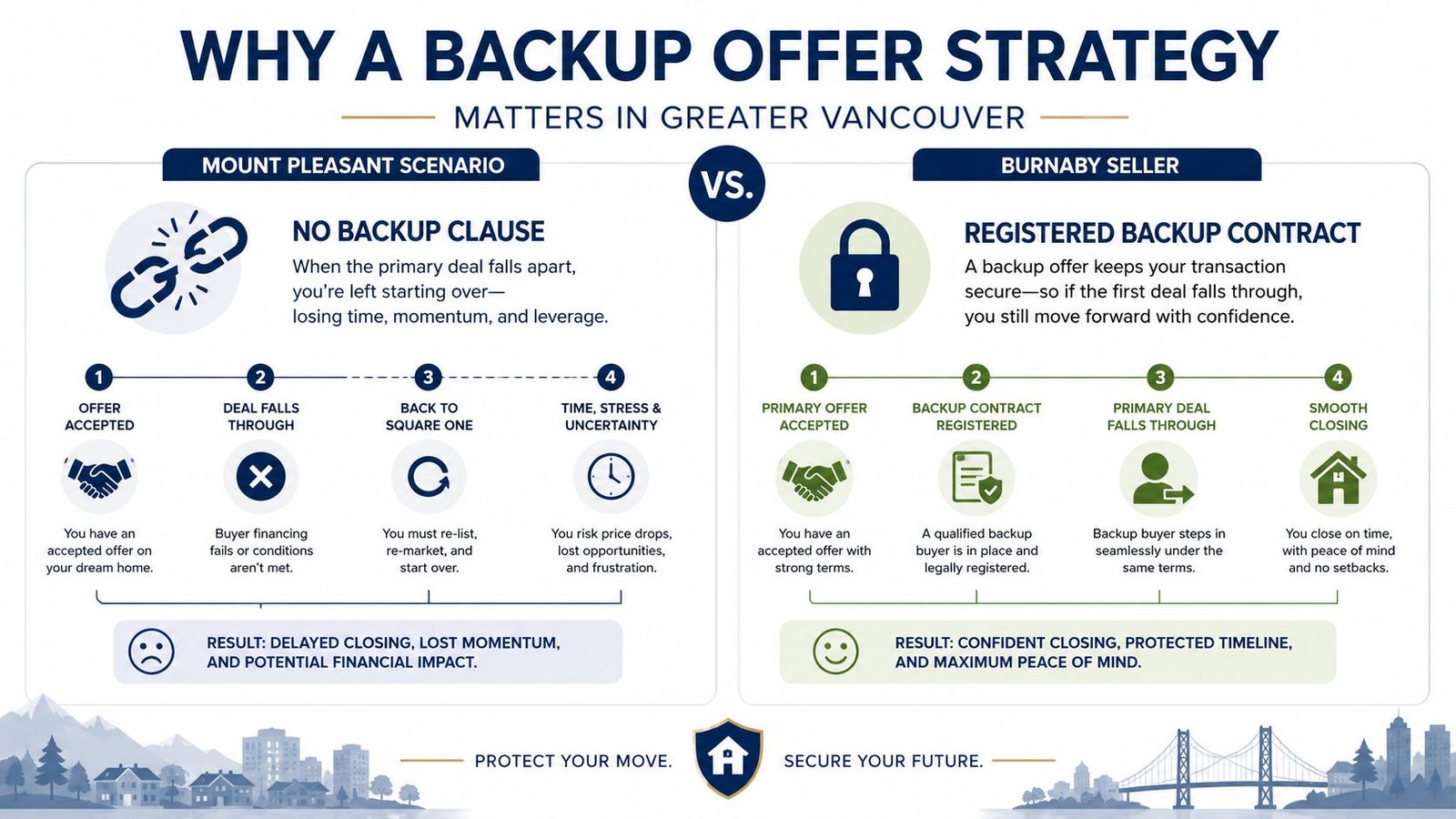
A Mount Pleasant buyer lost a home after the accepted offer collapsed. The buyer had negotiated seriously and was ready to proceed, but no formal backup clause had been registered. By the time the seller contacted the runner-up, discussions had reopened with other buyers and the original opportunity had changed.
A Burnaby seller managed the same risk more deliberately. After accepting a primary offer, the seller signed a properly documented backup contract with a second buyer. When the first transaction failed during the condition period, the replacement buyer proceeded under agreed terms. The seller avoided relaunching the property, while the second buyer avoided another competitive bidding process.
Greater Vancouver is not one uniform market. Vancouver West can still produce multiple-offer pressure for well-priced, desirable homes. Buyers in Maple Ridge, Surrey, and Langley may have more time to investigate, negotiate, and reconsider. The value of a backup offer changes with that pace.
In a competitive Vancouver West sale, a backup can preserve momentum and reduce the chance that a failed deal sends the seller back to market. In a slower segment, it provides a relisting hedge. Preparing a property again can bring fresh uncertainty, renewed negotiations, and additional carrying time, especially as days on market increase.
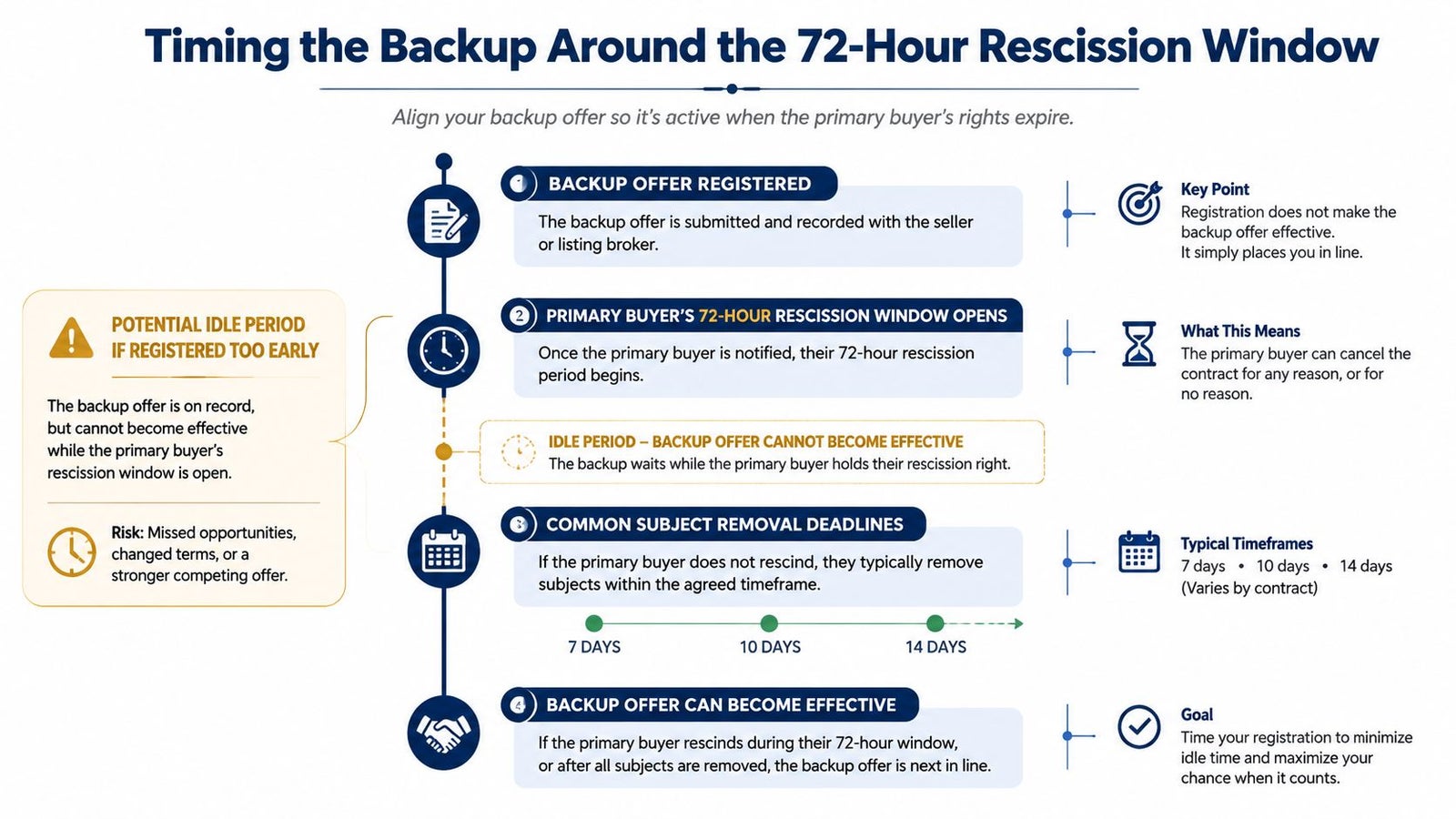
The timing around BC's 72-hour rescission window also matters. A backup signed before the primary buyer's rescission period and subjects are resolved can give the seller a defined alternative, but it does not eliminate the first buyer's rights. Once rescission and subject-removal milestones pass, the backup may offer less protection because the primary contract is more secure. Sellers should set the clause deadline and activation terms around those dates, not treat every backup as equally valuable.
Conditional offers remain common in BC. The BC Financial Services Authority's 2025 real estate brokerage data summary reported that 88% of accepted offers in its sample included at least one condition, while 11% were unconditional. Home inspection conditions appeared in approximately 85%, financing conditions in approximately 81%, and insurance conditions in approximately 71% of accepted offers.
That insurance has the greatest value while the first deal still faces financing, inspection, insurance, or rescission risk. Use it carefully. Protect confidentiality, document the trigger precisely, and never use the backup to pressure or breach the primary contract.
A BC backup offer isn't an informal promise that the seller will call you next. It must be documented in a contract that clearly places the second buyer behind the existing Contract of Purchase and Sale.
Ask your REALTOR® for the BCREA back-up offer clause by name. BCREA publishes wording that makes the backup effective only if the seller ceases to be obligated under the previously accepted contract by a specified date. The clause states:
That wording matters because it identifies the trigger, gives the arrangement a deadline, and makes clear that the primary contract remains controlling until it ends. The BCREA explanation of the back-up offer clause is the right reference to discuss with your agent and lawyer.
The backup offer is negotiated like any other offer. Price, deposit, completion date, possession date, financing, inspection, insurance, and other terms can be proposed and countered. A buyer might negotiate a price adjustment, a stronger deposit payable on activation, or timelines that begin only when the backup becomes operative.
The seller's licensee should involve legal counsel if changes to the first contract could activate the backup or create a dual-sale risk. The second buyer should also obtain legal advice, particularly where the first transaction is being extended, amended, or renegotiated. BC backup offer guidance explains why both sides need clarity before relying on the arrangement.
The practical workflow is straightforward: negotiate the offer, insert the dated backup clause, sign and document the complete agreement, monitor the primary contract, and deliver written activation notice if the first deal ends. The backup shouldn't be treated as active until the contractual trigger has occurred and the parties understand what happens next.
For related offer mechanics, review this BC buyer's guide to escalation clauses, but don't confuse an escalation clause with a backup clause. One adjusts price in response to competing offers. The other governs a second contract waiting behind an existing one.
The first mistake I see is treating the primary offer's subject-removal date as the only important deadline. It isn't. BC's Home Buyer Rescission Period begins the day after acceptance, runs for three business days, and operates concurrently with the subject-removal period. If the buyer rescinds, the buyer must pay 0.25% of the offer price. The BCFSA seller guidance on offers sets out the basic rule.
That overlap creates a short period in which a backup can become relevant sooner than expected. If the buyer removes subjects on day two, the rescission right ends immediately. If subjects remain in place, the seller may still face a cancellation during the rescission window and then further uncertainty while financing, inspection, or insurance is completed.
A Kitsilano condo has financing and inspection subjects. Registering a backup immediately may protect the seller, but the second buyer could sit idle while the primary buyer completes its investigation. The backup should include a clear activation deadline and an expiry date that doesn't leave the second buyer committed indefinitely.
A Coquitlam townhome faces a low appraisal. The primary buyer may need to renegotiate price, increase funds, or seek a lender solution. A backup buyer should not assume activation means a clean transaction. Ask what happens to the backup if the seller amends the first contract rather than ending it, and have counsel review the risk.
A Langley single-family home has a buyer who waives conditions early. The rescission right ends once subjects are removed, according to BCFSA's Home Buyer Rescission Period guideline. A backup registered after that point may have less immediate activation potential, but it can still protect against later financing or completion problems.
Early 2025 reporting showed a Metro Vancouver dataset with average days on market reaching 121 days by June 30, while the gap between displayed and actual listing days reached 47 days, as reported by Business in Vancouver. That environment makes a backup more useful as a seller's fallback, but less attractive to a buyer who can find comparable homes without waiting.
Confirm the acceptance date, calculate the three-business-day window, map subject removal, and set the backup expiry before anyone signs. Don't rely on a verbal assurance that the listing agent will call.
A seller should evaluate a backup offer against the existing contract, not against the emotional relief of having another interested buyer. Start with four questions: Is the price stronger? Is the deposit meaningful and available? Are the conditions more reliable? Does the completion and possession schedule work if activation happens quickly?
Create a side-by-side comparison before discussing strategy with anyone outside the seller's representation team. Review:
Set a hard deadline for acceptance or countering. A backup buyer who has submitted a clean offer may move on quickly, and a seller shouldn't leave the arrangement vague.
The offer should be presented through the seller's REALTOR® and properly documented. Don't use an assistant, a casual text message, or a handshake arrangement as a substitute for an executed contract. The seller must also avoid leaking the primary buyer's price, financing information, inspection findings, or private negotiations.
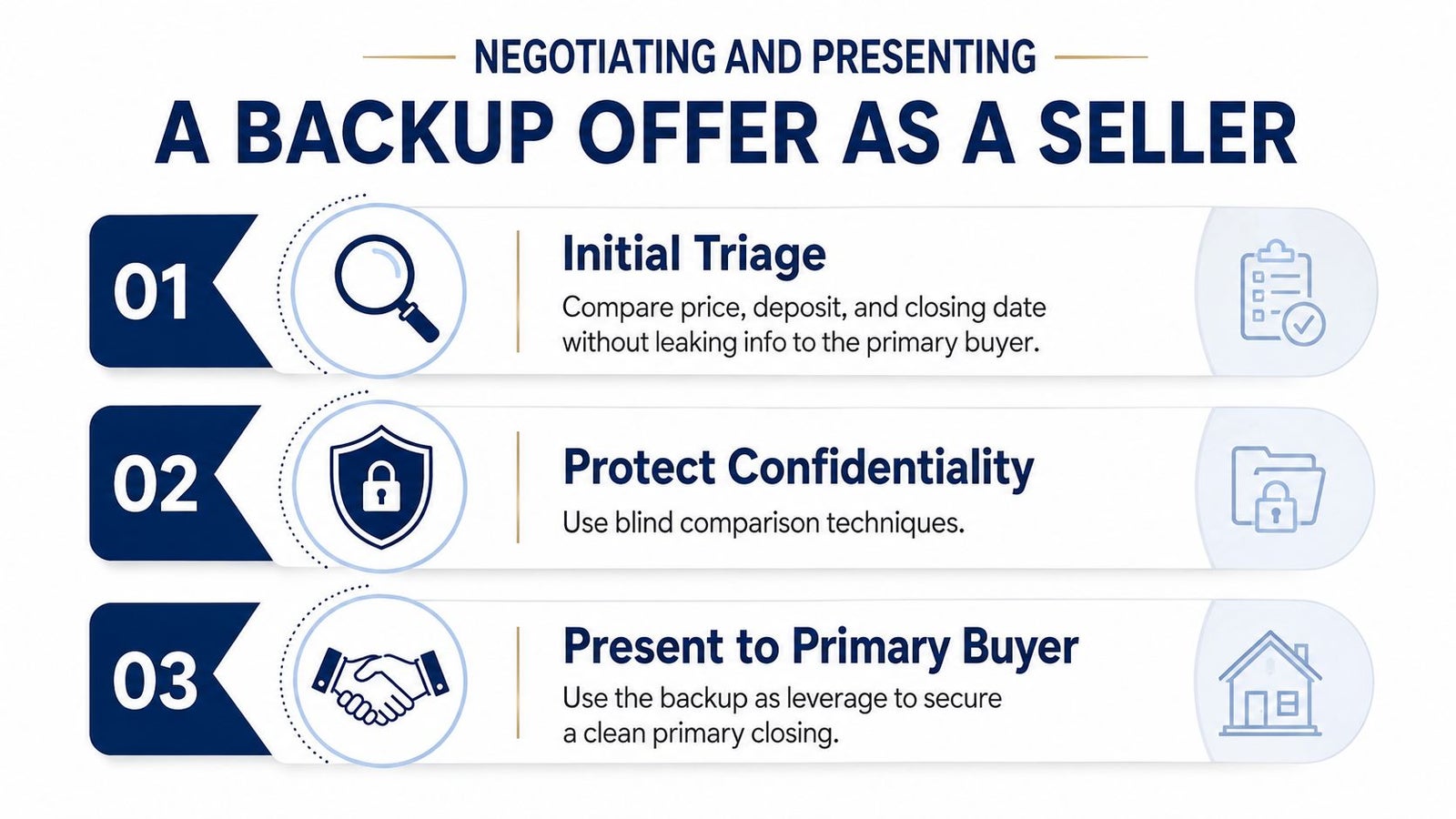
A seller can offer the backup buyer something concrete in exchange for a better package. Possible negotiating levers include:
Don't pressure the primary buyer by falsely suggesting the sale has already failed. A genuine backup can strengthen the seller's position, but the first contract continues to govern until it ends.
If the backup is too weak, reject it without drama: “Thank you for the offer. The seller isn't prepared to enter a backup contract on those terms, but we appreciate your interest and will contact you if the property becomes available.” That response preserves the relationship and avoids disclosing the primary buyer's confidential information.
For broader preparation and pricing considerations, see these tips for selling a Vancouver home quickly. A backup can protect a well-managed sale, but it can't repair poor pricing, weak presentation, or disorganized transaction management.
The old assumption is that backup offers belong only to bidding wars. That's wrong for Greater Vancouver's slower 2025 environment. A seller with a property sitting on the market has a different problem from a seller who receives several offers immediately, but both face the same danger when a primary contract fails.
By late 2025, broader market updates placed detached homes around 47 days on market and apartments around 44 to 42 days, as summarised in Vancouver real estate sales reporting for May 2025. Those figures don't mean every home needs a backup. They do show why a failed contract can be expensive strategically. The seller may have to relaunch after the listing has aged, explain the failed transaction, and rebuild buyer attention.
A backup also exposes the weakness of a fragile first contract. Financing or inspection uncertainty may surface near subject removal, while lender requests and appraisal concerns can force extensions or renegotiation. A prepared second buyer gives the seller a negotiated alternative instead of a blank MLS relaunch.
For buyers, the slower market changes the calculation too. You may be able to submit a backup without overpaying to secure second position, but you shouldn't abandon inspection, financing, or insurance protection to do it. If comparable homes are available, keep shopping while the backup waits.
A backup offer only reduces risk when its trigger, timing, and funding are clear. In BC's condition-heavy market, inspection, financing, and insurance can still derail the first contract. A second buyer gives the seller a negotiated alternative, but it does not remove those failure points. In slower 2025 conditions, the seller should also compare the backup with the likely result of relaunching after the listing has accumulated more days on market.
For the seller:
For the buyer:
Appraisal risk affects both sides differently. The buyer may need additional funds or face renegotiation if the valuation is low. The seller could lose both transactions if the price cannot be supported. Financing risk sits mainly with the buyer, while inspection risk can reduce value, delay completion, or trigger a price dispute for everyone.
In a multiple-offer setting, Greater Vancouver boards require a Disclosure of Multiple Offers Presented form. Since July 17, 2023, it has recorded the number of offers, brokerages involved, and offer date, while excluding the winning price and terms. Multiple offers are not present in every transaction, so do not impose an aggressive backup structure on a listing that does not need one.
Accept the backup when the property is difficult to replace, the first contract has unresolved risk, and the backup buyer can perform. Counter when price, dates, deposit, or conditions need improvement. Walk away when the seller wants a vague commitment, the clause has no firm expiry, material property issues remain unclear, or the buyer would be financially strained if activation occurred tomorrow.
If you're considering a backup offer in Greater Vancouver, don't sign first and ask questions later. Arrange a 30-minute strategy call this week with a licensed BC REALTOR® and a real estate lawyer before accepting or drafting anything that could bind you.
Start by auditing the primary contract. Write down the acceptance date, rescission deadline, subject-removal date, extension provisions, completion date, and any event that could end the seller's obligation. Then confirm that the proposed backup uses a specific BCREA-style clause with a dated trigger, rather than vague language about being “next in line.”
Prepare a replacement-buyer brief before you need it. It should state the minimum acceptable price, preferred completion and possession dates, acceptable financing evidence, and conditions the seller won't entertain. This prevents rushed decision-making if the first buyer rescinds or the transaction collapses during subject removal.
Bring the MLS listing history, all counter-offer correspondence, the existing contract, and a written list of walk-away triggers to the meeting. If the property is a strata home, include available strata documents and any communication relevant to insurance or building concerns.
A buyer considering second position should refresh pre-approval with the lender, establish a firm price ceiling, and decide in advance which conditions are essential. Prepare a one-page offer summary covering price, deposit, financing, inspection, insurance, completion, possession, and expiry. If activation occurs with little notice, that summary lets your REALTOR®, lender, inspector, and lawyer work from the same instructions.
Ask how activation notice will be delivered, when your deposit becomes payable, whether you can withdraw before activation, and what happens if the primary contract is amended rather than terminated. Keep viewing other homes while you wait unless your lawyer advises that your particular contract restricts you.
A BC real estate contract is a legal document. Verbal assurances about backup status, priority, activation, or withdrawal aren't enough. Your REALTOR® can negotiate the commercial terms and manage the transaction, but your lawyer should advise on enforceability, dual-sale risk, rescission overlap, and any unusual amendment.
Choose representation based on real transaction experience, not just a familiar name. These questions to ask when interviewing a Vancouver REALTOR® can help you test whether the advisor understands local board procedures, strata documentation, condition management, and backup paperwork.
Bring the documents, set your walk-away rules, and map the dates before you make the offer. If you're weighing a backup position this week, book the call and have a licensed Vancouver REALTOR® and lawyer review the structure before you sign.
Jacky Levi - Sotheby's Realty Advisor & Realtor helps Greater Vancouver buyers and sellers evaluate backup offers, manage subject-removal timing, and negotiate documented terms for condos, townhomes, and detached homes. Visit Jacky Levi - Sotheby's Realty Advisor & Realtor to arrange a practical strategy discussion about your property and next move.
A sound backup offer strategy depends on more than being second in line. You need to understand the primary contract, the BC Home Buyer Rescission Period, subject-removal dates, market conditions, and the exact clause that controls when the second offer can take effect. The recommendations below reflect how I'd advise a Vancouver buyer or seller weighing that position today.
Why a Backup Offer Strategy Matters in Greater Vancouver
A Mount Pleasant buyer lost a home after the accepted offer collapsed. The buyer had negotiated seriously and was ready to proceed, but no formal backup clause had been registered. By the time the seller contacted the runner-up, discussions had reopened with other buyers and the original opportunity had changed.
A Burnaby seller managed the same risk more deliberately. After accepting a primary offer, the seller signed a properly documented backup contract with a second buyer. When the first transaction failed during the condition period, the replacement buyer proceeded under agreed terms. The seller avoided relaunching the property, while the second buyer avoided another competitive bidding process.
The local reason this matters
Greater Vancouver is not one uniform market. Vancouver West can still produce multiple-offer pressure for well-priced, desirable homes. Buyers in Maple Ridge, Surrey, and Langley may have more time to investigate, negotiate, and reconsider. The value of a backup offer changes with that pace.
In a competitive Vancouver West sale, a backup can preserve momentum and reduce the chance that a failed deal sends the seller back to market. In a slower segment, it provides a relisting hedge. Preparing a property again can bring fresh uncertainty, renewed negotiations, and additional carrying time, especially as days on market increase.
The timing around BC's 72-hour rescission window also matters. A backup signed before the primary buyer's rescission period and subjects are resolved can give the seller a defined alternative, but it does not eliminate the first buyer's rights. Once rescission and subject-removal milestones pass, the backup may offer less protection because the primary contract is more secure. Sellers should set the clause deadline and activation terms around those dates, not treat every backup as equally valuable.
Conditional offers remain common in BC. The BC Financial Services Authority's 2025 real estate brokerage data summary reported that 88% of accepted offers in its sample included at least one condition, while 11% were unconditional. Home inspection conditions appeared in approximately 85%, financing conditions in approximately 81%, and insurance conditions in approximately 71% of accepted offers.
Practical rule: Treat a backup offer as transaction insurance, not ceremonial second place.
That insurance has the greatest value while the first deal still faces financing, inspection, insurance, or rescission risk. Use it carefully. Protect confidentiality, document the trigger precisely, and never use the backup to pressure or breach the primary contract.
How the BC Backup Offer Clause Actually Works
A BC backup offer isn't an informal promise that the seller will call you next. It must be documented in a contract that clearly places the second buyer behind the existing Contract of Purchase and Sale.
Start with the recognized wording
Ask your REALTOR® for the BCREA back-up offer clause by name. BCREA publishes wording that makes the backup effective only if the seller ceases to be obligated under the previously accepted contract by a specified date. The clause states:
Subject to the seller ceasing to be obligated in any way under the previously accepted Contract of Purchase and Sale on the subject property on or before(date). This condition is for the sole benefit of the seller.
That wording matters because it identifies the trigger, gives the arrangement a deadline, and makes clear that the primary contract remains controlling until it ends. The BCREA explanation of the back-up offer clause is the right reference to discuss with your agent and lawyer.
The backup offer is negotiated like any other offer. Price, deposit, completion date, possession date, financing, inspection, insurance, and other terms can be proposed and countered. A buyer might negotiate a price adjustment, a stronger deposit payable on activation, or timelines that begin only when the backup becomes operative.
- Position: Standard BCREA position is a second contract behind the accepted primary contract. In Greater Vancouver, confirm whether it's the first backup and whether other backup contracts exist.
- Activation: Standard BCREA position is that it takes effect when the seller is no longer obligated under the first contract. In Greater Vancouver, define the activation event, notice method, and effective date.
- Expiry: Standard BCREA position is that it ends on the date stated in the clause. In Greater Vancouver, negotiate a realistic deadline tied to the first contract.
- Price and terms: Standard BCREA position is that these are agreed when the backup contract is signed. In Greater Vancouver, price, deposit, closing date, and conditions can be negotiated.
- Deposit: Standard BCREA position is that there is no statutory requirement for a backup deposit. In Greater Vancouver, negotiate whether it's payable on signing or activation.
- Legal review: Standard BCREA position is that the contract should be reviewed for enforceability and dual-sale risk. In Greater Vancouver, buyer and seller can obtain independent legal advice.
The seller's licensee should involve legal counsel if changes to the first contract could activate the backup or create a dual-sale risk. The second buyer should also obtain legal advice, particularly where the first transaction is being extended, amended, or renegotiated. BC backup offer guidance explains why both sides need clarity before relying on the arrangement.
The practical workflow is straightforward: negotiate the offer, insert the dated backup clause, sign and document the complete agreement, monitor the primary contract, and deliver written activation notice if the first deal ends. The backup shouldn't be treated as active until the contractual trigger has occurred and the parties understand what happens next.
For related offer mechanics, review this BC buyer's guide to escalation clauses, but don't confuse an escalation clause with a backup clause. One adjusts price in response to competing offers. The other governs a second contract waiting behind an existing one.
Timing the Backup Around the 72-Hour Rescission Window
The first mistake I see is treating the primary offer's subject-removal date as the only important deadline. It isn't. BC's Home Buyer Rescission Period begins the day after acceptance, runs for three business days, and operates concurrently with the subject-removal period. If the buyer rescinds, the buyer must pay 0.25% of the offer price. The BCFSA seller guidance on offers sets out the basic rule.
That overlap creates a short period in which a backup can become relevant sooner than expected. If the buyer removes subjects on day two, the rescission right ends immediately. If subjects remain in place, the seller may still face a cancellation during the rescission window and then further uncertainty while financing, inspection, or insurance is completed.
Three Vancouver examples
A Kitsilano condo has financing and inspection subjects. Registering a backup immediately may protect the seller, but the second buyer could sit idle while the primary buyer completes its investigation. The backup should include a clear activation deadline and an expiry date that doesn't leave the second buyer committed indefinitely.
A Coquitlam townhome faces a low appraisal. The primary buyer may need to renegotiate price, increase funds, or seek a lender solution. A backup buyer should not assume activation means a clean transaction. Ask what happens to the backup if the seller amends the first contract rather than ending it, and have counsel review the risk.
A Langley single-family home has a buyer who waives conditions early. The rescission right ends once subjects are removed, according to BCFSA's Home Buyer Rescission Period guideline. A backup registered after that point may have less immediate activation potential, but it can still protect against later financing or completion problems.
Match timing to market reality
Early 2025 reporting showed a Metro Vancouver dataset with average days on market reaching 121 days by June 30, while the gap between displayed and actual listing days reached 47 days, as reported by Business in Vancouver. That environment makes a backup more useful as a seller's fallback, but less attractive to a buyer who can find comparable homes without waiting.
Confirm the acceptance date, calculate the three-business-day window, map subject removal, and set the backup expiry before anyone signs. Don't rely on a verbal assurance that the listing agent will call.
Negotiating and Presenting a Backup Offer as a Seller
A seller should evaluate a backup offer against the existing contract, not against the emotional relief of having another interested buyer. Start with four questions: Is the price stronger? Is the deposit meaningful and available? Are the conditions more reliable? Does the completion and possession schedule work if activation happens quickly?
Triage the offer privately
Create a side-by-side comparison before discussing strategy with anyone outside the seller's representation team. Review:
- Price: Does the amount justify waiting behind the primary contract?
- Deposit: Can the buyer provide it promptly if the backup activates?
- Conditions: Are financing, inspection, insurance, and appraisal risks acceptable?
- Dates: Can the buyer complete on dates compatible with the seller's move, purchase, or lender obligations?
- Expiry: Does the backup remain useful without creating an indefinite commitment?
Set a hard deadline for acceptance or countering. A backup buyer who has submitted a clean offer may move on quickly, and a seller shouldn't leave the arrangement vague.
The offer should be presented through the seller's REALTOR® and properly documented. Don't use an assistant, a casual text message, or a handshake arrangement as a substitute for an executed contract. The seller must also avoid leaking the primary buyer's price, financing information, inspection findings, or private negotiations.
Trade certainty for stronger terms
A seller can offer the backup buyer something concrete in exchange for a better package. Possible negotiating levers include:
- A stronger price in exchange for a buyer who accepts a clearly defined activation structure.
- A shorter completion timeline if the buyer has financing prepared and can move quickly.
- A narrowed inspection condition only where the buyer understands the property and receives proper advice.
- A non-refundable extension fee, if drafted and reviewed appropriately, when the seller needs more time before the backup expires.
Don't pressure the primary buyer by falsely suggesting the sale has already failed. A genuine backup can strengthen the seller's position, but the first contract continues to govern until it ends.
If the backup is too weak, reject it without drama: “Thank you for the offer. The seller isn't prepared to enter a backup contract on those terms, but we appreciate your interest and will contact you if the property becomes available.” That response preserves the relationship and avoids disclosing the primary buyer's confidential information.
For broader preparation and pricing considerations, see these tips for selling a Vancouver home quickly. A backup can protect a well-managed sale, but it can't repair poor pricing, weak presentation, or disorganized transaction management.
Backup Offers as a Hedge in Slower 2025 Market Conditions
The old assumption is that backup offers belong only to bidding wars. That's wrong for Greater Vancouver's slower 2025 environment. A seller with a property sitting on the market has a different problem from a seller who receives several offers immediately, but both face the same danger when a primary contract fails.
By late 2025, broader market updates placed detached homes around 47 days on market and apartments around 44 to 42 days, as summarised in Vancouver real estate sales reporting for May 2025. Those figures don't mean every home needs a backup. They do show why a failed contract can be expensive strategically. The seller may have to relaunch after the listing has aged, explain the failed transaction, and rebuild buyer attention.
- Under 30 days: Market phase is early marketing or fresh acceptance. Backup offer value is that it preserves momentum and protects against a quick collapse. Seller action is to seek a clean, documented backup without weakening the primary deal.
- 30-plus days: Market phase is slower exposure and greater relisting concern. Backup offer value is that it provides a replacement path before the listing becomes harder to position. Seller action is to counter for stronger financing, clearer dates, and useful conditions.
- Around 47 days: Market phase is a meaningful period of market exposure for some property types. Backup offer value is that it can reduce the risk of returning to market with a failed-sale narrative. Seller action is to compare the backup against realistic relaunch pricing, not the original list price.
- Beyond the local norm: Market phase is a stale or repeatedly repositioned listing. Backup offer value is that it may be more valuable than another uncertain marketing cycle. Seller action is to accept only if the buyer can perform and the terms remain commercially sensible.
A backup also exposes the weakness of a fragile first contract. Financing or inspection uncertainty may surface near subject removal, while lender requests and appraisal concerns can force extensions or renegotiation. A prepared second buyer gives the seller a negotiated alternative instead of a blank MLS relaunch.
For buyers, the slower market changes the calculation too. You may be able to submit a backup without overpaying to secure second position, but you shouldn't abandon inspection, financing, or insurance protection to do it. If comparable homes are available, keep shopping while the backup waits.
Risk Management and Common Mistakes to Avoid
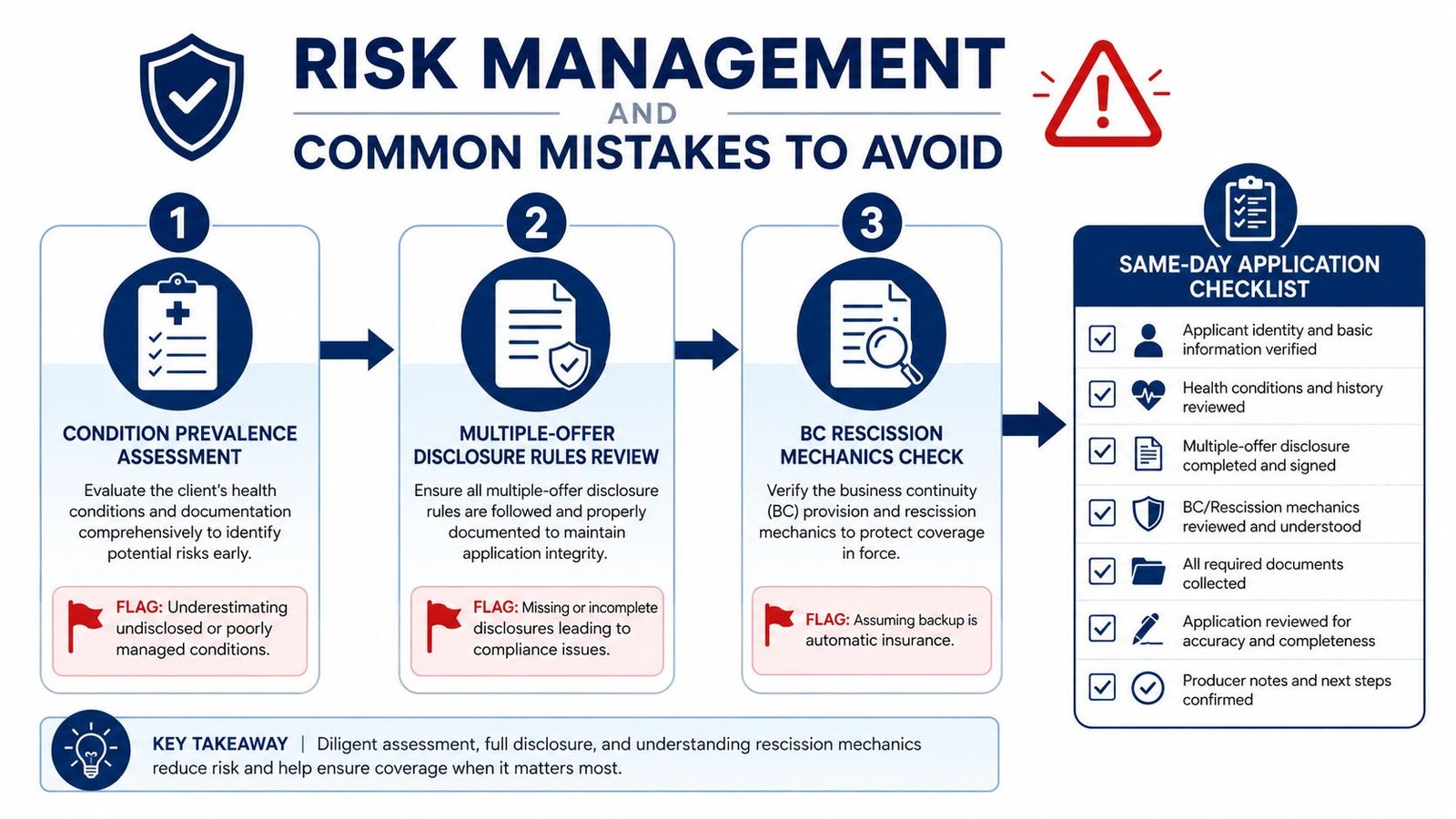
A backup offer only reduces risk when its trigger, timing, and funding are clear. In BC's condition-heavy market, inspection, financing, and insurance can still derail the first contract. A second buyer gives the seller a negotiated alternative, but it does not remove those failure points. In slower 2025 conditions, the seller should also compare the backup with the likely result of relaunching after the listing has accumulated more days on market.
Apply the same-day checklist
For the seller:
- Confirm the clock: Record acceptance, the 72-hour rescission deadline, subject-removal date, extension terms, backup-expiry date, completion date, and every event that could end the first contract.
- Protect confidentiality: Do not disclose the primary buyer's private terms or inspection findings to manufacture pressure. Share material property information with legal guidance.
- Check activation: Ask the lawyer to confirm exactly when the first contract ends, what written notice activates the backup, and whether the wording works during or after rescission.
- Plan the deposit: Confirm that the backup buyer can deliver the required deposit as soon as the contract becomes operative.
- Review the economics: Compare the backup price and terms with a realistic relaunch, not only with the original list price. A fast replacement can be valuable, but a weak buyer can create another failed transaction.
For the buyer:
- Inspect independently: If the first buyer's deal failed over inspection, review the property yourself. Do not rely on another buyer's report or assumptions.
- Refresh financing: Have the lender confirm current qualification, appraisal expectations, and the ability to meet the backup contract dates.
- Test insurance: Confirm that the property remains insurable before activation, particularly for strata or older construction.
- Price appraisal risk: A second appraisal can expose the same value gap that troubled the first buyer. Decide in advance whether you can add funds or renegotiate.
- Keep looking: Continue pursuing other suitable properties unless the backup contract restricts you.
Appraisal risk affects both sides differently. The buyer may need additional funds or face renegotiation if the valuation is low. The seller could lose both transactions if the price cannot be supported. Financing risk sits mainly with the buyer, while inspection risk can reduce value, delay completion, or trigger a price dispute for everyone.
In a multiple-offer setting, Greater Vancouver boards require a Disclosure of Multiple Offers Presented form. Since July 17, 2023, it has recorded the number of offers, brokerages involved, and offer date, while excluding the winning price and terms. Multiple offers are not present in every transaction, so do not impose an aggressive backup structure on a listing that does not need one.
Decide quickly and objectively
Accept the backup when the property is difficult to replace, the first contract has unresolved risk, and the backup buyer can perform. Counter when price, dates, deposit, or conditions need improvement. Walk away when the seller wants a vague commitment, the clause has no firm expiry, material property issues remain unclear, or the buyer would be financially strained if activation occurred tomorrow.
Your Next Step and How a Vancouver Advisor Can Help
If you're considering a backup offer in Greater Vancouver, don't sign first and ask questions later. Arrange a 30-minute strategy call this week with a licensed BC REALTOR® and a real estate lawyer before accepting or drafting anything that could bind you.
Sellers should prepare the file
Start by auditing the primary contract. Write down the acceptance date, rescission deadline, subject-removal date, extension provisions, completion date, and any event that could end the seller's obligation. Then confirm that the proposed backup uses a specific BCREA-style clause with a dated trigger, rather than vague language about being “next in line.”
Prepare a replacement-buyer brief before you need it. It should state the minimum acceptable price, preferred completion and possession dates, acceptable financing evidence, and conditions the seller won't entertain. This prevents rushed decision-making if the first buyer rescinds or the transaction collapses during subject removal.
Bring the MLS listing history, all counter-offer correspondence, the existing contract, and a written list of walk-away triggers to the meeting. If the property is a strata home, include available strata documents and any communication relevant to insurance or building concerns.
Buyers should be ready to activate
A buyer considering second position should refresh pre-approval with the lender, establish a firm price ceiling, and decide in advance which conditions are essential. Prepare a one-page offer summary covering price, deposit, financing, inspection, insurance, completion, possession, and expiry. If activation occurs with little notice, that summary lets your REALTOR®, lender, inspector, and lawyer work from the same instructions.
Ask how activation notice will be delivered, when your deposit becomes payable, whether you can withdraw before activation, and what happens if the primary contract is amended rather than terminated. Keep viewing other homes while you wait unless your lawyer advises that your particular contract restricts you.
A BC real estate contract is a legal document. Verbal assurances about backup status, priority, activation, or withdrawal aren't enough. Your REALTOR® can negotiate the commercial terms and manage the transaction, but your lawyer should advise on enforceability, dual-sale risk, rescission overlap, and any unusual amendment.
Choose representation based on real transaction experience, not just a familiar name. These questions to ask when interviewing a Vancouver REALTOR® can help you test whether the advisor understands local board procedures, strata documentation, condition management, and backup paperwork.
Bring the documents, set your walk-away rules, and map the dates before you make the offer. If you're weighing a backup position this week, book the call and have a licensed Vancouver REALTOR® and lawyer review the structure before you sign.
Jacky Levi - Sotheby's Realty Advisor & Realtor helps Greater Vancouver buyers and sellers evaluate backup offers, manage subject-removal timing, and negotiate documented terms for condos, townhomes, and detached homes. Visit Jacky Levi - Sotheby's Realty Advisor & Realtor to arrange a practical strategy discussion about your property and next move.