
You've just stepped off the SkyTrain at Waterfront with a partner, two suitcases, and a printed list of the “best Vancouver neighbourhoods.” Within a short walk, the list starts to feel useless. Glass towers, heritage streets, office workers, waterfront paths, and older rental buildings all sit within the same broad downtown label.
That confusion continues across the city. A costly West Side teardown can stand only a short drive from a much more attainable townhouse, while a new Yaletown tower may rise behind an older Strathcona block. The phrase neighbourhoods in Vancouver BC sounds tidy, but Vancouver's real housing map is a patchwork of distinct micro-markets.
I've spent more than two decades helping buyers, sellers, and investors read that patchwork. My advice is straightforward: don't choose an area from a prestige ranking or a social-media list. Compare the MLS benchmark price, the local population profile, the walking environment, transit access, rental conditions, and the kind of household that competes there.
The couple at Waterfront has three immediate questions. Where can they afford to live? Which neighbourhood will make daily life easier? And will the home they buy still appeal to the next buyer if their plans change?
Those questions can't be answered by saying “West Side” or “East Van.” A district can contain quiet streets, busy commercial corridors, older apartments, new concrete buildings, and very different household patterns. Downtown Vancouver's 2021 neighbourhood profile recorded 72,975 people, with children aged 0 to 18 representing a small share of that profile, while the citywide population was 662,248. The contrast tells you something important about demand. A downtown one-bedroom and a family-oriented detached home aren't competing for the same buyer. Vancouver's neighbourhood census profiles make that difference visible.
A buyer may say they want “Kitsilano,” but what they often mean is a walkable block near shops, a manageable commute, and access to the beach. Another buyer may say “East Van” while really seeking a character house near Commercial Drive, a newer Mount Pleasant condo, or a townhouse near rapid transit.
Sellers make the same mistake in reverse. They compare their property with a broad city average, then wonder why buyers don't respond to an ambitious price. The relevant competition is usually narrower, such as similar apartments in the same local area, townhomes with comparable strata obligations, or detached homes serving the same family profile.
North Shore buyers face the same issue. A home search that starts with Vancouver can quickly include different commuting, topography, and school considerations across the bridges. A focused North Vancouver neighbourhood guide helps keep that comparison grounded in the actual lifestyle a buyer wants.
The clearest way to understand Vancouver is to combine three views: the city's defined planning areas, Statistics Canada's geographic data, and the physical experience of moving through the neighbourhood. That approach exposes trade-offs that headline rankings hide.
A premium address may offer stronger perceived status but less housing choice. A less celebrated area may provide better access to a station, a larger home, or a more practical monthly budget. The right decision isn't about finding Vancouver's single best neighbourhood. It's about matching the neighbourhood's actual demand profile to your own plans.
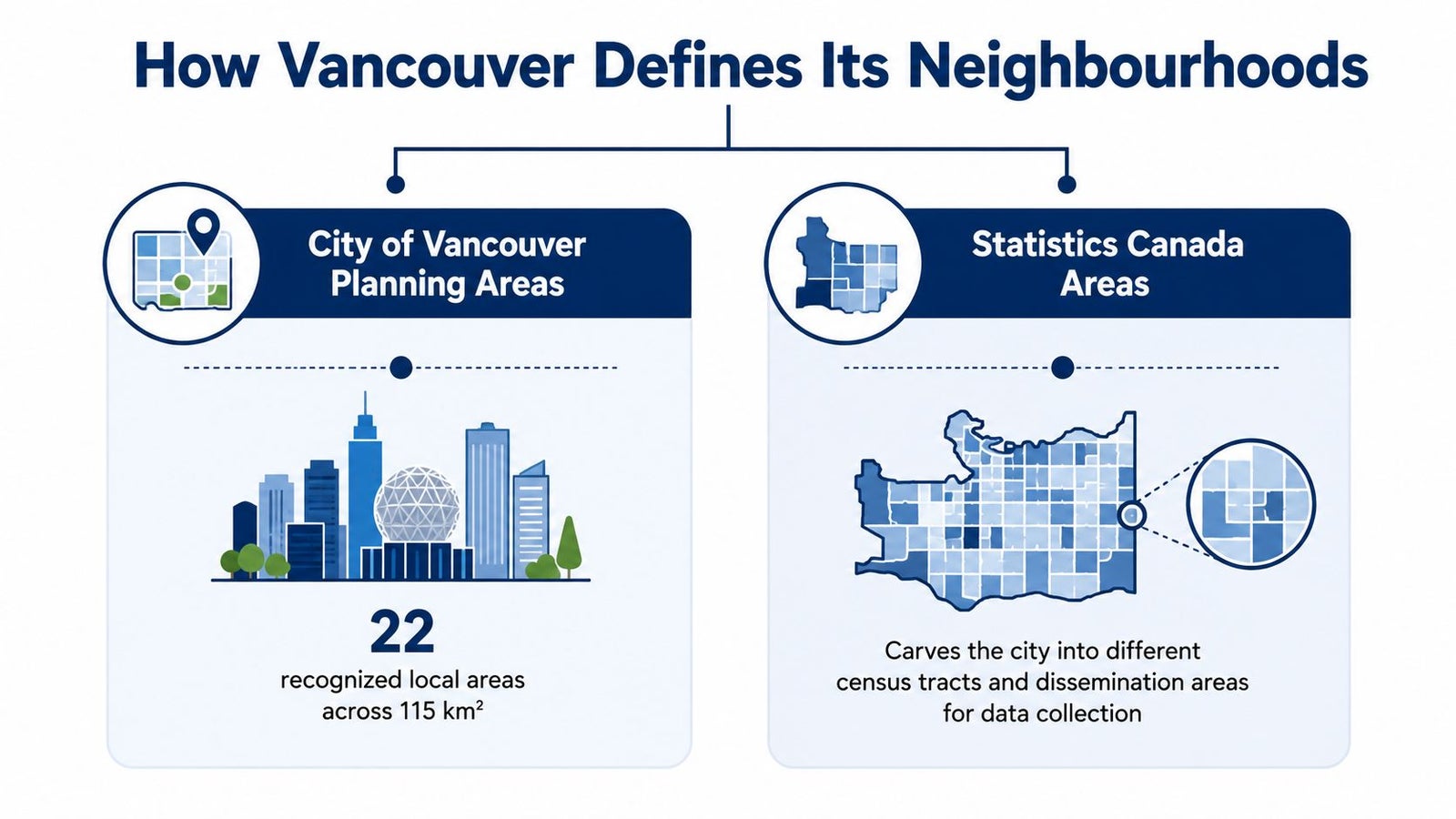
Before comparing areas, get the geography right. The City of Vancouver's neighbourhood framework is built around 22 local areas, with census information tied to recognized boundaries rather than vague labels. The city has maintained custom neighbourhood census tabulations for every census since 1971, creating a long-running record that can be compared over time through its local-area census profiles.
Statistics Canada uses a different framework. Census tracts and dissemination areas don't always match municipal planning boundaries, so a neighbourhood article can accidentally combine data from areas that residents experience as separate markets. Always check which boundary a profile uses before treating its household, tenure, or population information as a direct description of a particular block.
Walkability isn't just a high score beside a neighbourhood name. Metro Vancouver's methodology uses a 1-kilometre street-network buffer around each postal-code centroid, an approximation of a 10 to 15 minute walk, rather than drawing a simple circular radius. It combines parcel-level land-use data, street networks, and census inputs across residential density, commercial density, land-use mix, and street connectivity. The Metro Vancouver residential preferences and public health report explains why that distinction matters.
A block can be close to a shop as the crow flies but awkward to reach because of major roads, cul-de-sacs, or weak connections. Denser, mixed-use, connected areas generally support more walking and reduce car dependence, but that doesn't automatically mean they offer better value or quieter living.
Active transportation is associated with neighbourhoods exceeding about 15 units per acre in net residential density, more than 44 intersections per square kilometre, and a retail floor-area ratio above 0.5, according to Metro Vancouver transportation research. Yaletown illustrates the difference between walking and transit intensity, with a reported transit score of 97/100, compared with 74/100 for Fairview.
Families should layer school catchments onto the map, then verify the current catchment information directly before making an offer. A school name in a listing isn't a guarantee of placement, and catchments can matter differently to a family than they do to a downsizer or investor.
Transit also changes the practical value of a location. Kitsilano has a strong walking environment and substantial amenities, but its transit calculation changes as the Broadway SkyTrain extension progresses toward Arbutus Station. For renters and entry-level buyers, tenure matters just as much. CMHC-linked commentary indicates that vacancy loosening is concentrated in mid- and higher-priced homes, while only 1% to 2% of units affordable to lower-income households are vacant, as discussed in Vancouver's Kitsilano neighbourhood analysis.
That is why a buyer should ask two separate questions: can I afford this home, and can the household profile I depend on continue to afford this area?
A buyer comparing Vancouver West and Vancouver East needs more than a neighbourhood label. Match the area to the property type, budget, and intended tenure. July 2026 benchmarks put apartments at $768,700 in Vancouver West and $628,600 in Vancouver East. Detached homes were $3,011,300 and $1,642,100, respectively, according to the July 2026 Vancouver housing market comparison.
The regional benchmark is a reference point, not a neighbourhood forecast. The Greater Vancouver Realtors June 2026 media package lists an MLS Home Price Index composite benchmark of $1,099,100 for Metro Vancouver. The June 2026 GVR statistics package gives buyers and sellers a useful regional anchor, but local properties still need local comparables.
Detached homes and apartments aren't moving as one market. Buyers who need land, redevelopment potential, or family space face a different negotiation environment from buyers comparing newer condos near rapid transit. That separation is especially important in Vancouver West and Vancouver East, where the benchmark spreads are substantial.
Rental conditions add another layer. The reported one-bedroom gap between $2,741 in West Point Grey and UBC and $1,802 in Sunset-Victoria Fraserview shows why affordability isn't a citywide concept. Downtown and West End softness may create more negotiating room for some renters and condo buyers, but lower-income households still face limited access where affordable vacancy remains scarce.
Transit expansion can alter which blocks feel practical, but buyers shouldn't pay for a future benefit without checking the current commute. Kitsilano's appeal is already strong because of its amenities and walkability, yet the Broadway corridor's transit outlook may change how buyers evaluate Arbutus-adjacent listings.
Yaletown and Fairview also show why walkability and transit aren't identical. A neighbourhood can support daily errands on foot while offering a different level of rapid-transit access. Your search should record both.
Pull closed comparables from the same neighbourhood and property category, then adjust for condition, parking, outdoor space, exposure, strata health, and transit access. A citywide benchmark can frame the conversation, but it can't price a specific home.
Stage for the dominant buyer. A family-oriented listing needs practical storage, flexible bedrooms, and a clear explanation of the school and park routine. A downtown condo needs polished presentation, efficient use of space, and precise building documentation.
Use professional photography, video tours, and a detailed showing plan when the property warrants it. The seller's job is to make the home easy to understand, while the advisor's job is to position it against the right local competition and manage the offer process.
That confusion continues across the city. A costly West Side teardown can stand only a short drive from a much more attainable townhouse, while a new Yaletown tower may rise behind an older Strathcona block. The phrase neighbourhoods in Vancouver BC sounds tidy, but Vancouver's real housing map is a patchwork of distinct micro-markets.
I've spent more than two decades helping buyers, sellers, and investors read that patchwork. My advice is straightforward: don't choose an area from a prestige ranking or a social-media list. Compare the MLS benchmark price, the local population profile, the walking environment, transit access, rental conditions, and the kind of household that competes there.
A Walk Through Vancouver's Many Neighbourhoods
The couple at Waterfront has three immediate questions. Where can they afford to live? Which neighbourhood will make daily life easier? And will the home they buy still appeal to the next buyer if their plans change?
Those questions can't be answered by saying “West Side” or “East Van.” A district can contain quiet streets, busy commercial corridors, older apartments, new concrete buildings, and very different household patterns. Downtown Vancouver's 2021 neighbourhood profile recorded 72,975 people, with children aged 0 to 18 representing a small share of that profile, while the citywide population was 662,248. The contrast tells you something important about demand. A downtown one-bedroom and a family-oriented detached home aren't competing for the same buyer. Vancouver's neighbourhood census profiles make that difference visible.
Read the street before you trust the label
A buyer may say they want “Kitsilano,” but what they often mean is a walkable block near shops, a manageable commute, and access to the beach. Another buyer may say “East Van” while really seeking a character house near Commercial Drive, a newer Mount Pleasant condo, or a townhouse near rapid transit.
Sellers make the same mistake in reverse. They compare their property with a broad city average, then wonder why buyers don't respond to an ambitious price. The relevant competition is usually narrower, such as similar apartments in the same local area, townhomes with comparable strata obligations, or detached homes serving the same family profile.
"My practical rule: if two properties don't share a similar buyer, commute pattern, and housing type, they aren't true comparables just because they share a municipal boundary."
North Shore buyers face the same issue. A home search that starts with Vancouver can quickly include different commuting, topography, and school considerations across the bridges. A focused North Vancouver neighbourhood guide helps keep that comparison grounded in the actual lifestyle a buyer wants.
Replace the postcard with a data layer
The clearest way to understand Vancouver is to combine three views: the city's defined planning areas, Statistics Canada's geographic data, and the physical experience of moving through the neighbourhood. That approach exposes trade-offs that headline rankings hide.
A premium address may offer stronger perceived status but less housing choice. A less celebrated area may provide better access to a station, a larger home, or a more practical monthly budget. The right decision isn't about finding Vancouver's single best neighbourhood. It's about matching the neighbourhood's actual demand profile to your own plans.
How Vancouver Defines Its Neighbourhoods
Before comparing areas, get the geography right. The City of Vancouver's neighbourhood framework is built around 22 local areas, with census information tied to recognized boundaries rather than vague labels. The city has maintained custom neighbourhood census tabulations for every census since 1971, creating a long-running record that can be compared over time through its local-area census profiles.
Statistics Canada uses a different framework. Census tracts and dissemination areas don't always match municipal planning boundaries, so a neighbourhood article can accidentally combine data from areas that residents experience as separate markets. Always check which boundary a profile uses before treating its household, tenure, or population information as a direct description of a particular block.
Use walkability as a physical measurement
Walkability isn't just a high score beside a neighbourhood name. Metro Vancouver's methodology uses a 1-kilometre street-network buffer around each postal-code centroid, an approximation of a 10 to 15 minute walk, rather than drawing a simple circular radius. It combines parcel-level land-use data, street networks, and census inputs across residential density, commercial density, land-use mix, and street connectivity. The Metro Vancouver residential preferences and public health report explains why that distinction matters.
A block can be close to a shop as the crow flies but awkward to reach because of major roads, cul-de-sacs, or weak connections. Denser, mixed-use, connected areas generally support more walking and reduce car dependence, but that doesn't automatically mean they offer better value or quieter living.
Active transportation is associated with neighbourhoods exceeding about 15 units per acre in net residential density, more than 44 intersections per square kilometre, and a retail floor-area ratio above 0.5, according to Metro Vancouver transportation research. Yaletown illustrates the difference between walking and transit intensity, with a reported transit score of 97/100, compared with 74/100 for Fairview.
Add schools, transit, and tenure
Families should layer school catchments onto the map, then verify the current catchment information directly before making an offer. A school name in a listing isn't a guarantee of placement, and catchments can matter differently to a family than they do to a downsizer or investor.
Transit also changes the practical value of a location. Kitsilano has a strong walking environment and substantial amenities, but its transit calculation changes as the Broadway SkyTrain extension progresses toward Arbutus Station. For renters and entry-level buyers, tenure matters just as much. CMHC-linked commentary indicates that vacancy loosening is concentrated in mid- and higher-priced homes, while only 1% to 2% of units affordable to lower-income households are vacant, as discussed in Vancouver's Kitsilano neighbourhood analysis.
That is why a buyer should ask two separate questions: can I afford this home, and can the household profile I depend on continue to afford this area?
Vancouver West vs Vancouver East by the Numbers
A buyer comparing Vancouver West and Vancouver East needs more than a neighbourhood label. Match the area to the property type, budget, and intended tenure. July 2026 benchmarks put apartments at $768,700 in Vancouver West and $628,600 in Vancouver East. Detached homes were $3,011,300 and $1,642,100, respectively, according to the July 2026 Vancouver housing market comparison.
Benchmark apartment price, July 2026:
- Vancouver Westside - $768,700
- Vancouver East - $628,600
- Vancouver Westside - $3,011,300
- Vancouver East - $1,642,100
The apartment gap shapes the first ownership decision. Vancouver East gives buyers more room to compare building age, floor plan, parking, and station access before reaching Vancouver West's higher benchmark range. That does not make every East Vancouver listing inexpensive. It changes the trade-offs available at the entry point.
For move-up buyers, the detached spread carries more weight. West Side homes command a premium for larger lots, established family streets, and location. If the goal is to add bedrooms, that premium may not justify the monthly carrying cost. An East Vancouver townhouse or detached property can offer more usable space for the budget, while transit and nearby commercial streets often protect day-to-day convenience.
Census profiles help explain why the price difference extends beyond negotiation. Renter concentration, household composition, and housing form shape demand. High-density areas can draw renters and investors, while lower-density districts often attract families planning to own for the long term.
That distinction changes how sellers should present a property. A West Side home should speak to its likely family buyer, including street character, schools, and usable space. An East Vancouver condo should make transit access, commercial life, building condition, and monthly affordability easy to assess.
Tenure also changes the calculation. A renter may value a shorter trip and lower monthly cost, while an owner may accept a longer commute to gain outdoor space or a lower purchase price. Investors must compare the full property economics, not rent by neighbourhood name alone. A Kitsilano one-bedroom, Mount Pleasant two-bedroom, and Renfrew-Collingwood apartment serve different tenants and carry different acquisition prices, strata costs, and resale audiences. For a more focused search, use this East Vancouver house-search resource to compare housing type and local market conditions rather than relying on the East Van label.
Defining Neighbourhoods Every Buyer Should Know
A buyer choosing between West Point Grey, Mount Pleasant, and Champlain Heights is not choosing between interchangeable versions of Vancouver. Each neighbourhood attracts a different household, supports a different daily routine, and demands a different compromise between purchase price, rent, space, and convenience.
West Point Grey and Kerrisdale suit buyers who value established streets, family-oriented housing, schools, parks, and institutional amenities. The rental gap is substantial: an unfurnished one-bedroom in West Point Grey and UBC reached $2,741 in August 2026, compared with $1,802 in Sunset-Victoria Fraserview. The figures were reported in Metro Vancouver rental reporting.
My advice is direct: treat this as a lifestyle purchase before a yield purchase. Owners pay for setting, stability, and long-term appeal. Renters with tighter budgets should compare commute time, grocery access, and nearby services against less expensive districts. A prestigious address does not automatically create a convenient daily routine.
For buyers comparing housing stock and local character, this Vancouver West Side neighbourhood resource is a useful starting point. Still, confirm the exact block, zoning, lot condition, and property type before using a neighbourhood label as a pricing guide.
Coal Harbour and Yaletown fit buyers who want restaurants, offices, waterfront routes, and a low-car routine close to home. Yaletown feels busier and more amenity-rich, with restaurants and services woven into the tower environment. Coal Harbour is quieter, more view-driven, and closely tied to the seawall.
The compromise is space and building responsibility. Before writing an offer, review depreciation reports, contingency reserves, insurance, elevator systems, and planned capital work. A polished lobby says little about future ownership costs. For an investor, the rent-versus-ownership calculation must include strata fees, taxes, financing, vacancy risk, and the building's resale audience.
Downtown rental conditions also affect the decision. BC government coverage cited one-bedroom rent declines of 13.8% downtown and 10.5% in the West End in March 2026. That weakens the case for assuming rapid rent growth will carry an expensive purchase. Read the reported shift alongside the building's own rental history and comparable listings.
Commercial Drive and Mount Pleasant appeal to buyers who choose character over polish. Independent shops, restaurants, older homes, converted spaces, and active streets create a stronger local identity than many newer developments. They also require comfort with older construction, tighter parking, renovation uncertainty, and a more varied streetscape.
Walkability creates much of the demand. Properties close to the main commercial corridors let residents handle errands, meals, and transit without driving. A home several blocks beyond that useful network can feel very different, even within the same neighbourhood. Walk the route to groceries, coffee, transit, and schools before paying a premium for the area name.
Edgemont and Lynn Valley attract families seeking parks, trails, quieter streets, and more room at home. The North Shore cost is transportation. Test the bridge or transit routine at the times you travel, especially if work or school is in Vancouver. A weekend showing can hide the daily burden.
Choose these areas for outdoor access and home size. Avoid them if your priority is nightlife, a short walk to downtown offices, or a car-light routine. The right buyer values the setting enough to accept longer travel.
South Vancouver and Champlain Heights can suit buyers who need more space without paying West Side detached-home pricing. The streets are primarily residential, and the walkability experience changes sharply from one block to the next. Champlain Heights, for example, is generally less connected to shops and frequent transit than central mixed-use districts.
The ownership calculation depends on how often you need a car, how much outdoor space matters, and whether the available transit serves your actual schedule. Check the route to daily services rather than judging convenience from a map.
For move-up buyers, the detached spread carries more weight. West Side homes command a premium for larger lots, established family streets, and location. If the goal is to add bedrooms, that premium may not justify the monthly carrying cost. An East Vancouver townhouse or detached property can offer more usable space for the budget, while transit and nearby commercial streets often protect day-to-day convenience.
What the population profile adds
Census profiles help explain why the price difference extends beyond negotiation. Renter concentration, household composition, and housing form shape demand. High-density areas can draw renters and investors, while lower-density districts often attract families planning to own for the long term.
That distinction changes how sellers should present a property. A West Side home should speak to its likely family buyer, including street character, schools, and usable space. An East Vancouver condo should make transit access, commercial life, building condition, and monthly affordability easy to assess.
Tenure also changes the calculation. A renter may value a shorter trip and lower monthly cost, while an owner may accept a longer commute to gain outdoor space or a lower purchase price. Investors must compare the full property economics, not rent by neighbourhood name alone. A Kitsilano one-bedroom, Mount Pleasant two-bedroom, and Renfrew-Collingwood apartment serve different tenants and carry different acquisition prices, strata costs, and resale audiences. For a more focused search, use this East Vancouver house-search resource to compare housing type and local market conditions rather than relying on the East Van label.
Defining Neighbourhoods Every Buyer Should Know
A buyer choosing between West Point Grey, Mount Pleasant, and Champlain Heights is not choosing between interchangeable versions of Vancouver. Each neighbourhood attracts a different household, supports a different daily routine, and demands a different compromise between purchase price, rent, space, and convenience.
West Point Grey and Kerrisdale
West Point Grey and Kerrisdale suit buyers who value established streets, family-oriented housing, schools, parks, and institutional amenities. The rental gap is substantial: an unfurnished one-bedroom in West Point Grey and UBC reached $2,741 in August 2026, compared with $1,802 in Sunset-Victoria Fraserview. The figures were reported in Metro Vancouver rental reporting.
My advice is direct: treat this as a lifestyle purchase before a yield purchase. Owners pay for setting, stability, and long-term appeal. Renters with tighter budgets should compare commute time, grocery access, and nearby services against less expensive districts. A prestigious address does not automatically create a convenient daily routine.
For buyers comparing housing stock and local character, this Vancouver West Side neighbourhood resource is a useful starting point. Still, confirm the exact block, zoning, lot condition, and property type before using a neighbourhood label as a pricing guide.
Coal Harbour and Yaletown
Coal Harbour and Yaletown fit buyers who want restaurants, offices, waterfront routes, and a low-car routine close to home. Yaletown feels busier and more amenity-rich, with restaurants and services woven into the tower environment. Coal Harbour is quieter, more view-driven, and closely tied to the seawall.
The compromise is space and building responsibility. Before writing an offer, review depreciation reports, contingency reserves, insurance, elevator systems, and planned capital work. A polished lobby says little about future ownership costs. For an investor, the rent-versus-ownership calculation must include strata fees, taxes, financing, vacancy risk, and the building's resale audience.
Downtown rental conditions also affect the decision. BC government coverage cited one-bedroom rent declines of 13.8% downtown and 10.5% in the West End in March 2026. That weakens the case for assuming rapid rent growth will carry an expensive purchase. Read the reported shift alongside the building's own rental history and comparable listings.
Commercial Drive and Mount Pleasant
Commercial Drive and Mount Pleasant appeal to buyers who choose character over polish. Independent shops, restaurants, older homes, converted spaces, and active streets create a stronger local identity than many newer developments. They also require comfort with older construction, tighter parking, renovation uncertainty, and a more varied streetscape.
Walkability creates much of the demand. Properties close to the main commercial corridors let residents handle errands, meals, and transit without driving. A home several blocks beyond that useful network can feel very different, even within the same neighbourhood. Walk the route to groceries, coffee, transit, and schools before paying a premium for the area name.
Edgemont and Lynn Valley
Edgemont and Lynn Valley attract families seeking parks, trails, quieter streets, and more room at home. The North Shore cost is transportation. Test the bridge or transit routine at the times you travel, especially if work or school is in Vancouver. A weekend showing can hide the daily burden.
Choose these areas for outdoor access and home size. Avoid them if your priority is nightlife, a short walk to downtown offices, or a car-light routine. The right buyer values the setting enough to accept longer travel.
South Vancouver and Champlain Heights
South Vancouver and Champlain Heights can suit buyers who need more space without paying West Side detached-home pricing. The streets are primarily residential, and the walkability experience changes sharply from one block to the next. Champlain Heights, for example, is generally less connected to shops and frequent transit than central mixed-use districts.
The ownership calculation depends on how often you need a car, how much outdoor space matters, and whether the available transit serves your actual schedule. Check the route to daily services rather than judging convenience from a map.
What 2026 Market Signals Mean for Each Area
The regional benchmark is a reference point, not a neighbourhood forecast. The Greater Vancouver Realtors June 2026 media package lists an MLS Home Price Index composite benchmark of $1,099,100 for Metro Vancouver. The June 2026 GVR statistics package gives buyers and sellers a useful regional anchor, but local properties still need local comparables.
Buyers are separating housing types
Detached homes and apartments aren't moving as one market. Buyers who need land, redevelopment potential, or family space face a different negotiation environment from buyers comparing newer condos near rapid transit. That separation is especially important in Vancouver West and Vancouver East, where the benchmark spreads are substantial.
Rental conditions add another layer. The reported one-bedroom gap between $2,741 in West Point Grey and UBC and $1,802 in Sunset-Victoria Fraserview shows why affordability isn't a citywide concept. Downtown and West End softness may create more negotiating room for some renters and condo buyers, but lower-income households still face limited access where affordable vacancy remains scarce.
Transit changes the shortlist
Transit expansion can alter which blocks feel practical, but buyers shouldn't pay for a future benefit without checking the current commute. Kitsilano's appeal is already strong because of its amenities and walkability, yet the Broadway corridor's transit outlook may change how buyers evaluate Arbutus-adjacent listings.
Yaletown and Fairview also show why walkability and transit aren't identical. A neighbourhood can support daily errands on foot while offering a different level of rapid-transit access. Your search should record both.
The neighbourhoods absorbing demand are the ones that combine a clear daily-life advantage with a price buyers can still defend. Areas that rely only on reputation are negotiating harder.
For market context and a local sales discussion, review Vancouver real estate sales in January 2026, then update the analysis with current property-specific sales before writing an offer or setting a list price.
A good Vancouver search starts with a shortlist you can defend. Don't save twenty neighbourhoods. Choose a small group that matches your housing type, commute, budget, and tolerance for maintenance.
For market context and a local sales discussion, review Vancouver real estate sales in January 2026, then update the analysis with current property-specific sales before writing an offer or setting a list price.
A Practical Plan for Buyers and Sellers
A good Vancouver search starts with a shortlist you can defend. Don't save twenty neighbourhoods. Choose a small group that matches your housing type, commute, budget, and tolerance for maintenance.
The buyer playbook
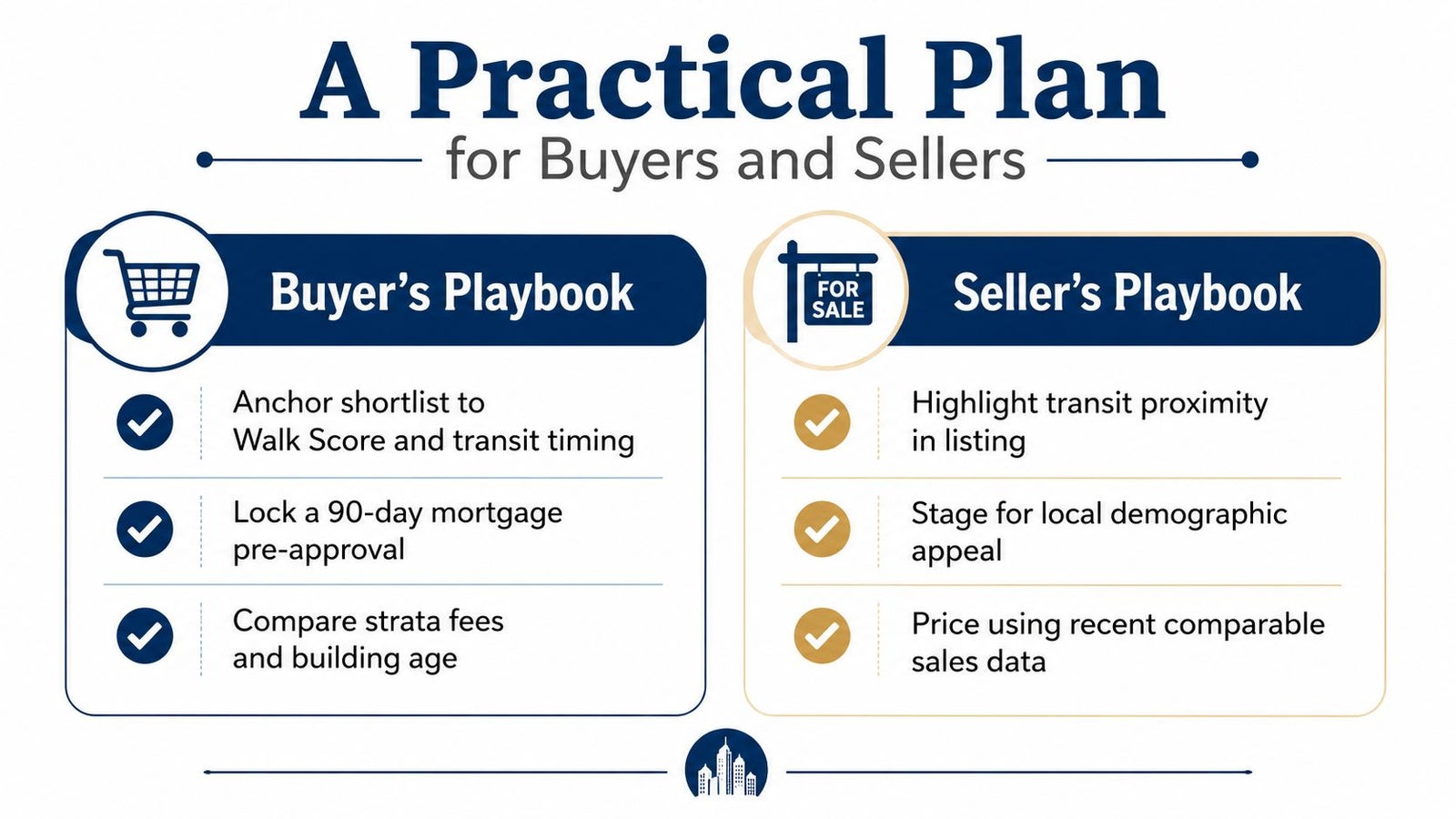
- Anchor the shortlist to walking and transit. Use the street-network logic behind walkability, then test the actual route to work, school, groceries, and parks. A high neighbourhood score won't fix a poor block-level connection.
- Lock a 90-day mortgage pre-approval. The benchmark prices above show why a buyer needs a firm ceiling before comparing West Side and East Vancouver options. Ask the lender to model strata fees, property taxes, insurance, and rate changes rather than approving only the purchase price.
- Compare strata fees with rent alternatives. A newer concrete condo may look attractive beside an older rental, but monthly ownership costs can change the rent-versus-own result. Review the budget, depreciation report, insurance history, and planned work before treating a low-maintenance building as low-cost.
- Pressure-test the resale audience. Ask who will buy the home from you. A compact downtown apartment, a family townhouse, and a detached property each depend on different demand pools.
The seller playbook
Pull closed comparables from the same neighbourhood and property category, then adjust for condition, parking, outdoor space, exposure, strata health, and transit access. A citywide benchmark can frame the conversation, but it can't price a specific home.
Stage for the dominant buyer. A family-oriented listing needs practical storage, flexible bedrooms, and a clear explanation of the school and park routine. A downtown condo needs polished presentation, efficient use of space, and precise building documentation.
"Seller discipline: price from evidence, not from the highest nearby sale you remember."
Use professional photography, video tours, and a detailed showing plan when the property warrants it. The seller's job is to make the home easy to understand, while the advisor's job is to position it against the right local competition and manage the offer process.
The buyer's and seller's calculations meet during the walk-through. Book a neighbourhood-specific consultation with Jacky Levi - Sotheby's Realty Advisor & Realtor to compare local MLS benchmarks, test walkability and transit trade-offs, review rent-versus-own assumptions, and update the pricing strategy before conditions are removed.