
You're probably doing the same thing a lot of Vancouver buyers are doing right now. You scroll past shiny listings, see prices that still look stubbornly high, then read that the market has cooled and wonder why the numbers don't match the headlines. That gap is real, and it's exactly why vancouver homes for sale needs a sharper lens than a citywide average.
A buyer who understands the market can stop wasting time on the wrong homes. A buyer who doesn't will keep chasing listings that are either overpriced, mismatched to budget, or located in submarkets that don't fit the actual buying plan. The right move in 2026 is to separate what's available, what's attainable, and what's worth negotiating hard on.
Get pre-approved before you tour seriously. That stops you from falling in love with homes your lender won't support. Then read the strata documents with a critical eye. If a building has messy governance or obvious maintenance risk, the “cheap” listing can become the expensive one fast.
The buyers who stay calm, compare carefully, and write clean offers usually do better than the ones who chase every listing and hope urgency will solve the rest.
A relocating buyer from Calgary might start with virtual tours, then narrow the list to three homes in Burnaby and East Vancouver. One looks good online, but the hallway is dated, the strata docs raise questions, and the parking stall is awkward. Another has less flashy staging but a cleaner building history and a better floor plan. That second home often wins because it holds up in real life, not just on screen.
The main job of a local representative is to translate what you can't see from far away. That means organising showings, checking strata minutes, spotting obvious condition issues, and making sure access for inspections and appraisals doesn't become a last-minute scramble. Lawyers and notaries can manage the legal close, but the buyer still needs someone on site to keep the process moving.
A solid remote workflow usually looks like this. First, shortlist homes through virtual tours and listing review. Second, ask for targeted follow-up on building condition and strata records. Third, use local viewing support for anything that is still in contention. Fourth, close with the legal and financing team once the property has passed the practical test.
The key is not to treat remote buying like a reduced-effort version of local buying. It needs more discipline, not less. If you get the structure right, you can buy confidently without flying back and forth every week.
Waiting until you've already picked a home is too late. By that point, you've usually developed a bias, and bias is expensive in Vancouver. An experienced Greater Vancouver REALTOR® should help before the search gets emotional, because that's when pricing errors, bad assumptions, and weak offer terms are easiest to catch.
A good early conversation should cover comparables, neighbourhood inventory, strata risk, and your true budget ceiling. It should also surface homes you won't find by casually scrolling public portals, especially when timing and local knowledge matter. For buyers comparing buildings or neighbourhoods, that's the difference between a competent search and an exhausting one.
The other value is document review. Strata minutes, rules, special levy exposure, and maintenance patterns can change the quality of a “good deal” very quickly. If you wait until the last minute to ask those questions, you're already under pressure to proceed or walk away. That's a bad place to make a decision.
For anyone interviewing representation, these questions for a Vancouver REALTOR® are worth reading before you commit. You want someone who understands neighbourhood-level pricing, offer strategy, and how to reduce avoidable risk, not someone who just opens doors.
Jacky Levi PREC brings over 20 years of Vancouver experience, Sotheby's International Realty Canada affiliation, and a vendor network that supports buyers, sellers, and investors across condos, townhomes, and detached homes. Used properly, that kind of setup helps with pricing strategy, showings, negotiations, and the messy parts of closing that can derail a deal if nobody is watching closely.
If you're serious about Vancouver homes for sale, talk to Jacky Levi PREC before you start making offers. He can help you narrow the search, pressure-test the price, and avoid the common mistakes that waste time and money in this market. Contact Jacky Levi to start with a straight answer about where your budget fits.
A buyer who understands the market can stop wasting time on the wrong homes. A buyer who doesn't will keep chasing listings that are either overpriced, mismatched to budget, or located in submarkets that don't fit the actual buying plan. The right move in 2026 is to separate what's available, what's attainable, and what's worth negotiating hard on.
What Buyers Are Facing in Vancouver Right Now
A buyer in spring 2026 can stare at two screens and get two different stories. One screen says the market has softened. The other shows a West Side condo or a detached home in a prime neighbourhood that still feels aggressively priced. That tension is why so many people feel stuck, not because they're uninformed, but because Vancouver pricing doesn't move in a straight line.
A realistic search starts with a simple acceptance. Not every part of the market is behaving the same way. The condo segment, the townhome segment, and the detached segment can all tell different stories in the same month, and the best listings still draw attention even when overall demand is quieter.
' Practical rule: don't judge the market by one headline. Judge it by the property type and the neighbourhood you actually want. '
Take a first-time buyer looking at a one-bedroom condo in Kitsilano, then compare that with a family trying to get into a detached home in Kerrisdale or West Point Grey. Those aren't the same buying problems, and they don't respond to the same strategy. One buyer needs to watch strata health and resale liquidity. The other needs to understand land value, renovation risk, and whether paying for location makes sense over the long term.
The smart question isn't, “Is Vancouver cheap now?” It's, “Where does the market give me an edge, and where do I still need to move fast?” That's the question that runs through the rest of this guide. If you know your budget, your property type, and your timeline, you can stop chasing noise and start focusing on listings that fit.
The smart question isn't, “Is Vancouver cheap now?” It's, “Where does the market give me an edge, and where do I still need to move fast?” That's the question that runs through the rest of this guide. If you know your budget, your property type, and your timeline, you can stop chasing noise and start focusing on listings that fit.
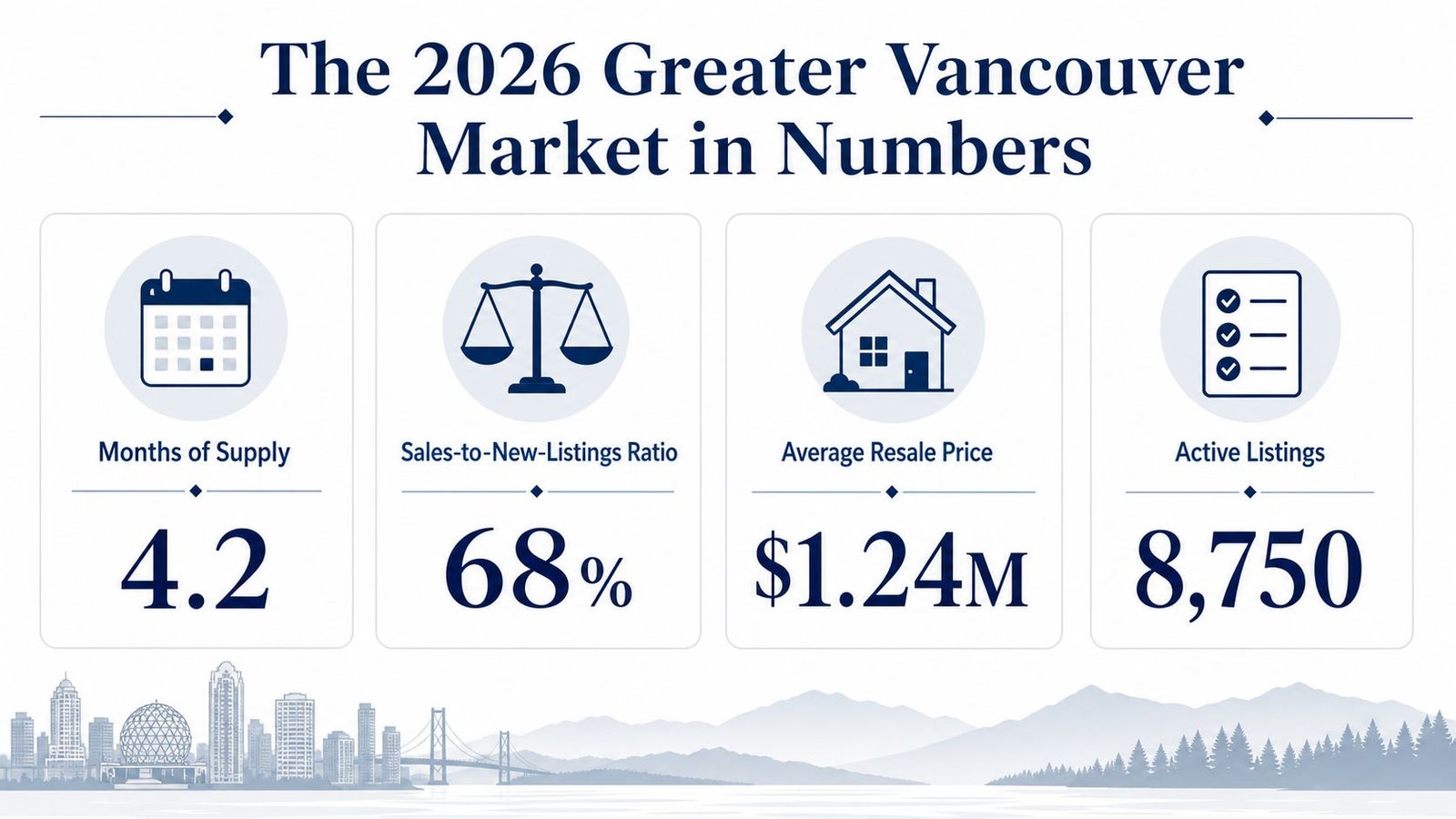
The 2026 Greater Vancouver Market in Numbers
A buyer looking at Vancouver homes for sale in 2026 should start with three numbers: supply, demand, and price. In Metro Vancouver, the resale market sat in buyer's-market territory in May 2026, with 7.9 months of supply and a sales-to-new-listings ratio of 35% (WOWA market data). On MLS-based market analysis, months of supply above about 6 and an SNLR below 40% usually point to weaker seller pricing power. That gives buyers more room to negotiate, especially on listings that have lingered or were priced too aggressively at launch.
The average resale residential price for Greater Vancouver was $1,100,700, down 6.2% year over year in May 2026 (nesto market outlook). That is the part many buyers miss. The market can soften and still stay expensive. High inventory and weaker demand do not automatically create bargains. They usually create more price sensitivity, especially when sellers have to compete against fresher comparables and recent reductions.
The older market read from September 2023 showed the same pressure in a different form. Greater Vancouver home sales fell to 1,959, the lowest level in more than 10 years for that month, and sales were down 13.2% from September 2022, while the benchmark price across the region was $1,196,700, only 3.4% higher year over year (CBC). The point is straightforward. Demand can weaken sharply without forcing an immediate price collapse, because supply constraints and long-term affordability pressure still support the market floor.
'Buyers get the most leverage when pricing is soft, and inventory is sitting. Sellers get the edge when a listing is scarce, well presented, and correctly priced from day one.'
May 2025 also gave a useful read on where detached-heavy averages can sit. Greater Vancouver's average home price reached $1,764,608, down 5.9% from the previous year (May 2025 market report). That number matters because it shows how a region can look weaker year over year and still remain far out of reach for many buyers. For search strategy, the lesson is simple. A falling average does not mean the whole market opened up. It means you need to know which property type, neighbourhood, and budget tier still offers a realistic path.
Jacky Levi's May 2025 market recap is useful context if you want a clear read on how the market shifted from a tighter resale environment to one that gave buyers more room to negotiate.
Condos, Townhomes, and Detached Homes Compared
The first serious decision in Vancouver is usually the property type. A condo, townhome, and detached house solve different problems, and they come with very different ownership trade-offs. Skip that decision and you end up touring the wrong homes, then wondering why nothing feels right.
A condo makes sense when location and budget matter more than square footage. A 600 sq ft Yaletown condo can be a smart starting point for a single buyer or couple who wants walkability, transit access, and a manageable entry cost. The trade-off is plain. You are buying convenience and liquidity, not privacy or land.
A townhome sits in the middle for a reason. It usually gives you more usable space, often a better family layout, and a closer feel to house living without jumping straight into detached pricing. That makes it the right fit for buyers who have outgrown a condo but are not ready to absorb the full carrying costs of land ownership.
Detached homes are a different category altogether. The Greater Vancouver average home price context, $1,764,608 in May 2025, helps show why detached searches quickly move into premium territory. A family looking in Kerrisdale wants yard space, privacy, and control over the property, but they also need to accept that the purchase price, upkeep, and renovation scope can all be larger than expected.
The honest way to choose is to ask what problem you are solving. If you want simplicity, pick a condo. If you want room to grow, look at a townhome. If you want land and long-term control, prepare for detached pricing and everything that comes with it.
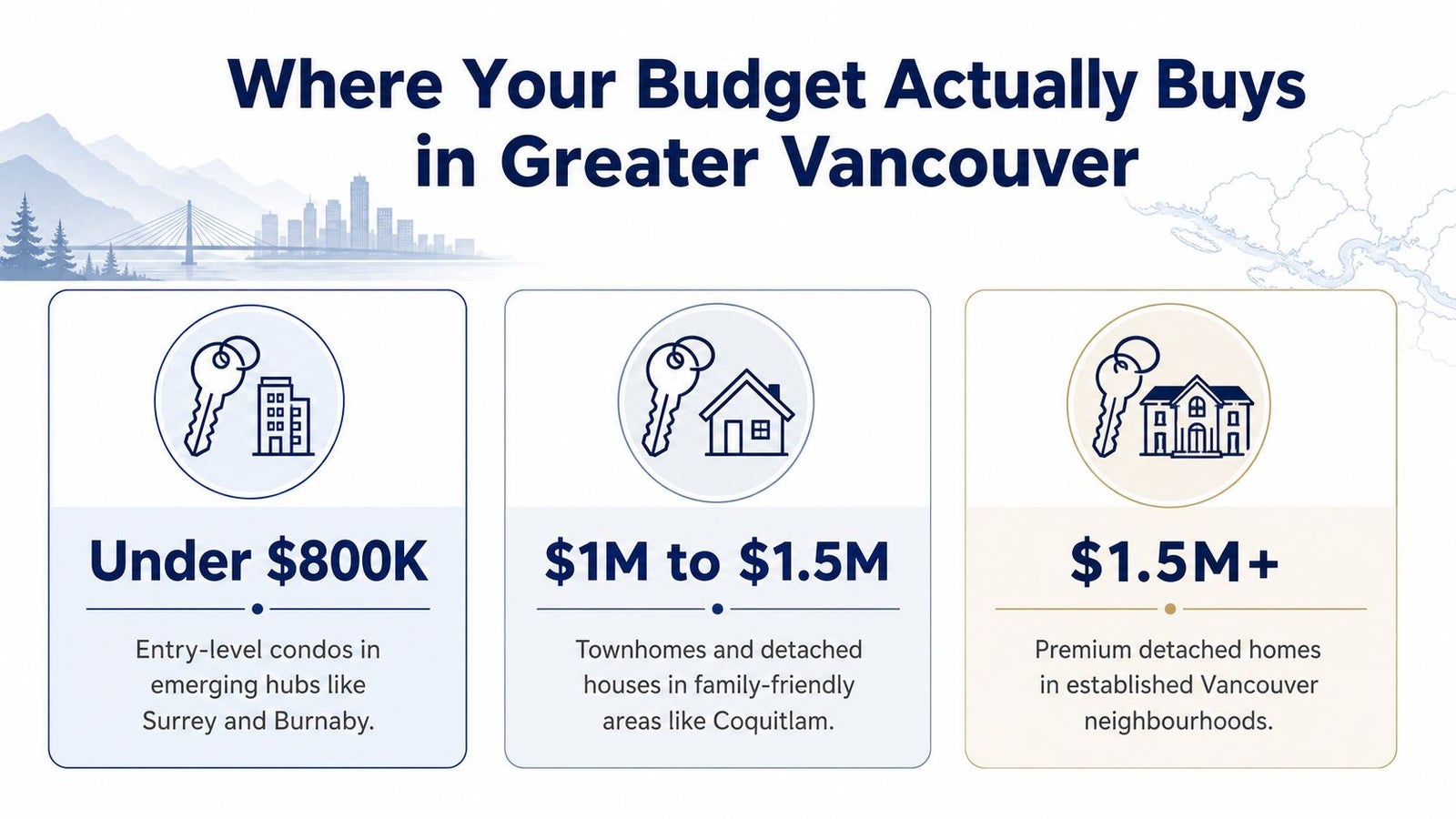
Where Your Budget Actually Buys in Greater Vancouver
The biggest mistake buyers make is treating Vancouver like one market. It isn't. West Point Grey at about $3.954M, Mackenzie Heights at about $2.998M, and Kitsilano at about $1.408M show just how steep the price spread can be inside one city (Redfin Vancouver, BC). That's why the right budget map matters more than broad neighbourhood prestige.
If you're under $800K, focus on condo searches where entry points still exist and stop pretending detached options are realistic. That budget is about finding the right building, the right strata, and the right location trade-off. A buyer who wants walkability and a smaller footprint should be looking hard at condo inventory before trying to force a house search that won't pencil.
For the $1M to $1.5M range, the conversation gets more interesting. You can start comparing townhomes and larger condos in parts of East Vancouver, Burnaby, and Richmond, and you may still find some older homes or more compromised properties that need work. At that level, the question becomes whether you value space, parking, transit, or renovation potential most.
If you're under $800K, focus on condo searches where entry points still exist and stop pretending detached options are realistic. That budget is about finding the right building, the right strata, and the right location trade-off. A buyer who wants walkability and a smaller footprint should be looking hard at condo inventory before trying to force a house search that won't pencil.
For the $1M to $1.5M range, the conversation gets more interesting. You can start comparing townhomes and larger condos in parts of East Vancouver, Burnaby, and Richmond, and you may still find some older homes or more compromised properties that need work. At that level, the question becomes whether you value space, parking, transit, or renovation potential most.
Once you move into the $2M to $4M range, detached homes become a real search category in established Vancouver neighbourhoods, but the list of realistic targets narrows quickly. That's where areas like Kitsilano and the more premium West Side submarkets start to show up, while elite pockets such as West Point Grey can still sit far above the middle of that range.
A practical shortlist looks like this. A condo buyer should scan West End, Yaletown, Mount Pleasant, and select Burnaby or Richmond options. A townhome buyer should look at East Vancouver, parts of Burnaby, and family-oriented pockets in Richmond. A detached buyer should go straight to the West Side, selected North Shore neighbourhoods, and the better-located pockets of the East Side if the goal is value, not status.
A practical shortlist looks like this. A condo buyer should scan West End, Yaletown, Mount Pleasant, and select Burnaby or Richmond options. A townhome buyer should look at East Vancouver, parts of Burnaby, and family-oriented pockets in Richmond. A detached buyer should go straight to the West Side, selected North Shore neighbourhoods, and the better-located pockets of the East Side if the goal is value, not status.
Searching the Market and Preparing a Competitive Offer
Search discipline beats browsing habits. The buyers who win in Vancouver don't casually check listings once a week. They set up proper alerts, read comparables closely, and know the difference between a home that is priced to move and a home that is priced to test the market.
Start with the filters that matter
Your first pass should narrow by property type, neighbourhood, building age, and strata rules. If you're buying a condo, fees, rental restrictions, pet policies, and building age can matter as much as the asking price. A newer building with cleaner documentation may be a better buy than a cheaper older one with unpredictable repair exposure.
For a full process breakdown, the buyer workflow guide is the kind of resource that keeps people from wasting time on a disorganized search.
For a full process breakdown, the buyer workflow guide is the kind of resource that keeps people from wasting time on a disorganized search.
- Good buyers don't just ask, “What's listed?” They ask, “What's likely to survive inspection, financing, and resale?” -
Make the offer around comparables, not emotion
Once you have a shortlist, compare it against recent sales in the same building or immediate area. That's where aspirational pricing gets exposed. If a seller is pushing too high, a below-asking offer with strong subjects can still make sense in a buyer-leaning market. If a home is clean, well-located, and attractively priced, a more aggressive offer may be the better call.
Here's how it plays out in East Vancouver. A buyer looking at a condo that has sat without much activity may offer below asking with financing, inspection, and strata document subjects intact. That protects the buyer while keeping the door open. The same buyer, facing a sharply priced turnkey townhouse with multiple interested parties, might need to move faster and tighten terms if they want a real shot.
The offer mechanics matter just as much as the number. Deposit size signals seriousness. Completion date can help or hurt the seller. Subjects can protect you, but too many subjects can make a strong offer feel weak. In a market with more supply, you do not need to overpay blindly, but you also shouldn't sabotage a good deal by pretending every listing will sit forever.
Here's how it plays out in East Vancouver. A buyer looking at a condo that has sat without much activity may offer below asking with financing, inspection, and strata document subjects intact. That protects the buyer while keeping the door open. The same buyer, facing a sharply priced turnkey townhouse with multiple interested parties, might need to move faster and tighten terms if they want a real shot.
The offer mechanics matter just as much as the number. Deposit size signals seriousness. Completion date can help or hurt the seller. Subjects can protect you, but too many subjects can make a strong offer feel weak. In a market with more supply, you do not need to overpay blindly, but you also shouldn't sabotage a good deal by pretending every listing will sit forever.
Don't skip financing and strata review
The buyers who stay calm, compare carefully, and write clean offers usually do better than the ones who chase every listing and hope urgency will solve the rest.
Buying From Out of Town Without the Stress
Out-of-town buyers can absolutely buy well in Vancouver, but they need structure. A remote search without local oversight turns into guesswork fast, especially when listings look polished online and the actual condition tells a different story. Video walkthroughs and 3D tours help, but they don't replace an on-the-ground read of noise, layout flow, building condition, and neighbourhood fit.A relocating buyer from Calgary might start with virtual tours, then narrow the list to three homes in Burnaby and East Vancouver. One looks good online, but the hallway is dated, the strata docs raise questions, and the parking stall is awkward. Another has less flashy staging but a cleaner building history and a better floor plan. That second home often wins because it holds up in real life, not just on screen.
Remote buying works best when someone local handles the details
The main job of a local representative is to translate what you can't see from far away. That means organising showings, checking strata minutes, spotting obvious condition issues, and making sure access for inspections and appraisals doesn't become a last-minute scramble. Lawyers and notaries can manage the legal close, but the buyer still needs someone on site to keep the process moving.
A solid remote workflow usually looks like this. First, shortlist homes through virtual tours and listing review. Second, ask for targeted follow-up on building condition and strata records. Third, use local viewing support for anything that is still in contention. Fourth, close with the legal and financing team once the property has passed the practical test.
Distance is manageable. Indifference isn't. If you're buying from afar, your team has to care about the details you can't inspect in person. Distance is manageable. Indifference isn't. If you're buying from afar, your team has to care about the details you can't inspect in person.
Jacky Levi has been known to manage remote transactions with local oversight, which matters when a buyer needs someone who can attend showings, coordinate access, and keep the timeline from slipping. That kind of support is especially useful for relocations, second-home buyers, and anyone trying to buy during a short trip to Vancouver.
The key is not to treat remote buying like a reduced-effort version of local buying. It needs more discipline, not less. If you get the structure right, you can buy confidently without flying back and forth every week.
Why Engaging an Agent Early Changes the Outcome
Waiting until you've already picked a home is too late. By that point, you've usually developed a bias, and bias is expensive in Vancouver. An experienced Greater Vancouver REALTOR® should help before the search gets emotional, because that's when pricing errors, bad assumptions, and weak offer terms are easiest to catch.
A good early conversation should cover comparables, neighbourhood inventory, strata risk, and your true budget ceiling. It should also surface homes you won't find by casually scrolling public portals, especially when timing and local knowledge matter. For buyers comparing buildings or neighbourhoods, that's the difference between a competent search and an exhausting one.
The other value is document review. Strata minutes, rules, special levy exposure, and maintenance patterns can change the quality of a “good deal” very quickly. If you wait until the last minute to ask those questions, you're already under pressure to proceed or walk away. That's a bad place to make a decision.
For anyone interviewing representation, these questions for a Vancouver REALTOR® are worth reading before you commit. You want someone who understands neighbourhood-level pricing, offer strategy, and how to reduce avoidable risk, not someone who just opens doors.
Jacky Levi PREC brings over 20 years of Vancouver experience, Sotheby's International Realty Canada affiliation, and a vendor network that supports buyers, sellers, and investors across condos, townhomes, and detached homes. Used properly, that kind of setup helps with pricing strategy, showings, negotiations, and the messy parts of closing that can derail a deal if nobody is watching closely.
If you're serious about Vancouver homes for sale, talk to Jacky Levi PREC before you start making offers. He can help you narrow the search, pressure-test the price, and avoid the common mistakes that waste time and money in this market. Contact Jacky Levi to start with a straight answer about where your budget fits.