
If you're looking at luxury homes in Vancouver for sale, you probably already know the problem. The listings look similar at first glance, the budgets are big, and yet one neighbourhood buys you a move-in-ready family house, another buys you land value and rebuilding potential, and another buys you a different kind of lifestyle entirely.
That's why I don't treat luxury as a fixed price tag in Vancouver. I treat it as a neighbourhood-defined category, because a $5 million budget can mean very different things on the West Side, in West Vancouver, or in North Vancouver. If you define the segment wrong, you'll tour the wrong homes, make the wrong offers, and miss the true value.
A buyer with a $5 million budget usually asks the wrong first question. They ask, “What counts as luxury?” The better question is, “What does this budget buy in the neighbourhood I want?” On the West Side, that money can still point you toward a serious detached home. In West Vancouver, the same budget can push you closer to a teardown, a land play, or a property where the value sits more in the site than the current house.
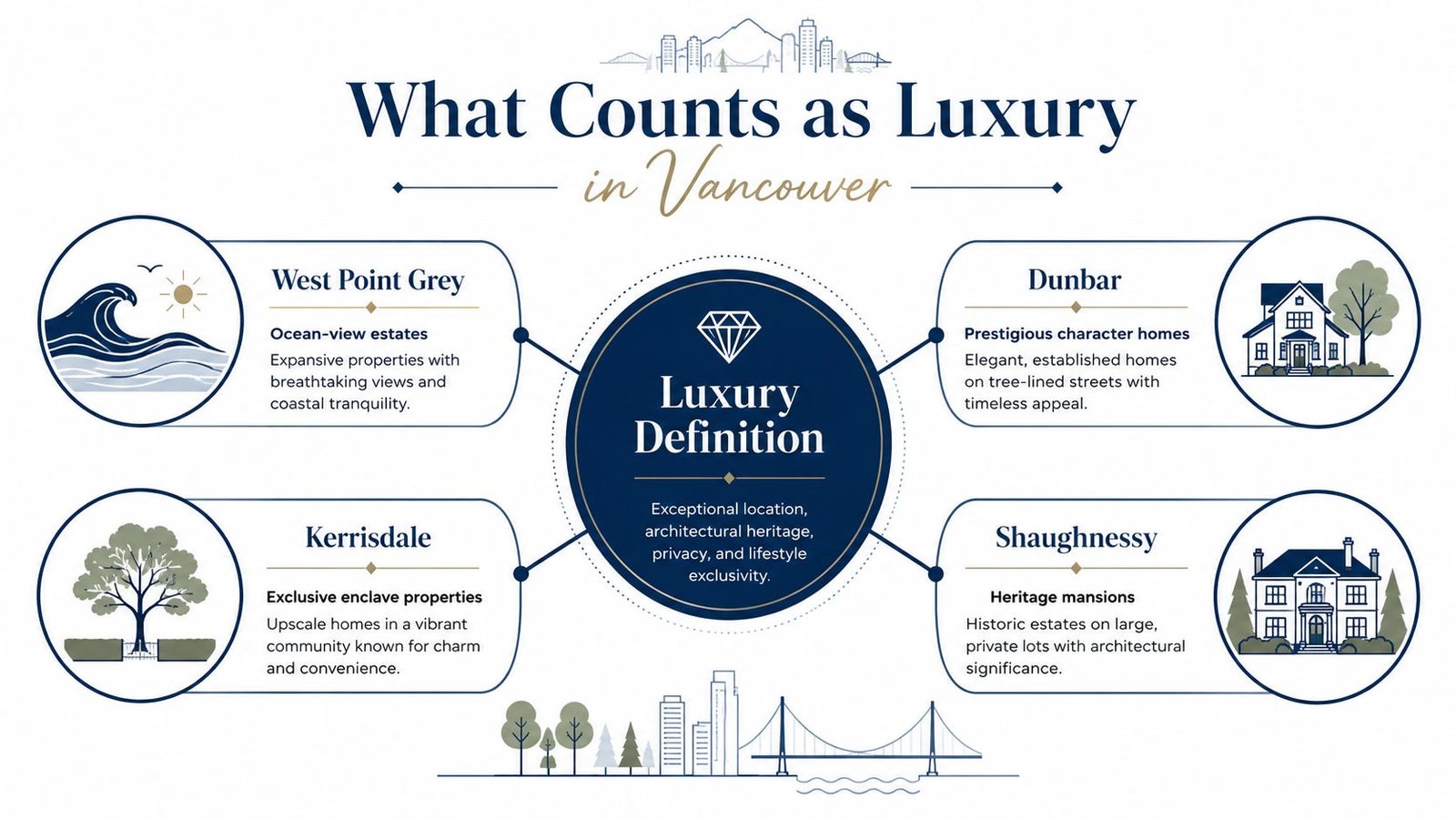
That's why generic portal browsing wastes time. Luxury homes Vancouver for sale isn't one clean category, it's a series of submarkets with different expectations around lot size, view corridors, architecture, and privacy. A home in West Point Grey can feel luxurious because of the ocean orientation. A home in Shaughnessy can feel luxurious because of heritage scale and presence. Dunbar and Kerrisdale play their own version of that game, where character, streetscape, and location do a lot of the work.
If you want a live market read and recent listing context, I'd also point you to this current Vancouver sales tracker from Jacky Levi's January 2026 sales update. It reinforces the same truth: demand is selective, and the well-priced homes still move.
Neighbourhood choice does more work in luxury than it does anywhere else. A C$4 million budget in Vancouver Westside is not the same experience as a $4 million budget in West Vancouver, and North Vancouver gives you an entirely different value proposition again. Downtown and Coal Harbour tilt toward luxury condo living, where view, amenities, and building quality matter more than land.
That's why I don't treat luxury as a fixed price tag in Vancouver. I treat it as a neighbourhood-defined category, because a $5 million budget can mean very different things on the West Side, in West Vancouver, or in North Vancouver. If you define the segment wrong, you'll tour the wrong homes, make the wrong offers, and miss the true value.
What Counts as Luxury in Vancouver
A buyer with a $5 million budget usually asks the wrong first question. They ask, “What counts as luxury?” The better question is, “What does this budget buy in the neighbourhood I want?” On the West Side, that money can still point you toward a serious detached home. In West Vancouver, the same budget can push you closer to a teardown, a land play, or a property where the value sits more in the site than the current house.
Luxury depends on the pocket, not the slogan
That's why generic portal browsing wastes time. Luxury homes Vancouver for sale isn't one clean category, it's a series of submarkets with different expectations around lot size, view corridors, architecture, and privacy. A home in West Point Grey can feel luxurious because of the ocean orientation. A home in Shaughnessy can feel luxurious because of heritage scale and presence. Dunbar and Kerrisdale play their own version of that game, where character, streetscape, and location do a lot of the work.
The practical move is simple. Start with the neighbourhood, then sort the product type, then decide whether you're buying a home, a holding property, or a redevelopment opportunity. If you skip that order, you'll overpay for the wrong kind of “luxury.”
A lot of buyers discover this only after they've toured half the city. A sharper approach is to define luxury by the life you want to live, then let the neighbourhood set the ceiling on what that luxury looks like.
The top end of Vancouver is cooling, but not collapsing. That distinction matters, because a soft sales pace changes negotiation power even when asking prices still look stubborn. In the first half of 2025, Vancouver's $4 million and above segment recorded 85 sales, a 51% year-over-year decline from the same period in 2024, which was the steepest drop among Canada's major cities in that report, according to the BIV coverage of the Sotheby's International Realty Canada data. The same report showed just 2 transactions above $10 million, down from 7 in the first half of 2024, while sales over $1 million fell 26% to 1,760 transactions. The $1 million to $2 million band dropped 19% to 1,194, and the $2 million to $4 million band fell 35% to 481 sales, which tells you the cooling wasn't limited to trophy homes. BIV's report on Vancouver luxury sales
That volume drop hasn't translated into a freefall in pricing. In the first two months of 2025, Greater Vancouver recorded 150 luxury home sales, down 12.8% from 172 in the same period of 2024, and detached luxury sales were especially soft, falling 21.4% year over year, according to the Re/Max summary reported by BIV. Luxury condos posted 15 sales and averaged about $4.3 million, while luxury detached homes averaged about $4.2 million, up slightly from $4.1 million a year earlier. That's the kind of market where sellers still anchor high, but buyers can negotiate harder if they come prepared. BIV's report on early-2025 luxury cooling
By April 2026, the segment had 1,241 active listings and 69 sales, producing a 6% sales ratio and putting luxury in Buyer's Market territory. The same report said the median days on market for attached luxury homes, condos, and townhomes priced above $1.4 million rose from 15 days in April 2025 to 25 days in April 2026. If you're selling, that means the first week matters more. If you're buying, it means clean terms and patience can save you real money. Hiatt's April 2026 Vancouver luxury report
For a broader read on the spring 2025 mood, the REW market summary showed residential sales over $4 million across condos, attached homes, and single-family homes down 48% year over year to 33 properties sold. Its figure for luxury single-family homes over $4 million also fell 47% year over year to 31 properties sold, which is exactly why disciplined offers are winning more often than emotional ones. REW's spring 2025 luxury market summary
"Practical rule: If two homes share the same price, the one with the better site, better light, and better long-term use usually wins. The prettier listing photos don't change that."
A lot of buyers discover this only after they've toured half the city. A sharper approach is to define luxury by the life you want to live, then let the neighbourhood set the ceiling on what that luxury looks like.
How the 2025–2026 Luxury Market Is Actually Moving
The top end of Vancouver is cooling, but not collapsing. That distinction matters, because a soft sales pace changes negotiation power even when asking prices still look stubborn. In the first half of 2025, Vancouver's $4 million and above segment recorded 85 sales, a 51% year-over-year decline from the same period in 2024, which was the steepest drop among Canada's major cities in that report, according to the BIV coverage of the Sotheby's International Realty Canada data. The same report showed just 2 transactions above $10 million, down from 7 in the first half of 2024, while sales over $1 million fell 26% to 1,760 transactions. The $1 million to $2 million band dropped 19% to 1,194, and the $2 million to $4 million band fell 35% to 481 sales, which tells you the cooling wasn't limited to trophy homes. BIV's report on Vancouver luxury sales
Fewer buyers, firmer pricing
That volume drop hasn't translated into a freefall in pricing. In the first two months of 2025, Greater Vancouver recorded 150 luxury home sales, down 12.8% from 172 in the same period of 2024, and detached luxury sales were especially soft, falling 21.4% year over year, according to the Re/Max summary reported by BIV. Luxury condos posted 15 sales and averaged about $4.3 million, while luxury detached homes averaged about $4.2 million, up slightly from $4.1 million a year earlier. That's the kind of market where sellers still anchor high, but buyers can negotiate harder if they come prepared. BIV's report on early-2025 luxury cooling
By April 2026, the segment had 1,241 active listings and 69 sales, producing a 6% sales ratio and putting luxury in Buyer's Market territory. The same report said the median days on market for attached luxury homes, condos, and townhomes priced above $1.4 million rose from 15 days in April 2025 to 25 days in April 2026. If you're selling, that means the first week matters more. If you're buying, it means clean terms and patience can save you real money. Hiatt's April 2026 Vancouver luxury report
"Sellers don't control the market just because they own a luxury address. They control the result by pricing into the current absorption rate, not last spring's optimism."
For a broader read on the spring 2025 mood, the REW market summary showed residential sales over $4 million across condos, attached homes, and single-family homes down 48% year over year to 33 properties sold. Its figure for luxury single-family homes over $4 million also fell 47% year over year to 31 properties sold, which is exactly why disciplined offers are winning more often than emotional ones. REW's spring 2025 luxury market summary
Where to Buy Luxury Across Greater Vancouver
Neighbourhood choice does more work in luxury than it does anywhere else. A C$4 million budget in Vancouver Westside is not the same experience as a $4 million budget in West Vancouver, and North Vancouver gives you an entirely different value proposition again. Downtown and Coal Harbour tilt toward luxury condo living, where view, amenities, and building quality matter more than land.
Luxury inventory at three budget tiers across Greater Vancouver
Vancouver Westside
West Vancouver
Downtown and Coal Harbour
The West Side suits buyers who want school catchments, established streets, and a more urban family rhythm. It's the most balanced choice for someone who wants a luxury detached home without leaving the city's core. You're often paying for location discipline, character, and long-term holdability as much as the house itself.
West Vancouver is a different proposition. The buyer here usually wants privacy, water outlooks, and a quieter daily experience, and the market often behaves like a scarcity trade. If your priority is land, views, and prestige, many serious luxury buyers end up here. For a deeper look at that submarket, see this West Vancouver resource.
North Vancouver draws buyers who want a stronger lifestyle-to-price ratio, especially if they care about outdoor access and easier maintenance. Downtown and Coal Harbour are more specialised, with the luxury condo buyer focused on building quality, views, and lock-and-leave convenience rather than land. That difference matters, because a luxury condo buyer and a detached-house buyer are solving two different problems.
A luxury listing is never just a price tag. It bundles land, build quality, design, view premium, and the way the seller has chosen to position the property. Break those parts apart or you end up paying trophy money for weak fundamentals, or passing on a home whose value is defensible.
Two current Vancouver examples make the point cleanly. A West Side listing at 4838 Belmont Ave is 12,410 sq ft and listed at $49.8 million, which works out to roughly $4,012 per sq ft. A newer 2023 single-family home at 2051 King Edward Ave W is listed at $5.78 million for 5,911 sq ft, about $978 per sq ft, and it includes technical specs such as an ICF foundation, triple-pane aluminum-clad wood windows, radiant heating, and an EV charging station. Those two numbers point to land scarcity, replacement cost, and finish quality in a way a plain listing summary never will. Current Vancouver luxury house market report
For sellers, the gap between asking and selling price deserves the same attention. The best starting point is this guide to asking price vs selling price in Vancouver, because list price in the luxury tier is a signal, not a verdict. It reflects where the seller thinks the market will meet the property, and that meeting point usually depends on who else would want the same home.
First, I look at lot utility. A large footprint means very little if the site is awkward, exposed, or poorly improved. Then I compare the build to what it would cost to replace today, because quality construction, envelope performance, and technical systems matter more than glossy finishes.
Next, I read the renovation story. If a home has been updated carefully, the seller has usually spent real money on the parts buyers never notice in photos. That is where better value hides, especially in a market where polished presentation can cover weak fundamentals.
The useful question is what you are paying for, and how much of that value the next buyer would still recognise.
A disciplined buyer also checks the asking price against likely resale logic. I am not talking about a quick flip. I am talking about whether the property still makes sense if the next owner thinks the same way you do. That separates a prestige purchase from a mistake.
Use that lens and you stop chasing square footage for its own sake. You start separating land value, build value, and presentation value, which is how serious buyers avoid emotional pricing traps.
Luxury transactions break when people apply standard-home habits to premium property. A C$5 million home can hide issues that never show up in a casual walkthrough, and the financing package often needs more care than the listing photos do. Sellers who skip serious preparation usually pay for it in longer marketing time and weaker offers.
Vancouver Westside
- At $4M: Strong detached options in established pockets, often with older homes and renovation upside
- At $6M: Better finished detached homes, stronger site quality, more prestige streets
- At $10M+: Rare trophy houses, larger lots, better architecture, top-tier address value
West Vancouver
- At $4M: Entry into detached luxury, often with older product or site-driven value
- At $6M: More selection in view homes and stronger estates
- At $10M+: Prime ocean-view or estate-level properties with real scarcity
- At $4M: Large family homes, newer builds, or townhouse and detached options depending on pocket
- At $6M: Better custom homes and view-oriented product
- At $10M+: Limited ultra-prime inventory, more selective buying
Downtown and Coal Harbour
- At $4M: High-end luxury condos with views and building amenities
- At $6M: Top-floor or larger view units in stronger buildings
- At $10M+: Penthouse-level product and rare signature residences
The West Side
The West Side suits buyers who want school catchments, established streets, and a more urban family rhythm. It's the most balanced choice for someone who wants a luxury detached home without leaving the city's core. You're often paying for location discipline, character, and long-term holdability as much as the house itself.
West Vancouver
West Vancouver is a different proposition. The buyer here usually wants privacy, water outlooks, and a quieter daily experience, and the market often behaves like a scarcity trade. If your priority is land, views, and prestige, many serious luxury buyers end up here. For a deeper look at that submarket, see this West Vancouver resource.
North Vancouver and the condo belt
North Vancouver draws buyers who want a stronger lifestyle-to-price ratio, especially if they care about outdoor access and easier maintenance. Downtown and Coal Harbour are more specialised, with the luxury condo buyer focused on building quality, views, and lock-and-leave convenience rather than land. That difference matters, because a luxury condo buyer and a detached-house buyer are solving two different problems.
"Buyer filter: Pick the corridor before you pick the house. If you reverse that order, you'll end up comparing products that don't belong in the same conversation."
Reading Luxury Prices Like an Insider
A luxury listing is never just a price tag. It bundles land, build quality, design, view premium, and the way the seller has chosen to position the property. Break those parts apart or you end up paying trophy money for weak fundamentals, or passing on a home whose value is defensible.
Two current Vancouver examples make the point cleanly. A West Side listing at 4838 Belmont Ave is 12,410 sq ft and listed at $49.8 million, which works out to roughly $4,012 per sq ft. A newer 2023 single-family home at 2051 King Edward Ave W is listed at $5.78 million for 5,911 sq ft, about $978 per sq ft, and it includes technical specs such as an ICF foundation, triple-pane aluminum-clad wood windows, radiant heating, and an EV charging station. Those two numbers point to land scarcity, replacement cost, and finish quality in a way a plain listing summary never will. Current Vancouver luxury house market report
For sellers, the gap between asking and selling price deserves the same attention. The best starting point is this guide to asking price vs selling price in Vancouver, because list price in the luxury tier is a signal, not a verdict. It reflects where the seller thinks the market will meet the property, and that meeting point usually depends on who else would want the same home.
How I read a luxury listing
First, I look at lot utility. A large footprint means very little if the site is awkward, exposed, or poorly improved. Then I compare the build to what it would cost to replace today, because quality construction, envelope performance, and technical systems matter more than glossy finishes.
Next, I read the renovation story. If a home has been updated carefully, the seller has usually spent real money on the parts buyers never notice in photos. That is where better value hides, especially in a market where polished presentation can cover weak fundamentals.
The useful question is what you are paying for, and how much of that value the next buyer would still recognise.
A disciplined buyer also checks the asking price against likely resale logic. I am not talking about a quick flip. I am talking about whether the property still makes sense if the next owner thinks the same way you do. That separates a prestige purchase from a mistake.
Use that lens and you stop chasing square footage for its own sake. You start separating land value, build value, and presentation value, which is how serious buyers avoid emotional pricing traps.
Inspection, Financing, and Staging at the Luxury Tier
Luxury transactions break when people apply standard-home habits to premium property. A C$5 million home can hide issues that never show up in a casual walkthrough, and the financing package often needs more care than the listing photos do. Sellers who skip serious preparation usually pay for it in longer marketing time and weaker offers.
What to inspect before you commit
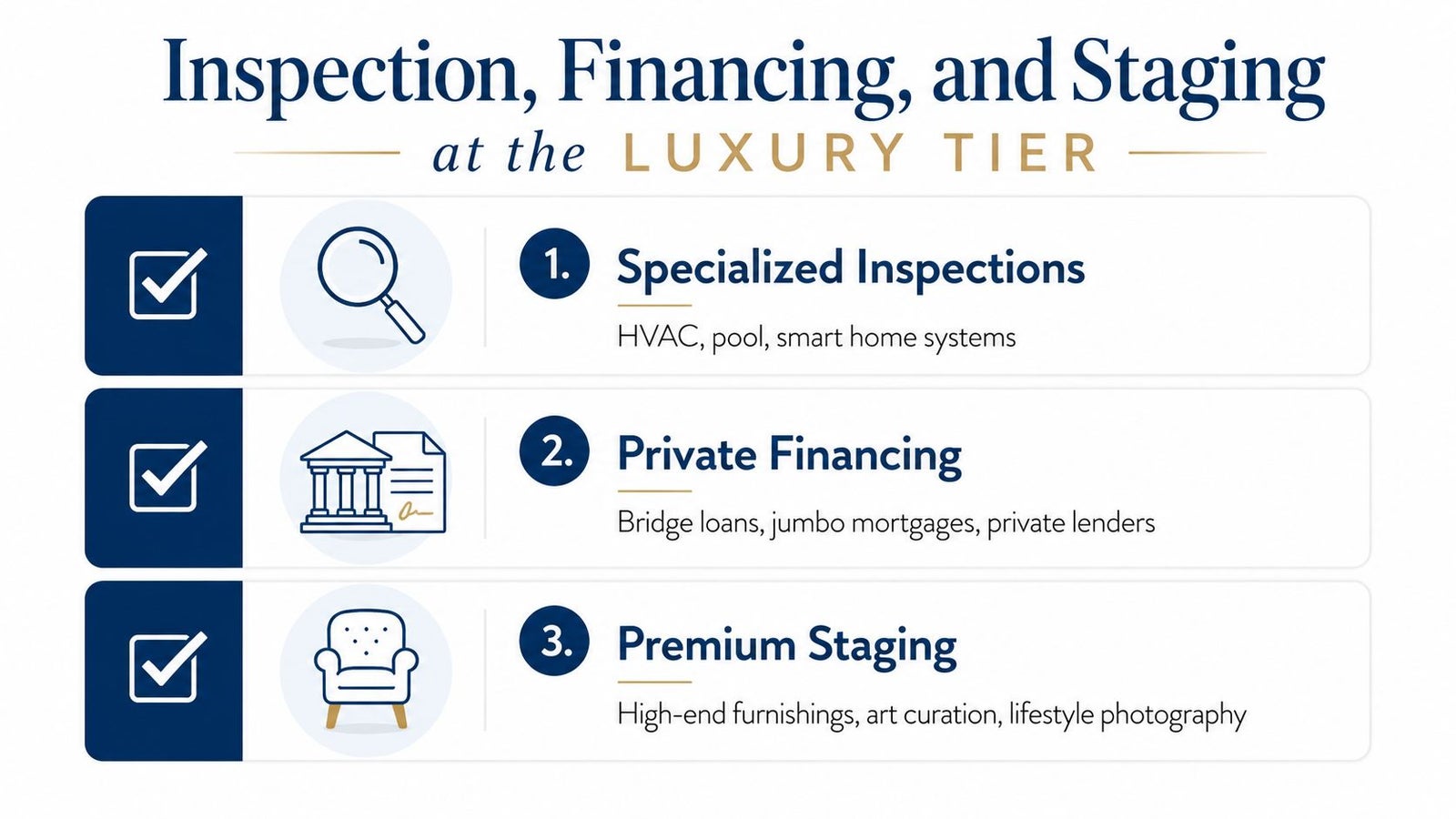
At this level, you want more than a general home inspection. Sewer scopes, geological reviews, and specialist assessments for pools, wine cellars, and home automation systems can expose issues that a broad inspection won't catch. If the home has complex mechanical systems or custom work, assume a standard checklist is incomplete.
High-value purchases often involve jumbo mortgages, larger equity contributions, and more documentation around complex income. Lenders want clarity, not storytelling. If your income is tied to bonuses, business earnings, or multiple entities, get the paperwork lined up early and don't wait until subject removal week to sort it out.
On the selling side, staging isn't decoration, it's positioning. Firms such as Urban Presentations, professional photography, video tours, and 3D walkthroughs help a buyer understand scale, flow, and lifestyle before they ever book a showing. That matters in luxury because the pool of qualified buyers is small and attention spans are shorter than owners think.
If you want the process handled tightly, one option is Jacky Levi - Sotheby's Realty Advisor & Realtor, especially when you need coordination across inspections, presentation, and financing contacts. The point isn't to make the deal look easy. The point is to remove avoidable friction.
In a market where luxury inventory is only about 0.17% of Vancouver residences, the advisor you choose matters. Pricing is concentrated in a tiny pool of comparables, and small judgement calls create large differences in the final result. A generalist can open doors. A specialist can manage the entire transaction around how luxury trades.
A serious luxury advisor should know how to price against the right comparables, spot when a listing is strong but overexposed, and shape the offer or listing strategy around current absorption rather than old momentum. That also means having the right vendor bench, because luxury deals rely on coordinated staging, media, legal, and inspection support.
Jacky Levi has over 20 years in Greater Vancouver residential real estate, works through Sotheby's International Realty Canada, and operates with a structured vendor network for staging, media, legal, and inspections. For out-of-town clients, that local oversight matters because remote ownership doesn't eliminate the need for hands-on coordination. It just raises the cost of getting it wrong.
Ask who will handle the listing process. Ask how they price against neighbourhood-specific comparables. Ask how they manage feedback after showings, and ask what they do when the first round of buyer interest is weaker than expected.
The best representation isn't about flashy promises. It's about protecting time, controlling presentation, and using market data to tighten decisions. In this segment, that usually beats discount brokerage logic and loose generalist service.
If you're buying, start with a private tour built around the neighbourhood that matches your lifestyle, not the one with the loudest listings. If you're selling, get a confidential valuation that uses current absorption, not old peak pricing, because the market is rewarding precision right now.
Bring three things to the first conversation, your target neighbourhood, your realistic budget range, and your timeline. That gives you a clean starting point whether you're weighing West Side family houses, West Vancouver estates, or North Vancouver options with a different maintenance profile.
Jacky Levi - Sotheby's Realty Advisor & Realtor offers buyer and seller representation, comparative market analysis, premium listing preparation, and local transaction management across Greater Vancouver. If you're thinking about luxury homes for sale in Vancouver, visit Jacky Levi - Sotheby's Realty Advisor & Realtor to discuss your next purchase, sale, or private showing plan.
At this level, you want more than a general home inspection. Sewer scopes, geological reviews, and specialist assessments for pools, wine cellars, and home automation systems can expose issues that a broad inspection won't catch. If the home has complex mechanical systems or custom work, assume a standard checklist is incomplete.
How financing changes at the top end
High-value purchases often involve jumbo mortgages, larger equity contributions, and more documentation around complex income. Lenders want clarity, not storytelling. If your income is tied to bonuses, business earnings, or multiple entities, get the paperwork lined up early and don't wait until subject removal week to sort it out.
Why presentation has to be premium
On the selling side, staging isn't decoration, it's positioning. Firms such as Urban Presentations, professional photography, video tours, and 3D walkthroughs help a buyer understand scale, flow, and lifestyle before they ever book a showing. That matters in luxury because the pool of qualified buyers is small and attention spans are shorter than owners think.
If you want the process handled tightly, one option is Jacky Levi - Sotheby's Realty Advisor & Realtor, especially when you need coordination across inspections, presentation, and financing contacts. The point isn't to make the deal look easy. The point is to remove avoidable friction.
Why a Specialist Luxury Advisor Changes the Outcome
In a market where luxury inventory is only about 0.17% of Vancouver residences, the advisor you choose matters. Pricing is concentrated in a tiny pool of comparables, and small judgement calls create large differences in the final result. A generalist can open doors. A specialist can manage the entire transaction around how luxury trades.
What a specialist brings that a generalist usually doesn't
A serious luxury advisor should know how to price against the right comparables, spot when a listing is strong but overexposed, and shape the offer or listing strategy around current absorption rather than old momentum. That also means having the right vendor bench, because luxury deals rely on coordinated staging, media, legal, and inspection support.
Jacky Levi has over 20 years in Greater Vancouver residential real estate, works through Sotheby's International Realty Canada, and operates with a structured vendor network for staging, media, legal, and inspections. For out-of-town clients, that local oversight matters because remote ownership doesn't eliminate the need for hands-on coordination. It just raises the cost of getting it wrong.
What to ask before you sign
Ask who will handle the listing process. Ask how they price against neighbourhood-specific comparables. Ask how they manage feedback after showings, and ask what they do when the first round of buyer interest is weaker than expected.
"If the answer sounds generic, move on. Luxury clients need process, documentation, and judgement, not vague reassurance."
The best representation isn't about flashy promises. It's about protecting time, controlling presentation, and using market data to tighten decisions. In this segment, that usually beats discount brokerage logic and loose generalist service.
Your Next Step in the Vancouver Luxury Market
If you're buying, start with a private tour built around the neighbourhood that matches your lifestyle, not the one with the loudest listings. If you're selling, get a confidential valuation that uses current absorption, not old peak pricing, because the market is rewarding precision right now.
Bring three things to the first conversation, your target neighbourhood, your realistic budget range, and your timeline. That gives you a clean starting point whether you're weighing West Side family houses, West Vancouver estates, or North Vancouver options with a different maintenance profile.
Jacky Levi - Sotheby's Realty Advisor & Realtor offers buyer and seller representation, comparative market analysis, premium listing preparation, and local transaction management across Greater Vancouver. If you're thinking about luxury homes for sale in Vancouver, visit Jacky Levi - Sotheby's Realty Advisor & Realtor to discuss your next purchase, sale, or private showing plan.